Black Swan
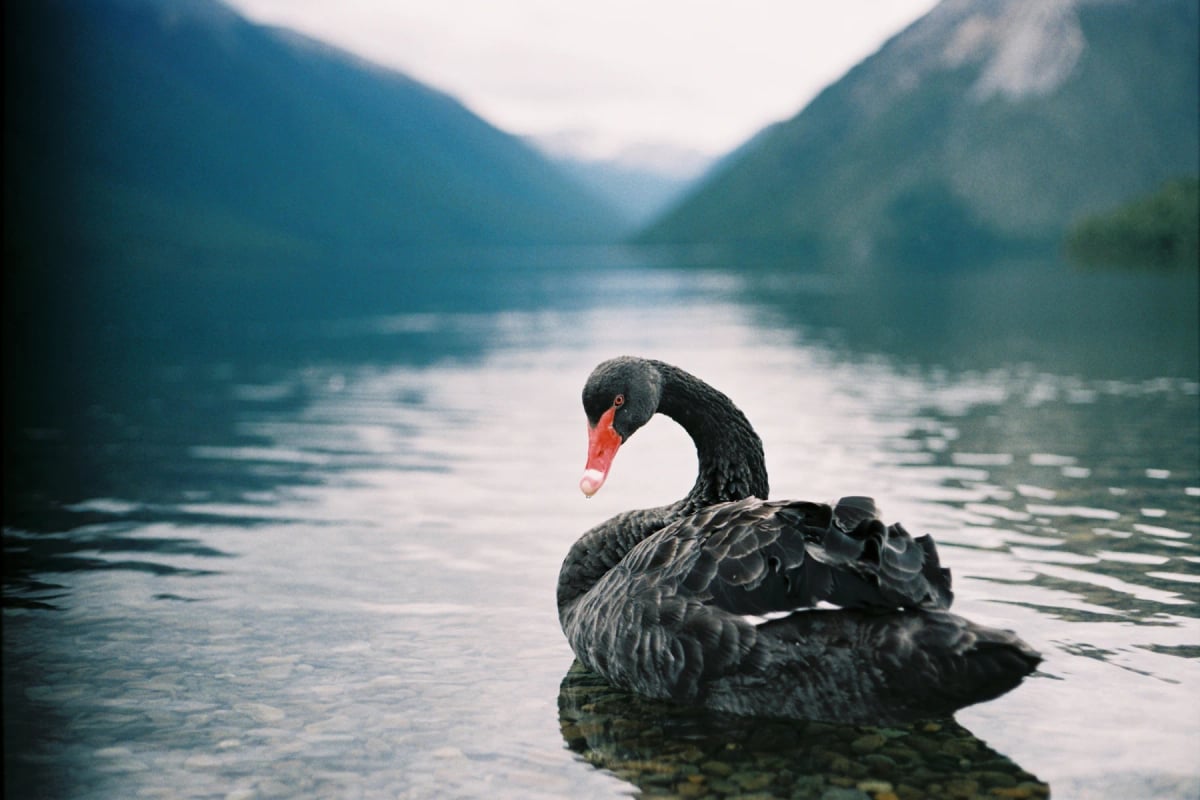
The black swan (Cygnus atratus) is native to Australia and today also widespread in New Zealand, where swans were released from 1864 and also arrived on their own across the Tasman Sea. It is instantly recognizable by its black plumage, bright red bill with a white band near the tip, and white flight feathers that show only when it flies. It lives on shallow lakes, rivers, estuaries, and coastal wetlands rich in water plants, which make up almost all of its diet. Pairs form long bonds, often nest after heavy rain, and build large mounds of reeds near the water, where the female lays four to eight greenish white eggs that both parents incubate. Outside the breeding season, black swans gather in flocks that can reach the thousands and move with the rains. Before Europeans saw one in 1697, a black swan was a byword for something impossible, which is why the name now means a rare, unexpected event. The IUCN lists the species as Least Concern.
Habitat and distribution
The black swan is native across much of Australia, where it occupies a wide range of wetland environments including shallow lakes, slow moving rivers, estuaries, and coastal lagoons. It shows a strong preference for areas with abundant aquatic vegetation, which provides both food and nesting material. Populations are most dense in the southwest and southeast of Australia, particularly in Western Australia and Victoria. In New Zealand, swans were released from 1864, and there is evidence that others flew across from Australia on their own; today the species is firmly established there, especially around Lake Ellesmere and the Rotorua lakes, and the IUCN counts it as native. Escaped birds from parks and collections turn up in Europe and elsewhere, but these small groups are not self sustaining. The black swan is highly nomadic within its native range, moving inland or toward the coast depending on rainfall patterns and the availability of suitable wetland habitat.
Why "black swan" means something unexpected
For almost two thousand years, a black swan was the European shorthand for something that could not exist. The Roman poet Juvenal wrote of a thing as rare as a black swan, and the phrase stuck: every swan anyone in Europe had ever seen was white, so all swans were assumed to be white. That changed in 1697, when the Dutch explorer Willem de Vlamingh sailed up a river in Western Australia and saw black swans for himself. The river became the Swan River, the city of Perth grew on its banks, and the bird became the emblem of the state. The idea lived on in philosophy as the classic example of why no number of observations can prove a general rule, since one black swan is enough to break it. In 2007 the writer Nassim Nicholas Taleb used it in his book The Black Swan to describe rare, unpredictable events with huge impact, such as financial crashes, which people explain only after they happen. The name also reached cinema with Darren Aronofsky's 2010 ballet film Black Swan. Meanwhile, in Australia, the real bird is a common sight on city lakes.
Built for water: size and adaptations
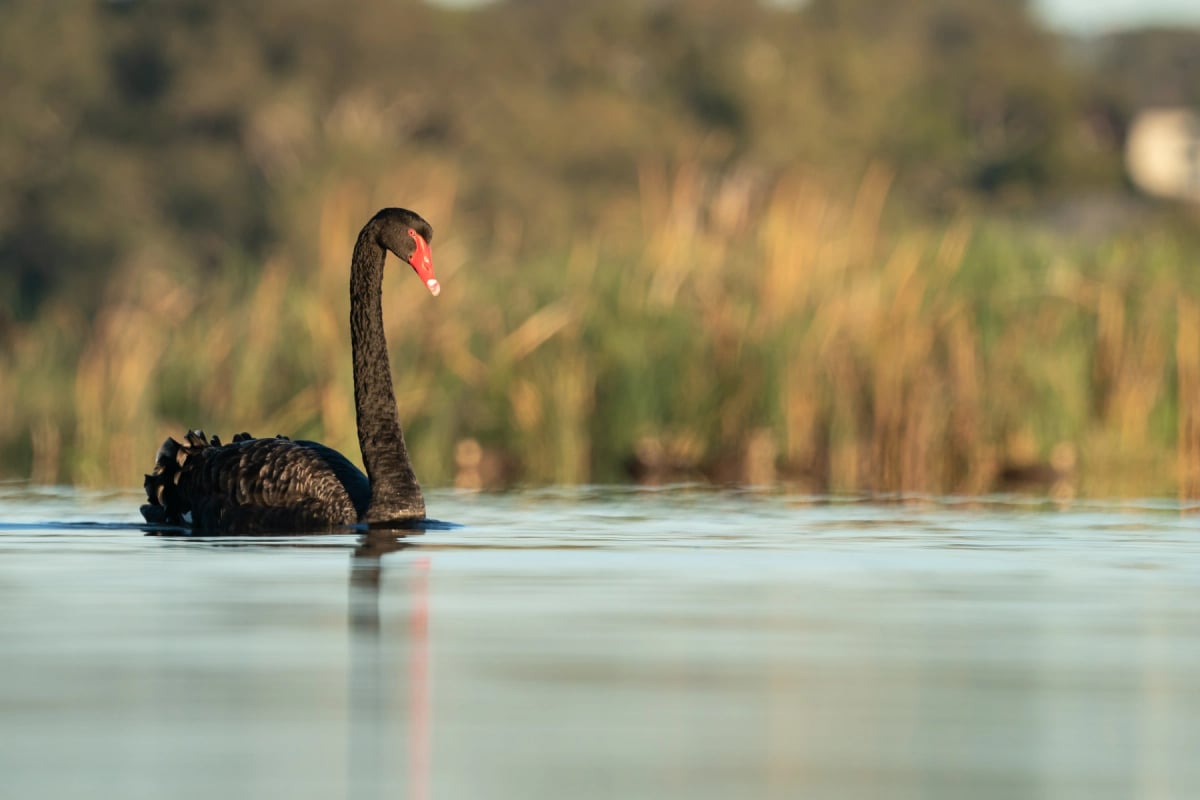
The black swan's entirely dark plumage is produced by melanin pigmentation, which also strengthens feather structure and reduces wear over time. Its long, flexible neck, one of the longest relative to body size among waterfowl, allows it to reach aquatic plants growing in water too deep for most other grazing birds. The bright red bill is broad and serrated along the edges, well suited to cropping vegetation just below the surface. White flight feathers, hidden at rest but revealed in flight, may help flocks keep together. The wingspan is 1.6 to 2 meters, and males are slightly larger than females, with longer, straighter bills. The species is a strong flier despite its large size, capable of traveling hundreds of kilometers overnight when relocating between wetlands. Its feet are fully webbed and set well back on the body, making it highly efficient in water while somewhat awkward on land.
Behavior and social life
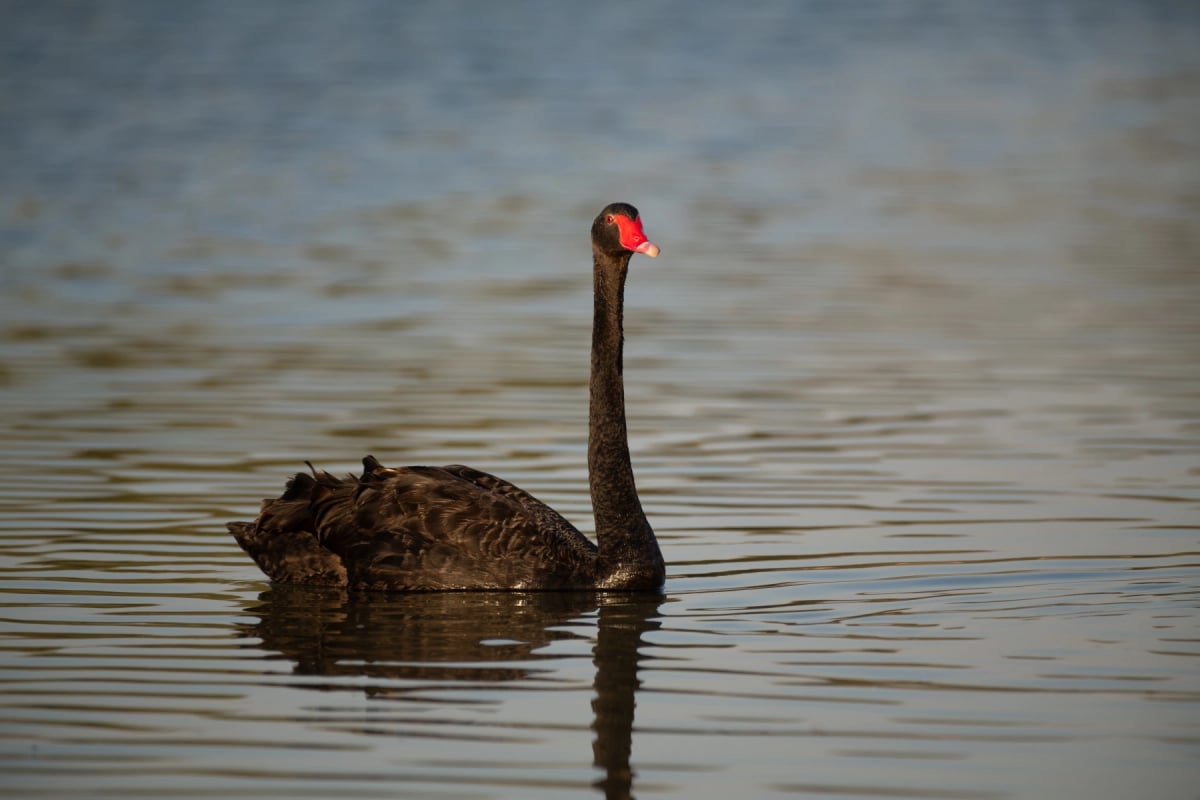
Black swans form pair bonds that can last for many years, and both parents incubate the eggs and raise the cygnets. Only about six percent of pairs divorce, although around a third of broods include chicks fathered by another male, and roughly a quarter of pairs are made up of two birds of the same sex, most often two males, which sometimes raise cygnets together. Nests are large platforms of reeds, grasses, and other plants, built at the water's edge or on small islands, and breeding often follows heavy rain rather than a fixed season. Clutches of four to eight greenish white eggs are incubated for 35 to 40 days, and the cygnets stay with their parents for months, depending on them for about nine months before they fly. Outside the breeding season, black swans gather in flocks that can reach the tens of thousands at key wetlands. Like other swans, they can be aggressive near the nest, using wing displays, hissing, and loud calls, and their voice is a range of whistles and musical, bugling notes.
Conservation
The black swan is listed as Least Concern on the IUCN Red List, with a population estimated at up to 500,000 birds. It is protected in Australia, and in Western Australia it is the state emblem, featured on the state flag since 1870. Wetland drainage, farm runoff, and long droughts are local threats, and the species can suffer heavy losses in severe droughts when lakes dry up. Its nomadic habits and its ability to use many kinds of wetlands, from coastal lagoons to temporary inland lakes, give it considerable resilience. In New Zealand, where it is also widespread, numbers on some lakes are managed and hunting is allowed in season. Collisions with aircraft near airports and with power lines cause some deaths, and in some places people feeding swans bread in parks leads to poor health. Overall, the outlook for the species is good.
Researched and written by Juan Pablo. Sources: IUCN Red List, scientific literature and regional field guides. Last updated: .
Technical factsheet

Frequently Asked Questions
Where do black swans come from?
Black swans are native to Australia, where they live across much of the continent, especially in the southwest and southeast, and they are also widespread in New Zealand. Swans were released there from 1864, and some probably also flew across the Tasman Sea on their own. In Western Australia they are the state emblem: the Swan River and the city of Perth take their identity from them. Birds seen in European parks come from collections and have not formed wild populations of their own.
How big is a black swan?
A black swan measures 110 to 142 centimeters long, has a wingspan of 1.6 to 2 meters, and weighs 3.7 to 9 kilograms. Males are slightly larger than females and have longer, straighter bills. It is a little smaller than the mute swan of Europe, but its very long neck, which it uses to reach water plants far below the surface, makes it look just as imposing on the water.
Are baby black swans black?
No. Black swan cygnets hatch covered in pale grey down and have a dark bill, so they look nothing like their parents. They gradually turn greyish brown as they grow and only reach the full black plumage and bright red bill of the adults later on. The female usually lays four to eight eggs, incubation takes 35 to 40 days, and the young depend on their parents for about nine months before they can fly.
What is a black swan event?
A black swan event is a rare, unexpected event with a huge impact, which people explain only after it has happened. The term was made famous by Nassim Nicholas Taleb in his 2007 book The Black Swan, and it comes from the bird itself: Europeans believed all swans were white until 1697, when black swans were seen in Western Australia. One sighting was enough to overturn a belief held for centuries, which is exactly the idea behind the expression.
Are black swans endangered?
No. The IUCN lists the black swan as Least Concern, with a population estimated at up to 500,000 birds across Australia and New Zealand. Drought can cause heavy local losses when wetlands dry up, and wetland drainage and pollution affect some areas, but the species is nomadic and moves quickly to wherever water and plants are available. In New Zealand it is common enough that hunting is allowed in season.
What do black swans eat?
Black swans feed almost entirely on aquatic plants and algae, which they gather by submerging their long necks while swimming. Their serrated bill is well suited to cropping vegetation just below the water surface. They occasionally graze on grasses and other low growing plants when on land, but the bulk of their diet comes from wetland vegetation. They do not actively pursue fish or other animal prey.
How long do black swans live?
There are few reliable figures for how long black swans live in the wild. Like other swans, they are long lived birds once they survive their first year, and they often keep the same partner for many seasons and raise several broods over their lives. Drought, predators such as foxes and dogs that take eggs and cygnets, and collisions with power lines are the main dangers. In captivity, with steady food and no predators, they can live for decades.
Are black swans aggressive?
Black swans can be quite assertive, particularly during the breeding season when they are protecting a nest or young cygnets. They use loud calls, hissing, and powerful wing strikes to warn off intruders, including humans who approach too closely. Outside of nesting periods they are generally calm and tolerant, especially in areas where they have grown accustomed to people, such as parks and public lake shores.
Why are black swans black?
The black swan's dark plumage comes from high concentrations of melanin in the feathers. This pigmentation is not simply a color trait. It also makes the feathers more resistant to physical wear and UV damage compared with white feathers, which have little or no melanin. The black swan is the only swan species in the world where the entire body is covered in dark plumage, making it genuinely unique among its close relatives.
Can black swans fly?
Yes, black swans are strong and capable fliers. Despite their large size, they can cover hundreds of kilometers in a single night when moving between wetlands in search of better conditions. During flight, their white primary feathers become visible against the otherwise black body, creating a striking contrast. They need a long runway of open water to build up enough speed for takeoff, much like other large waterfowl.
Do black swans mate for life?
Black swans form pair bonds that often last for many years, and in some cases for life: only about six percent of pairs divorce. Pairs can split if one partner dies or if nesting fails repeatedly, and about a third of broods include chicks fathered by another male. Roughly a quarter of pairs are two birds of the same sex, most often two males. Both parents share incubation and caring for cygnets, which strengthens the bond between them.