Kiwi
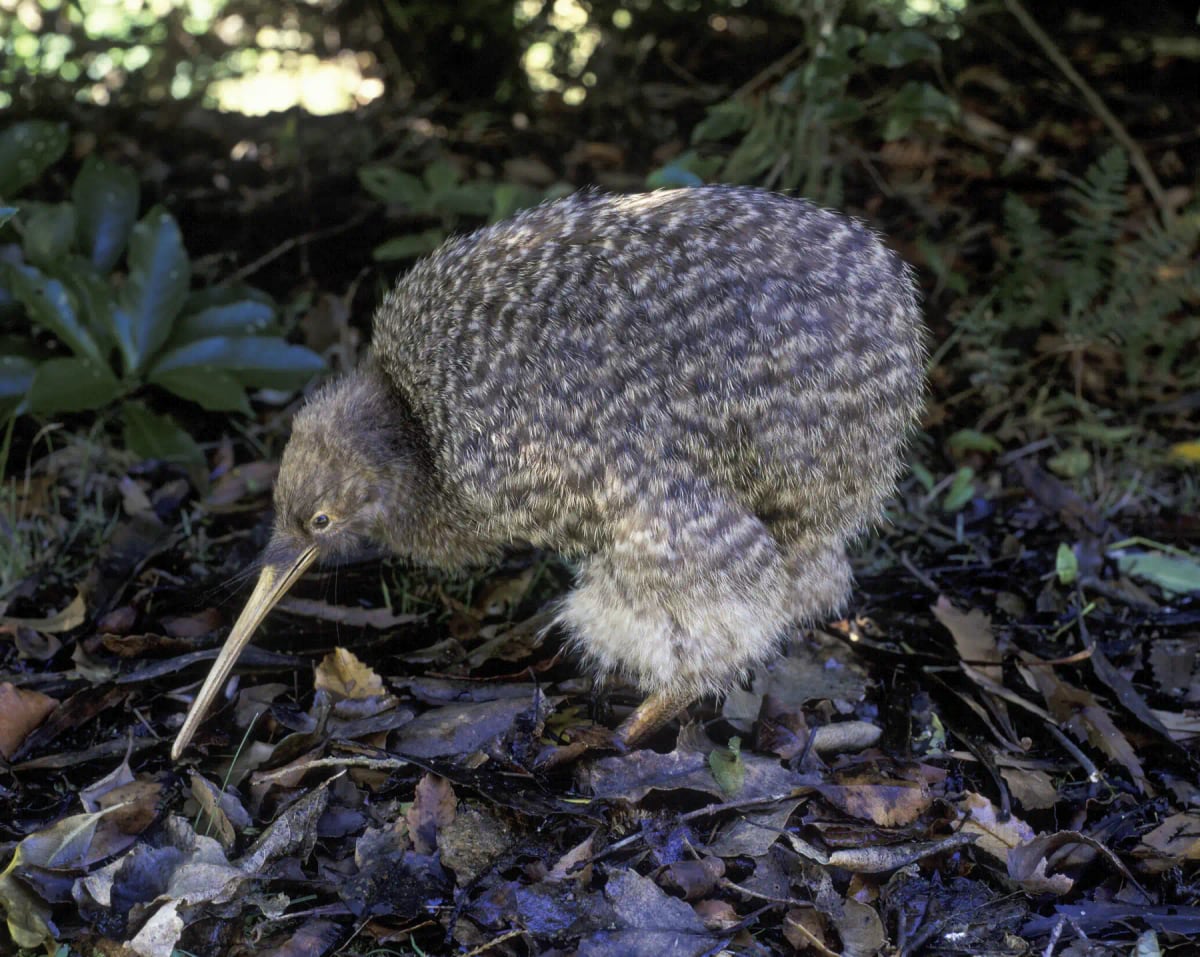
The kiwi is a flightless, nocturnal bird found only in New Zealand, belonging to the genus Apteryx, which includes five species: the North Island brown kiwi, the tokoeka or southern brown kiwi, the rowi, the great spotted kiwi and the little spotted kiwi. Instead of typical feathers, it is covered in loose, hair-like plumage that gives it a shaggy appearance. Its most remarkable feature is the long bill with nostrils positioned at the tip, an arrangement unique among birds that allows it to sniff out earthworms, insects, and larvae buried in the soil. The female lays a single egg that can account for up to 20 percent of her body weight, one of the largest eggs relative to body size of any bird on Earth. In most species the male takes on most of the incubation, sitting on the egg for up to 80 days. Kiwis depend on dense forest and scrubland for shelter. Four of the five species are listed as Vulnerable and the little spotted kiwi as Near Threatened. Introduced predators and habitat loss continue to threaten wild populations, though dedicated conservation efforts are making a real difference.
The five kiwi species
Kiwi is not one bird but a genus, Apteryx, with five species, all found only in New Zealand. The North Island brown kiwi, with streaky reddish brown plumage, is the most familiar, with around 24,500 birds in Northland, Coromandel, the central North Island and other areas. The tokoeka, or southern brown kiwi, is similar but lives in Fiordland, around Haast and on Stewart Island, where some birds even feed by day; it numbers about 26,000. The rowi, the rarest species, survives only in the Ōkarito forest on the West Coast, with around 500 birds. The two spotted kiwis have grey plumage with pale mottled bands. The great spotted kiwi, or roroa, is the largest spotted form and lives in the mountains of the northwest South Island, with about 14,000 birds, while the little spotted kiwi, the smallest of all at roughly the size of a chicken, disappeared from the mainland and was saved on Kapiti Island; today about 1,900 live in sanctuaries such as Zealandia in Wellington.
Kiwi bird or kiwifruit?
Most people who search for kiwi are looking for the fruit, but the bird came first. The name kiwi comes from the Māori language and is thought to imitate the shrill call of the male bird. The fuzzy brown fruit is native to China and was long known in English as the Chinese gooseberry. New Zealand growers began exporting it in the twentieth century, and around 1959 they renamed it kiwifruit, after the national bird, partly to make it more appealing in foreign markets. The name stuck so well that today, outside New Zealand, many people simply call the fruit a kiwi. In New Zealand, kiwi also means a New Zealander, a nickname that goes back to New Zealand soldiers in the First World War. So when a New Zealander talks about a kiwi, it can mean a person, while the fruit is almost always called kiwifruit. The bird and the fruit do share one thing: a brown, hairy look on the outside.
Habitat and distribution
Found nowhere else on Earth, kiwis are entirely restricted to New Zealand. The five recognized species occupy a surprisingly wide range of environments, from dense temperate rainforests and coastal scrublands to tussock grasslands and subalpine zones. The North Island brown kiwi is the most widespread, while the rowi and tokoeka are confined to smaller areas on the South Island and offshore islands. Kiwis depend heavily on soft, moist soil where invertebrates are plentiful, and they need thick vegetation nearby for daytime shelter. Habitat clearance for farming and urban expansion has reduced and fragmented these environments considerably over the past two centuries, pushing many populations onto protected reserves and predator-free islands where conditions can be carefully managed.
Diet
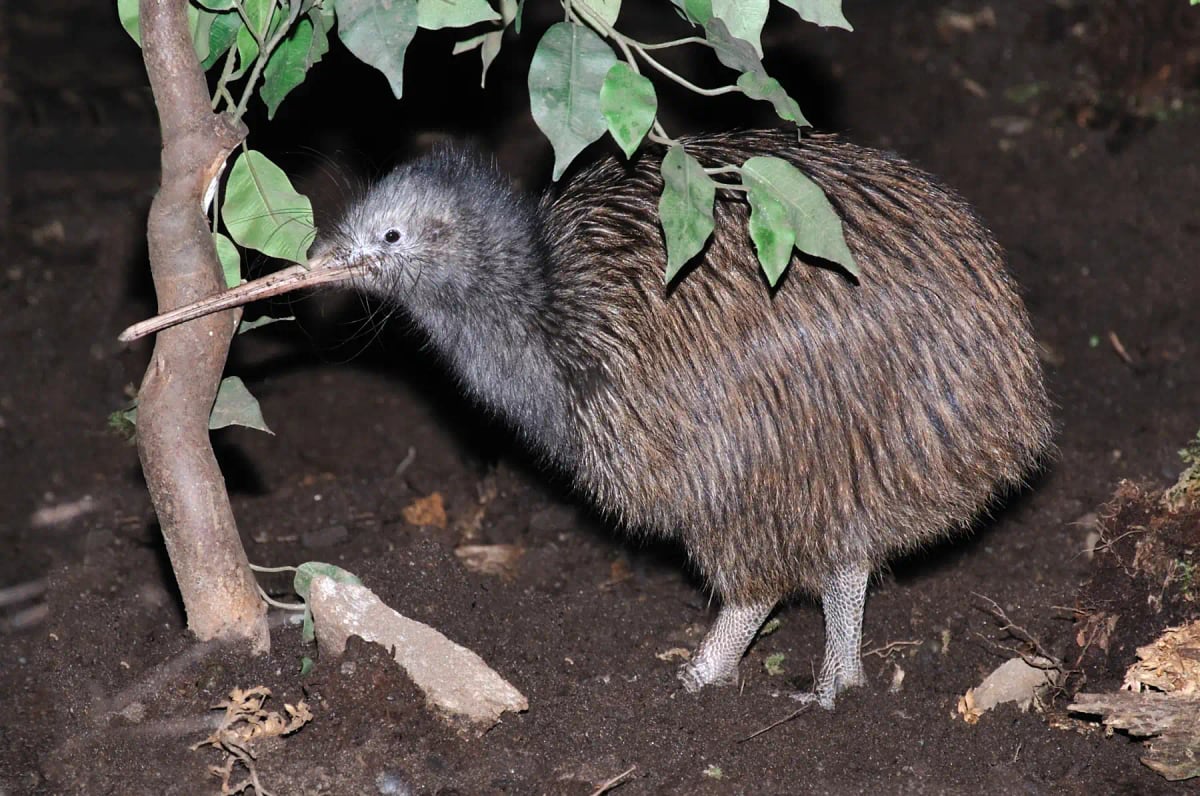
Among all birds, the kiwi has one of the most remarkable tools for finding food: nostrils positioned at the very tip of its long bill. This allows it to sniff out prey hidden underground without needing to see it. Earthworms make up the bulk of the diet, but kiwis also eat insect larvae, beetles, freshwater crayfish, and fallen fruit. When foraging, a kiwi probes the ground repeatedly, using both smell and the sensitive nerve endings in the bill tip to detect movement below the surface. Foraging happens almost entirely at night, and a single bird may cover a large area within its territory in search of enough food. Berries and seeds are eaten more frequently during seasons when invertebrate numbers are lower.
Reproduction
Few birds produce an egg as extraordinary as the kiwi's. A single egg can account for up to 20 percent of the female's body weight, making it one of the largest eggs relative to body size recorded for any bird on Earth. The female invests enormous energy in producing it, then passes most of the incubation responsibility to the male. He sits on the egg for roughly 70 to 80 days, one of the longest incubation periods among birds of similar size. Kiwi pairs tend to form bonds that last for many years, sometimes for life. Chicks hatch fully feathered and surprisingly independent, needing little parental feeding. Even so, young kiwis face serious dangers from predators during their first months and are highly vulnerable before they grow large enough to fend for themselves.
Behavior
After dark is when the kiwi truly comes alive. It spends the daylight hours resting inside a burrow, hollow log, or dense patch of vegetation, then emerges at night to forage across its territory. Kiwis are strongly territorial and will call loudly to advertise their presence and warn off rivals. The call varies by species but can carry a considerable distance through forest. Males and females of a pair often call back and forth to maintain contact. Their sense of smell is extraordinary for a bird, and their hearing is also sharp, but their eyesight is poor and they rely on it very little. Kiwis generally live solitary lives outside of their pair bond, avoiding contact with other individuals. When threatened, they can deliver a powerful kick with their strong legs.
How the kiwi lost its wings: the Māori legend
A popular Māori story, often told to children in New Zealand, explains why the kiwi cannot fly. Tāne Mahuta, the god of the forest, noticed that his trees were being eaten by insects on the ground and were getting sick. He asked the birds of the canopy whether one of them would come down to the forest floor to eat the insects and protect the trees, even if that meant losing the ability to fly. The tūī said it was afraid of the dark, the pūkeko did not want to get its feet wet, and the shining cuckoo was too busy building its nest. Only the kiwi agreed. In return for its sacrifice, the kiwi lost its wings and gained thick, strong legs, and Tāne promised it would become the best known and most loved bird of all. The other birds were marked for their refusal: the tūī with two white feathers at its throat, the pūkeko by having to live in the swamp, and the cuckoo by never building a nest again, laying its eggs in other birds' nests instead. That is why the story is also known as how the kiwi saved the forest.
Cultural importance
No other animal is as deeply tied to New Zealand's national identity as the kiwi. The Māori people held the bird in high regard for centuries, using its feathers to make precious cloaks called kahu kiwi, which were worn by people of high status on ceremonial occasions. When European settlers arrived, the bird's unusual appearance and shy nature captured widespread fascination. By the early twentieth century, New Zealanders had adopted the name "Kiwi" as an informal label for themselves, a nickname now recognized around the world. The kiwi appears on the country's coat of arms, on military badges worn during both World Wars, and on the one dollar coin. Sports teams, businesses, and government agencies across New Zealand regularly use the kiwi as a symbol of pride and national character.
Conservation
The IUCN lists four of the five kiwi species as Vulnerable, and the little spotted kiwi as Near Threatened. In total there are about 68,000 kiwi left, compared with millions before people arrived, and the rarest species, the rowi, has only around 500 birds, although it has grown from about 160 in the mid 1990s. Introduced predators are the single biggest threat, with stoats, cats, dogs, and ferrets killing large numbers of kiwis each year, particularly chicks that are too small to defend themselves. Before conservation programs were established, some populations were declining at a rate of around 2 percent per year. Today, programs such as Operation Nest Egg collect eggs from the wild, raise chicks in facilities safe from predators, and release them once they are large enough to survive. Predator control across large areas of forest using traps and poison stations has also helped stabilize several populations. Dedicated sanctuaries and predator-free island reserves now hold some of the healthiest kiwi communities, offering genuine hope for recovery over the long term.
Researched and written by Juan Pablo. Sources: IUCN Red List, scientific literature and regional field guides. Last updated: .
Technical factsheet

Frequently Asked Questions
How many kiwi birds are left?
There are about 68,000 kiwi left in New Zealand, counting all five species, compared with millions before humans arrived. The tokoeka has about 26,000 birds and the North Island brown kiwi about 24,500, followed by the great spotted kiwi with about 14,000, the little spotted kiwi with about 1,900 and the rowi with only about 500. Where predators are not controlled, kiwi numbers fall by around 2 percent a year, but in managed areas several species are growing again, and the goal of conservation groups is to turn the overall decline around.
Where can you see kiwi birds in New Zealand?
Because kiwi are nocturnal and shy, the easiest way to see one is in a nocturnal house, a darkened enclosure found at places such as the Kiwi Birdlife Park in Queenstown, Ōtorohanga Kiwi House or Auckland Zoo. To see wild kiwi, the best options are guided night walks in sanctuaries such as Zealandia in Wellington, home to little spotted kiwi, or tours on Stewart Island, where the local tokoeka sometimes feed on beaches even in daylight. At Ōkarito on the West Coast, small guided groups can look for the rare rowi.
Is the kiwi related to the ostrich?
The kiwi belongs to the ratites, the group of flightless birds that also includes ostriches, emus, cassowaries and rheas, so they are relatives. But DNA studies published in 2014 found that the kiwi's closest relative is not the giant moa that once lived beside it in New Zealand, nor the emu of nearby Australia, but the extinct elephant birds of Madagascar, huge birds that weighed hundreds of kilograms. This suggests the kiwi's ancestors were small flying birds that reached New Zealand by air and only later lost the ability to fly.
What sound does a kiwi make?
Kiwi are noisy at night. The male gives a loud, shrill, rising whistle, repeated many times, which is thought to be the origin of the Māori name kiwi. The female answers with a lower, hoarse, rasping call. Pairs often call back and forth to keep in touch and to tell neighbors that the territory is taken, and the calls can be heard more than a kilometer away on a still night. Conservation workers count calling birds at night to estimate how many kiwi live in an area, so their voice is also a key tool for protecting them.
Which is the biggest kiwi species?
The largest kiwi are the brown kiwi species and the great spotted kiwi, which can stand about 45 to 55 centimeters long, with females, which are larger than males in every kiwi species, weighing up to around 3 to 4 kilograms. The smallest is the little spotted kiwi, roughly the size of a chicken at about 1 to 2 kilograms. In all kiwi the female is the bigger bird, which helps her produce the enormous egg that can equal up to a fifth of her body weight.
What do kiwis eat?
Kiwis eat mostly earthworms, but they also go after beetle larvae, insects, freshwater crayfish, and fallen fruit. They find food by probing the ground with their long bill, using nostrils at the very tip to smell prey buried underground. It is a foraging method unlike anything seen in other birds. When invertebrate numbers drop during certain seasons, berries and seeds become a bigger part of their diet.
Where do kiwis live?
Kiwis are found only in New Zealand. The five species live across a wide variety of environments, including temperate rainforests, coastal scrublands, tussock grasslands, and subalpine zones. They need soft, moist soil full of invertebrates and thick vegetation for shelter during the day. Habitat loss over the past two centuries has pushed many populations onto protected reserves and predator-free islands where they can be managed safely.
Are kiwis nocturnal?
Yes, kiwis are fully nocturnal. They spend daylight hours resting inside burrows, hollow logs, or dense vegetation, then come out after dark to forage across their territory. Their eyesight is quite poor, so they rely heavily on a sharp sense of smell and keen hearing instead. At night they can also be very vocal, calling loudly to mark their territory and stay in contact with their partner.
Why is the kiwi egg so big?
A kiwi egg can weigh up to 20 percent of the female's body weight, making it one of the largest eggs relative to body size of any bird on Earth. Scientists think this is partly a result of the kiwi's evolutionary history as a larger bird long ago. The egg produces a well-developed chick that hatches already covered in feathers and able to move around with very little help from its parents.
What are the biggest threats to kiwis?
Introduced predators are the greatest danger kiwis face. Stoats, cats, ferrets, and dogs kill large numbers each year, especially young chicks that are too small to defend themselves. Habitat loss from farming and urban development has also reduced the areas where kiwis can live. Before modern conservation programs began, some populations were shrinking by around 2 percent every year, though dedicated efforts have since helped stabilize several groups.
Can kiwis fly?
No, kiwis cannot fly at all. Their wings are tiny and completely useless for flight, hidden beneath their loose, hair-like feathers. Unlike most birds, they also have no keel on their breastbone, which is the bony structure that anchors flight muscles in birds that do fly. Kiwis evolved in New Zealand over millions of years without land predators, so there was no pressure to take to the air for safety.
Are kiwis endangered?
Four of the five kiwi species are listed as Vulnerable by the IUCN, and the fifth, the little spotted kiwi, as Near Threatened. The level of risk varies: the rowi has only about 500 birds, while the North Island brown kiwi and the tokoeka number around 25,000 each. Conservation programs like Operation Nest Egg, which raises chicks safely away from predators and releases them once they are large enough, have made a real difference. Predator-free island reserves now support some of the healthiest kiwi populations in the country.