European Adder
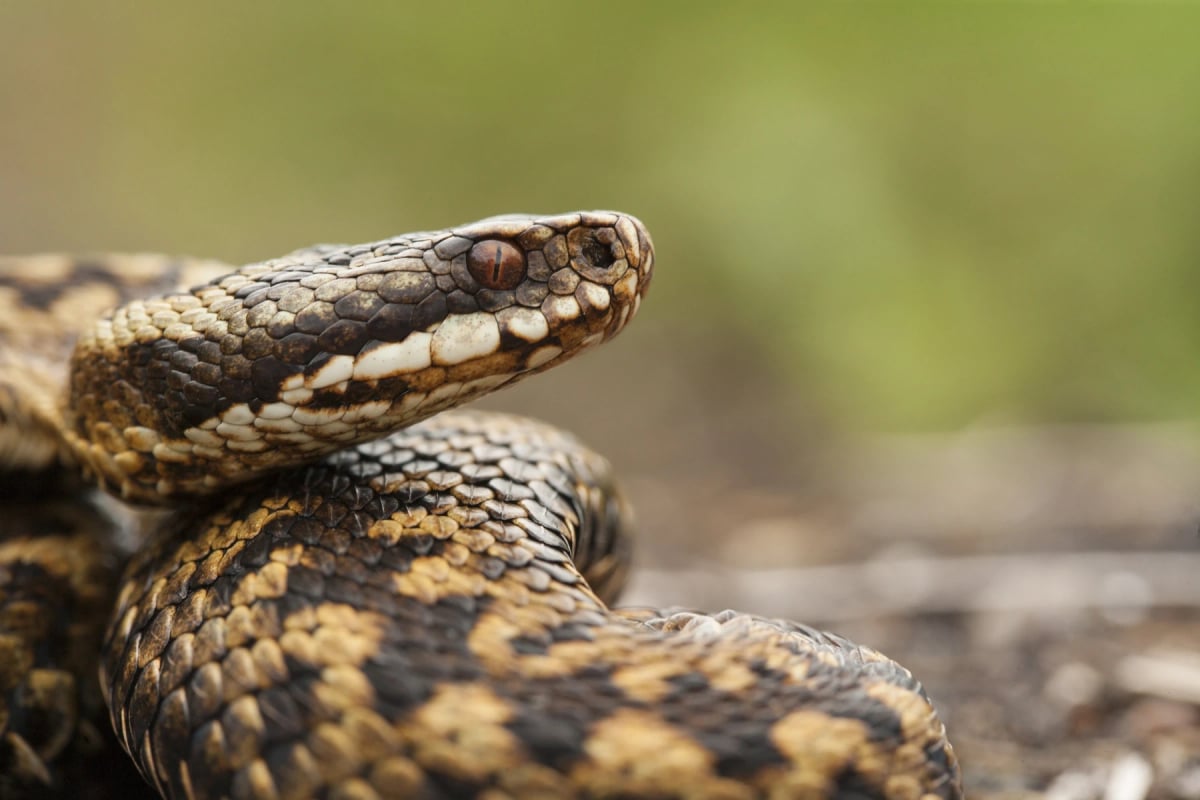
The European adder (Vipera berus), also called the common viper, is the most widely distributed venomous snake in the world, stretching from Britain and France across Scandinavia and Russia to the Pacific coast, and it lives farther north than any other snake, beyond the Arctic Circle. It is a stocky, relatively small viper most easily recognized by the bold zigzag stripe along its back: males are usually gray with a black zigzag and females brown, while some individuals are entirely black. Adults typically measure 55 to 65 cm, with females larger than males. It favors heathland, moorland, woodland edges and mountain meadows, where it spends much of its time basking. It preys mainly on voles, mice and lizards. A shy animal, it bites only in self-defense; its venom causes pain and swelling and needs medical care, but deaths are very rare. It gives birth to live young and is declining in much of western Europe.
What is the European adder?
The European adder (Vipera berus), also called the common European adder, common viper or simply the adder, is a small venomous viper and one of the most widespread snakes on Earth. It was described by Carl Linnaeus in 1758 and belongs to the family Viperidae, the true vipers, which also includes the asp viper and the nose-horned viper of southern Europe. Its range runs across northern Eurasia, from Britain and France through Scandinavia, central and eastern Europe and Russia to the Pacific coast, including Sakhalin, North Korea, Mongolia and northern China, making it the most widely distributed venomous snake in the world. It also lives farther north than any other snake, well beyond the Arctic Circle in Scandinavia. Three subspecies are generally recognized. In many countries, including Britain, Denmark, Norway, Sweden, Finland and the Baltic states, it is the only native venomous snake, which makes it one of the best known animals in local folklore. Despite its fearsome reputation, the adder is a shy, slow animal that spends most of its time basking quietly and avoids people whenever it can.
How to identify an adder: size and appearance
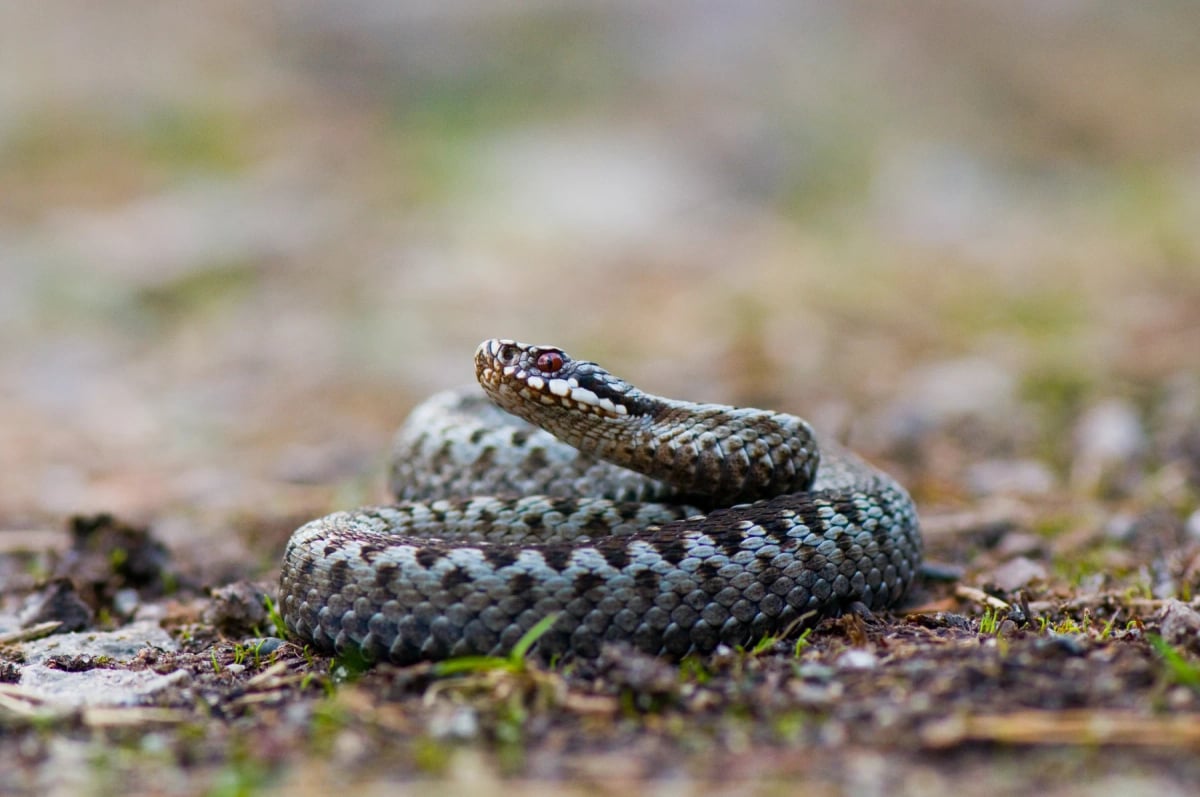
The European adder is a short, thick bodied snake with a fairly broad head, a short tail and vertical pupils, usually set in a red or coppery eye. Its best known feature is the dark zigzag stripe that runs down the whole length of the back, often with a dark V or X shaped mark on the top of the head. Males and females look different: males are usually silvery gray or cream with a jet black zigzag, while females are brown, tan or reddish with a dark brown zigzag. Some adders, more often females, are completely black, which hides the pattern. Adults usually measure about 55 to 65 centimeters, and females grow larger than males. In Britain and France the maximum is around 80 to 87 centimeters, while the biggest adders come from Scandinavia, where two specimens of 104 centimeters have been recorded. They weigh only about 50 to 180 grams, and newborns are just 14 to 23 centimeters long. In Britain, the adder can be told apart from the harmless grass snake, which is longer, greenish and has a yellow collar, and from the rare smooth snake, which is slimmer, with round pupils and small dark spots instead of a zigzag.
Where do adders live?
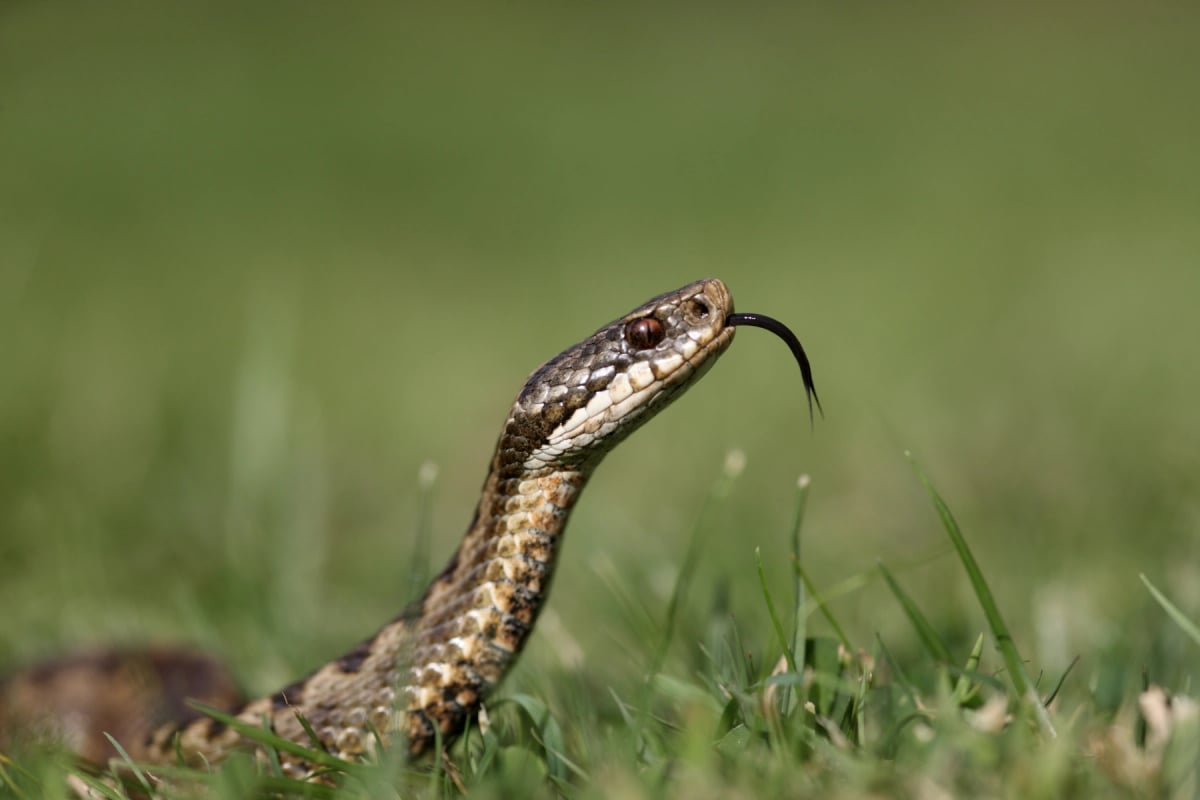
European adders live in cool, open places with plenty of cover: heathland, moorland, bogs and fens, woodland edges and clearings, rough grassland, coastal dunes, rocky hillsides and mountain meadows. What they need above all are sunny spots to bask close to dense vegetation to hide in, and safe places underground to spend the winter. In the north they live from sea level to the edge of the tundra, north of the Arctic Circle in Scandinavia, while in the Alps they reach about 3,000 meters. In the south of their range, in Italy, the Balkans, Greece and Turkey, they are mostly mountain snakes, found in cooler highlands. In the United Kingdom, adders live in England, Wales and Scotland, but not in Northern Ireland or anywhere in Ireland, which has no native snakes. They remain most widespread in Scotland and on the heaths, moors and coastal areas of southern and southwestern England and Wales, such as the heathlands of Dorset, the New Forest and Surrey, while in much of central England they have become rare or have disappeared. The species is absent from Spain and Portugal, where related vipers take its place.
What do adders eat?
Adult adders feed mainly on small mammals, especially voles, mice and shrews, and also take lizards, frogs and newts, and occasionally the eggs and nestlings of ground nesting birds. Young adders, which are too small to tackle most mammals, eat mostly small lizards and amphibians; in some Alpine areas, young alpine salamanders make up nearly half of their diet. The adder is an ambush and stalking predator. It waits beside a vole run or moves slowly through vegetation, finding prey by sight, smell and with its flicking tongue. It strikes quickly, injects venom and then lets go, avoiding injury, and follows the scent trail until the animal dies, then swallows it whole, head first. Because digestion depends on outside warmth, a large meal can keep an adder going for days or even weeks, and adults may eat only a few times in a season. Males feed very little in spring, when they are busy shedding and searching for mates, and catch up later in the summer. During hibernation, which can last more than half the year in the north, adders do not eat at all.
Are European adders dangerous?
The European adder is venomous, but it is rarely deadly. It bites only in self-defense, usually when someone steps on it, sits on it or tries to pick it up, and its venom yield is low, only a few milligrams. The venom mainly damages tissue and blood vessels, causing pain, swelling and bruising that can spread up the limb over hours, and in more serious cases nausea, vomiting, dizziness and a drop in blood pressure. Children, the elderly and people with health problems are most at risk, and recovery after a serious bite can take months. Deaths are very rare. In Britain, only 14 deaths were recorded between 1876 and 2005, the last in 1975, a five year old child. In Sweden, where about 1,300 people are bitten each year, around 12 percent need hospital care, and a man who did not seek treatment died after a bite in 2023. Several effective antivenoms are available and are given to patients with severe symptoms. Anyone bitten should stay calm, keep the bitten limb still, remove rings and watches and go to a hospital quickly; cutting the wound, sucking out venom or using a tourniquet should be avoided.
Behavior, hibernation and reproduction
Adders are active by day in most of their range, especially in the north, and spend much of their time basking to warm up, often flattening their bodies to catch more sun. They spend the winter hibernating underground, often in communal sites among tree roots, in old burrows or under rocks, sometimes shared with other snakes and returned to year after year. In Britain, males hibernate for about 150 days and females for about 180, while in northern Sweden hibernation lasts eight to nine months. Winter is a dangerous time: around 15 percent of adults and 30 to 40 percent of young adders die during hibernation. Males emerge first in early spring, bask until they shed their skin, and then go in search of females, following their scent trails. Rival males perform the famous adder dance, rearing up and pushing against each other in a wrestling contest without biting, until one gives up. Mating takes place from late April in Hungary and in May farther north. Adders give birth to live young, usually in August or September, in litters of 3 to 20, and females breed only every two or three years, because they need time to rebuild their fat reserves.
Is the European adder endangered?
Not globally. The IUCN lists the European adder as Least Concern, in an assessment from 2021, because of its enormous range, but it also notes that its population is decreasing, and in western Europe the declines are serious. In Britain, a long term citizen science survey called Make the Adder Count found extensive declines, especially at small, isolated sites, and researchers warned that the adder could disappear from much of the country within a few decades; the release of millions of pheasants and partridges for shooting has been suggested as a major factor, as the birds eat young adders. Elsewhere, the main threats are the loss of heathland and grassland to farming, forestry and building, the fragmentation of habitat into small patches whose isolated populations suffer from inbreeding, disturbance at hibernation sites, road traffic and deliberate killing by people who fear snakes. The adder is legally protected in Great Britain under the Wildlife and Countryside Act 1981 and in many other countries, including Norway, Denmark, Finland and Sweden, and it is listed as endangered in Switzerland. Conservation work focuses on managing heathlands with grazing and scrub clearance and protecting known hibernation sites.
Where it is found
The European Adder can be found in places such as:
Researched and written by Juan Pablo. Sources: IUCN Red List, scientific literature and regional field guides. Last updated: .
Technical factsheet















Frequently Asked Questions
Is the adder the only venomous snake in the UK?
Yes. The adder is the only venomous snake native to Great Britain. The other two native snakes, the grass snake and the smooth snake, are harmless to people. The grass snake is longer, usually greenish with a yellow and black collar, and is often found near water, while the rare smooth snake lives mainly on a few heaths in southern England and has round pupils and small dark markings instead of a zigzag. The slow worm, often mistaken for a snake, is actually a legless lizard.
Are there adders in Ireland?
No. There are no adders, or any other native snakes, in Ireland or Northern Ireland. Legend credits Saint Patrick with driving the snakes out, but scientists explain it differently: after the last ice age, Ireland became separated from Britain by the sea before snakes, which spread north slowly as the climate warmed, could reach it. The only native reptile in Ireland is the common lizard. Adders do live across Great Britain, in England, Wales and Scotland.
When are adders most active in the UK?
Adders spend the winter hibernating and usually come out between February and March, when males can be seen basking on sunny mornings, often in the same spots each year. Mating, with the famous adder dance between rival males, takes place in April and May. Through summer, adders are active but harder to see as vegetation grows, and the young are born in August or September. By October most adders have returned to their hibernation sites. Early spring mornings are the best time to see them.
Why is it called an adder?
The word adder comes from the Old English nædre, which simply meant snake or serpent. In Middle English, people said "a nadder", but over time the n moved across to the article and "a nadder" became "an adder", the same change that turned "a napron" into "an apron". Related words still survive in other languages, such as the German Natter. The scientific name Vipera comes from the Latin word for viper.
What should you do if you see an adder?
Enjoy it from a distance and leave it alone. Adders are shy and will usually move away if given time, and they only bite if they feel threatened, stepped on or handled. Keep at least a few meters away, never try to touch or move one, and keep dogs on a lead in heathland and moorland in spring and summer, as curious dogs are often bitten. If you are walking in adder country, wear boots and watch where you step and sit. Adders are legally protected in Britain, so harming one is an offense.
Why do some European adders appear completely black?
Some European adders are melanistic, meaning their skin produces so much dark pigment that the whole body looks black and the zigzag is hard or impossible to see. Black adders are found in many populations, more often among females, and are especially common in some cool, damp or mountainous areas. A black body absorbs heat faster, which helps an adder warm up quickly in places with short, cool summers, though it may also make the snake easier for predators to spot.