Tawny Eagle

The tawny eagle is a large bird of prey found across the open savannas, dry woodlands, and semi-arid plains of Africa, as well as parts of the Middle East and the Indian subcontinent. Adults wear a warm brown coat of feathers that can vary from pale to dark, with fully feathered legs and a strong bill suited to tearing flesh. This eagle is highly opportunistic: it hunts small mammals, reptiles, and birds, but it also feeds on carrion and is well known for stealing meals from other raptors. It soars for long periods on rising columns of warm air, scanning the ground below. Once abundant across much of its range, it has suffered serious declines caused by habitat loss, accidental poisoning, and electrocution on power lines. The IUCN currently lists it as Vulnerable.
Appearance
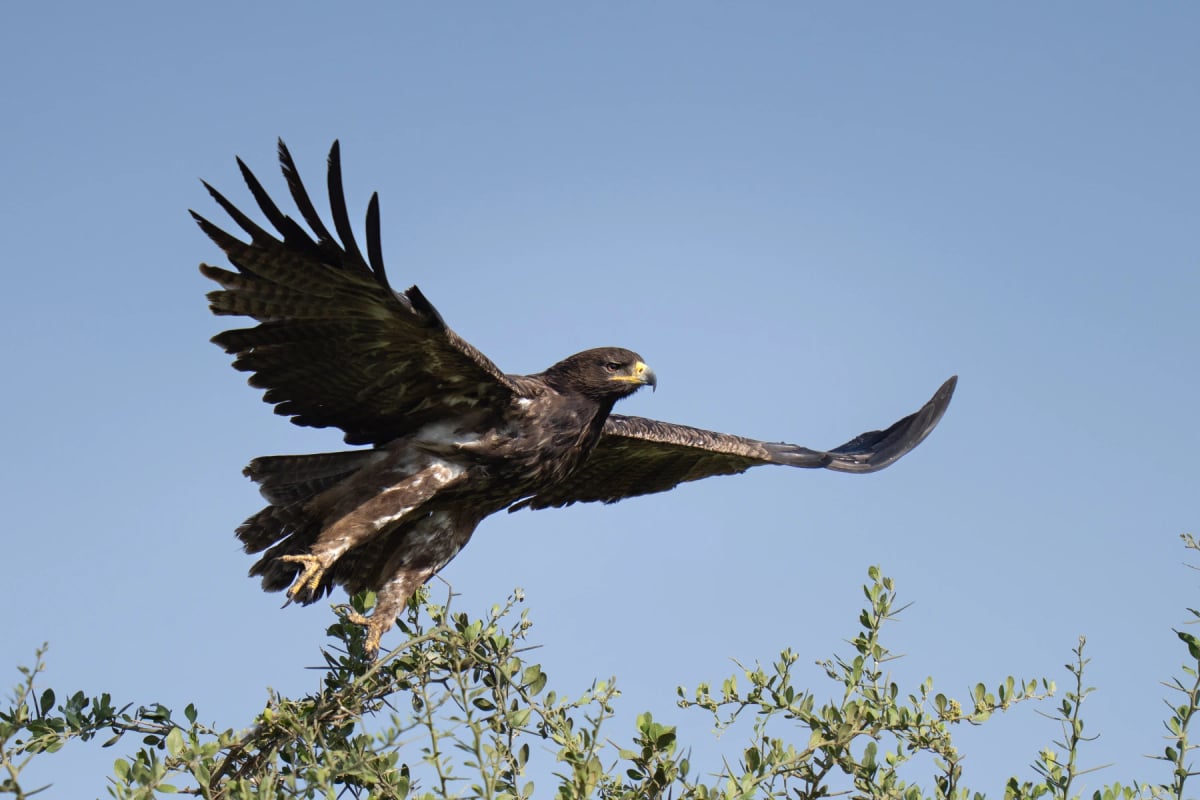
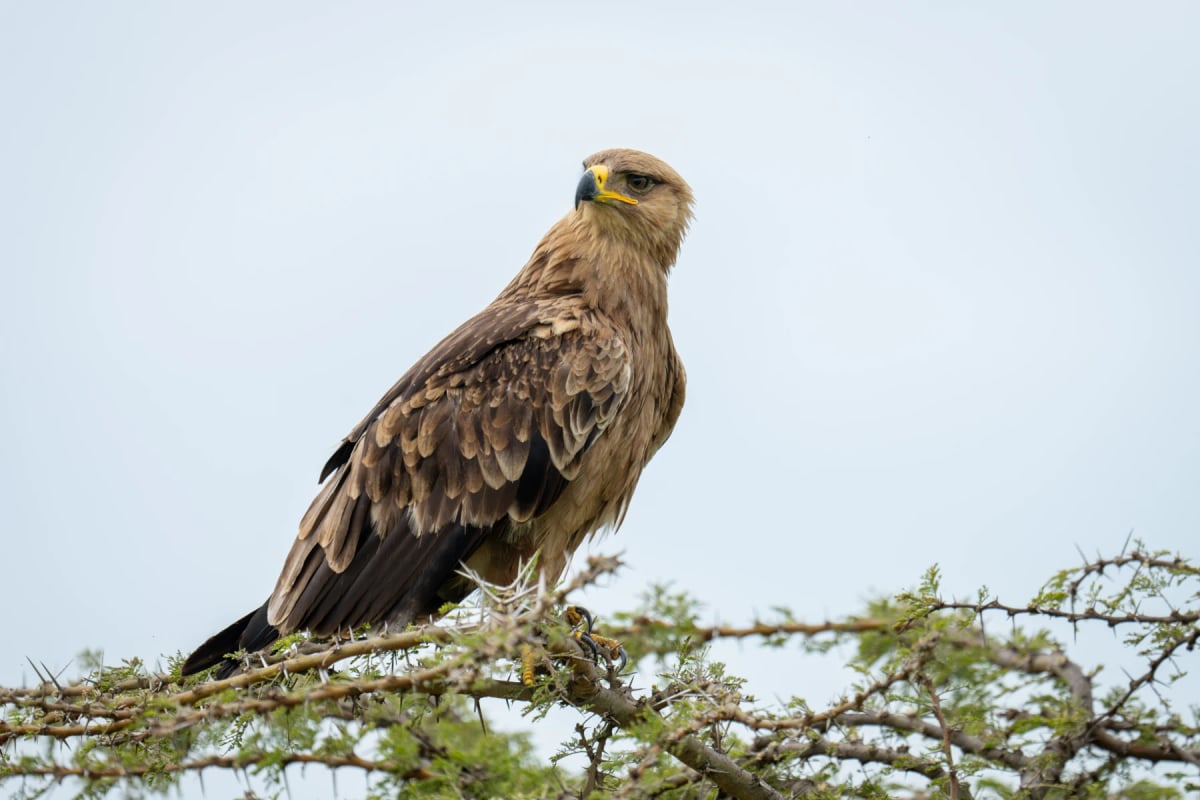
The tawny eagle is a large, sturdy raptor with plumage that ranges from pale sandy brown to a much deeper chocolate tone, depending on the individual. The upperparts tend to be slightly paler than the underparts, and some birds show a small whitish patch on the upper wing. Its eyes are yellow to pale brown, and the cere at the base of the hooked bill is also yellow. Unlike many eagles, its legs are fully feathered all the way down to the toes, a feature shared with other members of the genus Aquila. In flight, the broad, rounded wings and a relatively short tail give it a distinctive silhouette against the sky. Adult birds take several years to reach full plumage, and younger birds are streakier and paler overall.
Habitat and distribution
Across its range, the tawny eagle favors open country with scattered trees or low scrub. It is most at home in dry savannas, open woodlands, and plains with sparse vegetation, where good visibility makes hunting easier. In Africa it is widespread south of the Sahara, with additional populations in the Horn of Africa and parts of North Africa. Beyond the continent, it occurs through the Arabian Peninsula, Iran, and into the Indian subcontinent, reaching as far as Nepal. It generally avoids dense forest and very high altitudes, though it can appear in cultivated areas and near human settlements. In India, the population has declined sharply, and the eagle is now a rare sight in many areas where it was once regularly recorded.
Diet
Few raptors are as flexible in their feeding habits as the tawny eagle. It hunts small mammals such as hares and ground squirrels, as well as lizards, snakes, and birds up to the size of francolins. It will readily feed on carrion and is a regular visitor to large carcasses alongside vultures. One of its most notable habits is kleptoparasitism: it harasses other birds, including smaller raptors and even storks, forcing them to drop their prey and then swooping in to claim it. Around locust swarms or grass fires, tawny eagles gather in numbers to take advantage of the easy pickings. This combination of active hunting, scavenging, and stealing makes it one of the most resourceful predators of the open plains.
Behavior
Outside of the breeding season, tawny eagles lead largely solitary lives, spending much of the day riding thermals at considerable height. Pairs form lasting bonds and return to the same nest year after year, adding fresh material each season until the structure becomes very large. Nests are usually placed in the fork of a tall tree, sometimes on a cliff face or even on a pylon. The female typically lays one or two eggs, and both parents share incubation duties over roughly six weeks. Chicks are dependent on the adults for several months after fledging. Although not especially vocal, the eagle does produce a barking call near the nest. It is largely a bird of the daytime and rarely moves at dusk or dawn.
Conservation
The IUCN classifies the tawny eagle as Vulnerable, reflecting steep population declines across much of its range over recent decades. Habitat loss driven by agricultural expansion and overgrazing removes the open landscapes it depends on. Poisoning is a serious concern: the eagle feeds on carcasses laced with poison set out to kill predators such as lions and hyenas, and it is also affected by veterinary drugs like diclofenac that contaminate livestock carcasses. Collisions with vehicles and electrocution on poorly insulated power lines claim additional birds every year. In India the decline has been particularly severe. Conservation efforts focus on retrofitting power lines, raising awareness among farming communities about the risks of poison baits, and monitoring breeding populations to understand where numbers are falling fastest.
Where it is found
The Tawny Eagle can be found in places such as:
Researched and written by Juan Pablo. Sources: IUCN Red List, scientific literature and regional field guides. Last updated: .
Technical factsheet







Frequently Asked Questions
What does the tawny eagle eat?
The tawny eagle is remarkably adaptable at the dinner table. It hunts small mammals, lizards, snakes, and birds, but it also scavenges from carcasses alongside vultures. One of its cleverest tricks is stealing food from other birds by harassing them until they drop their meal. Near grass fires or locust swarms, groups of tawny eagles gather to feast on whatever is flushed out into the open.
Where does the tawny eagle live?
Tawny eagles are found across a huge stretch of the world, from the savannas and dry woodlands of sub-Saharan Africa through the Arabian Peninsula, Iran, and across the Indian subcontinent to Nepal. They prefer open landscapes with scattered trees where they can spot prey from above. Dense forests and high mountain terrain are generally avoided, though the eagles sometimes turn up near farms and villages.
Is the tawny eagle endangered?
The tawny eagle is currently listed as Vulnerable on the IUCN Red List, which means it faces a high risk of decline if the threats it faces are not addressed. Populations have dropped significantly across Africa and Asia over recent decades. In India, the situation is especially serious, and the bird is now rarely spotted in areas where it once was common. Poisoning, habitat loss, and power line electrocution are the main culprits.
How does the tawny eagle steal food from other birds?
This behavior is called kleptoparasitism, and the tawny eagle is quite good at it. It will chase smaller raptors, storks, and other birds in the air or on the ground, pestering them relentlessly until they drop or abandon whatever they are carrying. The eagle then swoops in and claims the meal for itself. This strategy saves energy compared to hunting and is especially useful when prey is hard to find.
Why is the tawny eagle being poisoned?
Tawny eagles are not targeted directly, but they are often killed accidentally. Farmers and herders sometimes lace carcasses with poison to kill lions, hyenas, or other predators they see as a threat to livestock. Eagles that feed on those carcasses die as a result. Livestock carcasses can also contain veterinary drugs such as diclofenac, which are toxic to birds of prey. This kind of indirect poisoning is one of the biggest threats the species faces today.
How big is a tawny eagle?
The tawny eagle is a large and powerful bird. It typically measures between 62 and 82 centimeters in length, with a wingspan that can reach up to 185 centimeters. Females tend to be noticeably larger than males, which is common among birds of prey. Despite its size, it is not the heaviest eagle in its range, but its broad wings and sturdy build make it an impressive sight when soaring overhead.
Do tawny eagles mate for life?
Tawny eagles form strong pair bonds and tend to stay with the same partner over many breeding seasons. Couples return to the same nest year after year, building it up a little more each time until it can become very large. The female usually lays one or two eggs, and both parents take turns incubating them for about six weeks. After hatching, the chicks rely on the adults for several months before becoming independent.