Pampas Deer
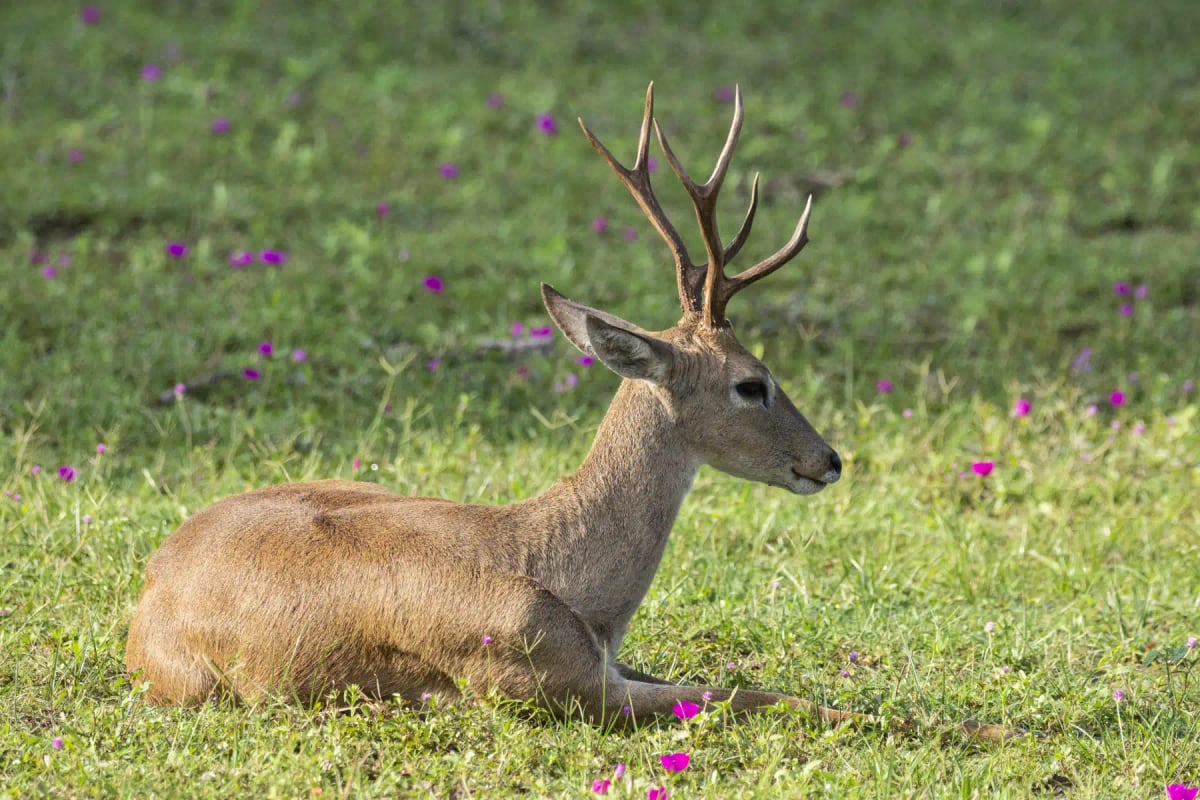
The pampas deer is a medium-sized cervid native to the open grasslands and savannas of South America. Slender in build, with long legs and a coat of pale yellowish brown, it once roamed in vast numbers across the Pampas, the Cerrado, and neighboring plains. Males grow simple antlers with up to three tines, and both sexes release a strong garlic-like scent from glands near the hooves, a trait unique among deer. Active mainly at dawn and dusk, it browses on grasses, herbs, and young shoots. Social structure varies: individuals may be solitary or gather in small groups depending on season and food availability. Populations survive today in Argentina, Brazil, Uruguay, Paraguay, and Bolivia, though numbers have fallen sharply due to agricultural expansion, cattle ranching, and hunting. The IUCN lists the species as Near Threatened, with fewer than 80,000 individuals estimated to remain.
Habitat and distribution
Pampas deer are found across five South American countries: Argentina, Brazil, Uruguay, Paraguay, and Bolivia. They favor open environments, particularly the vast temperate grasslands of the Pampas, the tropical savannas of the Brazilian Cerrado, and the flood plains of the Pantanal fringe. Within these landscapes, they seek areas with short to medium grass cover and good visibility, which helps them spot approaching predators. Although the species was once widespread across nearly the entire interior of South America, habitat loss has broken its range into scattered, isolated pockets. Many populations are now separated by cropland and cattle pastures, making movement between groups extremely difficult. The largest concentrations today are found in protected areas and private ranches where native grassland still survives in reasonable condition.
Diet
Feeding mainly at dawn and dusk, pampas deer are selective grazers with a diet built around grasses, flowering herbs, and the tender shoots of low shrubs. They tend to prefer young, fresh growth over dry or mature vegetation, adjusting what they eat according to the season and what is available locally. During the wet season, when new grass is abundant, grasses make up the bulk of their intake. In drier months, they shift toward herbs and forbs to meet their nutritional needs. Unlike some other deer species, they do not depend heavily on browse from trees or tall shrubs, which reflects their adaptation to open, treeless terrain. This preference for low vegetation also means that changes in grassland management, such as overgrazing by cattle, can directly reduce the quality of food available to them.
Behavior
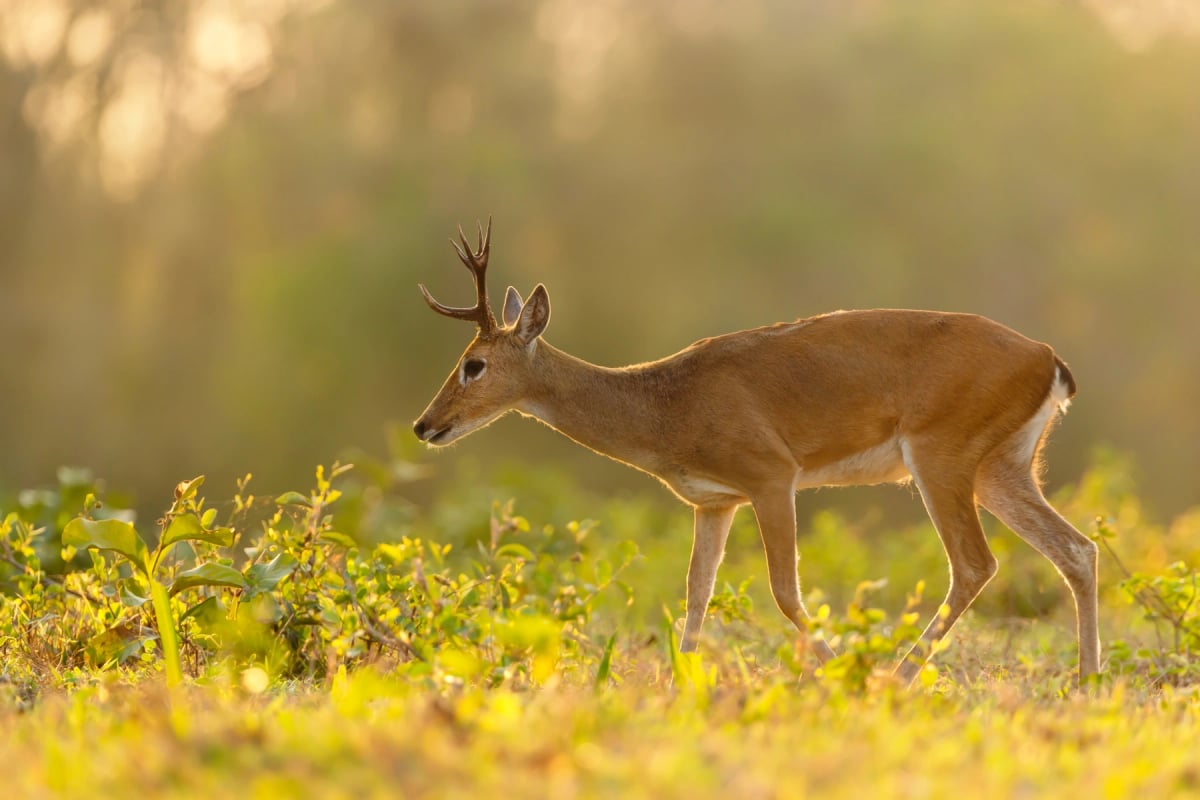
One of the most distinctive traits of the pampas deer is the strong garlic-like scent produced by glands situated near the hooves. This odor is unique among deer worldwide and is thought to play a role in communication between individuals. The species is crepuscular, meaning it is most active during the low light of dawn and dusk, resting in taller grass during the heat of the day. Social behavior is flexible: some individuals roam alone, while others form small groups of up to a few animals, particularly females with young. Males live apart from females for much of the year, coming together during the breeding season. When threatened, pampas deer rely on speed and their ability to read open terrain rather than seeking cover in dense vegetation, bounding away in long, fluid strides.
Conservation
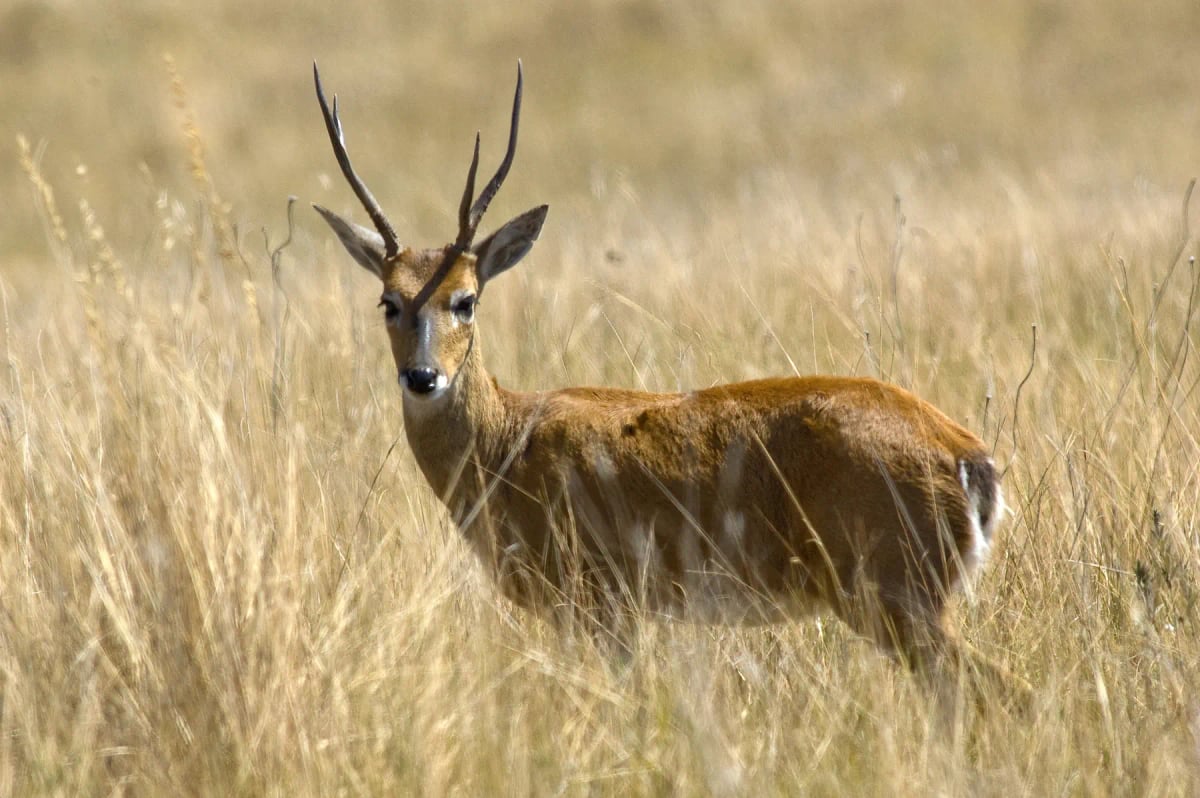
The IUCN classifies the pampas deer as Near Threatened, with current estimates suggesting fewer than 80,000 individuals remain across its entire range. The biggest pressure on the species comes from the conversion of native grasslands into cropland and pasture for cattle, a process that has accelerated across the Pampas and Cerrado over recent decades. Hunting, both for meat and to reduce competition with livestock, has also taken a toll. Disease transmitted by domestic cattle poses an additional risk, particularly in areas where the two species share territory. Conservation efforts include legal protection in all five range countries, management of protected areas where viable populations persist, and research programs aimed at understanding population dynamics. Some private landowners have also adopted practices that benefit the deer, though progress across its range as a whole remains uneven.
Ecological role
Within the grassland and savanna ecosystems it calls home, the pampas deer plays several important roles. As a grazer, it helps regulate the growth of grasses and herbs, preventing any single plant from dominating and contributing to the overall variety of vegetation across a landscape. This, in turn, supports a wider range of insects and other small animals that depend on diverse plant communities. The deer also serves as a key prey species for large carnivores of the South American plains, including pumas and maned wolves. By sustaining these predator populations, it contributes to the balance of the broader food web. Additionally, seeds pass through the digestive system of the deer and are deposited across the landscape in droppings, making it a modest but real contributor to plant dispersal across open terrain.
Where it is found
The Pampas Deer can be found in places such as:
Researched and written by Juan Pablo. Sources: IUCN Red List, scientific literature and regional field guides. Last updated: .
Technical factsheet





Frequently Asked Questions
What does the pampas deer eat?
Pampas deer are selective grazers that feed mainly on grasses, flowering herbs, and the tender shoots of low shrubs. They prefer fresh, young growth over dry or mature vegetation. During the wet season, grasses dominate their diet, while in drier months they shift toward herbs and forbs. They avoid heavy browsing on trees, which reflects how well adapted they are to open grassland environments.
Where does the pampas deer live?
The pampas deer lives in open grasslands and savannas across five South American countries: Argentina, Brazil, Uruguay, Paraguay, and Bolivia. It thrives in areas with short to medium grass cover, including the Pampas, the Brazilian Cerrado, and the edges of the Pantanal. Habitat loss has fragmented its range considerably, so today the largest populations are found inside protected areas and on ranches that still preserve native grassland.
Why does the pampas deer smell like garlic?
Pampas deer have scent glands located near their hooves that produce a strong odor often compared to garlic. This is one of the most unusual traits in the entire deer family, as no other species shares it. Researchers believe the scent helps individuals communicate with one another, though the full range of its purpose is still being studied. You can sometimes detect the smell before you even spot the deer.
Is the pampas deer endangered?
The pampas deer is listed as Near Threatened on the IUCN Red List, with fewer than 80,000 individuals estimated to remain in the wild. While it is not yet classified as endangered, its numbers have dropped sharply over the decades. The conversion of native grasslands into farmland and cattle pastures is the main driver of decline, alongside hunting and diseases spread by domestic cattle. Its situation requires close monitoring and continued conservation efforts.
How do pampas deer behave in the wild?
Pampas deer are most active at dawn and dusk, resting in taller grass during the hottest part of the day. Their social life is flexible: some live alone, while others form small groups, especially females with young. Males generally stay apart from females except during the breeding season. When danger approaches, they do not hide in thick vegetation but instead sprint across open ground in long, smooth strides.
What are the main threats to the pampas deer?
The greatest threat to the pampas deer is the loss of native grassland, driven by the expansion of agriculture and cattle ranching across South America. This has broken the species' range into isolated patches, making it hard for populations to recover. Hunting remains a problem in some areas, and diseases passed on by domestic cattle add further pressure. All five countries where the deer lives offer it legal protection, but enforcement and habitat restoration vary widely.
What role does the pampas deer play in its ecosystem?
Pampas deer help keep grassland ecosystems healthy in several ways. By grazing selectively, they prevent any single plant species from taking over, which supports a greater variety of vegetation and the insects that depend on it. They are also an important food source for predators such as pumas and maned wolves. On top of that, seeds pass through their digestive system and are spread across the landscape in their droppings, contributing to plant diversity over time.