Common Dolphin

The common dolphin (Delphinus delphis) is one of the most abundant cetaceans on Earth, found in warm and temperate waters across all major ocean basins. Its most recognisable feature is the striking hourglass pattern on its flanks, where panels of yellow and grey meet a dark back and a pale belly. Adults typically reach about 1.7 to 2.4 metres in length and weigh between 80 and 150 kilograms. They live in groups that range from a few dozen to several thousand individuals, and these large gatherings, often called superpods, are a spectacular sight at sea. Common dolphins feed mainly on small fish such as anchovies and sardines, as well as squid, and they hunt cooperatively to herd prey into tight balls near the surface. They are energetic animals, frequently riding the bow waves of ships and leaping clear of the water. Lifespan in the wild can reach 35 years.
Habitat and distribution
Common dolphins are found across a vast stretch of the world's oceans, from the warm tropical belt to cooler temperate zones. They inhabit the Atlantic, Pacific, and Indian Oceans, and are also well established in the Mediterranean and Black Seas. Rather than wandering randomly, they tend to favour areas where cold and warm currents meet, as these upwellings push nutrients to the surface and attract large concentrations of fish. Continental shelf edges, submarine canyons, and coastal upwelling zones are particularly productive hunting grounds. In the eastern North Atlantic, they are a common sight off the coasts of Ireland, Portugal, and Spain. Populations in the Pacific are especially numerous, with some of the largest gatherings recorded off California and in the waters around Japan and New Zealand.
Appearance
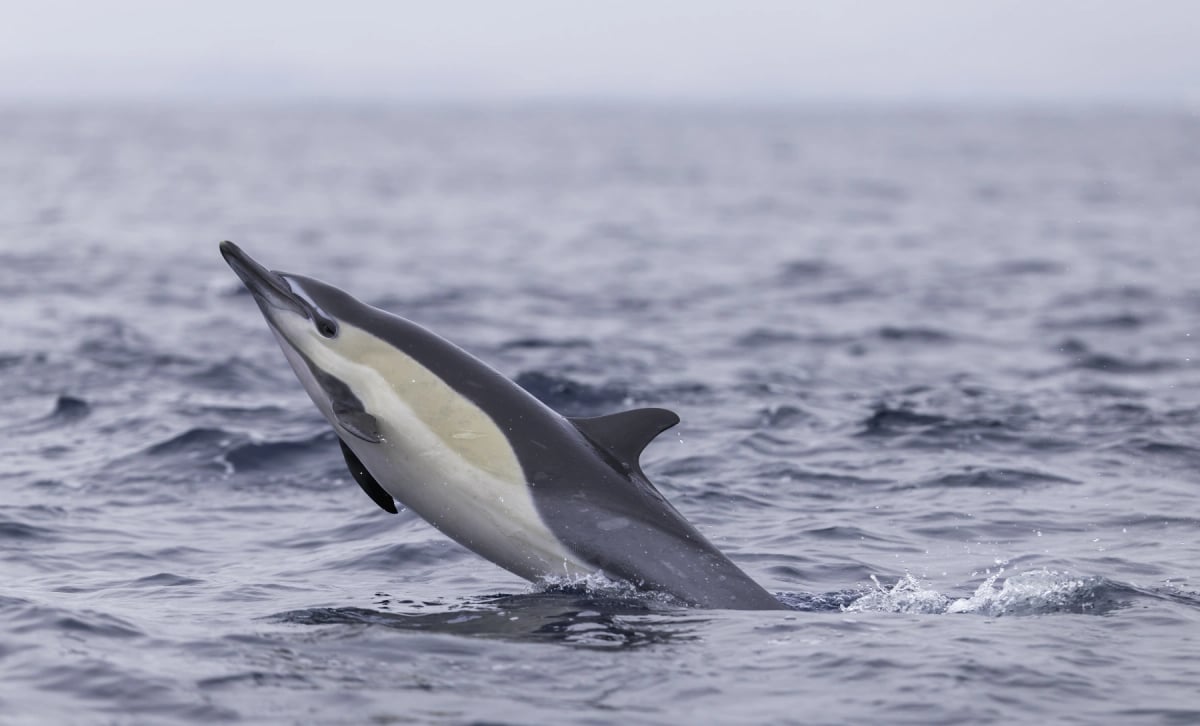
Few dolphins are as instantly recognisable as this species. The common dolphin carries a bold hourglass pattern along each flank, where a patch of ochre yellow at the front transitions into pale grey toward the tail. The back is dark charcoal or black, and the belly is white or cream. A dark stripe runs from the jaw to the flipper, and the beak is moderately long and well defined. Adults typically measure between 1.7 and 2.4 metres in length and weigh anywhere from 80 to 150 kilograms, with males generally being slightly larger than females. The dorsal fin sits near the centre of the back and is tall and gently curved. Up close, the eyes are surrounded by a dark ring that connects to the stripe along the beak.
Diet
Anchovies, sardines, and squid make up the core of the common dolphin's diet, though they also take mackerel, herring, and a range of other small schooling fish depending on what is available in their region. Feeding often happens at night or at dawn, when prey species rise closer to the surface as part of their natural daily movement through the water column. Groups work together to drive fish into tight, spinning balls near the surface, a behaviour known as bait balling, which makes it far easier to pick off individuals. Seabirds often gather above these events to catch fish that escape upward. An adult common dolphin may consume around eight percent of its body weight in food each day to fuel its active lifestyle.
Behavior
Common dolphins are among the most social of all cetaceans. They typically travel in pods of several dozen to a few hundred individuals, though multiple pods sometimes merge into superpods that can contain several thousand animals. These gatherings are among the most spectacular wildlife events visible at sea. Within their groups, dolphins communicate constantly through clicks, whistles, and burst pulse sounds, and each individual develops a unique signature whistle that others can recognise. Bow riding, where dolphins surf the pressure wave in front of a moving vessel, is a favourite activity and requires almost no energy from the animal. They also leap clear of the water frequently, a behaviour called breaching, and slap the surface with their tails. Common dolphins can dive to at least 200 metres and hold their breath for several minutes.
Interaction with humans
People have shared the sea with common dolphins for thousands of years, and the species holds a place in the art and mythology of ancient Greece and Rome. Today, they are a favourite subject for wildlife watching trips along coastlines in Europe, the Americas, and beyond, providing an important source of income for local communities. Common dolphins pose no threat to swimmers or divers and regularly approach vessels out of apparent curiosity. That said, getting too close or attempting to touch or feed them causes stress and disrupts their natural behaviour. Responsible watching means keeping a respectful distance, cutting engine speed when dolphins are nearby, and never attempting to chase or surround a pod. Strandings occasionally bring common dolphins into contact with coastal rescue teams, and rehabilitation efforts have had some success.
Conservation
Globally, the common dolphin is listed as Least Concern on the IUCN Red List, reflecting its large overall population and wide range. The picture is more worrying at the regional level, however. The population in the Mediterranean Sea is listed separately as Endangered, having declined sharply over recent decades. Accidental capture in fishing gear, known as bycatch, is one of the main pressures affecting dolphins across their range, with gillnets, trawls, and purse seines all posing risks. Overfishing of their prey species reduces the food available to them, while underwater noise from shipping and sonar can interfere with their communication and navigation. Pollution, including plastic debris and chemical contamination, is an additional concern. Monitoring programmes and international agreements, such as ACCOBAMS in the Mediterranean and Black Sea, are working to improve protections for this species.
Where it is found
The Common Dolphin can be found in places such as:
Researched and written by Juan Pablo. Sources: IUCN Red List, scientific literature and regional field guides. Last updated: .
Technical factsheet













Frequently Asked Questions
What do common dolphins eat?
Common dolphins feed mainly on small schooling fish such as anchovies, sardines, herring, and mackerel, along with squid. They are cooperative hunters, working together to herd fish into tight balls near the surface before picking them off one by one. Seabirds often join in from above. An adult can eat roughly eight percent of its body weight each day to keep up with its active lifestyle.
Where do common dolphins live?
Common dolphins are found in warm and temperate waters across all major ocean basins, including the Atlantic, Pacific, and Indian Oceans, as well as the Mediterranean and Black Seas. They tend to favour areas where ocean currents meet and push nutrients to the surface, such as continental shelf edges and coastal upwelling zones. Some of the largest populations are found off California, Japan, and New Zealand.
How fast can a common dolphin swim?
Common dolphins are among the fastest cetaceans in the sea, capable of reaching speeds of around 60 kilometres per hour in short bursts. They love riding the bow waves of ships, which lets them travel at speed without much effort at all. Their streamlined bodies and powerful tail flukes make them built for speed, and watching them keep pace with a fast vessel is a remarkable sight.
How big do common dolphins get?
Adults typically grow to between 1.7 and 2.4 metres in length and weigh between 80 and 150 kilograms. Males are generally a little larger than females. They are not the biggest dolphins in the sea, but they are among the most energetic, frequently leaping clear of the water and keeping pace with fast moving vessels. Their lifespan in the wild can reach around 35 years.
Are common dolphins endangered?
Globally, common dolphins are listed as Least Concern by the IUCN, meaning the species as a whole is not at risk of extinction. However, the Mediterranean population is listed separately as Endangered and has dropped sharply in recent decades. The main threats across their range include accidental capture in fishing nets, overfishing of their prey, underwater noise pollution, and contamination from plastics and chemicals.
Do common dolphins live in groups?
Yes, common dolphins are highly social animals. They usually travel in pods of several dozen to a few hundred individuals, but separate pods sometimes join together to form superpods of several thousand dolphins. These massive gatherings are one of the most breathtaking sights in the natural world. Within their groups, they communicate through clicks, whistles, and each dolphin's own unique signature whistle that others can recognise.
What is the hourglass pattern on a common dolphin?
The hourglass pattern is the common dolphin's most distinctive feature. Looking at the side of the animal, a bright ochre yellow patch at the front of the flank gradually fades into pale grey toward the tail. Combined with the dark back and white belly, this creates a shape that resembles an hourglass. No other dolphin species has quite this combination of colours, making it easy to identify at sea.