Eagle Owl
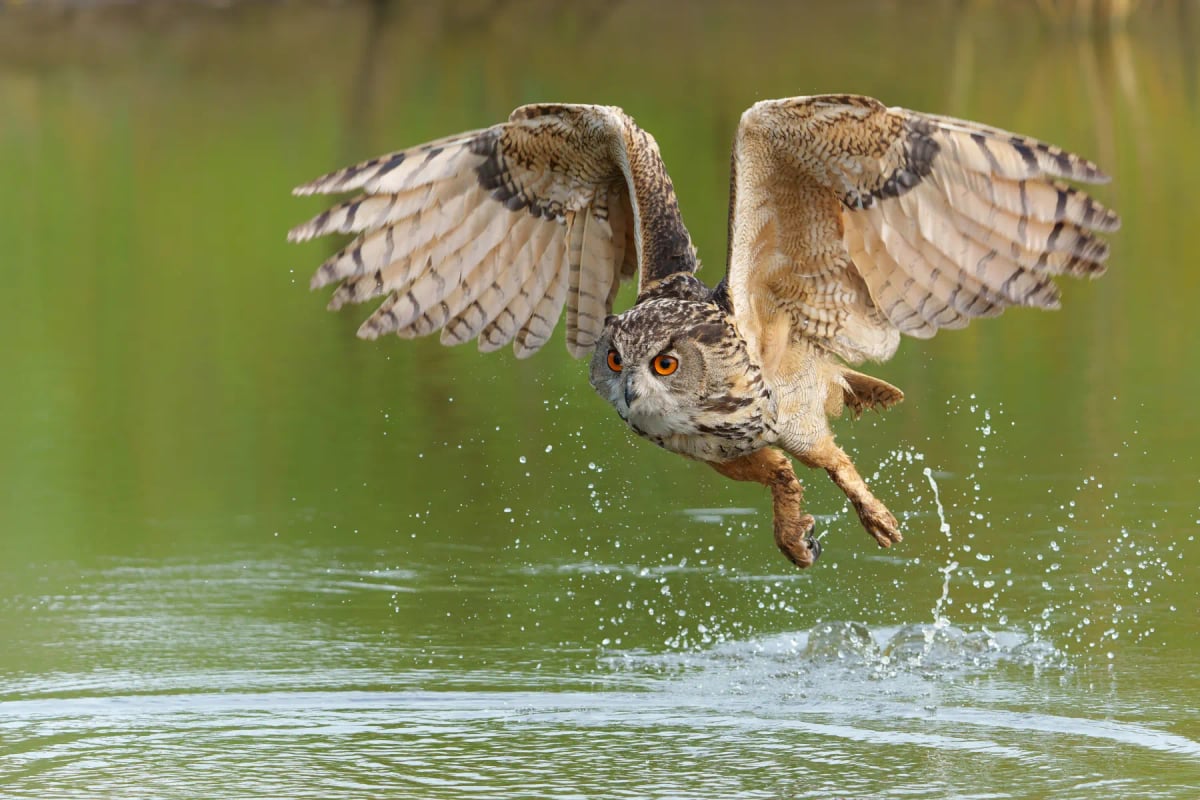
The Eurasian eagle owl (Bubo bubo) ranks among the largest owls on Earth, with a wingspan that can reach 188 centimeters and a body weight of up to 4.6 kilograms in the largest females. Its most striking features are the vivid orange eyes and the prominent ear tufts that frame its broad, rounded face. This owl ranges from Spain and Portugal across Europe and Asia all the way to the Pacific coast of Russia, Korea, and Japan, taking in forests, rocky gorges, open steppe, and mountain terrain along the way. It hunts almost entirely at night, catching rabbits, hares, hedgehogs, rats, crows, ducks, and even other birds of prey. A mated pair holds a territory centered on a cliff ledge or rocky outcrop, where the female lays two to four eggs directly on the ground. The IUCN lists the species as Least Concern, with 100,000 to 500,000 birds, and although the global trend is downward, populations in much of Europe have recovered since hunting was banned.
Habitat and distribution
Few birds occupy as wide a range as the Eurasian eagle owl. It breeds from the Iberian Peninsula through virtually all of Europe, across Russia and Central Asia, and into China, Mongolia, the Korean Peninsula, the Russian Far East, and, rarely, Japan. To the south it reaches the Himalaya of Pakistan, India, and Nepal, and parts of the Middle East such as Turkey, Iran, Iraq, the Levant, and northern Israel, where smaller desert relatives replace it in the driest areas. Rather than committing to a single habitat type, this owl is remarkably adaptable. It thrives in rocky gorges, dense forests, open steppe, semidesert, and mountain slopes up to significant elevations. The one consistent requirement is access to cliffs, rock faces, or steep embankments for nesting. In parts of Scandinavia and Central Europe, eagle owls have even moved into quarries and river valleys, showing just how flexible they can be when suitable nest sites are available.
Eurasian eagle owl, Indian eagle owl and Pharaoh eagle owl
The Eurasian eagle owl used to be treated as one huge species stretching from Europe to Africa and India, but two of its old subspecies are now recognized as species of their own. The Indian eagle owl (Bubo bengalensis), also called the Bengal or rock eagle owl, lives across the Indian subcontinent and is smaller and less heavily streaked. Its facial disk is unmarked and framed by a clear black border, a feature much weaker in the Eurasian bird, and it prefers bushy rocky hills, ravines, and river banks below about 1,500 meters. The Eurasian eagle owl, by contrast, is found in India only in the high Himalaya of the north. The Pharaoh eagle owl (Bubo ascalaphus) is the desert version: at 46 to 50 centimeters it is one of the smaller eagle owls, paler and more sandy, and it lives in the deserts and rocky wadis of North Africa and the Middle East, including southern Israel and Jordan. That is why the eagle owls of the Sahara and of the Negev are not Eurasian eagle owls. There is also no American eagle owl: in the Americas its role is played by the great horned owl, a close relative in the same genus.
Diet
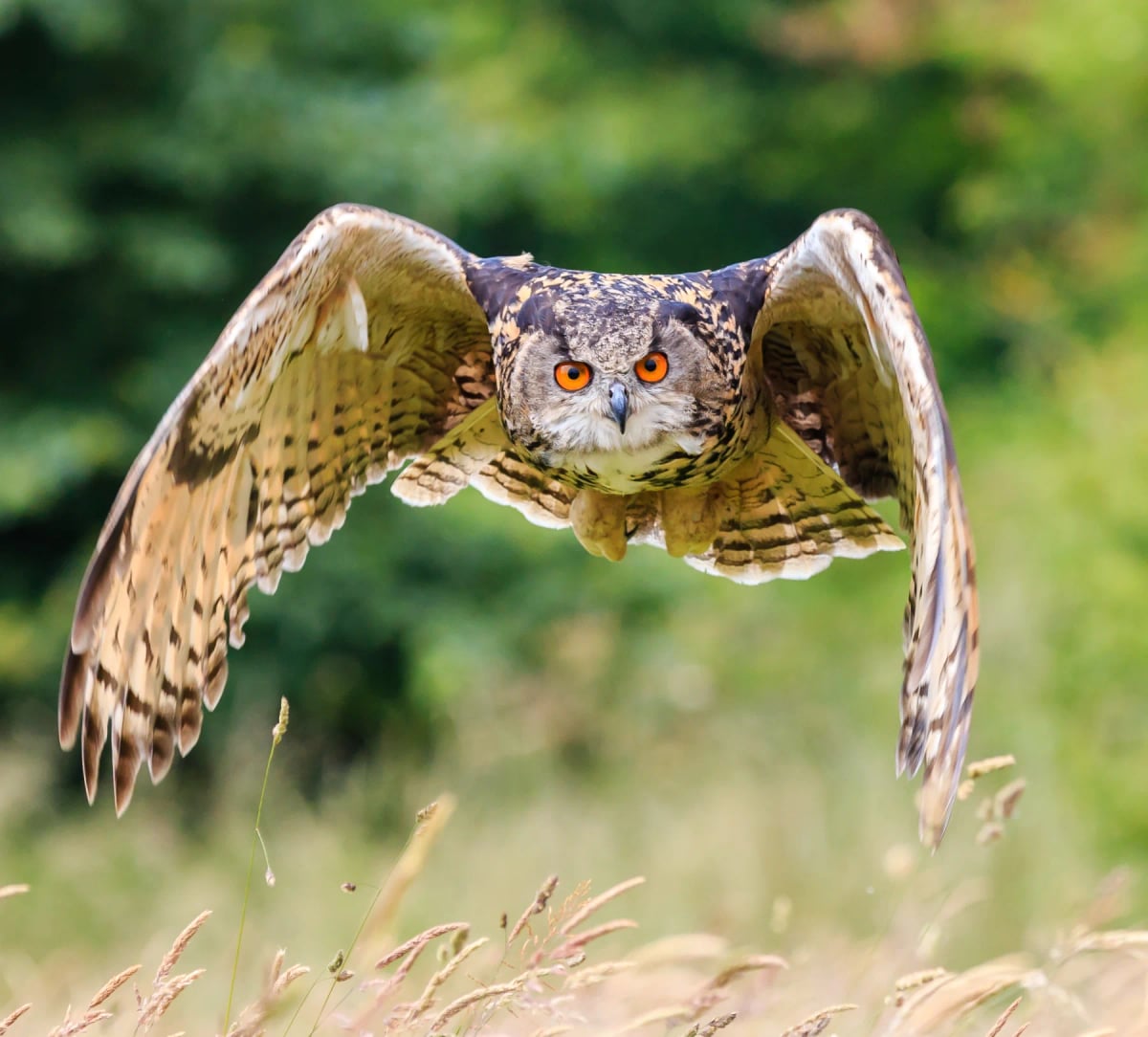
As a predator at the top of the nocturnal food chain, the eagle owl takes a remarkably broad range of prey. Rabbits and hares form the backbone of its diet across much of its range, but it also regularly catches hedgehogs, rats, ducks, corvids such as crows and jays, and other medium sized birds. In some areas it has been recorded killing birds of prey, including smaller owl species and even buzzards. On occasion it targets young foxes or other small carnivores. Prey is located using acute hearing and sharp eyesight, then seized with powerful talons that can exert crushing force. Indigestible material such as fur, feathers, and bones is later regurgitated as compact pellets, which researchers use to study exactly what these owls have been eating.
Behavior
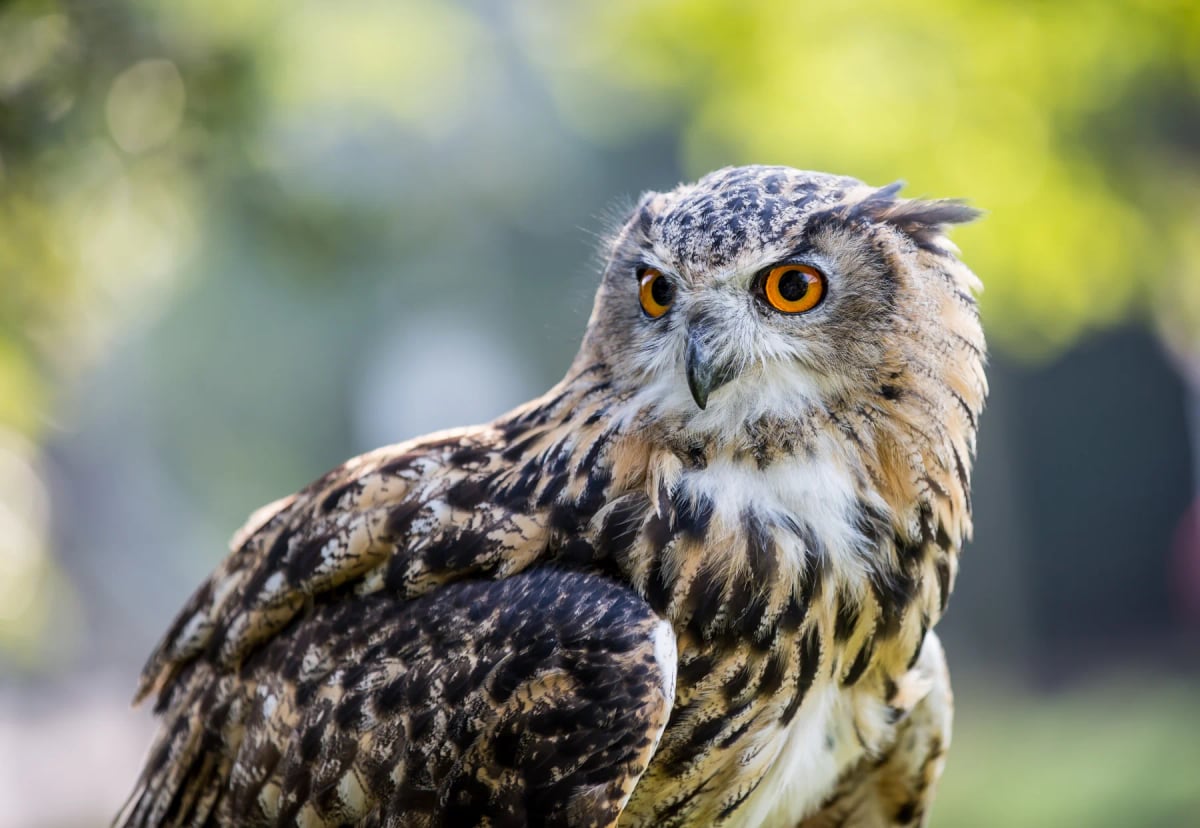
Throughout most of the year, eagle owls are active from dusk until the early hours of the morning, spending the daylight hours roosting against a rock face or tucked into dense vegetation where their streaked brown plumage provides excellent camouflage. Mated pairs hold large territories, which they defend vocally rather than through constant physical confrontation. A pair that establishes itself on a cliff will often return to the same ledge year after year, with some sites known to have been used continuously for several decades. Outside of the breeding season, juveniles disperse widely in search of their own territories, sometimes traveling hundreds of kilometers. Despite their size, eagle owls fly with surprising silence, aided by the soft fringes on their flight feathers that muffle the sound of air passing over the wing.
Nesting and chicks
Eagle owls do not build a nest. The female simply scrapes a shallow hollow on a sheltered cliff ledge, in a crevice, among rocks on a steep slope, or at the foot of a tree, and in places such as the Netherlands and Germany pairs have also nested in quarries, on the ground in forests, and even on buildings. The breeding season starts early: pairs call most in winter, and eggs are usually laid from late winter to early spring. The clutch has two to four eggs, laid a few days apart, so the chicks hatch at different times and differ in size. The female does all of the incubating, which lasts about five weeks, while the male hunts and brings food to her. Once the chicks hatch, she tears up the prey for them. The young leave the nest on foot before they can fly properly, wandering among the rocks nearby, and the parents keep feeding them for about five months in total. In autumn the young birds disperse, sometimes traveling hundreds of kilometers to find a territory of their own.
Vocalizations
Sound plays a central role in the life of the eagle owl. The male produces a deep, resonant "oo hu" call that carries across open landscapes for several kilometers on a calm night. The female has a slightly higher pitched version of the same call, and paired birds often duet, with the two voices overlapping in a way that makes the exchange instantly recognizable. Calling peaks in the winter months, from around December through February, when pairs are reinforcing their bond and advertising their territory before eggs are laid. Young owls produce a persistent, rasping food call that adults can locate easily even in dense cover. When threatened at close range, eagle owls snap their bills loudly, spread their wings, and raise their feathers to appear as large as possible.
Conservation
The IUCN currently lists the eagle owl as Least Concern, with a world population estimated at 100,000 to 500,000 birds. The global trend is listed as decreasing, but in much of Europe the story of the last fifty years has been a genuine recovery. For much of the nineteenth and early twentieth centuries, the species was relentlessly persecuted. Gamekeepers, farmers, and hunters shot or trapped eagle owls in large numbers, viewing them as a threat to game birds and livestock. Populations collapsed in many countries, and the species disappeared entirely from parts of Western Europe. Legal protection, introduced progressively from the 1970s onward, allowed numbers to recover. Reintroduction programs in Germany, Sweden, and several other countries helped speed that process along, and the owl has since returned on its own to places such as Belgium, the Netherlands, and Denmark. Today the main threats are electrocution and collisions with power lines, road traffic, disturbance at nest sites, and secondary poisoning from rodenticides.
5 Curiosities about the Eagle Owl
Here are five things about the eagle owl that tend to surprise people: • With a wingspan reaching up to 188 centimeters, it is one of the largest owls on Earth, heavier than most hawks and buzzards. • Its vivid orange eyes cannot move in their sockets at all. To look sideways, the owl must turn its entire head, which it can rotate up to 270 degrees. • Eagle owls have been documented preying on other raptors, including peregrine falcons, goshawks, and smaller owls. • The female does all of the incubating while the male brings her food. She rarely leaves the nest during the five week incubation period. • In the wild, eagle owls can live for over 20 years, and individuals in captivity have lived more than 60 years.
Where it is found
The Eagle Owl can be found in places such as:
Researched and written by Juan Pablo. Sources: IUCN Red List, scientific literature and regional field guides. Last updated: .
Technical factsheet









Frequently Asked Questions
Is the eagle owl the largest owl in the world?
It is often called the largest, and it is certainly among the top three, but the title is shared. Blakiston's fish owl of the Russian Far East and Japan is slightly heavier on average, and the great grey owl is a little longer, mostly because of its long tail and fluffy plumage. In wingspan and in sheer power, though, the biggest female Eurasian eagle owls, with 188 centimeters of wing and up to 4.6 kilograms, are hard to beat.
How many eagle owls are there?
The IUCN estimates the world population at 100,000 to 500,000 birds spread over a huge range from Portugal to the Pacific. The global trend is listed as decreasing, but the picture is mixed: in much of Western and Central Europe numbers have grown for decades, and the owl has returned to countries such as Belgium, the Netherlands, and Denmark, while in other regions power lines, traffic, and poisoning keep populations under pressure.
Do eagle owls attack people or pets?
Attacks on people are very rare, but they happen, usually when someone walks close to a nest with chicks or when a bird raised by humans has lost its fear of them. In those cases the owl may swoop and strike with its talons. As a predator of animals the size of hares and young foxes, a large eagle owl can also take a cat or a very small dog left outside at night, although this is unusual. Keeping a respectful distance from nesting sites avoids almost all problems.
Are the eagle owl's ear tufts really ears?
No. The two tufts on top of the head are just feathers and have nothing to do with hearing. The real ears are openings hidden at the sides of the face, behind the facial disk, and they are placed slightly unevenly, which helps the owl pinpoint sounds in the dark. The tufts are raised or flattened to show mood, and they break up the outline of the head, which helps the owl blend in with rocks and branches during the day.
Are there eagle owls in Britain?
Yes, but only a few. Britain has an estimated 12 to 40 pairs, and their origin is debated: most experts think they descend from birds that escaped from captivity, since there is no clear evidence that the species survived there naturally in recent centuries. Because of that, the IUCN does not count Britain as part of its native range. The best known British pairs have nested in the north of England, in forests and on moorland edges.
What does the eagle owl eat?
Eagle owls are versatile hunters. Rabbits and hares make up the bulk of their diet, but they also catch hedgehogs, rats, ducks, crows, and other medium sized birds. They are powerful enough to take young foxes and even other birds of prey. Prey is caught at night using sharp eyesight and acute hearing, then gripped with talons capable of exerting considerable crushing force.
How big is an eagle owl?
The eagle owl is one of the largest owls in the world. The biggest females reach 75 centimeters in length with a wingspan of up to 188 centimeters, and they weigh 1.75 to 4.6 kilograms, while males are smaller at 1.2 to 3.2 kilograms. That makes it heavier than most hawks and buzzards. Despite this impressive size, it flies almost silently thanks to soft fringes on its flight feathers that muffle the sound of air passing over the wing.
Where does the eagle owl live?
This owl has one of the broadest ranges of any bird, stretching from Spain and Portugal across Europe, Russia, and Central Asia all the way to China and the Korean Peninsula. It adapts to a wide variety of habitats, including rocky gorges, forests, open steppe, and mountain slopes. The one thing it always needs is a cliff, rock face, or steep embankment where it can nest.
Is the eagle owl endangered?
No. The IUCN lists the eagle owl as Least Concern, with 100,000 to 500,000 birds, although the global trend is listed as decreasing. Populations across Europe collapsed during the 1800s and early 1900s due to heavy persecution by hunters and gamekeepers, but legal protection from the 1970s onward allowed numbers to recover. Reintroduction programs in Germany, Sweden, and other countries helped. The main threats today are power lines, road traffic, and poisoning from rodenticides.
Can an eagle owl turn its head all the way around?
Not quite all the way, but close. Eagle owls can rotate their heads up to 270 degrees. This is necessary because their eyes are fixed in their sockets and cannot move at all. To look in a different direction, they have to turn their entire head. Those vivid orange eyes are extremely sensitive to low light, which makes them highly effective hunters during the night.
How long do eagle owls live?
In the wild, eagle owls regularly live for more than 20 years, which is a long lifespan for a bird. In captivity, where they face no predators and receive regular food and veterinary care, individuals have been known to reach over 60 years of age. Their longevity in the wild depends largely on avoiding powerline collisions and other human related hazards, which are the leading causes of death today.
How does the eagle owl sound?
The male produces a deep, resonant "oo hu" call that can travel several kilometers on a calm night. The female has a slightly higher version of the same call, and pairs often duet together. Calling is most frequent between December and February, when pairs are strengthening their bond before the breeding season. When threatened up close, eagle owls snap their bills loudly and spread their wings to look as large as possible.