Turquoise browed Motmot
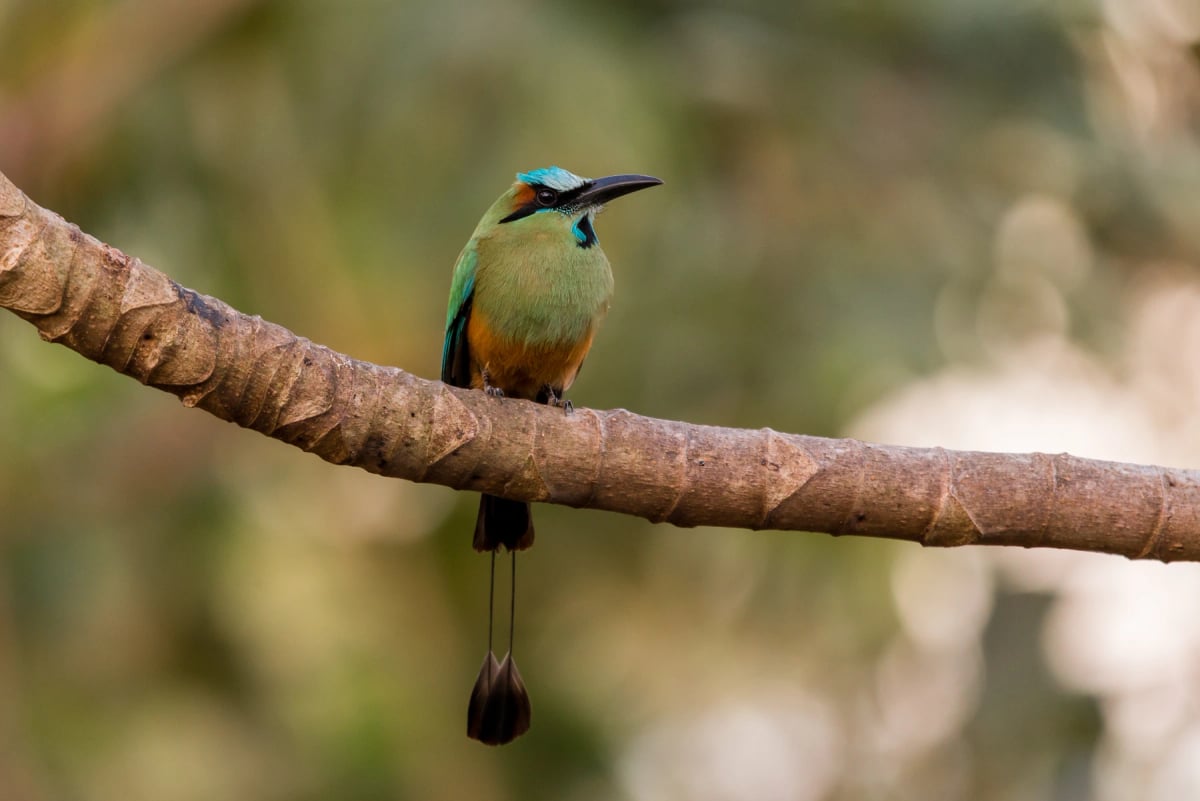
The turquoise browed motmot is one of Central America's most striking birds, easily recognized by its vivid turquoise eyebrow stripe, chestnut and green body, and a long tail that ends in two bare-shafted racket tips. It ranges from southern Mexico through Guatemala, Honduras, El Salvador, Nicaragua, and into Costa Rica, where it favors dry forests, scrubby woodland, and forest edges. Pairs often nest in burrows dug into earthen banks or road cuts, where both parents share incubation duties. The species is well known for swinging its tail from side to side in a slow, pendulum motion, a signal that tells predators they have been seen. It hunts from a perch, dropping onto insects, small lizards, and frogs below. Both El Salvador and Nicaragua have named it their national bird, a reflection of how deeply it is woven into Central American culture.
Turquoise browed motmot, turquoise motmot or torogoz?
Turquoise browed motmot is the standard English name, and many birders shorten it to turquoise motmot. Its scientific name is Eumomota superciliosa, and it is the only member of its genus: the word superciliosa refers to the eyebrow, the bright turquoise stripe above each eye that gives the bird its name. In Spanish the bird has almost as many names as countries. The standard name is momoto cejiturquesa, but in Nicaragua it is the guardabarranco, the guardian of the ravine, because it nests in earthen banks, and in El Salvador it is the torogoz, a name that echoes its call. In the Yucatán Peninsula of Mexico it is known as the pájaro reloj, the clock bird, because of the way it swings its tail like the pendulum of a clock, and also by its Maya name, toh. All these names refer to the same species, which is why this page appears in English as the turquoise browed motmot and in Spanish as the guardabarranco.
The racket tail: how it forms and why it swings
The most famous feature of the turquoise browed motmot is its tail. The two long central feathers end in bare shafts tipped with blue and black rackets, as if someone had trimmed away part of each feather. For a long time people believed the bird plucked those barbs off itself, but the barbs on that stretch of the feather are simply weakly attached and fall off with wear, leaving the naked shaft and the racket at the tip. Both males and females have racket tails, although males tend to have longer ones, and studies have linked longer tails in males with greater breeding success. The other famous trait is the slow, side to side swing of that tail, which looks like a clock pendulum. Field experiments in Mexico's Yucatán showed that motmots start wagging when they spot a predator, and the display is aimed at the predator itself: it tells it that it has been detected and that a surprise attack will not work. Motmots also wag near their nests before feeding chicks, as if warning any hidden predator in advance.
National symbol
Few birds carry the cultural weight of the turquoise browed motmot. Both El Salvador and Nicaragua have named it their national bird, a distinction that speaks to how familiar and beloved this species is across the region. In El Salvador it is commonly called the torogoz, a name said to echo its call, while Nicaraguans know it as the guardabarranco, meaning guardian of the ravine, a nod to its habit of nesting in earthen banks. It appears in local art, folklore, and school materials throughout Central America. The combination of jewel-like color and that swinging racket tail makes it instantly recognizable, and its tolerance for living near towns and villages means that people of all ages encounter it regularly, strengthening the bond between the bird and the communities that claim it.
Habitat and range
Across its range, the turquoise browed motmot shows a clear preference for warm, dry environments. It is found from the Yucatán Peninsula in southern Mexico south through Guatemala, Honduras, El Salvador, Nicaragua, and into northwestern Costa Rica, skipping Belize, where it does not occur. Rather than dense rainforest, it gravitates toward dry forest, scrubby woodland, and the edges where trees give way to open ground. Pastures bordered by trees, coffee plantations, and roadsides lined with vegetation all suit it well. The species tends to be more common at lower elevations, though it does reach mid-elevation areas in some parts of its range. Its ability to adapt to landscapes shaped by human activity has helped it persist in places where original forest cover has been reduced significantly over recent decades.
Diet
Watching a motmot hunt is one of the pleasures of birdwatching in Central America. The bird sits quietly on an exposed perch, scanning the ground and low vegetation below. When it spots something worth pursuing, it drops down in a swift arc, snatches the prey, and returns to its perch to subdue it before swallowing. Insects make up the bulk of its diet, but it also takes small lizards, frogs, and occasionally small snakes. Fruit is consumed as well, particularly during seasons when animal prey is harder to find. This flexibility in diet is one reason the species manages so well across a range of habitats. Larger prey items are sometimes beaten against the perch to soften them before eating, a behavior common to several members of the motmot family.
Behavior and burrow nests
Turquoise browed motmots are calm, patient birds that spend long periods sitting upright on an open perch, which makes them easy to watch. They are most active early and late in the day and are often heard before they are seen, giving low, croaking calls. Pairs nest in burrows that both partners dig, usually in March, into earthen banks, road cuts, quarries or sometimes flat ground. The tunnels can reach up to a meter or more in length, with a rounded chamber at the end where the female lays three to six white eggs. In the Yucatán Peninsula, where there are few earthen banks, motmots also nest in crevices in the limestone walls of cenotes and even in Maya ruins, sometimes in loose colonies of several pairs. Both parents take turns incubating the eggs, which hatch after about 16 to 20 days, and both feed the chicks. Outside the breeding season, the birds tend to roost in groups, often returning to the same perch sites night after night.
Conservation
The IUCN currently lists the turquoise browed motmot as Least Concern, meaning its overall population is not considered at risk of extinction in the near future. That said, the dry forests and open woodlands it depends on are among the most threatened ecosystems in Central America, cleared for agriculture and cattle ranching at a steady pace for decades. Local populations in heavily deforested areas can decline even when the wider species remains stable. The bird does benefit from a degree of tolerance for altered landscapes, including farms and gardens with mature trees, which gives it more resilience than many specialists. Still, protecting remaining patches of dry forest and encouraging tree cover in agricultural zones would go a long way toward keeping this iconic species common across the region.
Where it is found
The Turquoise browed Motmot can be found in places such as:
Researched and written by Juan Pablo. Sources: IUCN Red List, scientific literature and regional field guides. Last updated: .
Technical factsheet





Frequently Asked Questions
Is the turquoise motmot the same as the turquoise browed motmot?
Yes. Turquoise motmot is simply a shortened name for the turquoise browed motmot, Eumomota superciliosa. The full name refers to the bright turquoise stripe above each eye. It should not be confused with other motmots of the region, such as the Lesson's motmot or the blue diademed motmot, which have a blue crown, mostly green bodies and live in wetter forests. The turquoise browed motmot is the one with the chestnut back, the black throat patch bordered in blue and the long bare shafts on the tail.
Do both male and female motmots have racket tails?
Yes. Both sexes of the turquoise browed motmot have the long central tail feathers with bare shafts and racket tips, and they look very much alike. Males tend to have slightly longer tails, and research in Mexico's Yucatán found that males with longer tails had greater breeding success, which suggests females pay attention to tail length. The rackets are not plucked by the bird: the barbs on that part of the feather are weakly attached and fall off as the feather wears, leaving the bare shaft.
Why is the motmot called the clock bird?
In the Yucatán Peninsula of Mexico the turquoise browed motmot is known as the pájaro reloj, the clock bird, because of the way it swings its tail slowly from side to side, like the pendulum of a clock. The motmot does this when it spots a predator, as a way of telling it that it has been seen. In Yucatán it is also a familiar bird around cenotes and Maya ruins, where it nests in crevices in the limestone, so many visitors meet it at sites such as Chichén Itzá.
How many eggs does the turquoise browed motmot lay?
The female usually lays three to six white eggs in a chamber at the end of a tunnel that the pair digs into an earthen bank, a road cut or, in the Yucatán, a crevice in the wall of a cenote. Digging usually starts in March, and both parents take turns incubating. The eggs hatch after about 16 to 20 days, and both adults feed the chicks inside the burrow until they are ready to fly. Some nesting sites are shared by several pairs, forming loose colonies.
Where can you see a turquoise browed motmot?
It is a common and easy bird to see across its range. In Mexico, look for it around the cenotes and Maya ruins of the Yucatán Peninsula. In Costa Rica it lives in the dry forests of Guanacaste, in places such as Santa Rosa and Palo Verde national parks. In El Salvador and Nicaragua, where it is the national bird, it is found in dry forest, farmland and even gardens and parks with trees, and in Honduras and Guatemala it is frequent in the dry interior valleys. It usually sits in the open, swinging its tail.
What does the turquoise browed motmot eat?
This bird is an opportunistic hunter. It perches quietly and watches for movement below, then swoops down to catch insects, small lizards, frogs, and occasionally small snakes. It will also eat fruit, especially when animal prey is scarce. Larger prey items get beaten against the perch before swallowing. This flexible diet helps the species thrive across a wide range of environments throughout Central America.
Where does the turquoise browed motmot live?
The species is found from the Yucatán Peninsula in southern Mexico down through Guatemala, Honduras, El Salvador, Nicaragua, and into northwestern Costa Rica. It prefers warm, dry forests, scrubby woodland, and open areas bordered by trees. It adapts well to farmland, coffee plantations, and roadsides with mature vegetation, which is one reason it remains relatively common even in landscapes shaped by human activity.
Is the turquoise browed motmot endangered?
The IUCN lists it as Least Concern, so the species as a whole is not facing extinction in the near future. However, the dry forests it depends on are being cleared for agriculture and cattle ranching across Central America, and local populations can suffer even when the wider species remains stable. Its ability to live in farms and gardens with mature trees gives it more resilience than many other birds in the region.
Why is the motmot the national bird of two countries?
Both El Salvador and Nicaragua have adopted it as their national bird. In El Salvador it goes by the name torogoz, thought to mimic its call, while in Nicaragua it is called guardabarranco, meaning guardian of the ravine. Its jewel-like colors, distinctive tail, and habit of living close to towns and villages have made it a familiar presence in everyday life, earning it a special place in the culture, art, and identity of both nations.
How can you recognize a turquoise browed motmot?
This bird is hard to mistake once you know what to look for. It has a vivid turquoise stripe above each eye, a body of chestnut and green, and a long tail with two bare-shafted tips shaped like small rackets. It tends to sit upright and still on an open perch, gently swinging that tail. It is about 34 centimeters long, much of it tail, but weighs only about 65 grams, and the combination of color and tail shape makes it unmistakable across its range.