Ostrich
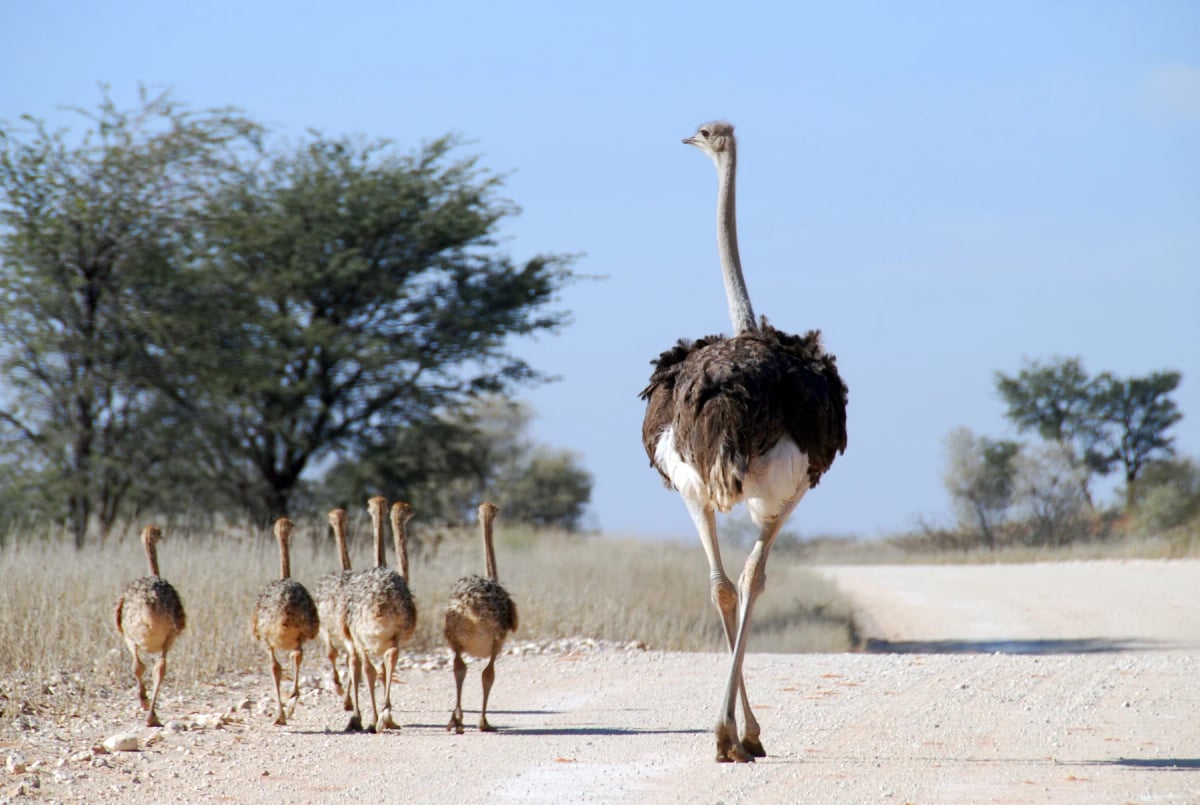
The ostrich is the largest bird alive today, native to the open savannas and arid plains of Africa. Males stand up to 2.75 meters tall and weigh up to 145 kilograms; females are shorter and lighter. Flightless they may be, but defenseless they are not: an ostrich runs at up to 70 kilometers per hour, holds around 50 over long distances, covers up to 5 meters in a single stride and is the fastest bird on land. Its two toed feet deliver a forward kick powerful enough to kill a lion. Ostriches live in loose groups, feed on grasses, seeds, leaves and the odd insect or lizard, and swallow stones to grind food in the gizzard because they have no teeth. Females lay the largest eggs of any living bird, about 1.4 kilograms each, more than twenty chicken eggs' worth, into a shared nest that a dominant male and a main female incubate in shifts. The species is listed as Least Concern, and the ostrich you see on a farm is the same bird: it has been raised for feathers, leather and meat for more than a century.
Habitat and distribution
Ostriches are birds of open spaces. They live across the savannas, semi-arid plains and scrublands of sub-Saharan Africa, with relict groups hanging on in parts of the Sahara and the Sahel. They avoid dense woodland and high rainfall, preferring terrain where their eyesight gives them early warning of a predator. In the Sahel and the Horn of Africa they survive in country that is extremely dry, taking enough food and water from sparse vegetation. The range once reached the Arabian Peninsula, where the Arabian ostrich was hunted to extinction by the mid twentieth century. Today the largest numbers are in eastern and southern Africa, across Tanzania, Kenya, Ethiopia, Namibia and South Africa. Farmed birds have also gone feral in Australia, where a small population has survived in the South Australian outback since the feather trade collapsed.
Diet
Plant matter makes up the bulk of an ostrich's diet, but these birds are flexible. Grasses, seeds, roots, leaves and flowers are the staples, and they forage steadily through the day across large areas of ground. Given the chance they also take insects, small lizards and other small animals for protein. Ostriches have no teeth, so they swallow stones and grit that sit in the gizzard and grind down tough plant material; a bird can carry more than a kilogram of stones at a time. An adult gets through several kilograms of vegetation a day. They can also go long stretches without drinking, pulling moisture straight out of the plants they eat, which is what makes life possible in the driest parts of their range.
Behavior
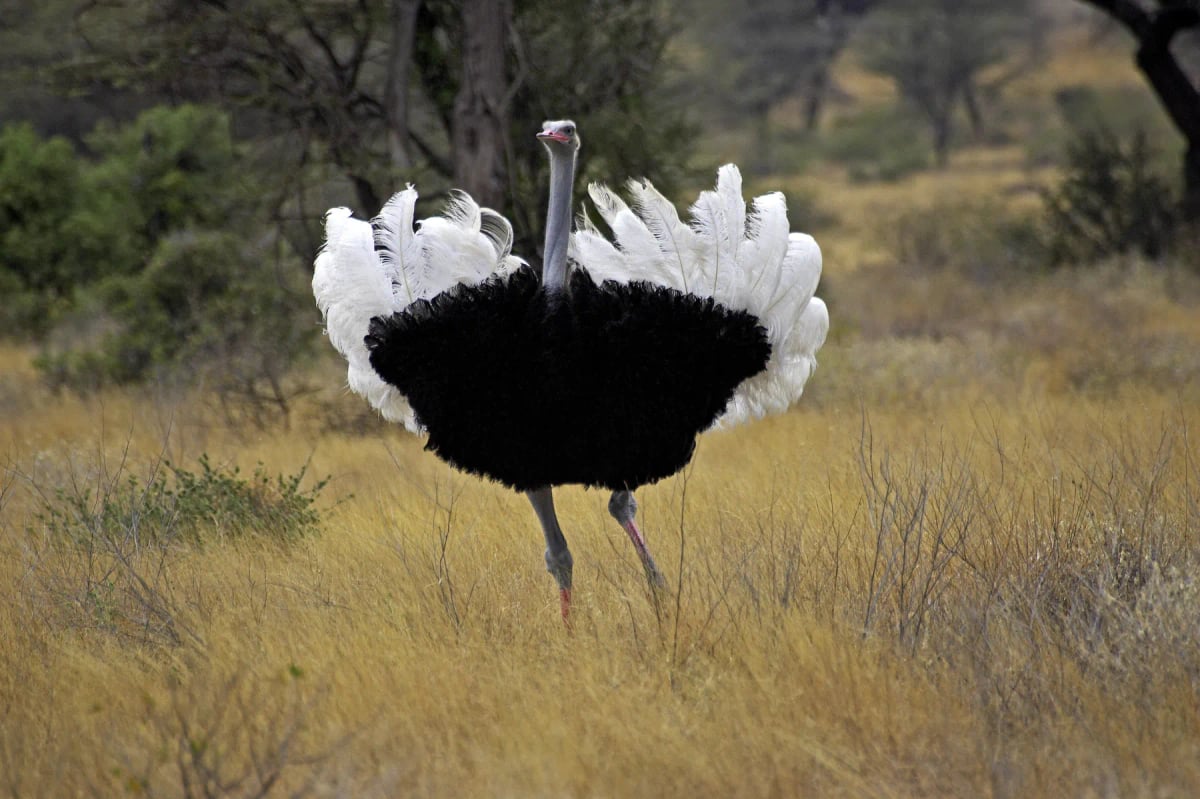
Social and alert, ostriches move in loose groups of five to fifty birds, and larger gatherings form on open plains. Their eyesight is extraordinary: at about 50 millimeters across, they have the largest eyes of any land animal, and they can pick out a lion from kilometers away. When danger closes in the first response is to run, and at full speed an ostrich covers up to 5 meters in a single stride and outpaces nearly every predator in its environment. If cornered it kicks forward with its two toed feet, and the kick lands with enough force to kill. Each foot carries a heavy claw on the inner toe that does most of the damage. Groups often feed alongside zebras and antelopes, an arrangement that suits everyone: the mammals have the better sense of smell and the ostrich has the better eyes.
Do ostriches bury their heads in the sand?
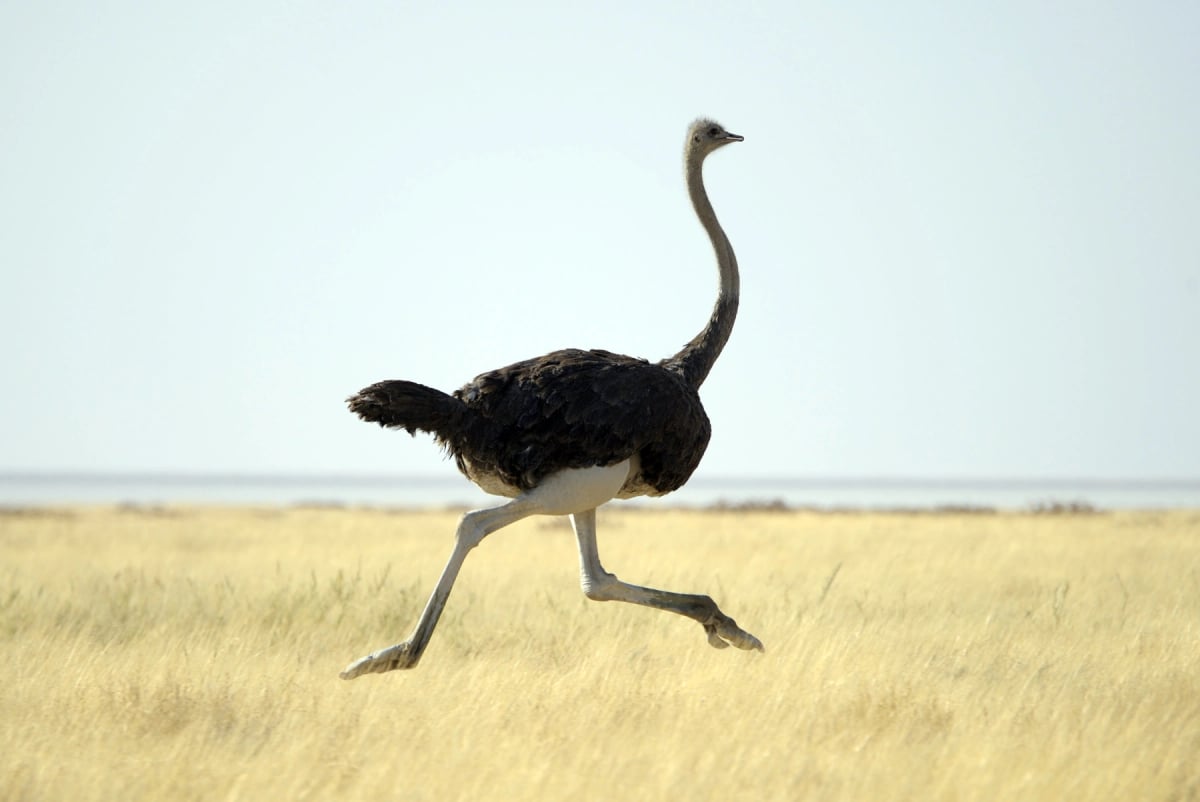
No, and no ostrich ever has. The bird would suffocate, which is reason enough, but the myth has a plausible source: an ostrich nest is a shallow pit scraped in the ground, and several times a day a parent pushes its head into that pit to turn the eggs. From a distance, on shimmering open ground, it looks exactly like a head disappearing into the sand. A second source is the bird's own alarm behavior. A sitting ostrich that has been spotted will sometimes flatten its neck and head along the ground to lower its profile, and at 2 meters tall it has a lot of profile to hide. The idea that the bird hides from danger by refusing to look at it is a human invention, first written down by Pliny the Elder in the first century and repeated ever since. What an ostrich actually does when threatened is run, and if running is not an option, kick.
Reproduction
Breeding season varies by region, but the pattern holds. A dominant male scrapes a shallow nest and mates with a main female, the major hen, while other females, the minor hens, lay in the same pit. The communal clutch usually holds about 20 eggs and can reach sixty, more than the pair can physically cover, so the major hen pushes the eggs she recognizes as her own into the center and lets the outer ones go. The two share incubation in shifts that match their colors: the brown female sits by day, the black male by night. After 35 to 45 days the chicks hatch, already the size of a chicken. They can run within days, and broods often merge into creches of a hundred or more chicks shepherded by one or two adults, which is how a single pair sometimes appears to be escorting an improbable crowd.
Ostrich eggs: size, weight and price
An ostrich egg is the largest laid by any living bird: about 15 centimeters long, 13 wide and 1.4 kilograms, the equivalent of more than twenty chicken eggs. Measured against the bird that lays it, though, it is the smallest egg of all, barely 1 percent of the female's body weight. The shell is around 2 millimeters thick and strong enough to take the weight of an adult standing on it, which is why a hatching chick needs hours of work to break out and why cooks crack the egg with a drill or a saw rather than a knock on the counter. Hard boiling one takes about 90 minutes. Farm eggs sell to restaurants and novelty buyers, usually for somewhere between 30 and 100 US dollars depending on country and season, and empty shells have been carved and used as water containers in southern Africa for tens of thousands of years, among the oldest containers known anywhere.
Ostrich farms and ostrich riding
Ostrich farming started in the Little Karoo of South Africa in the 1860s, when feathers were worth more by weight than most metals and the town of Oudtshoorn built mansions on the trade. The fashion collapsed around the First World War, and the industry rebuilt itself around leather and meat: ostrich skin is one of the most valuable leathers in the world, and the meat is red, lean and low in fat. Farms now operate in South Africa, Australia, the United States, China and across Europe. Ostrich riding is offered at some South African farms, and it is exactly as bad an idea as it sounds: the bird is not built to carry weight, riders are regularly thrown, and a startled ostrich kicks. Several farms have dropped it on welfare grounds. Nothing about a farmed ostrich is tame, which is also why most serious ostrich injuries to humans happen on farms rather than in the wild.
Conservation
The IUCN lists the common ostrich as Least Concern: the species as a whole remains widespread and reasonably stable. The picture is uneven, though. Numbers have fallen sharply across West Africa and the Sahel, where hunting and the steady loss of habitat to farming and settlement press on small, isolated groups, and the North African subspecies, Struthio camelus camelus, has disappeared from most of its former range and is now the focus of reintroduction projects in Morocco, Tunisia and Chad. Libya has lost its ostriches entirely. In southern Africa large numbers live on game farms and reserves, which cushions the species overall but says little about wild populations elsewhere. One clarification often missed: the birds of the Horn of Africa were split off in 2014 as a separate species, the Somali ostrich, which is listed as Vulnerable rather than Least Concern.
Where it is found
The Ostrich can be found in places such as:
Researched and written by Juan Pablo. Sources: IUCN Red List, scientific literature and regional field guides. Last updated: .
Technical factsheet


Frequently Asked Questions
Why can't ostriches fly?
Because they gave it up. Ostriches descend from flying ancestors, but on open African plains running worked better than flying, and over millions of years the body followed: the breastbone lost the keel that anchors flight muscles, the wings shrank relative to the body, and the legs became the engine. The feathers changed too, losing the interlocking barbs that make a stiff flight surface, which is why an ostrich feather is loose and soft. The wings still work, just not for lift: they act as rudders at speed, as balance in a turn, as shade for chicks and as display banners in courtship.
How tall is an ostrich?
A male stands between about 2.1 and 2.75 meters tall, a female between 1.75 and 1.9, measured to the top of the head. Most of that is neck and leg: the body itself sits at roughly the height of a person's chest. Males weigh up to about 145 kilograms and females a little less. Those numbers make the ostrich not only the tallest bird alive but the heaviest, and the reason it is both is the same: at that weight, flight stopped being an option a long time ago.
How long do ostriches live?
Between 30 and 40 years in the wild, which is long for a bird and very long for an animal that size. In captivity they do better still: the record for a common ostrich is over 62 years. Birds reach breeding age at two to four years old, so a healthy adult has decades of breeding seasons ahead of it. The main causes of death in the wild are predators taking chicks, which suffer heavy losses in the first months, rather than anything that happens to adults.
What animals eat ostriches?
Adult ostriches have few predators: lions and packs of spotted hyenas are the main ones, and even they usually pick off a bird that is sick, cornered or caught at a waterhole. The eggs and chicks are another story. Jackals, mongooses, vultures and warthogs take eggs, and Egyptian vultures are known to crack them by throwing stones at the shell. Cheetahs, leopards and hyenas take chicks. Most ostriches that die young die in their first few months, which is why a pair may start with sixty eggs and raise a handful of birds.
Is there more than one kind of ostrich?
Yes. Until 2014 all ostriches were treated as one species, but the birds of the Horn of Africa, which have blue grey necks and legs instead of pink, were split off as the Somali ostrich, Struthio molybdophanes, and are listed as Vulnerable. Everything else is the common ostrich, Struthio camelus, with surviving subspecies in North Africa, East Africa and southern Africa, plus the Arabian ostrich, hunted to extinction around the middle of the twentieth century. Farmed birds worldwide are mostly South African stock or hybrids of it.
How fast can an ostrich run?
Ostriches are the fastest birds on land. They can reach speeds of up to 70 kilometers per hour in short bursts and keep a pace of around 50 kilometers per hour over long distances. That combination of top speed and endurance means they can outrun almost every predator in their environment, making their legs their most effective tool for survival.
What do ostriches eat?
Ostriches eat mostly plant material: grasses, seeds, roots, leaves, and flowers. They also snack on insects, small lizards, and other tiny animals when they get the chance. Since they have no teeth, they swallow small stones to help grind food in their gizzard. Adults can get through several kilograms of vegetation in a single day while foraging across open ground.
Where do ostriches live in the wild?
Wild ostriches are found across much of Africa, mainly in the open savannas, semi-arid plains, and scrublands of sub-Saharan Africa. The largest populations are in eastern and southern Africa, including Tanzania, Kenya, Ethiopia, Namibia, and South Africa. They prefer wide, open terrain where they can spot predators from a distance, and they avoid dense forest and areas with heavy rainfall.
Are ostriches dangerous to humans?
Ostriches can be genuinely dangerous. Their legs are built for power, and a single forward kick from one of their two-toed feet can kill a lion. Around humans, they are usually calm, but they become aggressive when they feel threatened or are protecting a nest. Most serious injuries happen on farms or in wildlife areas where people get too close. It is best to keep a safe distance from them.
Is the ostrich endangered?
The ostrich is listed as Least Concern by the IUCN, meaning the species as a whole is not at immediate risk. However, populations in parts of West Africa and the Sahel have dropped noticeably due to poaching and habitat loss. The North African subspecies has disappeared from much of its former range and is in a more fragile position than the wider species, which remains relatively stable across eastern and southern Africa.