Lanner Falcon
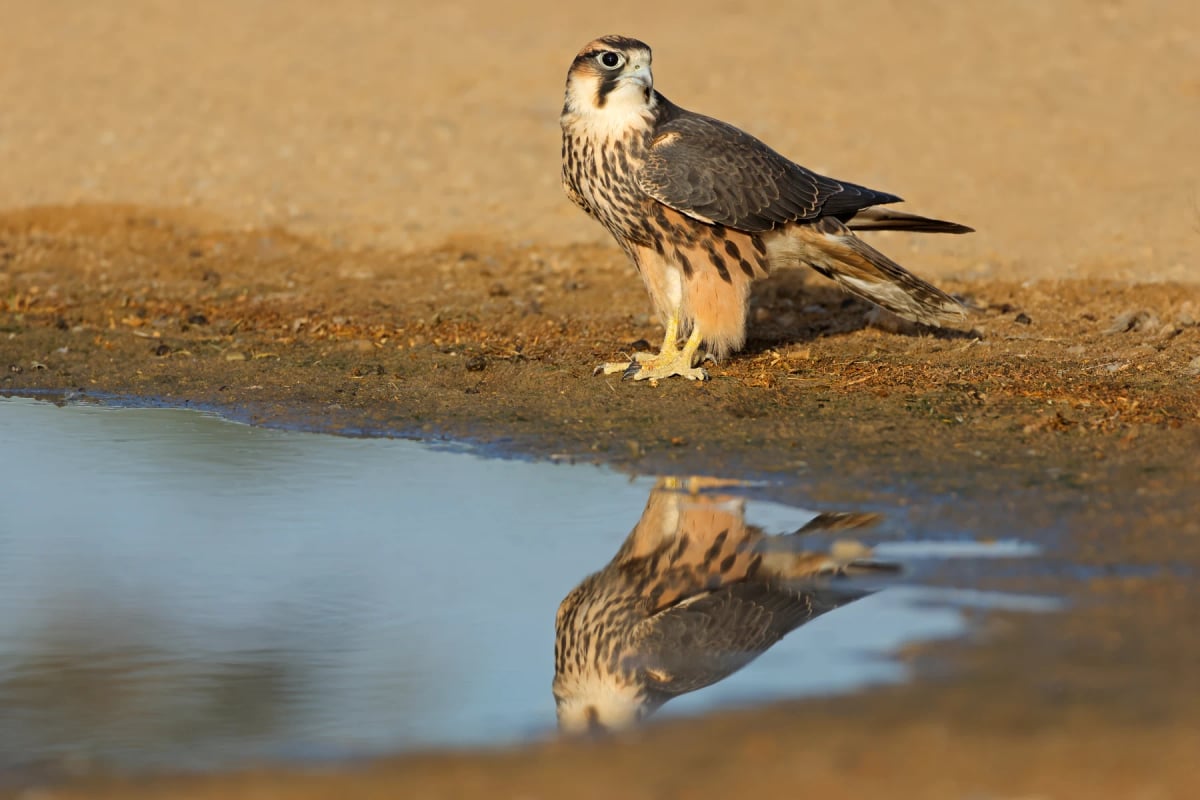
The lanner falcon is a medium-sized bird of prey found across much of Africa, the Middle East, and southern Europe. It has a slate-grey back, pale underparts, and a reddish or buff crown and a dark stripe below each eye. Adults measure 43 to 50 cm, reach a wingspan of around 95 to 105 cm and weigh between 550 and 900 g, with females noticeably larger than males. It hunts mainly birds, including doves and pigeons, using fast and low pursuit flights rather than the steep stoops typical of the peregrine. Pairs often hunt together, flushing prey into the open before striking. It nests on cliff ledges, rocky outcrops, and occasionally tall buildings or pylons. Pairs are territorial throughout the year. Long prized in falconry across Africa and the Middle East, the species is listed as Least Concern by the IUCN, though it faces local pressure from habitat loss, electrocution on power lines, and illegal capture.
Lanner falcon: name and subspecies
The name lanner comes from the Old French lanier, a word usually translated as cowardly. Medieval falconers used it for this falcon because they considered it less bold than the peregrine, an unfair label for a bird that hunts as well as it does in its own style. Falconers also called the smaller male a lanneret. The scientific name is Falco biarmicus. In Spanish it is mostly called halcón borní, the name used in field guides, and also halcón lanario, the traditional falconry name. Five subspecies are recognized across its huge range. Falco biarmicus biarmicus lives in southern Africa, from the Democratic Republic of the Congo to South Africa, and abyssinicus from Mauritania across the Sahel to Kenya. In the north, erlangeri occupies northwestern Africa and tanypterus northeastern Africa and the Middle East as far as Iraq. The European birds belong to feldeggii, known as Feldegg's falcon, which breeds from Italy through the Balkans and Turkey to northwestern Iran and is darker and more heavily marked than its African relatives.
Size and how to tell it from the peregrine and saker
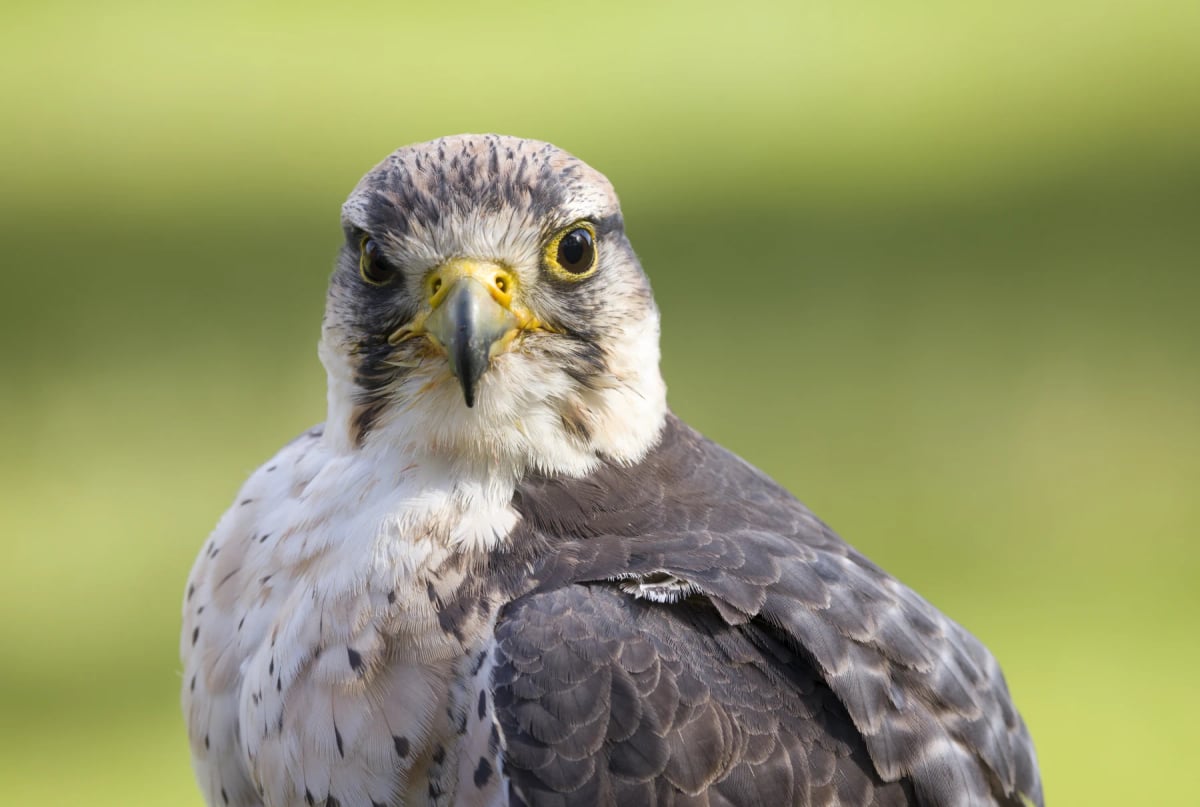
The lanner is a large falcon, 43 to 50 centimeters long with a wingspan of 95 to 105 centimeters. As in most birds of prey, females are clearly bigger than males, weighing up to about 900 grams. It is often confused with two relatives. The peregrine falcon is more compact, with shorter wings and tail, a blue gray back and a dark hood with a broad black mustache. The lanner is slimmer and longer tailed, with a paler back, a thinner mustache and, above all, a reddish or buff crown, which is the best field mark when the bird is seen well. The saker falcon is larger and heavier, browner above and with a pale, streaky head that shows much less contrast than the lanner's. Hunting style helps too. The peregrine usually climbs high and stoops at birds in steep dives, while the lanner prefers fast, level chases close to the ground, often with its partner. In Europe, where lanners are rare, many birds reported as lanners turn out to be escaped falconry birds or hybrids, so records are checked carefully.
Habitat and distribution
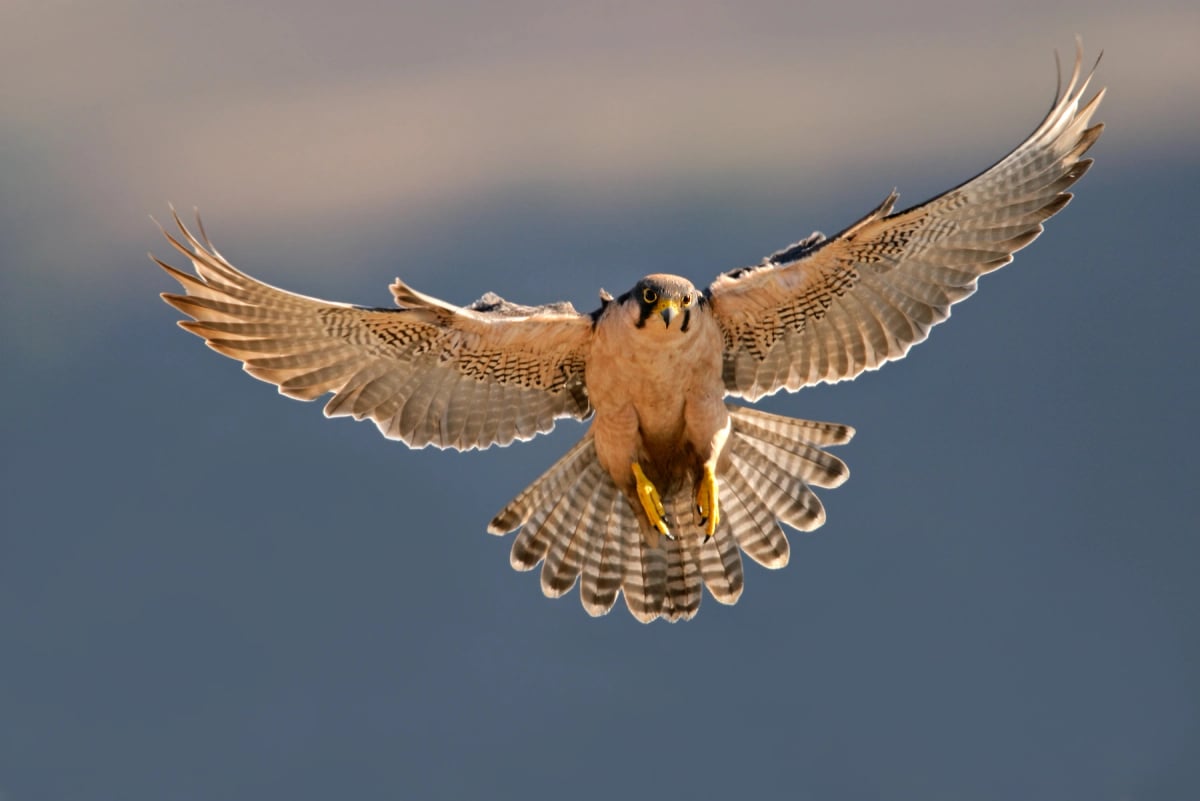
Across its vast range, the lanner falcon occupies some of the most open landscapes on earth. It favours dry savannas, grasslands, rocky gorges, and cliff faces from sea level up to considerable elevations in mountainous areas. In Africa it is widespread south of the Sahara and throughout the continent's arid north, while in Europe it breeds only in small numbers, mainly in Italy, Greece, and the Balkans. Populations also exist across the Middle East, including the Arabian Peninsula, Turkey, and parts of the Caucasus. Most lanners stay on their territories all year, although young birds wander widely and some move to Oman in winter. The species tends to avoid dense forest, preferring terrain where it can spot and pursue prey over open ground. Cliff ledges and rocky outcrops are central to its distribution, as these sites provide both nesting opportunities and commanding views of the surrounding landscape.
Diet
Birds make up the core of the lanner falcon's diet. Doves, pigeons, larks, and starlings are among the most frequently taken prey, though the falcon is adaptable and will target whatever species are locally abundant. Alongside birds, it also catches bats, small rodents, and lizards when the opportunity arises, particularly in areas where avian prey is less plentiful. The lanner is an opportunist at feeding sites too, and groups have been recorded gathering at locust swarms or grass fires to pick off insects and small vertebrates flushed by the flames. Prey is typically caught in the air or taken from the ground after a low chase. Pairs hunting together are noticeably more successful, as one bird flushes the prey while the other makes the strike.
Behavior
Rather than the near vertical stoops used by the peregrine falcon, the lanner relies on fast, low pursuit flights to run down its prey. Pairs often hunt cooperatively, working together to herd birds into the open before one of them closes in for the kill. This teamwork makes the lanner particularly effective in open terrain. Nesting takes place on cliff ledges and rocky outcrops, and the species occasionally uses the old nests of other large birds or settles on tall man made structures such as pylons. The female lays three or four eggs, incubates them for about 32 days, and the chicks fly roughly 44 days after hatching. Pairs hold their territories throughout the year and return to the same nest sites repeatedly. Calls are loud and sharp, used to maintain contact and warn rivals. Outside the breeding season, young birds may wander some distance from where they hatched.
Falconry
Few raptors have as long a connection to falconry as the lanner falcon. Records of its use in the sport stretch back centuries across Africa, the Middle East, and the Mediterranean, where it was prized for its agility in open country and its willingness to work alongside the falconer. It handles hot and arid conditions better than many other falcons, which made it particularly valued in desert regions. In parts of Africa and the Arab world it remains in active use today. Because the lanner is easier to train than some of its relatives and responds well to handling, it has also been widely used in falconry schools and demonstration displays in Europe. Demand from falconers has historically contributed to the illegal trapping of wild birds, which remains a concern in parts of its range.
Conservation
The IUCN currently lists the lanner falcon as Least Concern, reflecting its huge range and large African population. Even so, numbers are falling steadily in Europe and North Africa, and the species faces a handful of serious threats. Electrocution on power lines is one of the most consistent causes of death for birds that nest or perch near electrical infrastructure. Changes to land use, including the conversion of open habitats to farmland or urban areas, reduce the availability of suitable hunting ground. Illegal capture for the falconry trade puts additional pressure on wild populations, especially in North Africa and the Middle East. In southern Europe, where the breeding population is small and fragmented, conservation efforts have focused on nest protection and fitting power lines with guards to reduce the risk of electrocution.
Where it is found
The Lanner Falcon can be found in places such as:
Researched and written by Juan Pablo. Sources: IUCN Red List, scientific literature and regional field guides. Last updated: .
Technical factsheet


Frequently Asked Questions
How big is a lanner falcon?
A lanner falcon measures 43 to 50 centimeters from bill to tail, with a wingspan of 95 to 105 centimeters. Females are clearly larger than males: males weigh roughly 500 to 600 grams, while females can reach about 900 grams. That makes it a large falcon, bigger than a kestrel or a hobby and close in length to the peregrine, though slimmer and longer tailed. Only the saker and the gyrfalcon are clearly larger among the falcons that share parts of its range.
How many eggs does a lanner falcon lay?
The lanner falcon usually lays three or four eggs on a bare cliff ledge or in the old stick nest of a crow, raven or other large bird, and sometimes on a pylon. Incubation takes about 32 days, and the chicks leave the nest roughly 44 days after hatching. Successful pairs raise a little over two young on average. In southern Africa laying happens mostly in the dry winter months, while in Europe and North Africa it takes place in late winter and spring.
Where do lanner falcons live in Europe?
In Europe the lanner falcon breeds only in the southeast and in Italy, where the largest European population lives on the cliffs and gorges of the central and southern Apennines and Sicily. Small numbers also breed in Greece, the Balkans and European Turkey. The European birds belong to the subspecies feldeggii and are in steady decline, affected by disturbance at nests, illegal persecution, egg and chick theft and electrocution. Birds seen farther north or west, as in Spain or France, are usually vagrants or escaped falconry birds.
What is Feldegg's falcon?
Feldegg's falcon is the European subspecies of the lanner falcon, Falco biarmicus feldeggii. It breeds from Italy through the Balkans and Turkey to northwestern Iran and is darker above and more heavily spotted below than the African lanners. It is named after Christoph Feldegg, a 19th century Austrian military officer and naturalist. It is also the most threatened part of the species: its population is small and falling, which is why it is protected under European Union law even though the lanner as a whole is listed as Least Concern.
Do lanner falcons migrate?
Mostly not. Adult lanner falcons are resident and hold their territories all year, even in the heat of the Sahara and the cold of the southern African highlands. Young birds, however, disperse widely after leaving the nest and can turn up hundreds of kilometers away, and some birds make seasonal movements, for example into Oman, where the species appears only outside the breeding season, or through Syria on passage. Birds may also follow rains, locust swarms or bird concentrations across the dry savannas of Africa.
What does the lanner falcon eat?
The lanner falcon feeds mostly on birds such as doves, pigeons, larks, and starlings. It also catches bats, lizards, and small rodents when birds are scarce. At grass fires or locust swarms, groups will gather to snatch insects and small animals flushed into the open. Pairs often hunt together, with one bird driving the prey toward the other to make the catch more reliable.
How fast is the lanner falcon?
The lanner falcon is a swift and agile flier, but it hunts differently from the peregrine. Instead of diving from great heights, it chases prey at low altitude in fast, direct pursuit flights. This approach suits the open savannas and grasslands it lives in. Exact speeds in the wild are difficult to measure, but the lanner is built for sustained speed and sharp turns rather than a single high speed plunge.
Where does the lanner falcon live?
The lanner falcon has one of the widest ranges of any falcon, covering most of Africa, much of the Middle East, and parts of southern Europe including Italy, Greece, and the Balkans. It favours open country such as dry savannas, rocky gorges, and cliff faces. It avoids dense forest and is most at home in places where it has a clear view over open ground to spot and chase prey.
Is the lanner falcon endangered?
The lanner falcon is listed as Least Concern by the IUCN, meaning it is not currently at risk of extinction globally. However, populations in parts of southern Europe are small and fragmented, and the species faces real threats including electrocution on power lines, loss of open habitat, and illegal capture for falconry. Local declines are a concern and the European and North African populations are in steady decline.
How does the lanner falcon hunt?
The lanner falcon relies on fast, low pursuit flights to catch prey rather than the steep dives used by the peregrine. One of its most interesting traits is cooperative hunting: pairs work as a team, with one bird flushing prey into the open while the other moves in to strike. This strategy makes them noticeably more successful than when hunting alone, especially across flat, open terrain.
Do lanner falcons mate for life?
Lanner falcons form strong pair bonds and are territorial throughout the year, returning to the same nest sites season after season. While long term fidelity to a partner is common in many falcon species, it is not guaranteed for life since pairs may change if one bird dies or disappears. What is clear is that established pairs invest heavily in holding and defending their territory as a unit across consecutive breeding seasons.