Black necked Swan
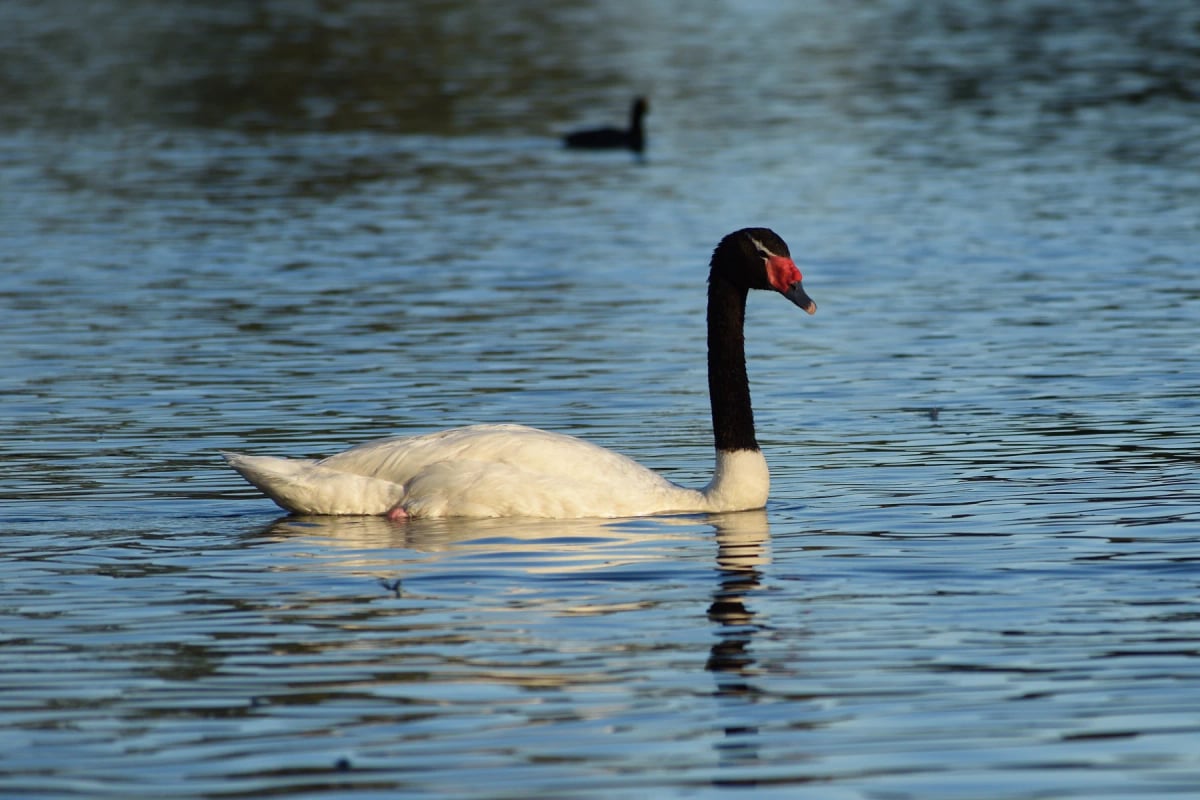
The black necked swan is the largest waterfowl native to South America and the only member of the true swans that lives there. Its snow white body and entirely black neck make it one of the most recognizable waterbirds in the region, and a bright red caruncle at the base of the bill adds a further splash of color. Males are notably larger than females, though both sexes share the same striking plumage. The species breeds across a wide range of wetland environments, from freshwater lakes and lagoons to coastal marshes and sheltered estuaries, with strongholds in southern Chile, Argentina, Uruguay, southern Brazil and the Falkland Islands. Pairs build floating nests anchored to emergent vegetation and are known for ferrying newly hatched cygnets on their backs. The diet centers on submerged water plants, and in Chile's Valdivia wetlands its fortunes rise and fall with a single plant, the luchecillo, whose loss in 2004 caused one of the best known wildlife disasters in South America. The IUCN lists the species as Least Concern, though wetland loss and water pollution remain ongoing pressures.
Habitat and distribution
The black necked swan occupies a broad range of wetland habitats across southern South America. It is most abundant in freshwater lakes, shallow lagoons, coastal marshes, and sheltered estuaries, though it also uses brackish and tidal environments. Its core range spans central and southern Chile, much of Argentina including Patagonia and Tierra del Fuego, Uruguay, the southernmost states of Brazil, and the Falkland Islands. In Chile, the Carlos Anwandter Nature Sanctuary in the Valdivia wetlands supports one of the most significant concentrations on the continent. At higher latitudes, populations are partly migratory, moving northward during the austral winter to avoid ice cover on breeding wetlands. Coastal lagoons along the Uruguayan and Argentine shoreline serve as important wintering grounds for birds from the far south.
Built for the water: physical adaptations
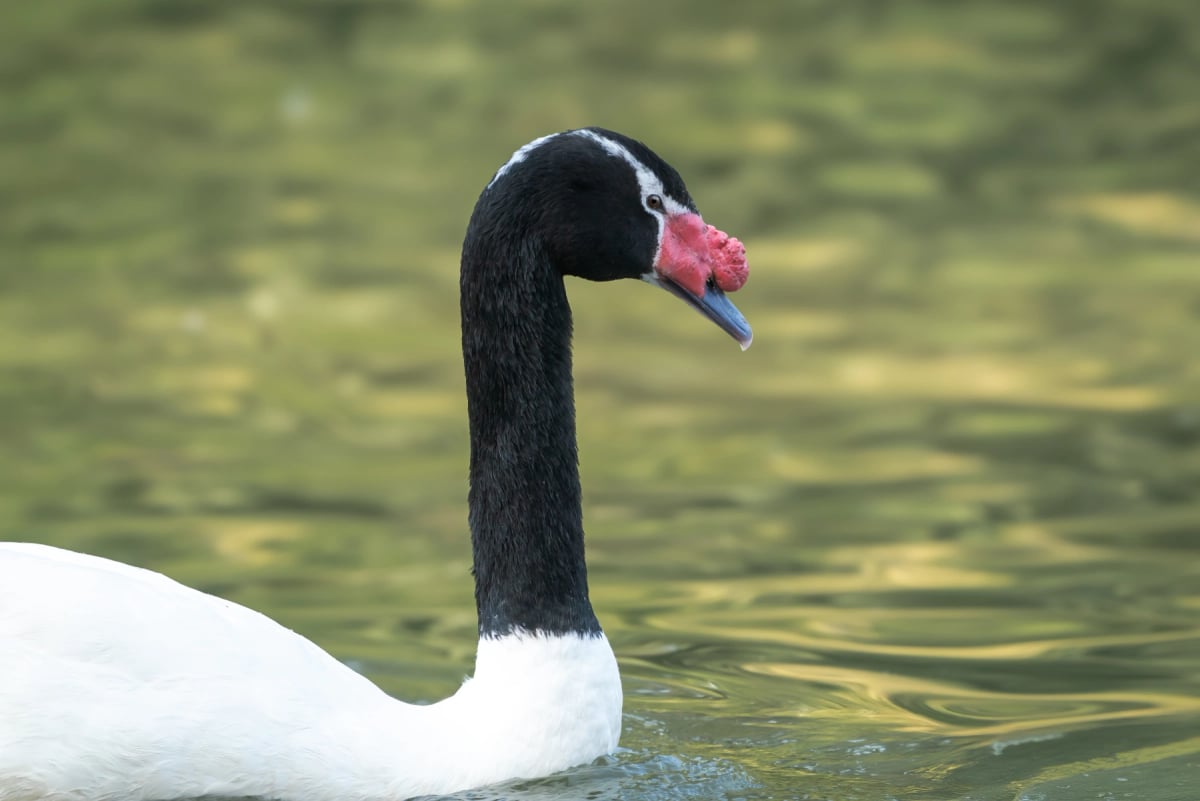
Every aspect of the black necked swan's body reflects a life spent on water. Its dense plumage traps air close to the skin, providing insulation in the cold wetlands of Patagonia and Tierra del Fuego. The feet are set far back on the body, making walking on land awkward but giving the bird exceptional propulsion while swimming. To feed, the swan submerges its long neck to reach aquatic vegetation growing on lake and lagoon floors. Males are much heavier than females, weighing 4.6 to 8.7 kilograms against 3.5 to 4.4, and the wingspan reaches about 1.6 meters. The red caruncle at the base of the bill is not purely ornamental. It swells and brightens during the breeding season, signaling health and fitness to potential mates. Flight, though requiring a long running takeoff across water, covers substantial distances during seasonal movements.
Behavior and social life
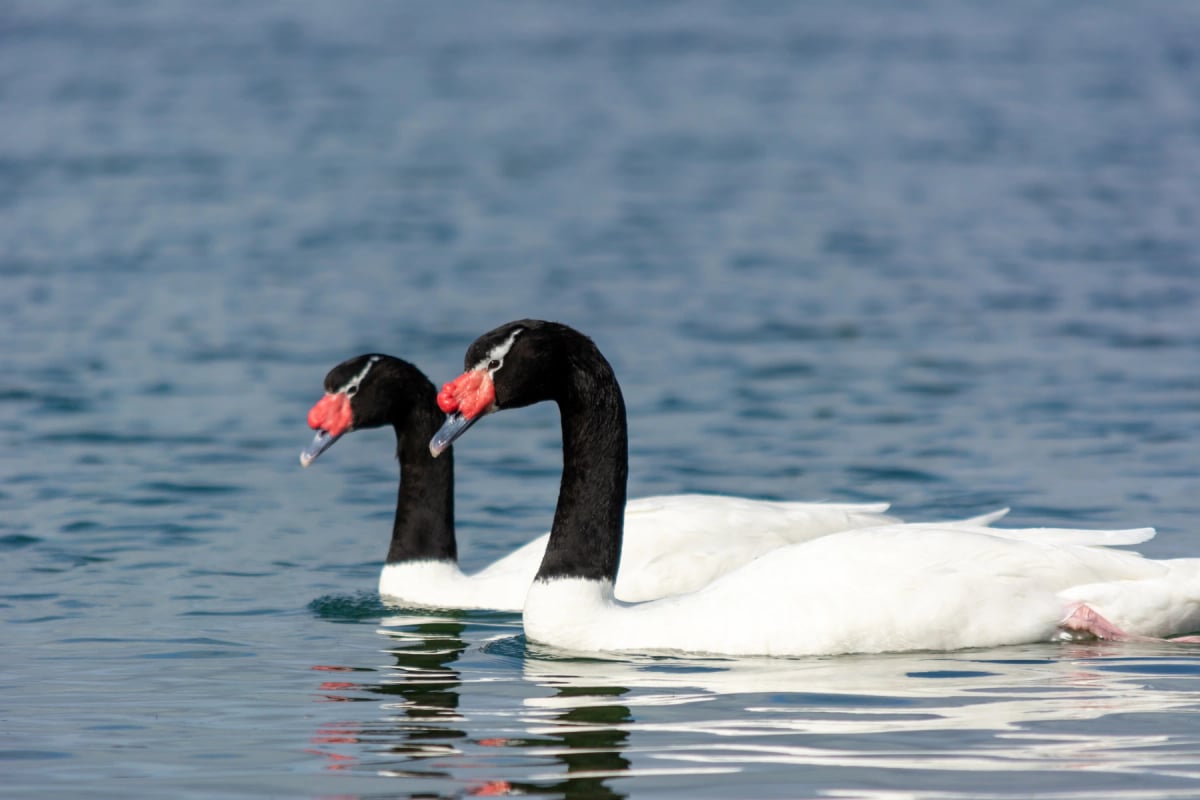
Black necked swans are monogamous and typically form pair bonds that last across multiple breeding seasons. Pairs construct large floating nests from reeds and aquatic plant material, anchoring them to emergent vegetation so the structure rises and falls with water levels. Clutches contain four to eight eggs, each weighing around 170 to 270 grams, and they are incubated for 34 to 36 days. Young birds in captivity take about 100 days to fly. One of the most distinctive behaviors in the species is cygnet transport: parents carry newly hatched young on their backs, sheltering them under partially raised wings. Outside the breeding season, the species gathers in flocks that can number in the thousands at productive wetland sites. Despite its elegant appearance, the black necked swan can be highly territorial around the nest and will actively chase away intruders, including birds considerably larger than itself.
The Río Cruces disaster: the swans of Valdivia
The best known chapter in the story of the black necked swan happened in the wetlands of the Río Cruces, near the city of Valdivia in southern Chile, inside the Carlos Anwandter Nature Sanctuary. These wetlands held one of the largest concentrations of the species, around 5,000 to 6,000 birds, feeding almost entirely on a submerged water plant called luchecillo. In 2004 a cellulose plant began discharging its waste about 15 kilometers upstream. Within months the luchecillo almost vanished, and the swans starved, left, or died: the average count fell from 5,323 birds to 513, and by January 2008 only 214 remained. The case became a national scandal, led to a court ruling against the company in 2013, and changed how Chile thinks about protecting wetlands. The birds did come back as the plants recovered: counts reached about 7,000 by 2017 and a peak of 22,419 in May 2020. But the population is still unstable, and by May 2022 it had dropped again to 2,782, a reminder of how closely this swan depends on the health of a few key wetlands.
Conservation
The IUCN classifies the black necked swan as Least Concern, because it has a very large range and a population considered stable, although there is no precise global count. Argentina alone is thought to hold about 50,000 birds. Despite this reassuring status, the species faces real and ongoing pressures. Drainage of wetlands for agriculture, urban growth around coastal lagoons, and water pollution from industry and farming all reduce the habitat it needs, and because it depends so heavily on a few water plants, damage to a single wetland can hit a large share of the birds that use it. The Río Cruces disaster in Chile, described above, showed how fast that can happen. Hunting, although illegal in most of its range, and disturbance at nesting sites add local stress. Protected wetlands such as the Carlos Anwandter Sanctuary in Chile, Laguna de Rocha in Uruguay, and the Lagoa do Peixe and Taim areas in southern Brazil are key to its long term future.
Where it is found
The Black necked Swan can be found in places such as:
Researched and written by Juan Pablo. Sources: IUCN Red List, scientific literature and regional field guides. Last updated: .
Technical factsheet




Frequently Asked Questions
What happened to the swans in Valdivia?
In 2004, waste from a cellulose plant on the Río Cruces, near Valdivia in southern Chile, destroyed most of the luchecillo, the water plant the black necked swans of the Carlos Anwandter Sanctuary fed on. The birds starved, left, or died, and the count fell from about 5,300 to around 500, with only 214 left in 2008. A court ruled against the company in 2013. The swans later returned as the plants recovered, peaking at 22,419 in 2020, but numbers have swung since.
How many eggs does a black necked swan lay?
The female lays four to eight eggs, each weighing about 170 to 270 grams, in a large floating nest of reeds and water plants anchored to vegetation. Incubation takes 34 to 36 days. The cygnets hatch covered in pale grey down, and they spend much of their first weeks riding on their parents' backs. In captivity, young birds take about 100 days before they can fly.
Is the black necked swan the only swan in South America?
It is the only true swan of the genus Cygnus in South America, and the largest waterfowl on the continent. It shares many of the same wetlands with the coscoroba swan, a smaller all white bird with a pink bill that is called a swan but belongs to its own genus and is more closely related to geese. Seeing the two together is common in places such as the Uruguayan coastal lagoons and Patagonian lakes.
Can black necked swans fly?
Yes. Despite their weight, black necked swans are good fliers, though they need a long running takeoff across open water to get airborne. Their wingspan reaches about 1.6 meters. Birds from Patagonia and Tierra del Fuego fly north each autumn to milder lagoons in Uruguay, central Argentina, and southern Brazil, and some have even been recorded as vagrants on the Antarctic Peninsula.
Are black necked swans aggressive?
They are calm most of the year, but pairs become very territorial around the nest and while they have cygnets. They chase away other waterbirds, including larger ones, with raised wings and fast charges across the water, and they may hiss at people who get too close. Outside the breeding season they are sociable and gather in flocks that can reach the thousands at good wetlands.
What does the black necked swan eat?
The black necked swan feeds mainly on submerged aquatic plants, which it reaches by dipping its unusually long neck below the water surface. Algae round out the bulk of its plant based diet, and the species also takes small invertebrates when available. Feeding typically happens in shallow areas of lakes and lagoons where vegetation grows close enough to the surface for the bird to reach without diving.
Is the black necked swan endangered?
No, the black necked swan is listed as Least Concern by the IUCN, because of its very large range and a population considered stable, with about 50,000 birds in Argentina alone. That said, it is not without pressures. Wetland drainage and pollution have caused sharp local declines, the most famous in Chile's Río Cruces wetland near Valdivia, where the swan count fell from over 5,000 to a few hundred after 2004. Protecting key wetlands is what keeps the species safe.
How big is a black necked swan?
The black necked swan is the largest waterfowl native to South America. It measures 102 to 124 centimeters long, and males are much heavier than females: 4.6 to 8.7 kilograms against 3.5 to 4.4. The wingspan is around 1.6 meters. Despite being the continent's largest swan, it is smaller overall than several Northern Hemisphere swans, such as the mute swan and the trumpeter swan.
Why does the black necked swan carry its chicks on its back?
Carrying cygnets on their backs is a protective strategy used by both parents. Newly hatched chicks are extremely vulnerable to cold water temperatures and to predators. Riding on a parent's back keeps them warm, dry, and out of reach of threats lurking below the surface. This behavior continues for several weeks after hatching, until the young birds are strong enough to swim and regulate their own body temperature independently.
What is the red bump on the black necked swan's bill?
That red structure at the base of the bill is called a caruncle, and it is found on both males and females. It is made of bare, fleshy skin rather than feathers or bone. Beyond giving the swan its distinctive look, the caruncle plays a role in communication between individuals. It becomes more prominent and vividly colored during the breeding season, which suggests it functions as a visual signal of a bird's condition and readiness to mate.
Where can you see black necked swans in the wild?
Black necked swans are found across several countries in southern South America, including Argentina, Chile, Uruguay, southern Brazil, and the Falkland Islands. Some of the best places to observe them include the wetlands of Uruguay's coast, the Patagonian lakes of Argentina, and various lagoons throughout Chile. Wetland reserves and national parks in these countries often provide reliable sightings, particularly during the cooler months when birds congregate in larger groups.
Do black necked swans migrate?
Populations in the southernmost parts of the range, such as Patagonia and Tierra del Fuego, do migrate seasonally. When wetlands freeze during the austral winter, these birds move northward to warmer coastal lagoons and estuaries in Uruguay and central Argentina. Populations living in milder climates tend to be largely resident year round. Migration distances vary considerably depending on where individual birds breed and how harsh local winter conditions become.