Cheetah
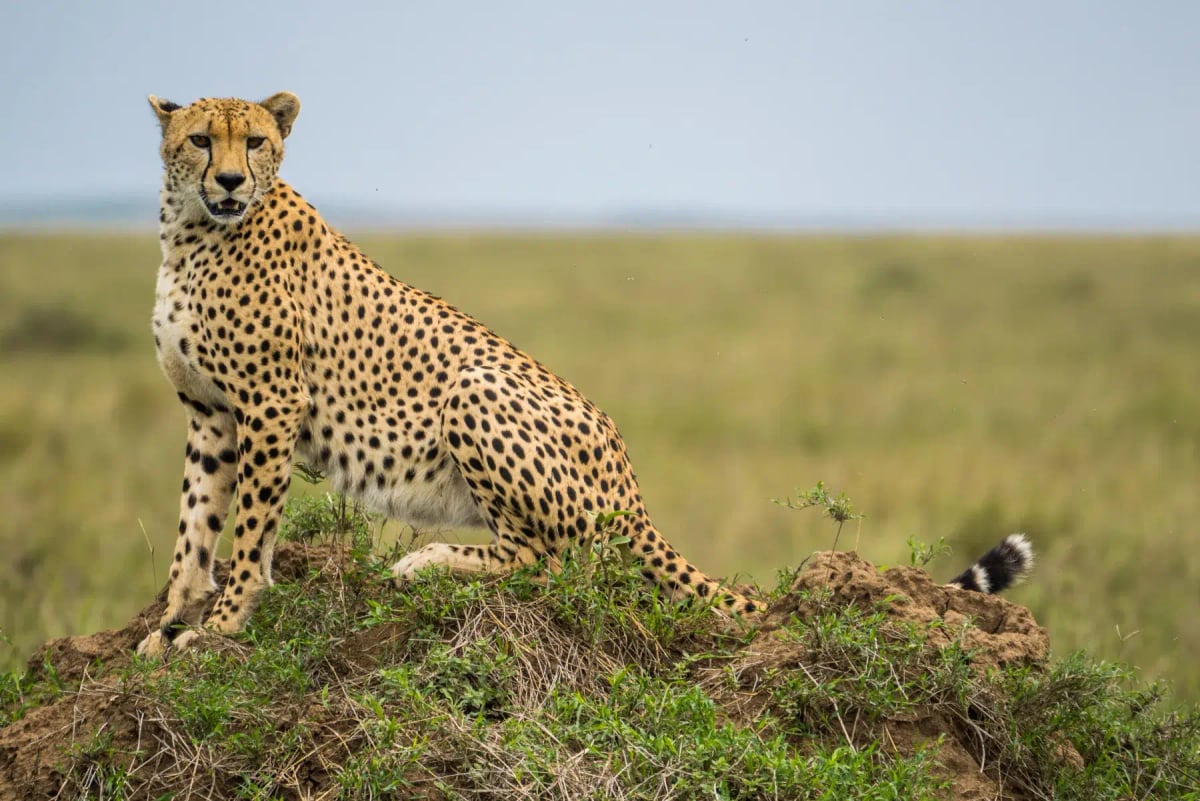
The cheetah (Acinonyx jubatus) is the fastest land animal on Earth, capable of reaching speeds close to 100 km/h in bursts that typically last no more than 30 seconds. Its slender frame, deep chest, flexible spine, and semi-retractable claws work together to deliver explosive acceleration from a standstill. Unlike lions or leopards, cheetahs hunt by sight in broad daylight, relying on a high-speed chase rather than ambush. Females are almost exclusively solitary, raising cubs on their own, while some males form coalitions, often with brothers, to hold territories and improve hunting success. Native to sub-Saharan Africa and, in very small numbers, Iran, the species has lost over 90 percent of its historical range. Roughly 6,700 mature individuals survive today, scattered across fragmented habitats where prey availability and human pressure shape their chances of long-term survival.
Speed
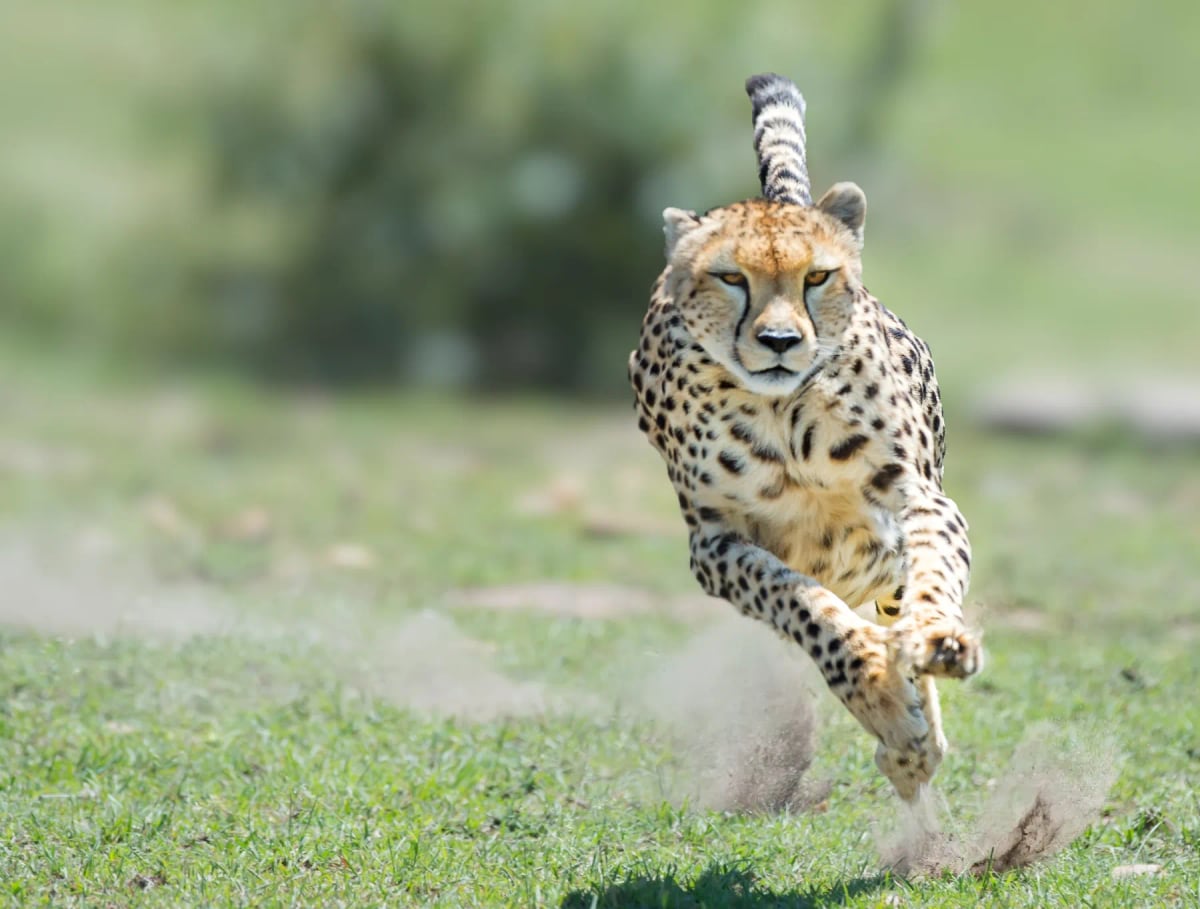
Few animals come close to the cheetah when it comes to raw acceleration. From a standing start, it can reach 96 km/h in roughly three seconds, covering ground with strides that can span up to seven metres. Specially adapted claws that are only semi-retractable grip the ground like running spikes, while a flexible spine coils and extends with each stride to add extra reach. The tail acts as a counterbalance through sharp turns at full pace. These sprints are intense but brief, rarely lasting more than 20 to 30 seconds before the animal must stop to recover. After a successful chase, a cheetah may need 15 minutes or more to bring its heart rate and body temperature back down before it can eat.
Differences with the leopard
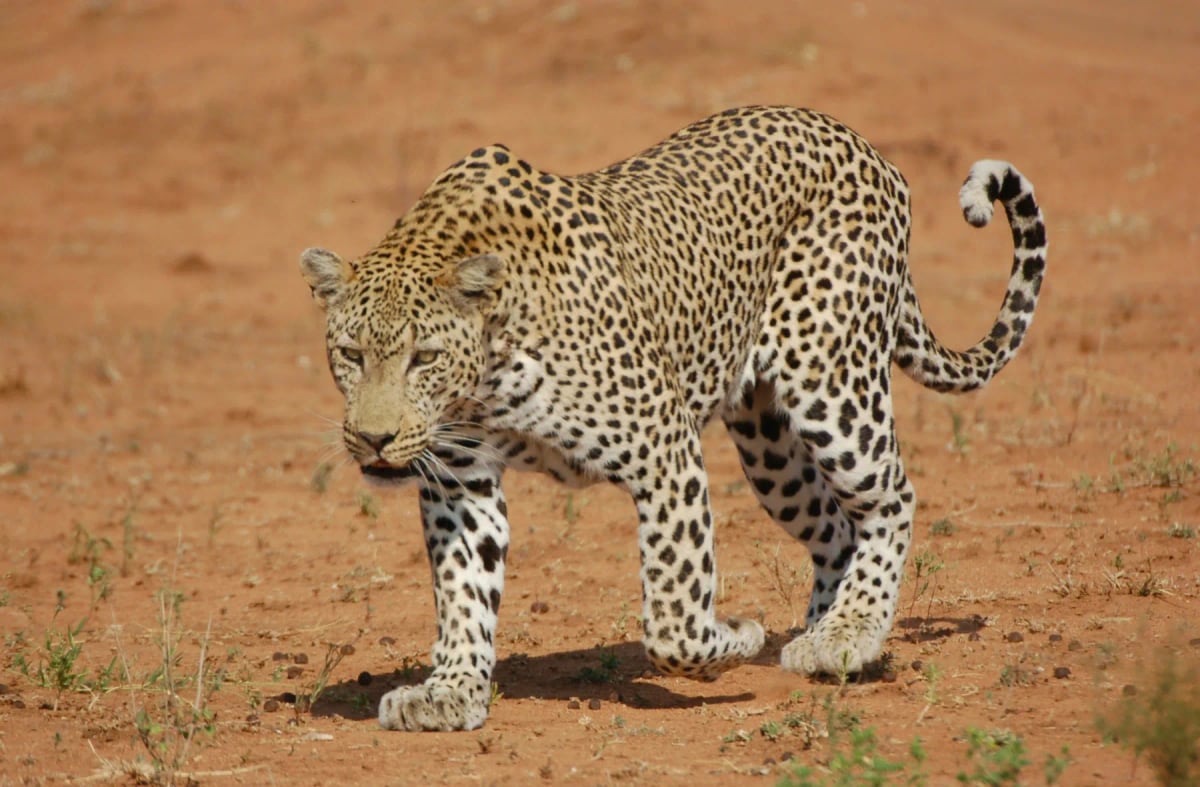
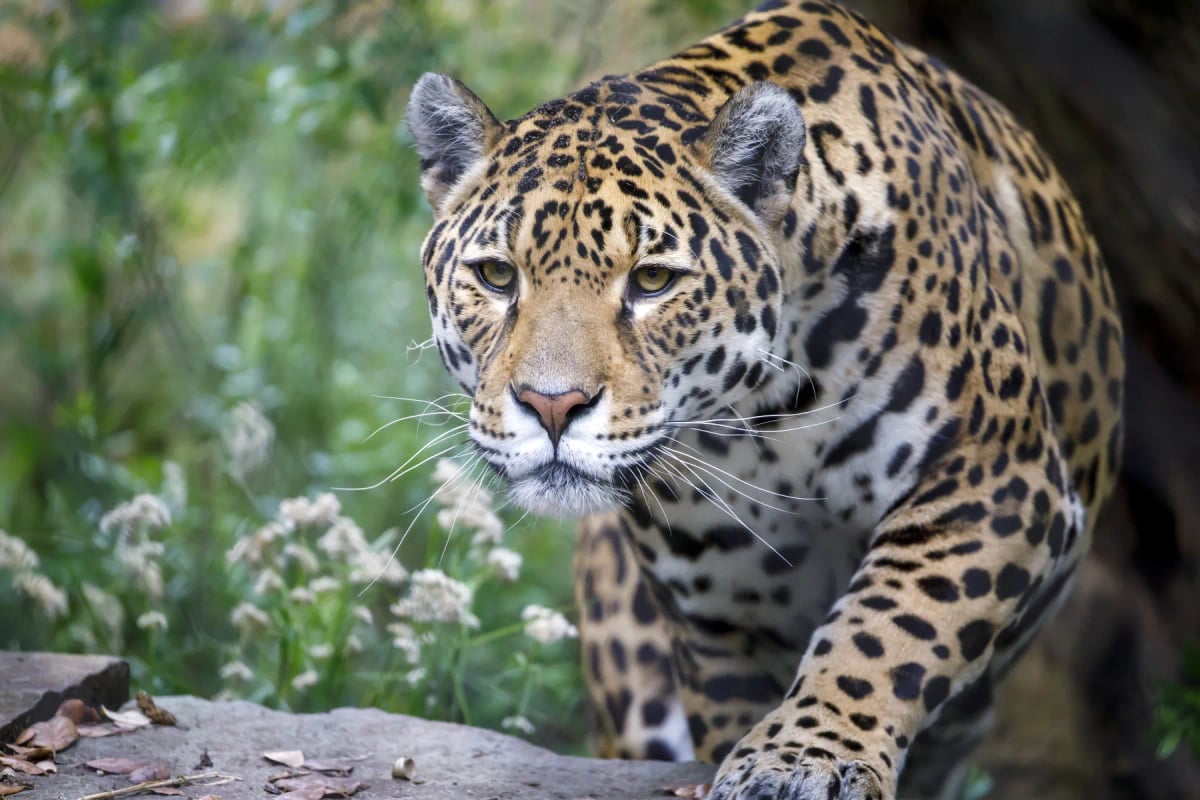
At first glance, cheetahs and leopards might seem similar, but the two species are easy to tell apart once you know what to look for. The cheetah has a lean, almost greyhound-like frame built for speed, while the leopard is stockier and far more muscular. Spot patterns differ clearly: cheetahs carry solid black spots across a tan coat, whereas leopards display rosettes, which are clusters of spots arranged in a ring around a pale centre. The most reliable field mark on a cheetah is the pair of black lines running from the inner corner of each eye down to the mouth. Known as tear marks, these are absent on leopards. Cheetahs also hunt in daylight and rarely climb trees, while leopards are nocturnal hunters with exceptional climbing ability.
Behavior and social life
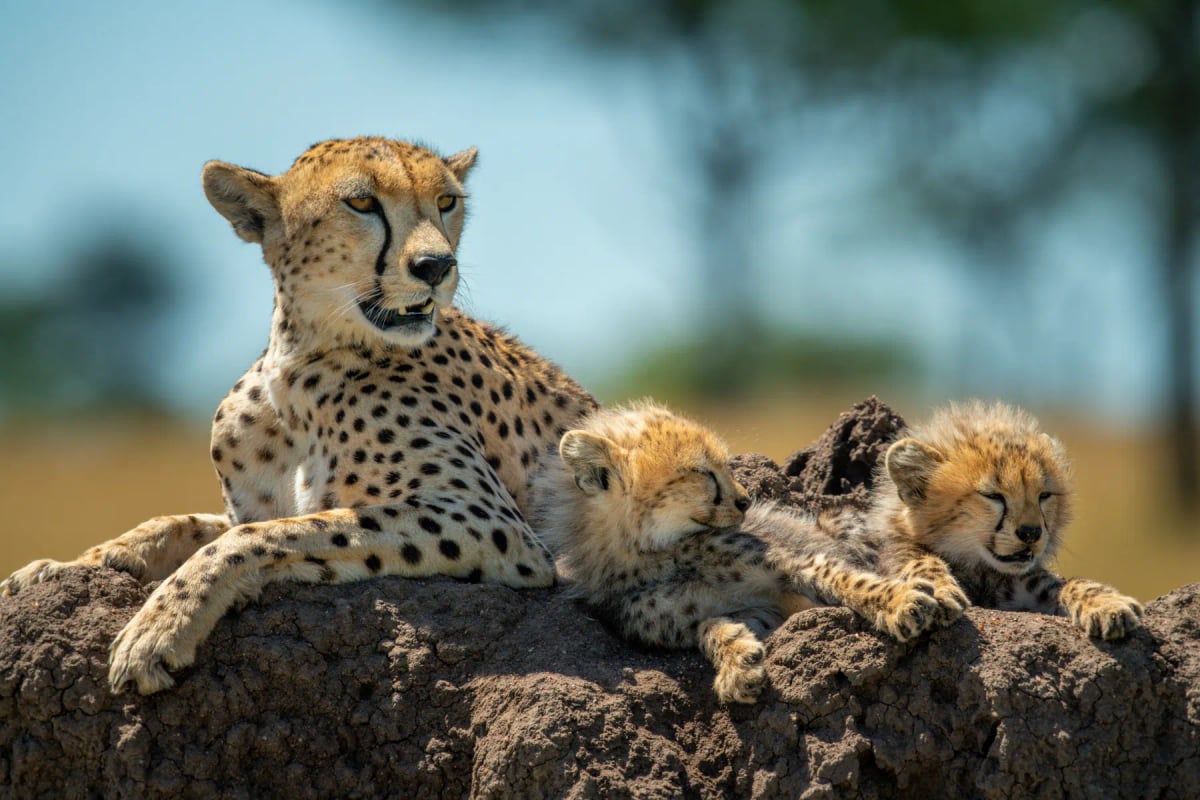
Social structure in cheetahs varies noticeably between the sexes. Females are almost always solitary, coming together with others only to mate. They raise their cubs entirely alone, moving frequently to avoid predators such as lions and hyenas, which will kill cubs when given the opportunity. Males, by contrast, sometimes form coalitions of two or three individuals, most often brothers from the same litter. These groups can hold territories more effectively than a single male and tend to bring down larger prey. Cheetahs communicate through a range of sounds that sets them apart from other big cats. They cannot roar, but they produce a distinctive high-pitched chirp, along with purrs, yelps, and a churring sound used during social interactions. Scent marking on trees and termite mounds helps convey territorial information across wide areas.
Habitat
Across most of their range, cheetahs favour open environments where their eyesight and speed can be used to maximum effect. Grasslands, open woodlands, and scrublands that are dry dominate the landscapes they occupy throughout sub-Saharan Africa. They are also found in areas that are semi-arid, including parts of the Sahel and the Karoo of southern Africa. Contrary to a common assumption, cheetahs do not rely on national parks alone. A large proportion of the global population lives outside protected areas, on private farmland and communal land. The only population outside Africa survives in the Kavir region of central Iran, where a small number of Asiatic cheetahs persist in desert terrain. Across all habitats, the availability of prey species such as gazelles, impalas, and hares is a key factor that determines where individuals can establish and maintain a home range.
Interaction with humans
Unlike lions or leopards, cheetahs pose very little danger to people. They are naturally shy and will almost always retreat rather than confront a human being. Verified attacks on people are extremely rare and typically involve animals that have been cornered or handled. The relationship between cheetahs and people is, however, far from simple. Across Africa, livestock farmers often view cheetahs as a threat to their herds, and retaliatory killing remains one of the leading causes of mortality outside protected areas. On the other side, cheetahs have been kept and admired by humans for thousands of years. Akbar the Great, the Mughal emperor, reportedly kept over a thousand during his reign. Today, illegal trade in live cheetahs for the exotic pet market, particularly in the Gulf states, drives poaching pressure on wild populations in East Africa and the Horn of Africa.
Conservation
The IUCN classifies the cheetah as Vulnerable, with the global population estimated at around 6,700 mature individuals. That figure represents a species that has lost more than 90 percent of its historical range, squeezed out by a combination of habitat loss, declining prey, conflict with farmers, and illegal trade. Because so much of the surviving population lives outside protected areas, conservation efforts cannot rely on park management alone. Community-based programmes that offer livestock protection tools, such as guardian dogs and predator-proof enclosures, have shown real promise in reducing retaliatory killings in Namibia and other countries. Captive breeding contributes to public awareness but has limited value for bolstering wild numbers due to the species' low genetic diversity. The Asiatic subspecies in Iran faces a particularly urgent situation, with fewer than 50 individuals believed to remain.
Where it is found
The Cheetah can be found in places such as:
Researched and written by Juan Pablo. Sources: IUCN Red List, scientific literature and regional field guides. Last updated: .
Technical factsheet

Frequently Asked Questions
What do cheetahs eat?
Cheetahs are carnivores that hunt by sight during daylight hours. Their preferred prey includes gazelles, impalas, springboks, and hares. They typically target animals that weigh between 20 and 60 kilograms. After a high-speed chase, a cheetah eats quickly, often within minutes, because larger predators such as lions and hyenas regularly steal kills. They need to consume food fast before losing it to a competitor.
How long do cheetahs live?
In the wild, cheetahs typically live between 10 and 12 years, though many do not reach that age due to competition with other predators, injury, and habitat pressures. In captivity, where food is guaranteed and threats are absent, individuals have been recorded living up to 15 years or more. Cubs face the greatest risk, with mortality rates in some populations exceeding 70 percent in the first few months of life.
Where do cheetahs live in the world?
Cheetahs are found across parts of sub-Saharan Africa, with the strongest populations in Namibia, Botswana, Zimbabwe, and Tanzania. Smaller groups survive in West and Central Africa, as well as the Horn of Africa. Outside Africa, only a tiny population of Asiatic cheetahs remains in central Iran, with fewer than 50 individuals believed to exist. The species has disappeared from most of its historical range across Asia and North Africa.
Are cheetahs endangered?
The IUCN lists the cheetah as Vulnerable, with around 6,700 mature individuals remaining in the wild. The species has lost more than 90 percent of its historical range. Habitat loss, declining prey populations, conflict with farmers, and illegal trade in live animals are the main drivers of decline. The Asiatic subspecies in Iran is in a far more critical situation, with a population so small it is considered functionally endangered.
Can cheetahs climb trees?
Cheetahs are not skilled climbers. Their body is built for speed on the ground rather than for gripping and scaling trunks. While they may occasionally rest on a low branch or a termite mound to get a better view of their surroundings, they do not haul prey into trees the way leopards do. This leaves their kills exposed and easily stolen by larger predators or scavengers in the area.
How many cubs do cheetahs have?
A female cheetah gives birth to litters of typically three to five cubs, though litters of up to eight have been recorded. Cubs are born blind and helpless, and the mother raises them entirely on her own. She moves them frequently to reduce the risk of predation. Young cheetahs stay with their mother for around 18 months, learning to hunt before eventually becoming independent.
What are the biggest threats to cheetahs?
The main threats facing cheetahs today are habitat loss, reduction of prey, conflict with livestock farmers, and illegal trade. Because a large share of cheetahs live outside protected areas, they frequently come into contact with farming communities, where retaliatory killing is common. Demand for live cheetah cubs as exotic pets, especially in the Gulf region, has also placed significant pressure on populations in East Africa and the Horn of Africa.