Pygmy Hippo
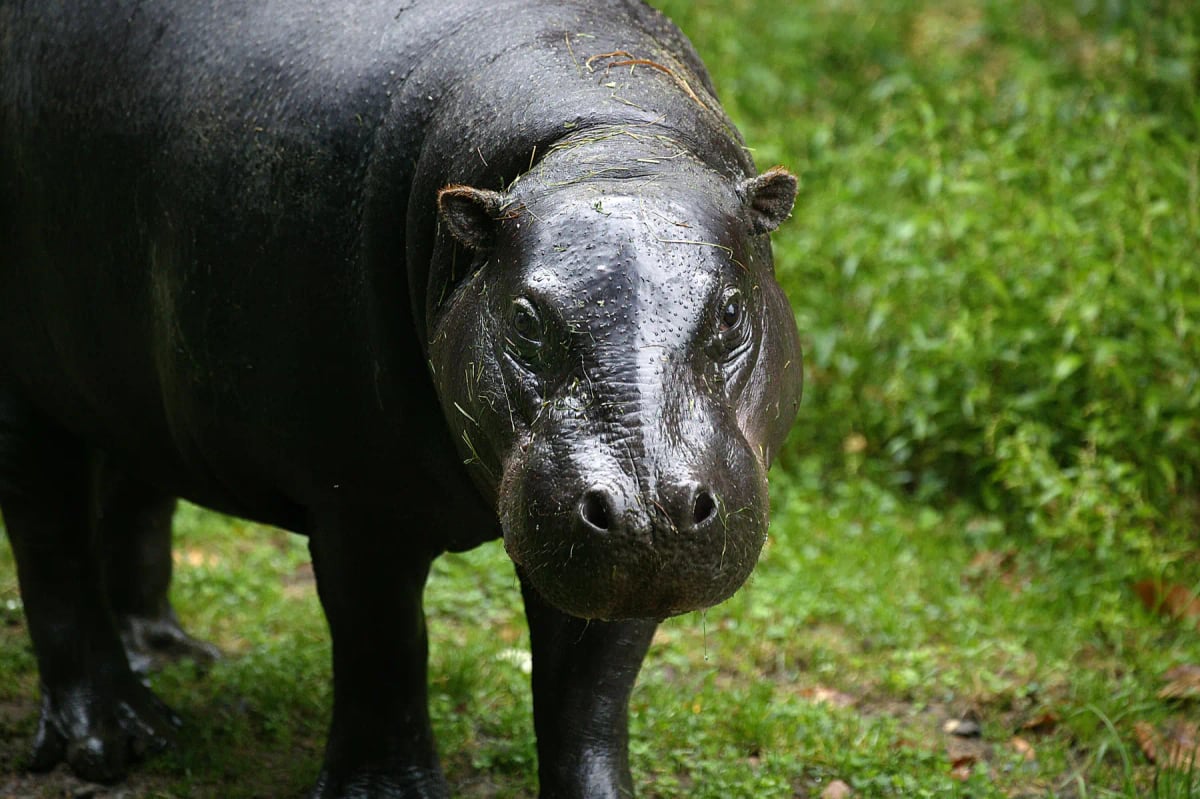
The pygmy hippo is a rare and secretive relative of the common hippopotamus, found only in the rainforests and swamps of West Africa. It is far smaller than its well-known cousin, standing roughly 75 to 83 centimetres at the shoulder and weighing between 180 and 275 kilograms. Where the common hippo thrives in large groups, the pygmy hippo lives alone and rarely shows itself. It spends most of the day resting near streams or tucked into dense cover, then ventures out after dark to feed on leaves, ferns, grasses, and fallen fruit. Its skin releases a reddish, oily fluid that acts as a natural moisturiser and may offer some protection against the sun. Fewer than 2,500 individuals are thought to remain in the wild, and the species is classified as Endangered, primarily due to deforestation, illegal hunting, and the ongoing loss of wetland habitat.
Appearance
At roughly 75 to 83 centimetres at the shoulder and weighing between 180 and 275 kilograms, the pygmy hippo is dramatically smaller than the common hippopotamus. Its body is compact and barrel-shaped, with relatively long legs compared to its bulk, which helps it move with surprising agility through thick forest undergrowth. The skin is a deep greenish black on the back and sides, fading to a pale grey or cream on the belly. Like its larger relative, it secretes a reddish, oily fluid through the skin. This natural substance keeps the skin moist and may offer some protection against the sun and bacteria. The head is smaller and more rounded than that of the common hippo, and the eyes are positioned more to the sides rather than on top, reflecting its more terrestrial way of life.
Behavior
Unlike the highly social common hippo, the pygmy hippo leads a largely solitary life. Adults come together only to mate, and mothers raise their young alone. During the day, individuals rest beside streams, in shallow water, or tucked beneath dense riverside vegetation, where they are extremely difficult to spot. After dark, they set out alone to forage, following well-worn trails through the forest floor. When threatened, a pygmy hippo is more likely to flee into the forest or dive beneath the water than to stand its ground. Males mark their territories by flicking dung with their tails, a behaviour also seen in the common hippo. Because the species is so secretive and nocturnal, much of what is known about it in the wild comes from camera trap studies.
Diet
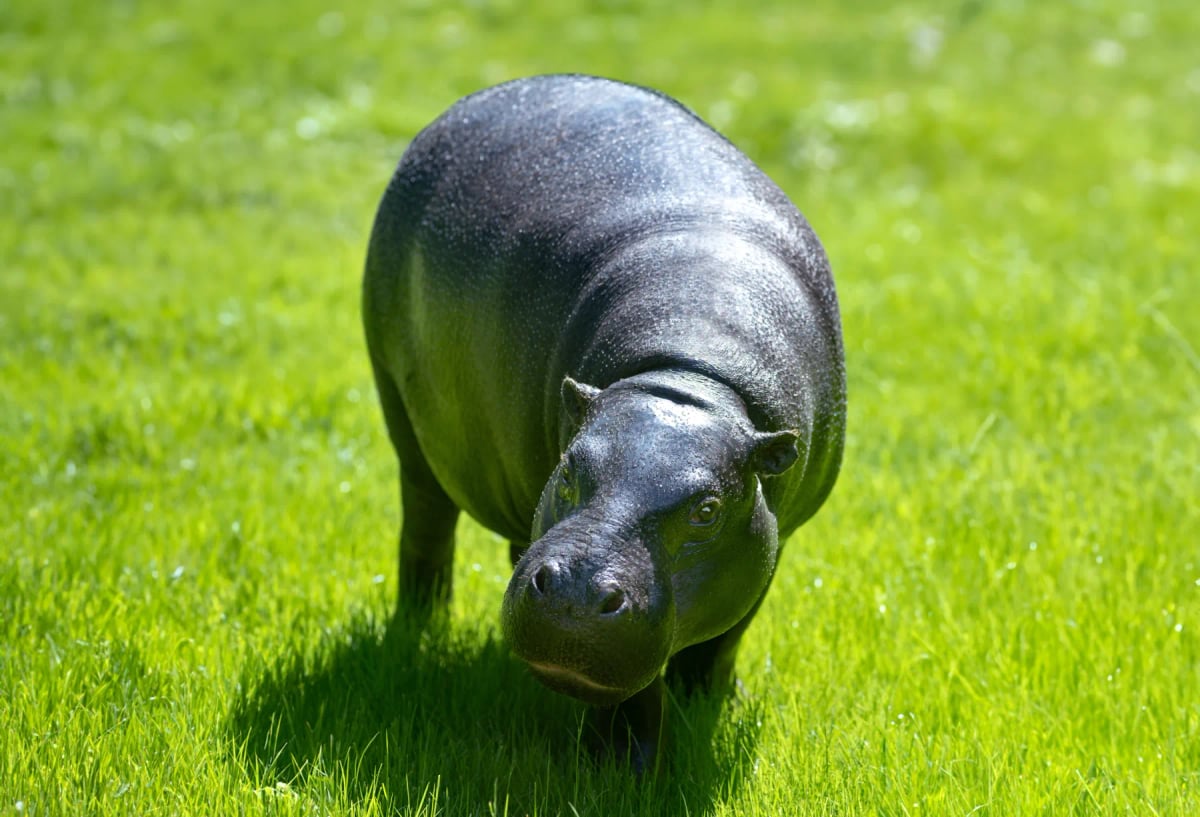
Feeding takes place almost entirely at night, when the pygmy hippo ventures away from its resting spots to browse through the forest. Its diet is made up mainly of broad-leaved plants, ferns, grasses, and fallen fruit found along the forest floor and stream banks. Unlike the common hippo, which grazes on open grassland, the pygmy hippo is adapted to life beneath the forest canopy, selecting food from the lower layers of vegetation. It uses its lips to grip and pull plant matter rather than relying heavily on its teeth to crop grass. The exact mix of plants eaten varies by season and location, with fruit becoming an important source of energy when available. Roots and aquatic plants are also consumed on occasion, rounding out a diet shaped by whatever the rainforest offers.
Habitat and range
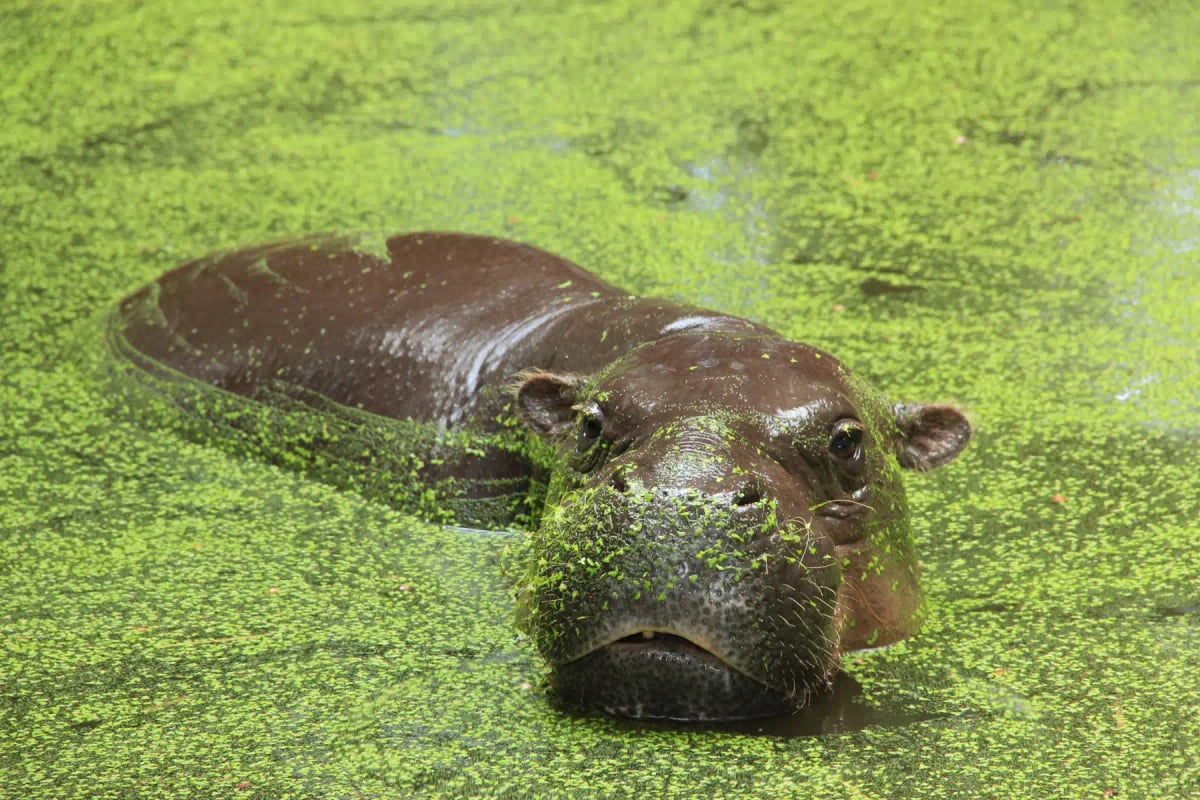
West Africa is the only place on Earth where pygmy hippos are found in the wild. Their range covers parts of Liberia, Sierra Leone, Guinea, and Côte d'Ivoire, with Liberia believed to hold the largest remaining population. Within this region, the species depends on lowland tropical rainforest with access to rivers, streams, and swampy ground. Dense cover is essential for shelter during the day, while clean freshwater is needed for cooling and resting. Pygmy hippos are sensitive to changes in their environment, and the fragmentation of forest into isolated patches has made it harder for individuals to move and find mates. A small population is also recorded on the Picathartes Island of Tumbo in Guinea, suggesting the species once had a wider coastal presence. Protected areas such as Sapo National Park in Liberia are now critical refuges.
Conservation
Classified as Endangered by the IUCN, the pygmy hippo faces serious pressure from several directions at once. Fewer than 2,500 individuals are estimated to remain in the wild, a figure that has been declining for decades. The clearance of rainforest for agriculture, logging, and human settlement continues to reduce and break apart the habitat these animals depend on. Illegal hunting adds further strain, with pygmy hippos taken for their meat and sometimes caught in snares set for other animals. Civil conflict in parts of West Africa has historically made conservation efforts harder to sustain and enforcement difficult to maintain. Captive breeding programmes in zoos around the world have helped build knowledge of the species and may serve as a safeguard if wild populations decline further. International cooperation and stronger protections inside existing reserves remain the most important factors for the survival of the species over the long term.
Where it is found
The Pygmy Hippo can be found in places such as:
Researched and written by Juan Pablo. Sources: IUCN Red List, scientific literature and regional field guides. Last updated: .
Technical factsheet





Frequently Asked Questions
What does a pygmy hippo eat?
Pygmy hippos feed at night, browsing on leaves, ferns, grasses, and fallen fruit along the forest floor and stream banks. They use their lips to grip and pull plant matter rather than cropping grass like the common hippo. Roots and aquatic plants are also eaten from time to time. The exact mix of food shifts with the seasons, and fruit becomes especially important as an energy source when it is available.
Where do pygmy hippos live?
Pygmy hippos are found only in West Africa, in parts of Liberia, Sierra Leone, Guinea, and Côte d'Ivoire. They rely on lowland tropical rainforest with rivers, streams, and swampy ground nearby. Liberia is thought to hold the largest share of the remaining population. Protected areas such as Sapo National Park are now among the most important places for the species to survive.
How is the pygmy hippo different from the common hippo?
The pygmy hippo is far smaller, weighing up to 275 kilograms compared to the common hippo's two to three tonnes. It also lives alone rather than in groups, is active at night rather than in the open during the day, and spends more time on land than in water. Its eyes sit on the sides of its head rather than on top, which reflects its life in the forest rather than in open rivers.
Is the pygmy hippo endangered?
Yes. The pygmy hippo is classified as Endangered by the IUCN, with fewer than 2,500 individuals estimated to remain in the wild. The main threats are the loss of rainforest to farming and logging, illegal hunting for meat, and the fragmentation of habitat that makes it hard for animals to find mates. Civil conflict in parts of its range has also made conservation work difficult to carry out consistently.
Why does the pygmy hippo have reddish oily skin?
Pygmy hippos secrete a reddish, oily fluid through their skin, just as the common hippo does. This natural substance keeps the skin from drying out and may also offer some protection against the sun and harmful bacteria. It is not blood or sweat, even though it can look that way. Scientists sometimes call it "blood sweat", but it is a unique secretion found only in hippos.
Are pygmy hippos nocturnal?
Yes, pygmy hippos are mostly nocturnal. They spend the day resting near streams, in shallow water, or hidden beneath dense vegetation where they are very hard to spot. Once night falls, they head out alone to forage through the forest. This secretive, nighttime lifestyle is one of the reasons so little was known about them for a long time, and camera traps have been essential for studying them in the wild.
How many pygmy hippos are left in the world?
Fewer than 2,500 pygmy hippos are thought to survive in the wild, and that number has been falling for decades. Liberia holds the largest portion of the remaining population. There are also pygmy hippos living in zoos around the world as part of captive breeding programmes. These programmes help researchers learn more about the species and act as a backup in case wild populations continue to decline.