Snow Leopard
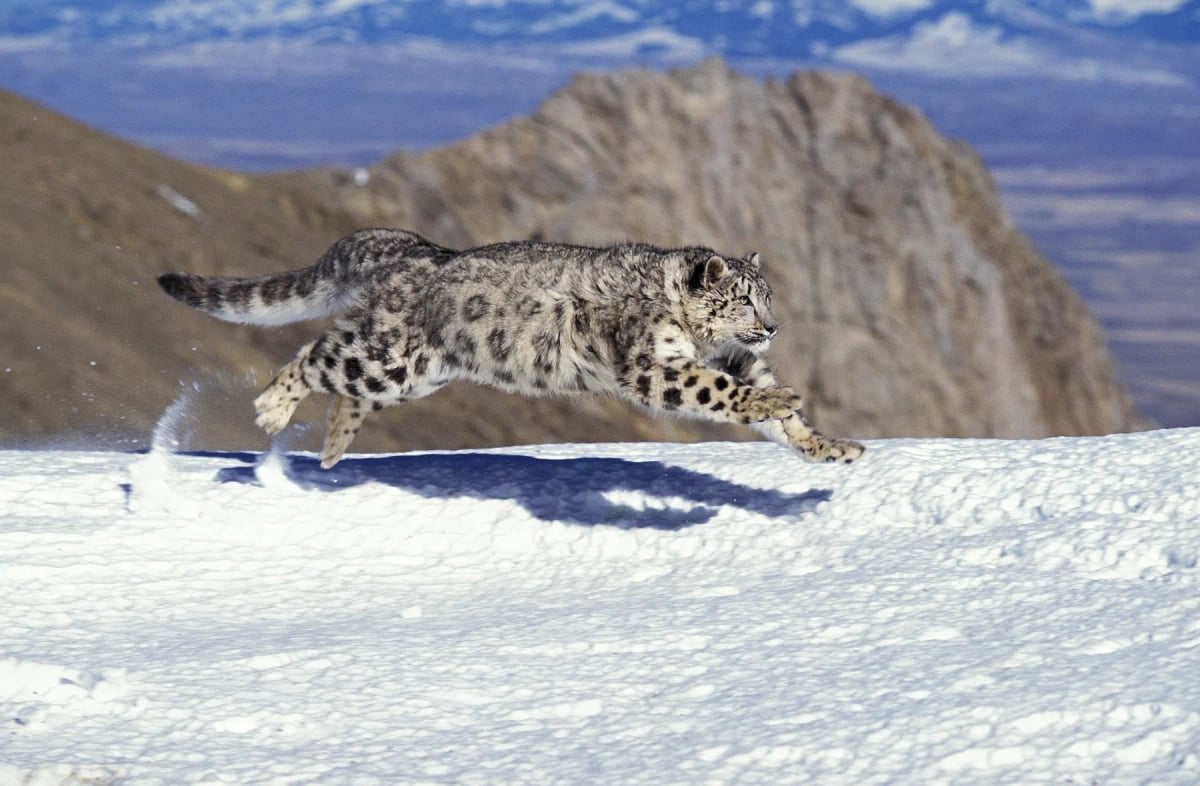
The snow leopard is a large cat built for life in the mountains of Central and South Asia. It ranges across 12 countries, from the rocky ranges of Afghanistan and Pakistan to the high plateaus of Mongolia and the remote borderlands of Russia. Its thick, smoky gray coat marked with dark rosettes blends almost perfectly into bare rock and patchy snow. The paws are broad and covered in fur, which spreads weight across the surface like a natural snowshoe. The tail is exceptionally long, often reaching nearly the length of the body itself, and the cat wraps it around its face for warmth when resting. Snow leopards prey mainly on blue sheep and Himalayan ibex, using steep terrain to their advantage during an ambush. Classified as Vulnerable by the IUCN, the species faces ongoing pressure from poaching and the loss of prey.
Habitat and range
Few large cats live as high as the snow leopard. Across 12 countries in Central and South Asia, this cat occupies some of the most rugged mountain terrain on Earth, from the Hindu Kush in Afghanistan to the Altai ranges of Mongolia and the remote highlands of southern Russia. Most individuals are found between 3,000 and 5,500 meters above sea level, in landscapes of bare rock, steep ravines, and sparse alpine scrub. In winter, some cats descend to lower elevations following their prey. A single snow leopard can patrol a home range of several hundred square kilometers, depending on the availability of prey and the terrain. China holds the largest share of suitable habitat, covering roughly 60 percent of the total range.
Physical adaptations
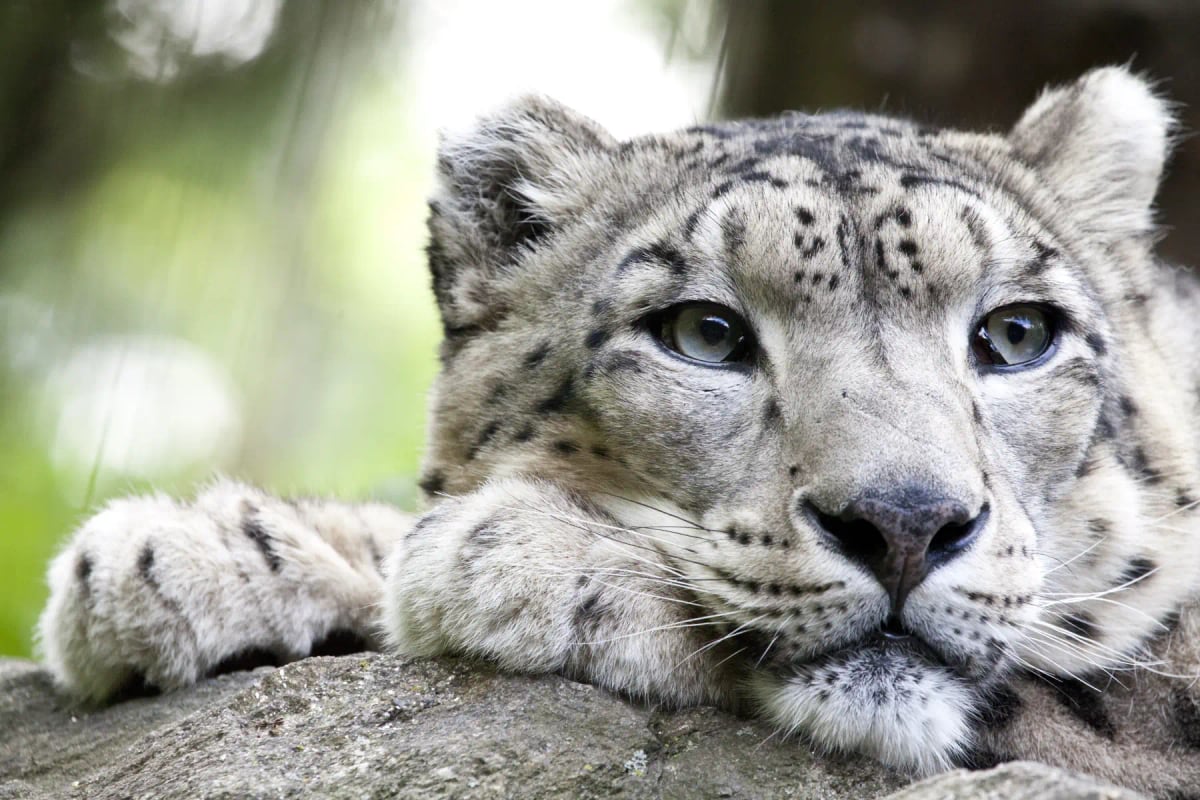
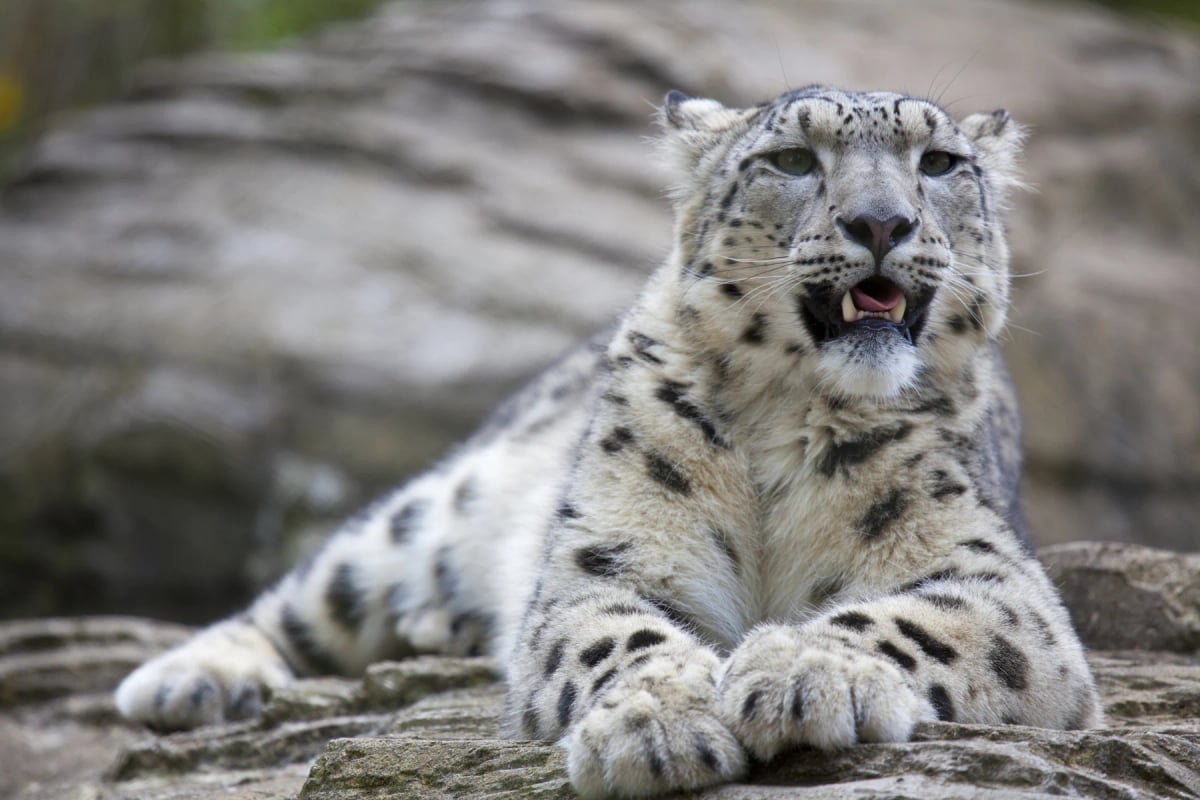
Everything about the snow leopard's body is suited to life in cold, steep places. The coat is thick and pale gray, patterned with dark rosettes and spots that break up the cat's outline against rock and snow, making it nearly invisible at a distance. The fur can grow up to five centimeters long on the belly, providing insulation against frozen ground. Broad, heavily furred paws distribute the cat's weight across snow and give grip on loose rock, much like a natural snowshoe. The tail is one of the longest relative to body size of any cat, often measuring close to a meter. It helps the animal balance on narrow ledges and serves as a warm wrap for the face and nose when the cat rests in exposed, windswept spots.
Diet
Blue sheep, known locally as bharal, and Himalayan ibex form the core of the snow leopard's diet wherever the two prey species are present. When large prey is scarce, the cat will also take marmots, hares, game birds, and occasionally domestic livestock. Snow leopards are ambush hunters. They use the broken terrain of cliffs and ridgelines to stalk close before launching a short, powerful charge. Prey is usually killed with a bite to the throat or the back of the neck. A single large kill can sustain an adult for several days. In areas where wild prey populations have been reduced by hunting or competition with livestock, snow leopards tend to turn to domestic animals more often, which brings them into direct conflict with the people who live nearby.
Behavior and reproduction
Snow leopards are largely solitary outside the breeding season, each adult holding its own territory marked with scrapes, scent sprays, and scratch marks on prominent rocks. Activity peaks around dawn and dusk, though cats will move at any hour in remote areas free from disturbance. Mating takes place between January and March, and after a gestation of roughly 93 to 110 days the female gives birth to a litter of one to three cubs. She raises them entirely on her own in a sheltered rocky den, often lined with her own fur. Cubs begin accompanying their mother on hunts by about three months of age and typically remain with her through their first winter before setting off to establish territories of their own.
Threats
Poaching remains one of the most serious dangers facing the snow leopard. Its bones and organs are sought after in illegal markets tied to traditional medicine, and its pelt is still traded despite international protections. Beyond poaching, retaliatory killing by herders is a widespread problem. When a snow leopard takes a goat or a yak, the loss can be severe for a family with limited income, and some communities respond by trapping or poisoning the cat. The decline of wild prey species through hunting also pushes leopards toward livestock, compounding the conflict. Climate change poses an additional concern, as warming temperatures alter vegetation zones and may shrink the high altitude habitat the species depends on. Across much of its range, human pressures from infrastructure development and expanding settlements are also reducing the amount of undisturbed terrain available.
Conservation
The IUCN currently lists the snow leopard as Vulnerable, with an estimated population of between 4,000 and 6,500 individuals remaining in the wild. All 12 range countries have granted the species legal protection, and a network of national parks and reserves covers parts of its habitat. The Global Snow Leopard and Ecosystem Protection Program, launched in 2013, brought together governments across the range to coordinate conservation efforts. On the ground, many organizations work directly with herding communities, offering compensation schemes for livestock losses and supporting predator proof enclosures to reduce the motivation for retaliatory killing. Anti poaching patrols and camera trap monitoring help track population trends in key areas. Community based conservation, where local people benefit directly from the presence of wildlife, has shown real promise in countries like Nepal and India.
Where it is found
The Snow Leopard can be found in places such as:
Researched and written by Juan Pablo. Sources: IUCN Red List, scientific literature and regional field guides. Last updated: .
Technical factsheet



Frequently Asked Questions
What do snow leopards eat?
Snow leopards rely mainly on blue sheep and Himalayan ibex. When those are hard to find, they will go after smaller animals like marmots, hares, and birds. In areas where wild prey is scarce, they sometimes take domestic livestock such as goats and yaks. A single large kill can keep an adult fed for several days, so the cat does not need to hunt every day.
Where do snow leopards live?
Snow leopards live across 12 countries in Central and South Asia, including Nepal, India, China, Mongolia, and Pakistan. They prefer steep, rocky mountain terrain, usually between 3,000 and 5,500 meters above sea level. China holds the largest share of their habitat. In winter, some individuals move to lower elevations to follow their prey, but they never stray far from the mountains.
Are snow leopards dangerous to humans?
Snow leopards are extremely shy and avoid people whenever they can. There are virtually no confirmed cases of a snow leopard attacking a human in the wild. They are far more likely to retreat than to confront anyone. Their reputation as a ghost of the mountains comes precisely from how rarely anyone sees them, even in areas where camera traps confirm they are present.
Why is the snow leopard's tail so long?
The tail of a snow leopard can measure close to a meter, making it one of the longest relative to body size of any cat in the world. It serves two purposes. When the cat is moving across narrow ledges or steep slopes, the tail acts as a counterbalance. When resting in cold, exposed spots, the snow leopard wraps the tail around its face and nose to keep warm.
How many snow leopards are left in the world?
The IUCN estimates that between 4,000 and 6,500 snow leopards remain in the wild. The species is currently listed as Vulnerable. Getting an accurate count is genuinely difficult because these cats live in some of the most remote terrain on Earth and are naturally very secretive. Researchers rely on camera traps and signs like tracks and scent markings to monitor populations across the range.
Do snow leopards roar?
Snow leopards cannot roar. Unlike lions or tigers, they lack the specialized throat structure needed to produce that sound. Instead, they communicate through a range of calls including hisses, growls, and a sound described as a puffing chuff called a prusten, which is also used by tigers. They are generally quiet animals, and their vocalizations are rarely heard even by researchers who study them closely.
What is the biggest threat to snow leopards today?
Poaching is one of the gravest dangers, driven by demand for their bones, organs, and fur in illegal markets. Retaliatory killings by herders who lose livestock to snow leopards are also a serious problem across much of the range. On top of that, the decline of wild prey forces the cats toward domestic animals, making conflicts worse. Climate change is an additional concern, as it gradually reduces the mountain habitat these cats depend on.