Black browed Albatross
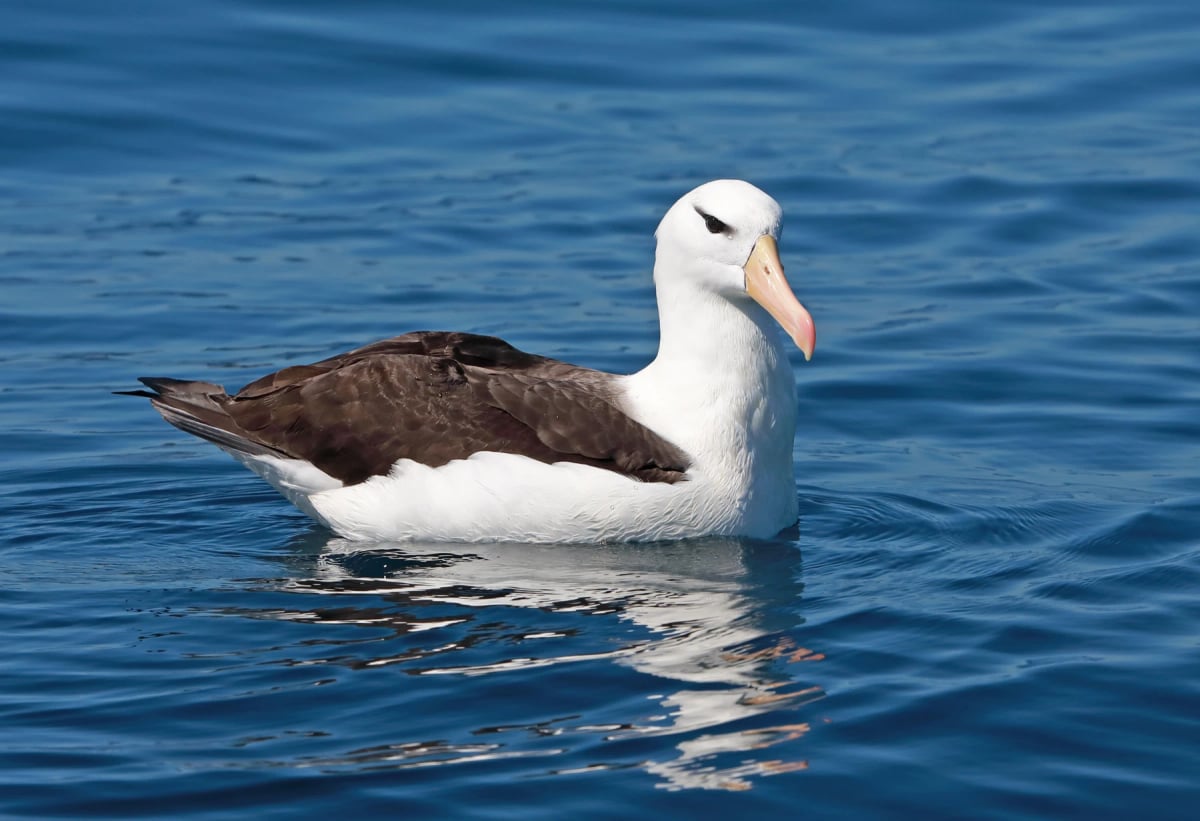
The black browed albatross (Thalassarche melanophris) is the most abundant and widespread of all albatrosses, circling the Southern Ocean on a wingspan that can reach 2.5 meters. Its name comes from the bold dark stripe above each eye, which gives the bird a permanently stern expression. It nests in large, noisy colonies on steep coastal cliffs across the Falkland Islands, Chile and several sub Antarctic islands, returning to the same nest site year after year and pairing for life. At sea it travels enormous distances, feeding on fish, squid, krill and carrion, often following fishing vessels for discarded catch. It can spend months aloft without landing. It is one of the few conservation success stories among albatrosses: listed as Endangered in the 2000s, it was downlisted to Near Threatened in 2013 and to Least Concern in 2018 as colonies stabilized, although bycatch in longline and trawl fisheries remains its biggest threat.
Habitat and distribution
The black browed albatross is a creature of the open Southern Ocean, spending most of its life over deep, cold, wind driven waters between roughly 35°S and 65°S. It breeds on steep coastal cliffs and grassy slopes across the Falkland Islands, southern Chile, South Georgia, the Kerguelen Islands and a handful of other sub Antarctic islands. The Falkland Islands alone support around 70 percent of the global breeding population, making them the single most important site for the species. New Zealand sits at the other extreme: barely 140 pairs nest there, most of them on Bollons Island in the Antipodes. Outside the breeding season, individuals disperse widely across the South Atlantic, South Pacific and Indian Ocean, and turn up regularly off South Africa, Namibia, Angola, Argentina, Uruguay and southern Brazil. Younger birds sometimes venture into the North Atlantic, and vagrants have been recorded as far north as Norway.
Built for the open ocean
Few birds are as physically suited to a life at sea as the black browed albatross. Its wingspan of up to 2.5 meters allows it to lock its wings and soar for hours using a technique called dynamic soaring, sweeping low over wave troughs to harvest wind energy with almost no muscular effort. A salt gland above the nasal passage actively filters excess salt from seawater, allowing the bird to drink from the ocean freely. Its hooked bill is lined with sharp, backward facing projections that grip slippery prey such as squid and fish with a secure hold. A highly developed sense of smell, uncommon among birds, helps it locate food across vast stretches of featureless ocean, and it can pick up the scent of a carcass from several kilometers downwind. Its dense, waterproof plumage retains body heat even in the frigid Southern Ocean, and its webbed feet make takeoff and landing on water practical.
Diet and feeding
The bulk of the diet is fish, squid and krill, taken at or just below the surface. The bird lands on the water and seizes prey with its bill, or makes a shallow plunge from low flight, and it can dive a few meters down when it needs to. Carrion matters too: dead squid and fish floating at the surface are easy calories for a bird that may be hundreds of kilometers from the nest. The habit that defines this species at sea, though, is following ships. Trawlers and longliners throw back enormous quantities of unwanted catch, and albatrosses gather behind them in squabbling crowds. That free meal is also what kills them, because the same boats carry the hooks and cables that drown and strike hundreds of birds every year.
Behavior and social life
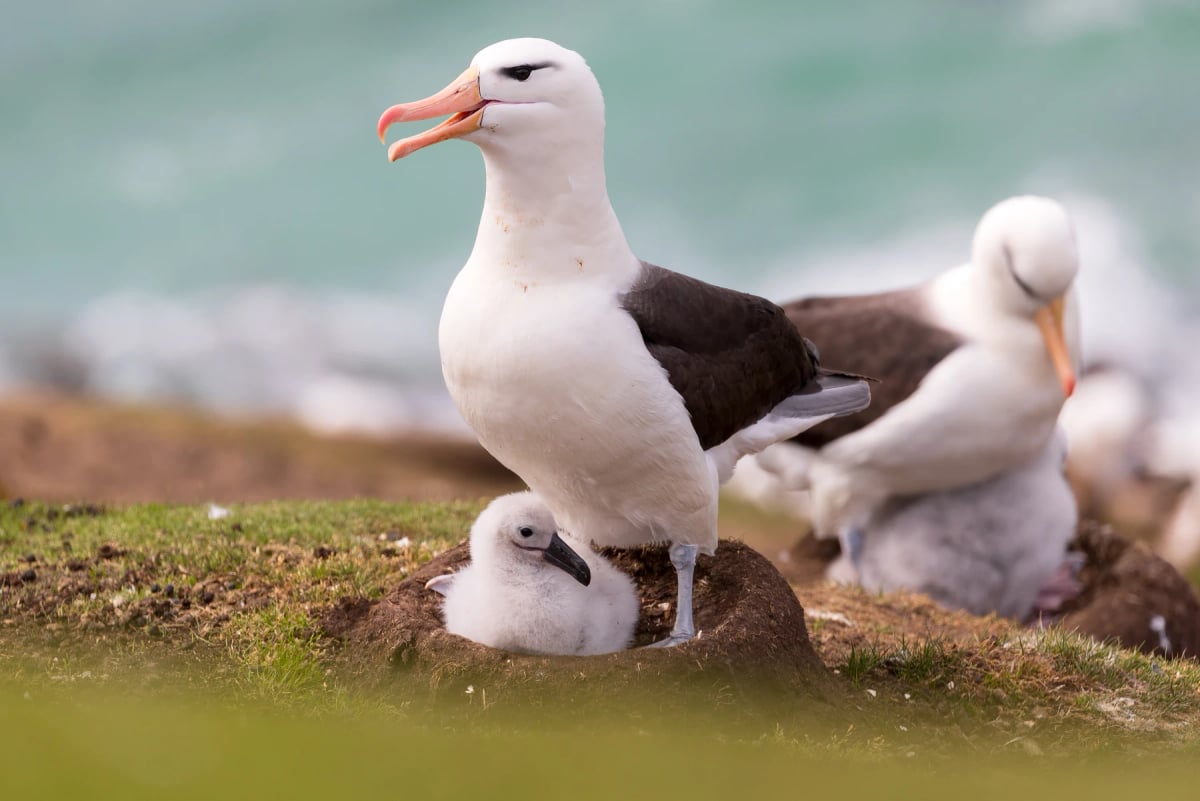
Black browed albatrosses are long lived birds that breed in dense, noisy colonies, often alongside penguins and other seabirds. Pairs form a bond that typically lasts for life, and both partners return to the same nest site each season. Courtship involves elaborate displays of bill clapping, sky pointing and synchronized calling that can take several years to refine before a young bird successfully secures a mate. Birds do not start breeding until around ten years of age. Each pair raises a single chick per season, sharing incubation duties over roughly 68 to 71 days, and the chick takes another four months to fledge. At sea, the birds are often seen trailing fishing vessels in search of discarded bycatch. They also engage in kleptoparasitism, stealing food from smaller seabirds. Foraging trips during chick rearing can cover thousands of kilometers, with GPS tracking studies showing birds regularly completing circuits of the South Atlantic within a matter of weeks.
Conservation
The black browed albatross is one of the few albatrosses whose story has improved. It was listed as Endangered in the 2000s, downlisted to Near Threatened in 2013 and finally to Least Concern in 2018, once surveys showed the big colonies were stable or growing again. The threat that caused the decline has not gone away. Longline fisheries are particularly dangerous: birds dive for baited hooks before they sink, get hooked and drown. Trawl cables also strike and kill birds in significant numbers each year. Plastic ingestion is an additional concern, as fragments accumulate in the stomachs of adults and chicks alike. The recovery is largely credited to mitigation measures promoted under agreements such as the Agreement on the Conservation of Albatrosses and Petrels: bird scaring lines, weighted hooks that sink faster and setting longlines at night. Population trends at key breeding sites like the Falkland Islands are monitored closely.
Where it is found
The Black browed Albatross can be found in places such as:
Researched and written by Juan Pablo. Sources: IUCN Red List, scientific literature and regional field guides. Last updated: .
Technical factsheet

Frequently Asked Questions
Is the black browed albatross endangered?
Not any more. It was listed as Endangered in the 2000s, moved to Near Threatened in 2013 and to Least Concern in 2018, after surveys showed the large colonies had stopped shrinking. That makes it one of the few albatrosses whose situation has improved. The reason for the recovery is mainly better fishing practice: weighted hooks, bird scaring lines and setting longlines at night all cut the number of birds killed as bycatch.
How big is a black browed albatross?
Its wingspan runs from 2.1 to 2.5 meters, which is wider than most people are tall, and the body is about 80 to 95 centimeters long. Weight sits between 2.9 and 4.7 kilograms. It is a mid sized albatross: the wandering albatross, its much larger relative, reaches well over three meters across. Males are slightly heavier than females, but the two sexes look alike.
Where do black browed albatrosses breed?
On cliffs and grassy slopes of cold southern islands. The Falkland Islands hold around 70 percent of the world's breeding pairs, at sites such as Steeple Jason, West Point and Beauchene. Southern Chile, South Georgia, the Kerguelen and Crozet archipelagos and a few other sub Antarctic islands hold most of the rest. New Zealand has the smallest share of all, roughly 140 pairs, nearly all of them on Bollons Island in the Antipodes.
How far do black browed albatrosses travel?
Enormous distances. GPS tracking of birds feeding a chick in the Falklands shows foraging trips of thousands of kilometers, with some individuals crossing large stretches of the South Atlantic and returning within weeks. Outside the breeding season the birds disperse even further, reaching the coasts of Africa, Australia and South America, and young birds occasionally stray into the North Atlantic. One famous wanderer spent years among gannets in Scotland.
How long does a black browed albatross live?
Black browed albatrosses are remarkably long-lived birds. In the wild, individuals regularly reach 70 years of age, and some banded birds have been recorded breeding well into their seventies. They do not begin breeding until they are around ten years old, spending their early years at sea refining courtship displays and scouting potential nest sites. This slow pace of maturity is typical among large seabirds.
What does the black browed albatross eat?
The black browed albatross feeds mainly on fish, squid, krill, and carrion picked from the ocean surface or caught in shallow dives. It is an opportunistic feeder and regularly follows fishing vessels to scavenge discarded catch. Its sharp, hooked bill and strong grip make it well equipped to handle slippery prey. During the breeding season, parents swallow food and regurgitate it as a rich, oily meal for their chick.
How fast can a black browed albatross fly?
Black browed albatrosses are capable of sustained speeds of around 80 kilometers per hour in strong winds, and short bursts can exceed that figure. Their remarkable efficiency comes from dynamic soaring, a technique that extracts energy from wind gradients above the waves rather than relying on continuous flapping. This allows them to cover enormous distances, sometimes several hundred kilometers in a single day, with very little energy expenditure.
Does the black browed albatross really mate for life?
Yes, black browed albatrosses form pair bonds that generally last for life. However, if a partner dies or repeatedly fails to raise a chick successfully, a bird may eventually seek a new mate. Establishing a new bond is a slow process, as courtship rituals are complex and take time to synchronize between two individuals. A stable, experienced pair tends to have noticeably better breeding success than a newly formed one.
Can the black browed albatross be found outside the Southern Ocean?
While the Southern Ocean is its true home, the black browed albatross does occasionally appear far outside that range. Younger birds in particular sometimes wander into the North Atlantic, and lone individuals have turned up off the coasts of Norway, Iceland, and even the British Isles. One famous bird spent decades visiting a gannet colony in Scotland. These sightings are rare but well documented and tend to attract considerable attention from birdwatchers.
How many eggs does a black browed albatross lay per year?
A breeding pair raises just one chick per season, produced from a single egg. Incubation lasts around 68 days, with both parents sharing the duty in alternating shifts. Once the chick hatches, it is guarded closely at first and then left alone at the nest while both adults head out to sea to forage. The chick fledges after approximately 120 days and heads out to sea independently, not returning to land for several years.
Why does the black browed albatross look angry?
The bird's perpetually stern expression comes from a thick, dark stripe of feathers running above each eye, similar in effect to furrowed brows on a human face. This marking is the origin of its common name. The stripe is not an expression of mood at all. It is simply a fixed feature of the bird's plumage. Whether it serves any communicative or camouflage function in the wild is not fully understood, but it makes the species immediately recognizable at sea.