Whale Shark
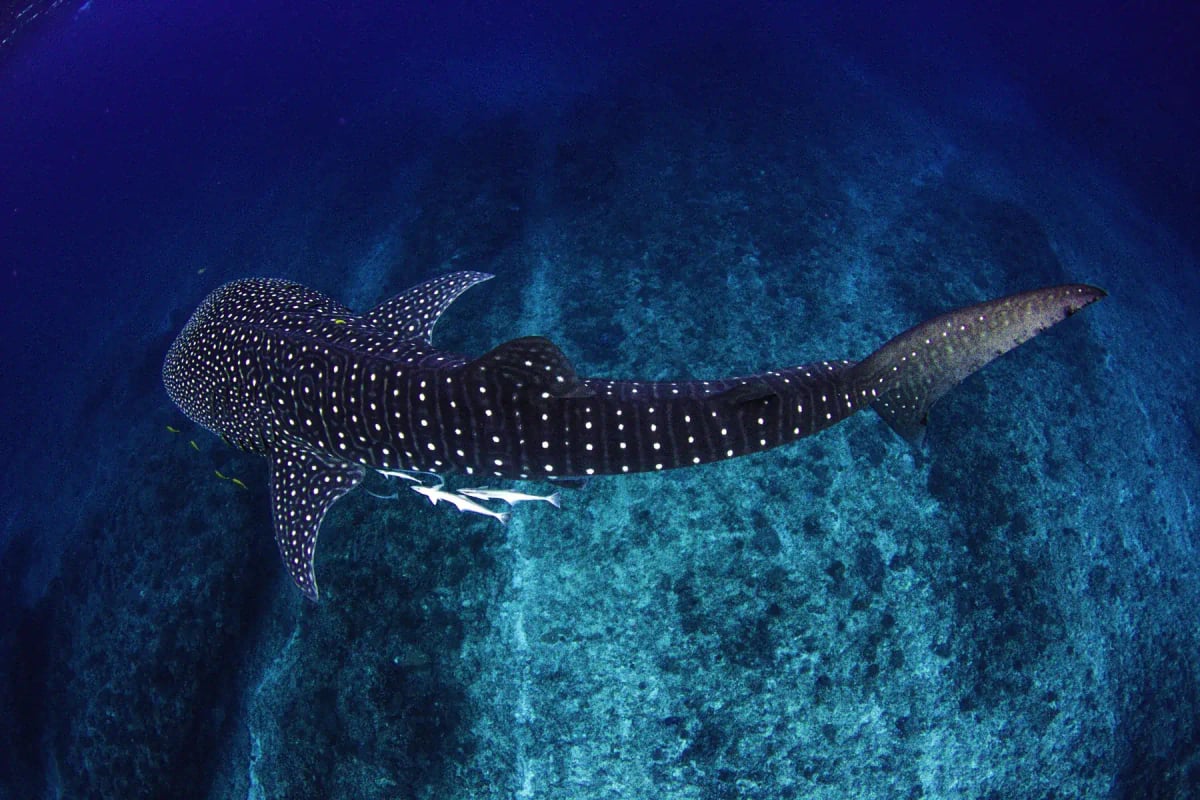
The whale shark (Rhincodon typus) is the largest fish in the world, reaching lengths of up to 18 meters yet feeding only on plankton and small fish. It inhabits tropical and warm temperate seas, often found drifting slowly near the surface with its enormous mouth open to filter food from the water. Despite its size, it is calm and harmless to people, and its unique pattern of spots lets researchers identify individuals over decades. Frequent contact with boats and fishing gear, combined with slow growth and late maturity, make it especially vulnerable, and the IUCN lists it as Endangered.
Habitat and distribution
Whale sharks live in tropical and warm temperate oceans around the world, generally favoring waters above about 21 degrees Celsius. They occur both close to shore, near coral reefs and continental shelves rich in plankton, and far out in the open ocean. Although they spend most of their time near the surface, satellite tracking shows that whale sharks regularly dive to depths beyond a thousand meters, likely to forage or regulate body temperature. Reliable aggregation sites exist in places such as Ningaloo Reef, the Yucatan Peninsula, the Philippines, the Maldives and Tofo Beach in Mozambique.
Diet
Whale sharks are filter feeders that consume enormous volumes of plankton, krill, fish eggs and small schooling fish such as sardines and anchovies, along with occasional squid. They feed using two methods, either swimming slowly with their mouth open to draw water across specialized gill rakers, or staying nearly still and pumping water through their mouth and gills using strong muscular suction. Both techniques trap food on fine sieve like structures while filtered water passes back out through the gill slits, letting a single shark process thousands of liters of seawater every hour.
Behavior
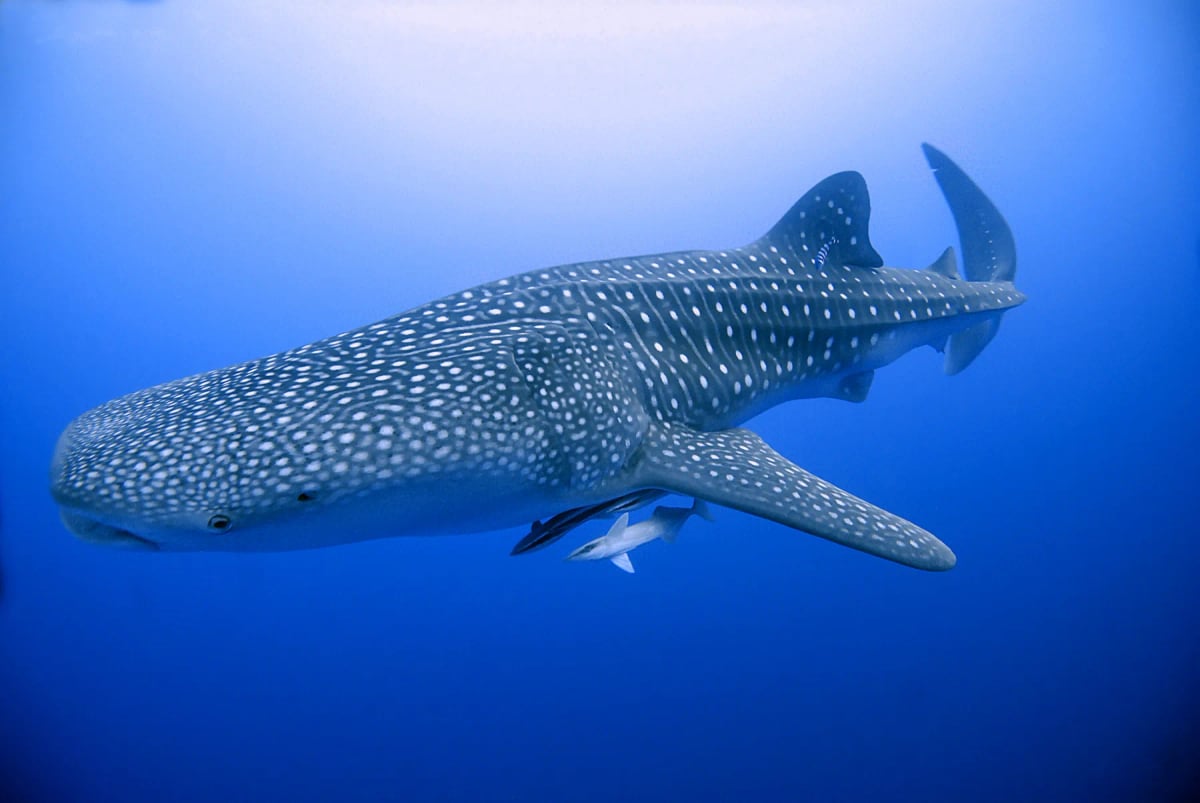
Despite reaching the size of a school bus, whale sharks are calm, slow moving animals that pose no threat to people and have never been confirmed to attack a human. They are largely solitary but gather in loose, non social aggregations wherever food is abundant, sometimes alongside dozens of other individuals at the same feeding ground. Each shark carries a unique pattern of spots, similar to a fingerprint, which researchers use to identify and track individuals across oceans through long term photo identification projects.
Migration
Whale sharks travel enormous distances, with satellite tagged individuals recorded crossing thousands of kilometers between feeding grounds and, in some cases, between ocean basins. Movements often track seasonal plankton blooms and the spawning events of fish such as mackerel, which release nutrient rich eggs that whale sharks gather to feed on. Because reliable pupping grounds have rarely been documented, scientists still know relatively little about where and how the species migrates to reproduce, making this one of the more active areas of whale shark research today.
Conservation
The whale shark is classified as Endangered by the IUCN, with populations in parts of the Indo Pacific estimated to have fallen by more than half over recent decades. Although several countries that once hunted whale sharks for meat, fins and oil have banned the practice, the species still suffers from accidental capture in tuna fisheries, collisions with ships near busy shipping lanes and aggregation sites, and stress from poorly managed tourism. International trade is restricted under CITES, and citizen science projects now help track individual sharks worldwide to support better protection.
Where it is found
The Whale Shark can be found in places such as:
Researched and written by Juan Pablo. Sources: IUCN Red List, scientific literature and regional field guides. Last updated: .
Technical factsheet













Frequently Asked Questions
Are whale sharks dangerous to humans?
Whale sharks are not dangerous to humans despite their enormous size. They are filter feeders with tiny teeth that play no role in feeding, and their diet consists entirely of plankton, fish eggs and small fish. There are no confirmed cases of a whale shark attacking a person. The main risk in an encounter usually comes from accidental contact, such as a diver getting bumped by the shark's tail or pectoral fin, which is why responsible tour operators keep a respectful distance.
How big do whale sharks get?
Whale sharks are the largest fish in the world, typically reaching between 10 and 12 meters in length, with some confirmed individuals measured at close to 18 meters. They can weigh as much as 15 to 30 tons, roughly comparable to a loaded truck. Despite this massive size, whale sharks grow slowly and do not reach full maturity until they are around 25 to 30 years old, which makes population recovery especially slow when numbers decline.
What do whale sharks eat?
Whale sharks feed almost entirely on plankton, fish eggs, krill and small schooling fish such as sardines and anchovies, occasionally taking squid as well. They filter enormous volumes of water through specialized gill rakers, either by swimming slowly with an open mouth or by pumping water in through strong suction while staying nearly still. A single whale shark can filter thousands of liters of seawater every hour, making it an efficient filter feeder despite its massive size.
Where can you swim with whale sharks?
Some of the most reliable places to swim with whale sharks include Ningaloo Reef in Australia, the waters around Isla Mujeres in Mexico, Donsol and Oslob in the Philippines, Tofo Beach in Mozambique and parts of the Maldives. Most of these sites have predictable seasonal windows tied to plankton blooms or fish spawning, and regulated tours follow guidelines that protect the sharks, such as keeping a safe distance and limiting the number of swimmers in the water at once.
How long do whale sharks live?
Whale sharks are thought to live between 70 and 130 years, making them one of the longest lived fish species known. Researchers estimate age mainly by counting growth bands in their vertebrae, similar to tree rings, since whale sharks cannot be reliably aged through external features alone. Their slow growth and late maturity, reaching adulthood only around 25 to 30 years of age, are closely tied to this long natural lifespan.
Are whale sharks endangered?
Yes, the whale shark is classified as Endangered by the IUCN, with some regional populations in the Indo Pacific estimated to have declined by more than half over recent decades. Major threats include accidental capture in tuna fisheries, collisions with ships near busy shipping lanes, and historical targeted hunting for meat and fins in several countries, much of which is now banned. International trade in whale shark products is restricted under CITES to help curb remaining pressure on the species.
Is a whale shark a whale or a shark?
A whale shark is a shark, not a whale, despite its enormous size and the name it carries. It belongs to the shark family Rhincodontidae and breathes through gills rather than lungs, unlike whales, which are mammals that breathe air at the surface. The name comes simply from its whale like size, since it is the largest fish in the world, far bigger than any other living shark species.