Chameleon
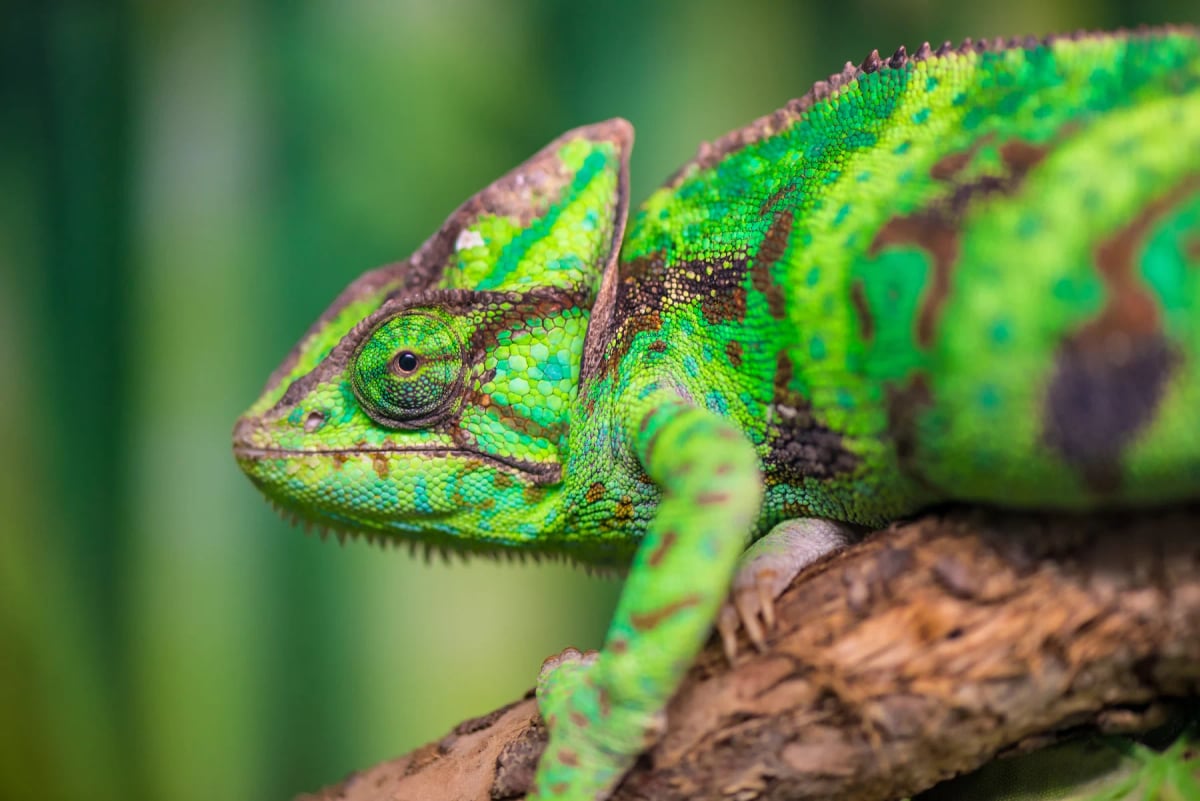
The common chameleon (Chamaeleo chamaeleon) is the only chameleon species native to Europe and is also found across North Africa, parts of the Middle East, and the Canary Islands. It favors warm, dry scrublands, olive groves, and the edges of open woodland where insects are plentiful. Two features set it apart from nearly every other vertebrate: eyes that rotate independently in almost any direction, giving close to 360-degree vision, and a ballistic tongue that can extend to twice the body length and snap back with prey in under a tenth of a second. Color change is driven primarily by mood, temperature, and social signaling rather than simple background matching. Iridophore cells beneath the skin reflect light differently as the animal expands or contracts them, producing a wide palette of greens, browns, yellows, and blacks. Habitat loss, road casualties, and collection for the pet trade are the main pressures on wild populations across its range.
Habitat and distribution
The common chameleon has one of the broadest ranges of any Old World chameleon. It is the only chameleon native to Europe, with populations established in southern Spain, Portugal, Greece, and several Mediterranean islands including Cyprus and Crete. Its range extends across North Africa, from Morocco and Algeria through Tunisia, Libya, and Egypt, and continues into the Middle East through Israel, Jordan, Lebanon, Syria, Iraq, Saudi Arabia, and Yemen. It also appears in the Canary Islands. Across this entire range the species gravitates toward warm, dry environments: scrublands dominated by mastic and other low shrubs, olive groves, coastal dunes stabilized by vegetation, and the open edges of woodland. It avoids dense forest interiors and very exposed terrain with no cover. Elevation records reach several hundred meters in some parts of its range.
Diet
Insects make up the overwhelming majority of what the common chameleon eats. Grasshoppers, crickets, beetles, flies, and moths are taken regularly, with the exact composition of the diet shifting according to what is locally abundant at any given time of year. The tongue is the species' primary hunting tool. It is launched from a specialized bone called the hyoid and can reach a distance of up to twice the animal's body length in a fraction of a second, with a sticky, muscular tip that secures prey on contact. The eyes assist the hunt equally well: each eye moves independently, allowing the chameleon to scan a wide field without moving its body, then converge both eyes forward to judge distance with precision before striking. Larger individuals will occasionally take small invertebrates beyond the typical insect prey.
Behavior
Solitary by nature, the common chameleon tolerates other individuals only briefly during the breeding season. Males are strongly territorial and will display vivid color patterns and flatten the body laterally to appear larger when confronting a rival. Outside of those encounters, this reptile moves with deliberate slowness through the vegetation, rocking gently in a motion thought to mimic a leaf stirred by wind. The feet are structured in a way that each splits into two opposing groups of toes, giving the animal a firm, pincer grip on branches of varying thickness. The tail is fully prehensile and used as a fifth anchor point during climbing. Most activity takes place during daylight hours. At night the chameleon rests on a branch and its skin often fades to pale tones, making it harder to spot.
Camouflage and color change
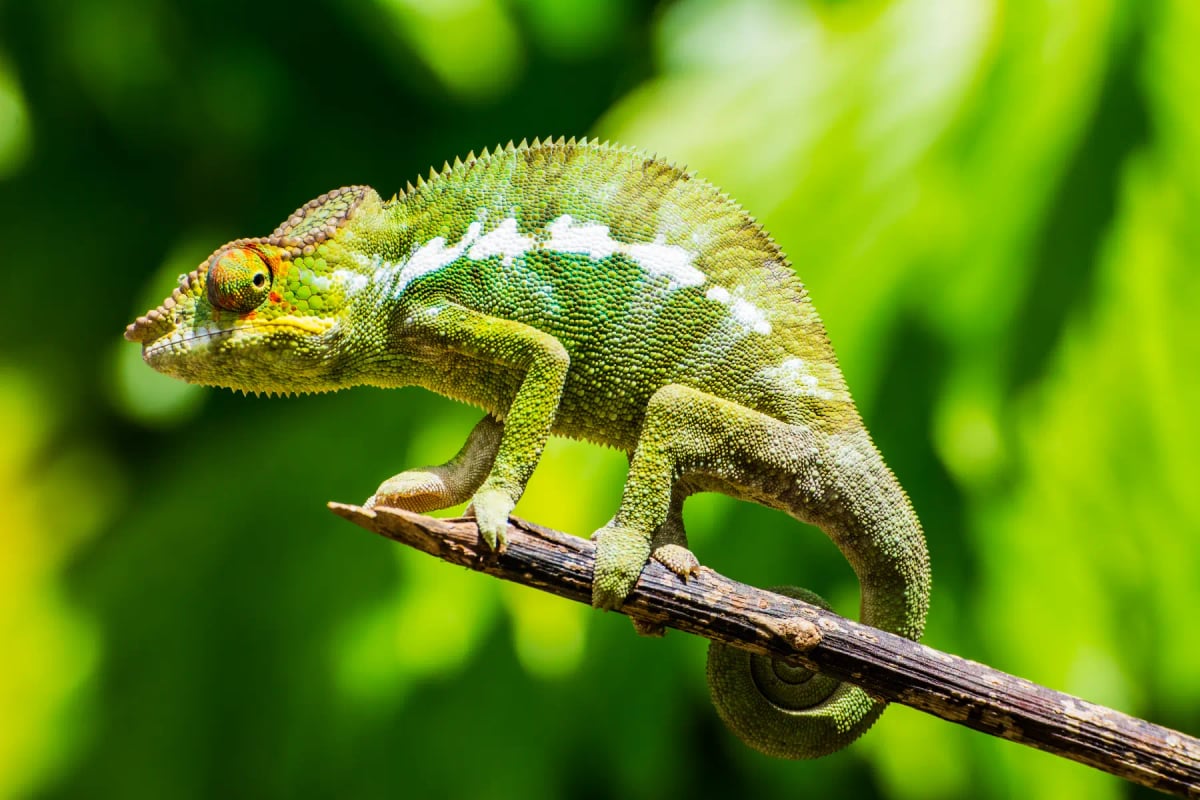
Color change in the common chameleon is far more nuanced than simple background matching. The process is driven by specialized cells in the skin called iridophores, which contain tiny crystals arranged in a lattice. When the animal relaxes or contracts these cells, the lattice spacing shifts and reflects different wavelengths of light, producing greens, yellows, browns, and near blacks without any change in pigment. Beneath the iridophores sit melanophores, which can spread or concentrate dark pigment to deepen or lighten the overall effect. The main triggers for color change are emotional state, social signaling, and thermoregulation. A male asserting dominance or competing for a female will display some of the boldest patterns. Temperature regulation is served by darkening the skin to absorb more warmth in the morning, then lightening it as the body reaches its preferred operating temperature.
Conservation
The IUCN currently lists the common chameleon as Least Concern, reflecting its wide range and the absence of a rapid overall decline. Even so, several pressures threaten populations at the local level. Coastal development and agricultural intensification across the Mediterranean have removed or fragmented the scrubland habitat this species depends on. Road mortality is a documented problem in areas where chameleons cross between patches of vegetation. Collection for the pet trade, though less severe than for some other chameleon species, continues to affect wild populations in parts of North Africa and the Middle East. In Spain and Portugal the species is legally protected, and it receives some coverage under European Union habitats legislation. Raising awareness among local communities remains one of the most practical measures for reducing unnecessary handling, road casualties, and deliberate persecution.
Where it is found
The Chameleon can be found in places such as:
Researched and written by Juan Pablo. Sources: IUCN Red List, scientific literature and regional field guides. Last updated: .
Technical factsheet





Frequently Asked Questions
Why do chameleons change color?
Color change is driven by mood, social signaling, and temperature regulation, not simply by matching the background. Specialized cells called iridophores contain tiny crystals that reflect different wavelengths of light when the animal expands or contracts them. A male competing for a female may flash bold patterns, while a cold chameleon darkens its skin in the morning to absorb warmth. Background camouflage is a side effect rather than the main purpose.
How does a chameleon catch its prey?
The chameleon fires its tongue from a specialized bone called the hyoid. The tongue can reach up to twice the animal's body length and strikes in a fraction of a second, with a sticky, muscular tip that secures the insect on contact. Before striking, both eyes converge forward to judge the exact distance to the target. The whole process from launch to retraction takes less than a tenth of a second.
What does the common chameleon eat?
Insects form the core of its diet. Grasshoppers, crickets, beetles, flies, and moths are among the most common prey, with the exact mix depending on what is locally available throughout the year. Larger individuals will occasionally take other small invertebrates as well. The chameleon is an ambush predator that waits patiently on a branch and relies on its extraordinary tongue and independent eye movement to secure a meal without giving itself away.
Where does the common chameleon live?
It is the only chameleon native to Europe, found in southern Spain, Portugal, Greece, and several Mediterranean islands. Its range also covers North Africa from Morocco to Egypt and extends into the Middle East through countries including Israel, Jordan, and Yemen. It favors warm, dry scrublands, olive groves, and the edges of open woodland. It avoids dense forest and exposed ground with no vegetation cover to hide in or climb on.
Is the common chameleon endangered?
The IUCN classifies it as Least Concern globally, meaning it is not currently facing a rapid overall decline. However, local populations face real pressure from coastal development, the loss of scrubland habitat, road casualties, and collection for the pet trade. In Spain and Portugal the species is legally protected. Awareness among local communities is considered one of the most practical ways to reduce unnecessary handling, road deaths, and deliberate persecution.
Can the common chameleon see in almost every direction at once?
Yes. Each eye moves completely independently of the other, rotating in almost any direction and giving the animal a field of view that approaches 360 degrees. This lets the chameleon monitor its surroundings for predators and prey without moving its body at all. When it spots something worth eating, both eyes swing forward together so the brain can measure distance with precision before the tongue is launched. It is one of the most remarkable visual systems of any vertebrate.
How does the chameleon move and grip branches?
The chameleon moves with deliberate slowness, rocking its body gently in a motion thought to mimic a leaf moving in the wind. Its feet are structured so the toes split into two opposing groups, forming a pincer grip that locks onto branches of different thicknesses. The tail is fully prehensile and acts as a fifth anchor point during climbing. This combination of grip and slow movement makes the animal remarkably secure in vegetation even during strong winds.