Emu
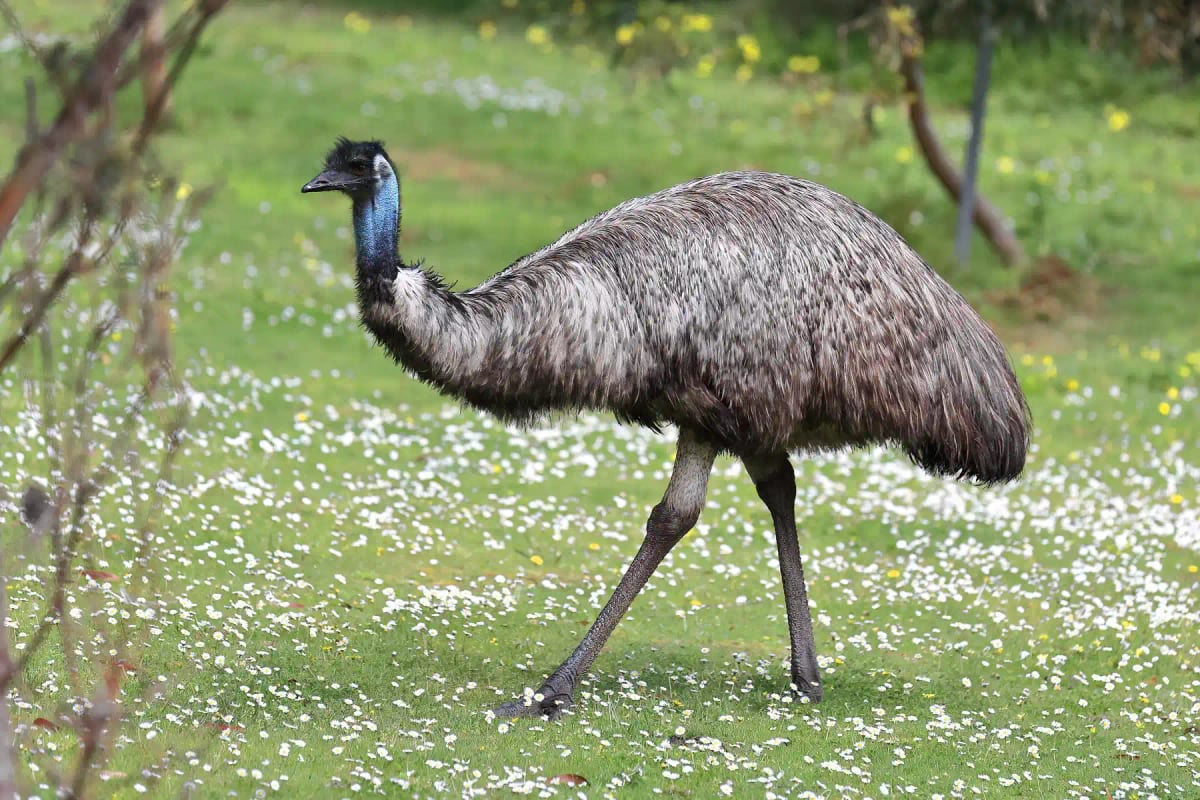
The emu is Australia's tallest bird and the second tallest bird on Earth after the ostrich, standing 1.5 to 1.9 meters tall and weighing 18 to 60 kilograms, with females slightly larger than males. It cannot fly, but its long, powerful legs carry it at up to 48 kilometers per hour with strides of nearly 3 meters, and it is also a good swimmer. Its shaggy gray brown feathers are unusual: each one has two plumes growing from a single shaft, and together they shield the bird from the fierce Australian sun. Emus live across most of mainland Australia, from savanna woodland to farmland and dry plains, moving long distances to follow rain and fresh food: seeds, fruits, shoots, and insects. Their breeding turns the usual roles upside down. The female courts the male, lays five to fifteen dark green eggs, and leaves. The male incubates them for about eight weeks without eating, drinking, or leaving the nest, losing about a third of his weight, and then guards the striped chicks for up to seven months. The emu appears on the Australian coat of arms beside the red kangaroo, and the IUCN lists it as Least Concern.
Emu vs ostrich: what's the difference?
Emus and ostriches are both huge, flightless running birds, and they are often confused, but they live on different continents and are not especially close relatives. The ostrich is African, while the emu is Australian, and its nearest living relatives are the cassowaries of Australia and New Guinea. The easiest difference is size. The ostrich is the tallest and heaviest bird in the world, standing up to about 2.75 meters and weighing 90 to 145 kilograms, while the emu reaches about 1.9 meters and 18 to 60 kilograms. Ostriches are also faster, reaching about 70 kilometers per hour against the emu's 48. Look at the feet: an ostrich has only two toes on each foot, the only bird with so few, while an emu has three. The plumage differs too. Male ostriches are black and white with bare pink or gray necks and legs, and females are gray brown, while both sexes of emu wear the same shaggy gray brown feathers that cover most of the neck. Their eggs are easy to tell apart: an ostrich egg is cream colored and weighs about 1.4 kilograms, while an emu egg is dark green and weighs 450 to 650 grams. Even parenting differs: ostrich pairs share incubation, the female by day and the male by night, while the male emu does it all alone.
Emu feathers and appearance
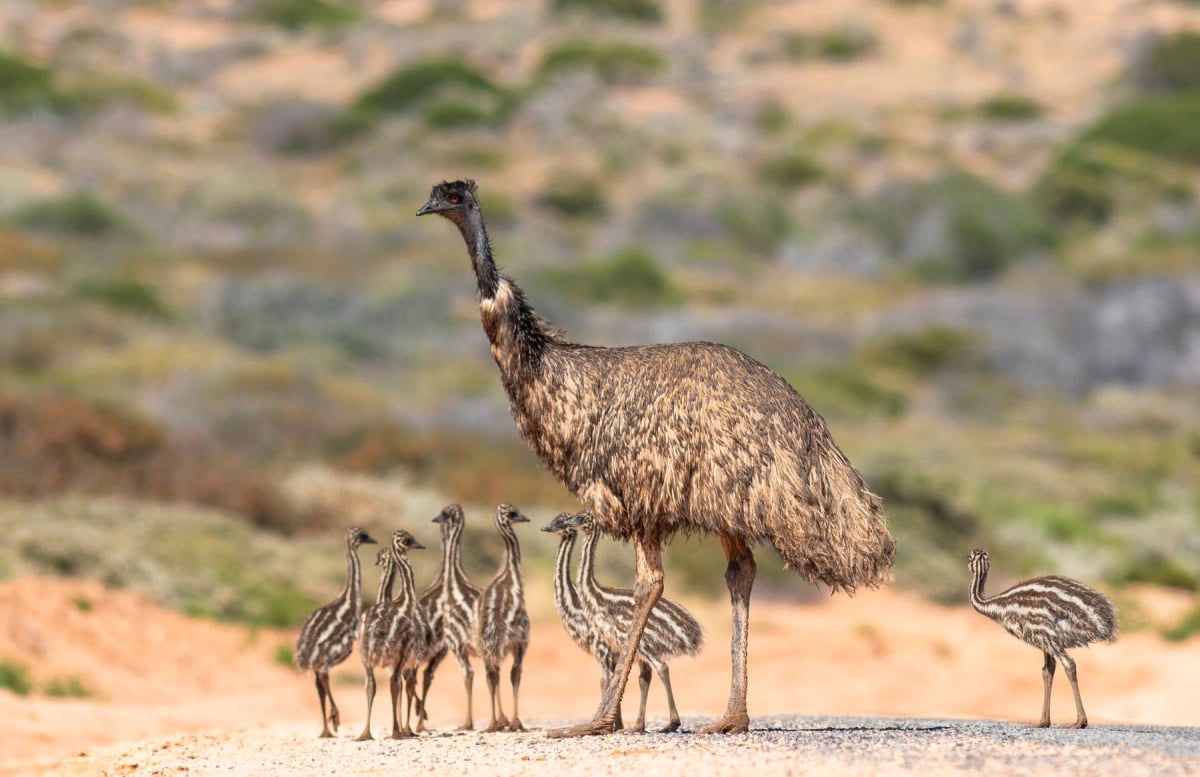
An emu's plumage looks more like shaggy hair than feathers, and for good reason. Each feather has a double rachis: two separate plumes grow from a single shaft, which is very unusual among birds. The feathers lack the tiny hooks that zip the barbs of most feathers together, so they hang loose and soft. That loose coat is an excellent shield against the sun. The tips of the feathers absorb heat and the inner part insulates the skin, so an emu can stay active in the heat of the day, and the same layer keeps it warm on cold desert nights. Color varies with the landscape: emus in dry regions with red soil often have a rusty tint, while birds from damper areas are darker. The neck is pale blue and shows through the thin feathers, and during courtship the female's plumage darkens and small patches of bare skin near her eyes and bill turn turquoise blue. Chicks look completely different, with cream and dark brown stripes that camouflage them in the grass, which fade by about three months old. White emus also exist, but they are leucistic birds, with a genetic lack of pigment, and are seen mostly in captivity.
Habitat and range
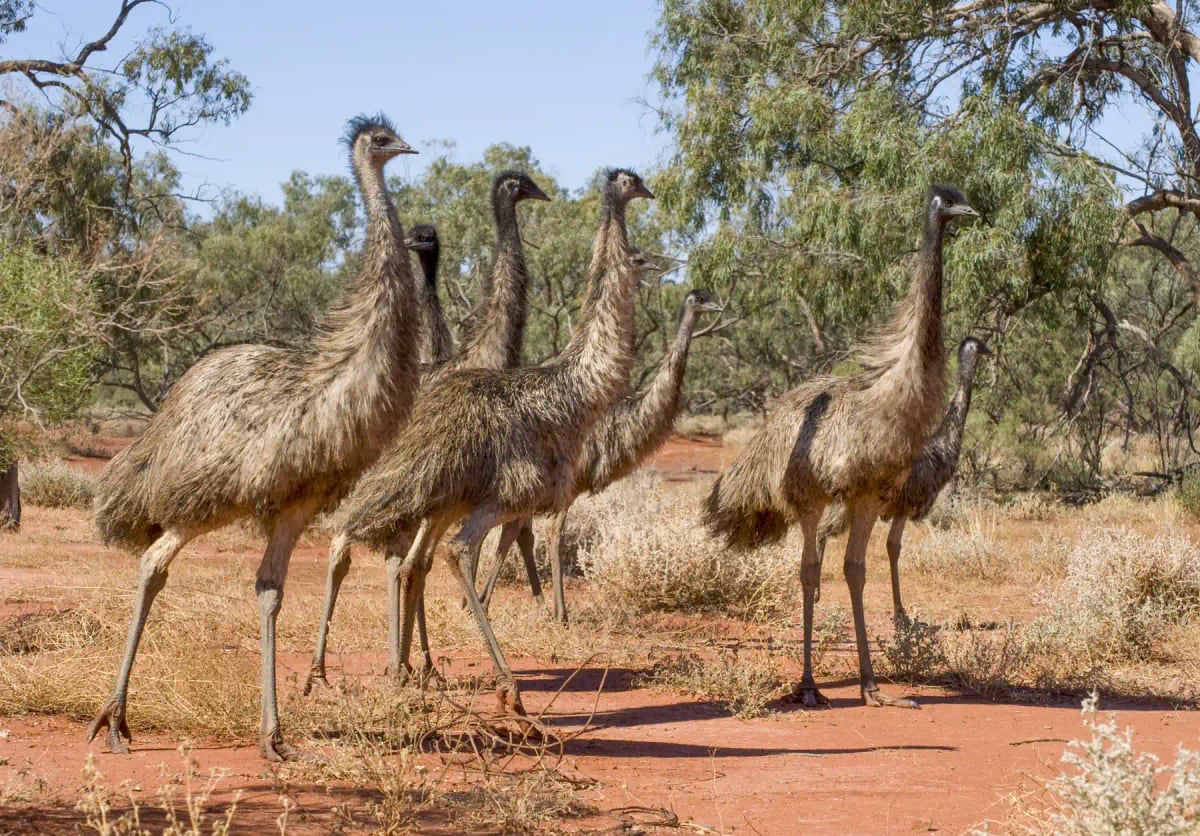
Emus are found across almost all of mainland Australia, making them one of the most widely distributed large animals on the continent. They are most common in savanna woodland and open eucalypt forest, but they also live in grasslands, shrublands, farmland, coastal heath, and the arid plains of the interior. They are least common in heavily populated districts and in the driest deserts, and they avoid the dense rainforests of Queensland's wet tropics. Emus are nomads. Their movements follow rain and the flush of new plant growth that comes after it, and in Western Australia they make regular seasonal journeys of hundreds of kilometers, north in summer and south in winter. They can go several days without water, but they drink daily when they can. Before Europeans arrived, emus also lived on Tasmania, King Island, and Kangaroo Island. All three island forms are now extinct: the Tasmanian emu by 1865, and the smaller King Island and Kangaroo Island emus soon after Europeans arrived, lost to hunting and fire. On the mainland, the population is thought to be larger today than before European settlement, thanks to farm dams and cleared land.
Diet
Opportunistic by nature, emus eat a wide variety of plant and animal matter depending on what is available at any given time of year. Seeds, fruits, flowers, and young shoots of native plants such as acacias and casuarinas form the bulk of their diet, along with grasses and introduced plants and crops. They also eat plenty of insects and other small animals: grasshoppers, crickets, beetles, cockroaches, caterpillars, ants, spiders, and millipedes. In Western Australia, studies have shown a clear seasonal menu: mulga acacia seeds until the rains arrive, then fresh grass shoots and caterpillars, the leaves and pods of cassia bushes in winter, and grasshoppers in spring. Emus swallow stones, up to about 45 grams each, which sit in the gizzard and help grind tough food, and a single bird can carry as much as 745 grams of stones at once. When food is scarce, they live on fat reserves built up during good times. Because many seeds pass through their gut intact, emus spread plants over huge distances, and some native plants depend on them to do it.
Reproduction
Breeding in emus involves an unusual division of roles that sets them apart from most birds. It is the female who courts the male: her plumage darkens, the bare skin near her eyes turns turquoise, and she circles him while making booming calls. Pairs form in summer and stay together for about five months, and in the cooler months of autumn and winter the female lays a clutch of five to fifteen large, thick shelled, dark green eggs, each about 13 by 9 centimeters and weighing 450 to 650 grams. Then the male takes over entirely. He sits on a rough nest of grass, leaves, and bark on the ground and incubates the eggs for about 56 days, during which he does not eat, drink, or defecate, standing only to turn the eggs, and he loses about a third of his weight. Meanwhile, the female often leaves to mate with other males, and up to half the chicks in a brood may not be his. The striped chicks hatch ready to walk and leave the nest within days. The father guards them for up to seven months, teaching them how to find food and defending them fiercely, and they reach full size at five to six months.
Behavior
Few birds match the emu for sheer physical capability. It can sprint at up to 48 kilometers per hour on powerful three toed feet, taking strides of about 2.75 meters at full gallop, and its pelvic muscles are specially built for running. It is also a confident swimmer, crossing rivers and lakes when necessary. Emus are active during the day, though they rest in the hottest part of the afternoon, and they sleep at night in short bouts, sitting down with their heads tucked. They live in loose groups rather than tight flocks, and in some years they gather in large numbers when many birds move toward the same area of fresh rain. Emus communicate with a range of sounds: females make a loud, deep booming call using an inflatable pouch in the throat, which can be heard up to about 2 kilometers away, while males mostly grunt. Their curiosity is famous. Emus often approach people, cars, and anything that moves or flashes, and they will investigate objects by pecking them. When threatened, they can defend themselves with powerful kicks from their clawed feet, strong enough to injure a dog.
The emu in Australian culture
The emu is one of Australia's national symbols. Since 1908 it has appeared on the Australian coat of arms, standing opposite the red kangaroo and holding up the shield, and it features on the Australian 50 cent coin as part of the arms. A popular explanation for the choice is that neither animal walks backward easily, making them symbols of a nation moving forward, although this is a later story rather than the official reason. Long before that, the emu was central to Aboriginal cultures across the continent. Many Aboriginal language groups see a giant emu in the night sky, formed not by stars but by the dark dust lanes of the Milky Way, with its head at the Coalsack near the Southern Cross. The position of this sky emu through the year was used to know when emus were laying eggs on the ground, a time to collect them. The name emu itself probably comes from Portuguese: early explorers used ema for large flightless birds such as ostriches and cassowaries, and the word stuck. Today emus are farmed in Australia and elsewhere for meat, leather, feathers, and emu oil, which is sold as a skin product.
Conservation
The IUCN lists the emu as Least Concern. A 1992 census estimated between 630,000 and 725,000 birds, and numbers rise and fall naturally with droughts and good rainy years. On the mainland, farming has actually helped emus in many areas by providing water from stock dams and open grazing land. The species does face local pressures: land clearing reduces habitat in some regions, collisions with vehicles kill many birds on rural roads, and fences can block their long seasonal journeys. Farmers in the wheat belt of Western Australia have long seen emus as pests, and in the 1930s tens of thousands were killed in a single year. The most famous episode is the Emu War of 1932, when the Australian army sent soldiers with machine guns to drive off about 20,000 emus that were damaging wheat crops. The birds scattered into small groups and proved extremely hard to hit, and after weeks of effort and thousands of rounds of ammunition the operation was called off, a story often told as a war the emus won. Today, emu proof fencing is the main tool for protecting crops. The loss of the island emus of Tasmania, King Island, and Kangaroo Island is a reminder that the species was not always this secure.
Researched and written by Juan Pablo. Sources: IUCN Red List, scientific literature and regional field guides. Last updated: .
Technical factsheet




Frequently Asked Questions
Is an emu bigger than an ostrich?
No. The ostrich is bigger in every way. It stands up to about 2.75 meters tall and weighs 90 to 145 kilograms, while the emu reaches about 1.9 meters and 18 to 60 kilograms. The ostrich is also faster, at about 70 kilometers per hour against the emu's 48, and it lays much bigger eggs. The emu is still the second tallest bird in the world, and the largest bird in Australia by height, though the southern cassowary can be heavier.
How fast can an emu run?
An emu can run at up to about 48 kilometers per hour, and it can keep up a fast trot over long distances. At full gallop its strides stretch to about 2.75 meters, and its legs have special muscles in the pelvis and calf built for running. That speed is its main defense against dingoes, along with sharp turns and powerful kicks.
Are emus dangerous?
Emus are not usually dangerous, and wild ones tend to avoid people, although they are famously curious and may walk up to cars and campers looking for food. Their legs are very strong and each foot has three toes with sharp claws, so a frightened or cornered emu can kick hard enough to injure a person or a dog. Males guarding chicks can be protective. The safest approach is to watch them from a distance and never feed them, since birds that get used to handouts become bolder.
Were there emus in Tasmania?
Yes. Tasmania had its own emu, usually treated as a subspecies, the Tasmanian emu. It was hunted heavily after European settlement, and its habitat was burned and cleared, and it was extinct by 1865. Two smaller island emus, on King Island and Kangaroo Island, also disappeared shortly after Europeans arrived. The emus seen in Tasmania today are mainland birds kept in wildlife parks, not survivors of the original island population.
Why are emus on the Australian coat of arms?
The emu and the red kangaroo have held up the shield on the Australian coat of arms since 1908, as two animals found only in Australia and known around the world. A popular story says they were chosen because neither can easily walk backward, symbolizing a country that only moves forward, but that explanation was added later and is not the official reason. The coat of arms, with the emu, also appears on the Australian 50 cent coin.
Can emus fly?
No, emus cannot fly at all. Their wings are tiny, about 20 centimeters long, and hidden under their body feathers, though they flap them while running, which may help with balance. What they lack in the air, they more than make up for on the ground. Emus can run at up to 48 kilometers per hour with strides of nearly 3 meters, and they are surprisingly strong swimmers too, crossing rivers and lakes with ease when they need to.
What do emus eat?
Emus eat a wide variety of foods depending on the season. Seeds, fruits, flowers, and young shoots are their main staples, but they also eat plenty of insects, such as grasshoppers, crickets, beetles, and caterpillars. They swallow small stones, sometimes more than 700 grams in total, to help grind tough plant material in their gizzard. When food is scarce, they can survive on fat reserves built up during better times, and they travel long distances to follow rain and fresh growth.
Where do emus live?
Emus are found across almost all of mainland Australia. They prefer open landscapes such as grasslands, dry woodlands, shrublands and the vast arid plains of the interior. They do well in areas with low or unpredictable rainfall and tend to follow rain events in search of fresh food. They generally avoid dense rainforests and busy urban areas.
How tall is an emu?
Emus are the tallest birds in Australia and the second tallest birds on Earth, standing 1.5 to 1.9 meters tall. Only the ostrich is taller. In weight they rank fourth or fifth, after the two ostrich species and the two largest cassowaries, at 18 to 60 kilograms. Despite their impressive size, they are fast and agile. Females are slightly larger than males, averaging about 37 kilograms against 31.5 for males.
Do male or female emus raise the chicks?
The male does all the work. After the female lays her clutch of five to fifteen eggs, she leaves, and the male takes over completely. He incubates the eggs for about 56 days without eating, drinking, or defecating, and loses about a third of his body weight. He then raises the striped chicks on his own for up to seven months, protecting them and teaching them to find food. Surprisingly, up to half the chicks he raises may have been fathered by other males.
Are emus endangered?
No, emus are not endangered. The IUCN classifies them as Least Concern, and a 1992 census estimated between 630,000 and 725,000 birds across Australia. Numbers go up and down with drought cycles, and there are local pressures such as land clearing and road collisions, but the mainland population is large and may even be bigger than before European settlement. The island emus of Tasmania, King Island, and Kangaroo Island, however, were all wiped out in the 1800s.
What is the Emu War?
In late 1932, the Australian government sent soldiers armed with machine guns to the wheat belt of Western Australia to drive off about 20,000 emus that were damaging crops and fences. The operation, quickly nicknamed the Emu War, turned into something of a fiasco. The birds scattered into small groups, ran fast, and were very hard to hit, and after several weeks and thousands of rounds of ammunition the effort was abandoned. It remains one of the most unusual wildlife management stories in history, often told as the war the emus won.