Raggiana Bird of paradise
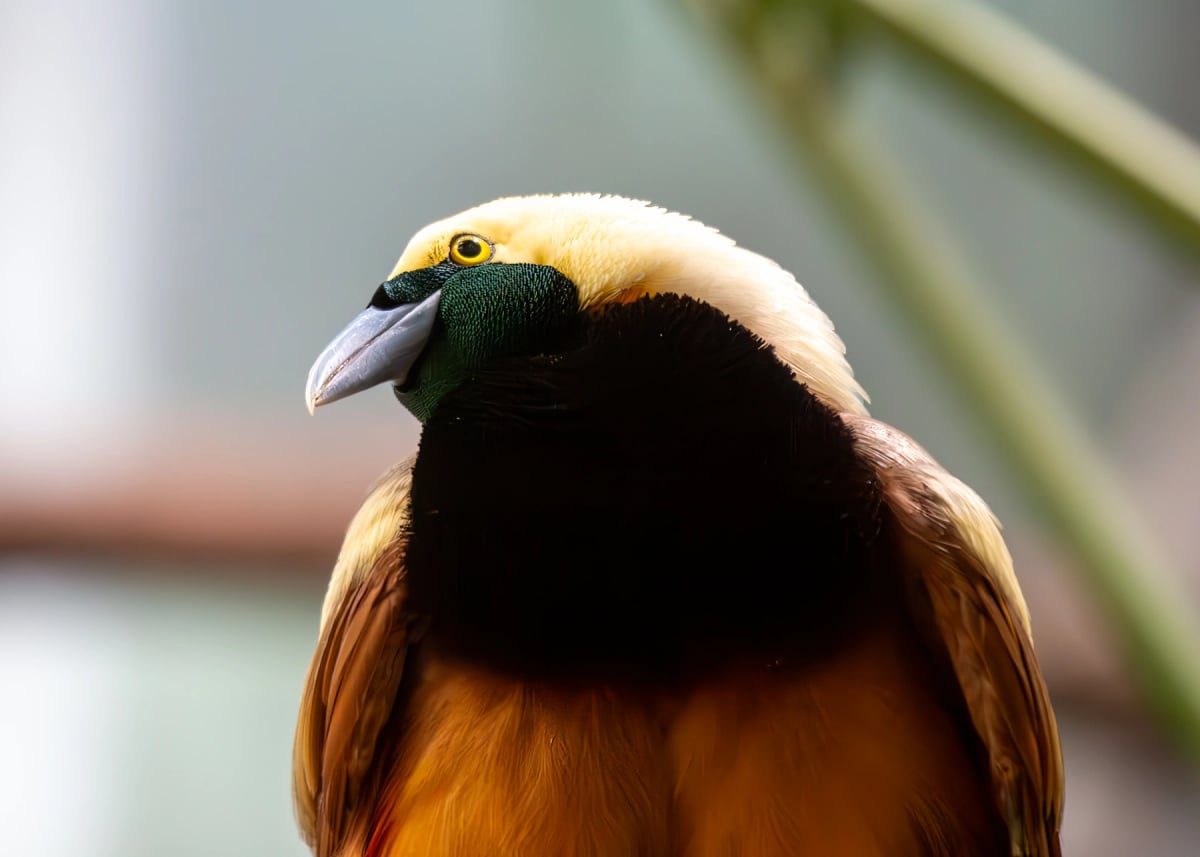
The Raggiana bird of paradise is the national bird of Papua New Guinea and one of the most spectacular birds on Earth. A male is about 34 centimeters long, with a pale orange yellow head, an iridescent emerald green face and throat, and two thin tail wires that can trail another 60 centimeters behind him. What made the species famous are the flank plumes: dense sprays of feathers that run from deep crimson in the south of the range to apricot orange in the north, and that a male throws over his back while he displays. Males gather at traditional display trees called leks, where they clap their wings, shake their heads, hang upside down and call loudly to compete for the females watching from nearby perches. Females are plain maroon brown, carry no plumes and raise the chicks alone. The species lives in lowland and hill rainforest across southern and northeastern New Guinea, almost all of it in Papua New Guinea, with the western edge of the range crossing into Indonesia. It feeds mainly on figs and other fruit, plus insects, and because it swallows fruit whole it is one of the main seed dispersers of the forests it lives in. The IUCN lists it as Least Concern, though forest clearance and hunting for ceremonial plumes are real pressures at a local level.
Size and appearance
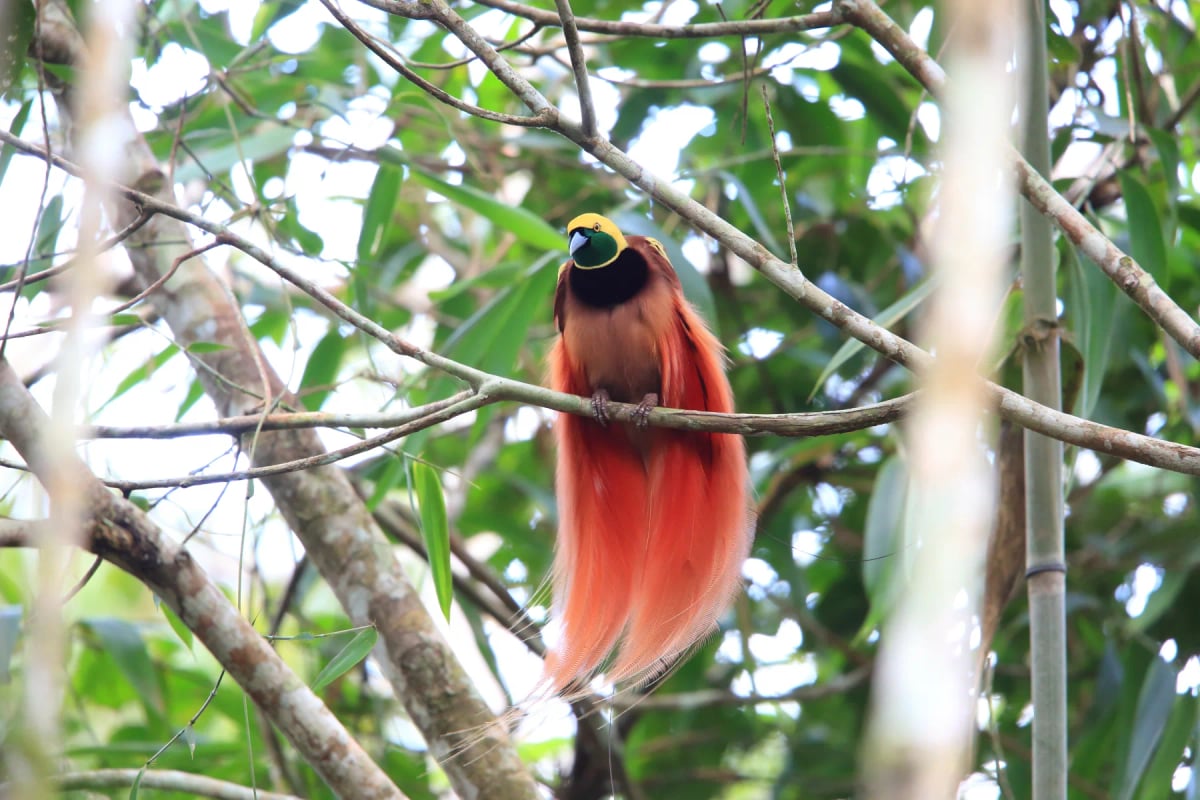
A male Raggiana bird of paradise measures about 34 centimeters from bill to tail, and a female about 33, which is ordinary until the ornaments are counted. Two wire like central tail feathers can add another 60 centimeters, and from the flanks grows the cascade of plumes the species is known for. The head is pale orange yellow, the face and throat iridescent emerald green, the bill pale bluish grey and the eye yellow. Plume color changes across the range: deep crimson red in the south and southeast, shading to apricot orange in the northern populations near Madang, so birds from opposite ends of the country look like different species. Females are another bird at first glance, maroon brown with a dark head and paler underparts, and no plumes at all. Young males look like females for years, because a male needs roughly seven years to grow the full adult plumage he will display with. Weights are modest for such a showy bird, around 220 grams in males and 170 in females.
Habitat and distribution
The Raggiana bird of paradise lives in the lowland and hill rainforests of New Guinea, from sea level up to around 1,500 meters. Almost all of its range lies in Papua New Guinea, across the south and southeast, west to the Fly and Strickland rivers, inland into highland valleys such as the Wahgi and the Tari, and north to the Ramu and Gogol rivers near Madang. At its western edge the range crosses the border into Indonesian New Guinea, in the Trans Fly, which is why the IUCN lists the species for two countries even though Indonesia holds only a narrow strip of it. It favors dense forest with plenty of fruiting trees, but it also uses forest edges, regrowth and gardens next to intact woodland, and that flexibility is one reason it still turns up near villages and on the outskirts of Port Moresby. Because it depends on large blocks of rainforest for the fruit supply that feeds a lek, the state of the forest decides where it thrives rather than where it merely survives.
Diet
Fruit makes up the greater part of this bird's diet, with figs a clear favorite alongside capsular fruits, nutmegs and other forest fruit. It also takes insects and other arthropods, which matter most when a female is feeding chicks that need protein to grow. The Raggiana forages in the canopy and the middle layers of the forest, working a circuit of fruiting trees across a home range and often feeding in loose company with other fruit eating birds. Because it swallows fruit whole and passes the seeds intact some distance away, it is one of the main dispersers for several rainforest trees, including species of mahogany and nutmeg whose seeds are too large for most other birds to handle. That relationship runs both ways: the trees depend on the bird to move their seeds away from the parent, and the bird depends on the trees to keep a lek supplied with food through the year.
Courtship displays
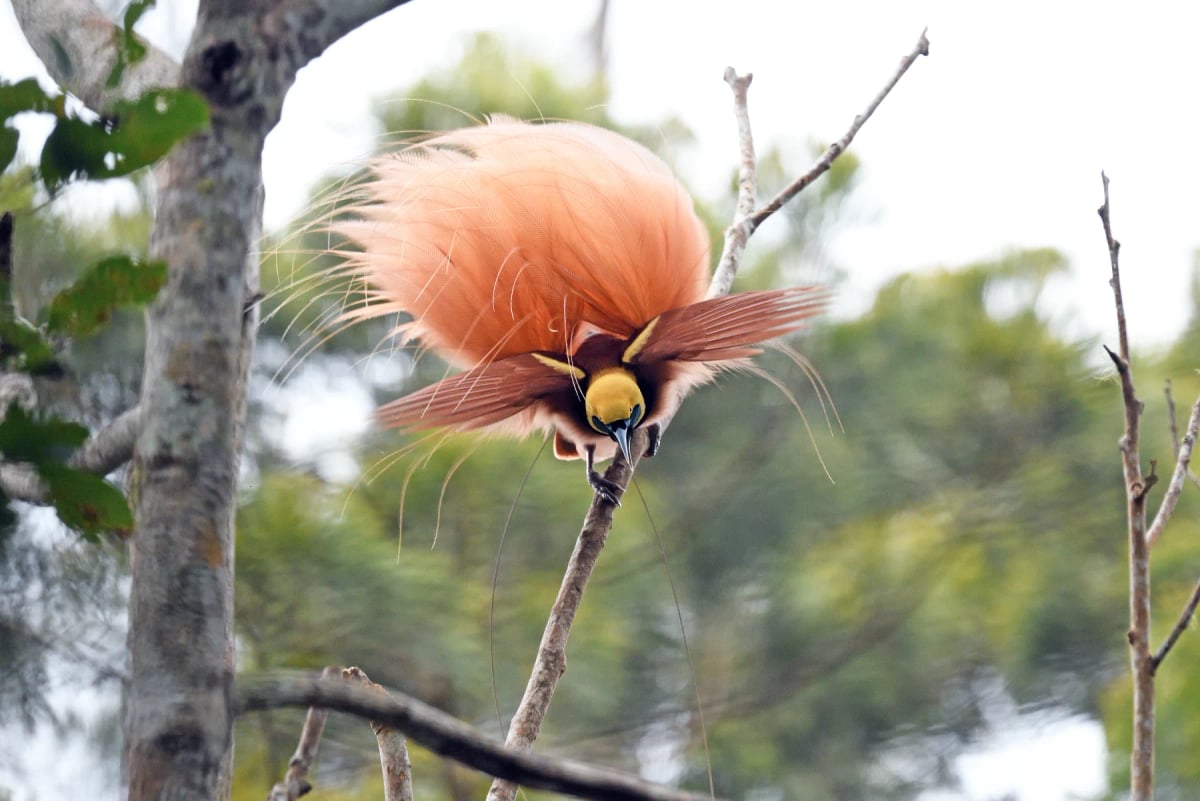
Few wildlife spectacles anywhere match the courtship of the Raggiana bird of paradise. Males gather in display arenas 30 to 100 meters across, a group of tall slender trees used year after year, where each male fights for the most prominent perch and defends it from rivals. The performance starts with loud, far carrying calls that rise in pitch and intensity, a series of wau wau wau notes that carry through the forest and are usually how a birder finds a lek in the first place. Then come the wing clapping, the head shaking, the plumes thrown forward over the back, and the moment the species is famous for, the male hanging upside down from the branch with the flank plumes fanned open around him. Females watch from nearby perches and mate with very few of the males present, which is the engine of the whole system: because only the best performers breed, generation after generation has pushed the plumage and the choreography further. Displays peak in the first hours after dawn.
Nesting and chicks
Once mating is over the male returns to the lek and takes no further part. The female does everything alone, starting with an open, bowl shaped nest of leaves, stems, ferns and other plant fibers, usually placed between 2 and 11 meters above the ground in a tree fork or a tangle of vines. She lays one or two pinkish buff eggs, two being the usual clutch, and incubates them by herself for about 18 days in the wild and up to 20 in captivity. The chicks hatch naked and helpless and leave the nest roughly 17 to 20 days later, still dependent on her for a while afterwards. This division of labor is what a lek system produces: the male invests everything in plumage and performance, the female in raising the young, and a successful male may father chicks with several females in a season while most males father none. It also explains the female's plain brown plumage, which keeps her hidden on the nest.
Cultural importance
This species sits at the center of Papua New Guinean identity. It flies across the red half of the national flag, adopted on 1 July 1971 from a design by Susan Karike, who was fifteen years old at the time, and it stands above a traditional spear and a kundu drum on the national emblem, which in turn appears on the country's banknotes. In Tok Pisin the bird is the kumul, a word that has become shorthand for the country itself: the national rugby league team is the Kumuls. For many communities the plumes have been part of ceremonial headdresses for centuries, worn at sing sings and other important occasions, and the best headdresses are heirlooms passed down through generations rather than made fresh each time. That cultural weight cuts both ways. It has kept demand for feathers alive, but it also means the bird is genuinely valued across the country, which gives conservation a base of local support that few species anywhere can count on.
Conservation
The IUCN rates the Raggiana bird of paradise as Least Concern: the population has not been quantified, but the bird remains common and widespread across a large part of New Guinea, and it is not thought to be declining fast enough to qualify for a threatened category. Like all birds of paradise it is listed on Appendix II of CITES, a legacy of the plume trade that shipped huge numbers of skins to European hat makers around 1900 and that national law ended long ago. Today the pressures are different. Logging, oil palm and clearance for gardens keep shrinking the intact lowland forest the species depends on, and that is the threat that matters most. Traditional hunting for headdress plumes continues, but it is concentrated on adult males and much of it feeds heirloom pieces rather than new ones, so its impact is local rather than national. Keeping large blocks of lowland rainforest connected across Papua New Guinea is what will decide this bird's future.
Where it is found
The Raggiana Bird of paradise can be found in places such as:
Researched and written by Juan Pablo. Sources: IUCN Red List, scientific literature and regional field guides. Last updated: .
Technical factsheet

Frequently Asked Questions
Why is it called the Raggiana bird of paradise?
The name comes from Europe, not New Guinea. The species was described in 1873 by the ornithologist Philip Lutley Sclater, who named it Paradisaea raggiana at the request of the Italian naturalist Luigi Maria D'Albertis, after his friend the Marquis Francesco Raggi of Genoa. In Papua New Guinea itself nobody uses that name: the bird is the kumul, the Tok Pisin word for bird of paradise, and that is the name on team shirts, signs and everyday speech.
Is the Raggiana bird of paradise found outside Papua New Guinea?
Only just. The IUCN lists it for two countries, Papua New Guinea and Indonesia, but the split is very uneven: almost the entire range is Papua New Guinean, and on the Indonesian side the species reaches only the Trans Fly, the strip of country just across the border in southern Indonesian New Guinea. Outside the island of New Guinea it does not occur in the wild anywhere, which is part of why it works so well as a national symbol.
Where is the best place to see a Raggiana bird of paradise?
Varirata National Park, about 40 kilometers from Port Moresby on the Sogeri plateau, is the classic spot and the easiest one to reach on a short trip. It holds long established display trees where several males gather, and the park records more than 200 bird species, including several other birds of paradise. The displays happen high in the canopy in the first hours of daylight, so visitors who want to see one aim to be at the tree by about six in the morning.
What sound does the Raggiana bird of paradise make?
A displaying male gives a loud, far carrying series of notes that rises in pitch and intensity, usually written as wau wau wau, with the last notes drawn out. The sound travels a long way through dense forest and is normally how people locate a lek long before they see a bird. Males also give a repeated nasal squawk, typical of the family. Away from the display tree the species is much quieter, which is why the dawn chorus at a lek is so striking.
How long do Raggiana birds of paradise live?
Around 15 years in the wild is the usual figure, and captive birds can do better. What is certain is that they are not short lived: a male needs roughly seven years to grow the full adult plumage, so every bird displaying at a lek is already several years old and has spent most of that time looking like a female. That slow maturity is one reason hunting adult males for their plumes has more effect on a population than the number of birds taken suggests.
What does the Raggiana bird of paradise eat?
Fruit is the backbone of its diet, with figs a clear favorite alongside nutmegs and other forest fruit. It also eats insects and other arthropods, which matter most when a female is feeding chicks that need protein to grow. The bird forages in the canopy and middle layers, working a circuit of fruiting trees. Because it swallows fruit whole and passes the seeds intact, it is one of the main seed dispersers of the forests it lives in.
Where does the Raggiana bird of paradise live?
It lives in the lowland and hill rainforests of New Guinea, from sea level up to around 1,500 meters. Almost the whole range is in Papua New Guinea, across the south and southeast and north to Madang, with the western edge crossing the border into Indonesian New Guinea in the Trans Fly. It favors dense forest with plenty of fruiting trees, though it also uses forest edges and gardens next to intact woodland, which is why it still turns up near villages and outside Port Moresby.
Why do male Raggiana birds of paradise have such bright feathers?
Those spectacular red plumes exist for one reason: attracting a mate. Males gather at traditional display sites called leks, where they fan out their feathers, hang upside down from branches, and call loudly to impress visiting females. Females are very selective, choosing only the males with the most impressive displays. Over many generations, this competition has driven the evolution of increasingly dramatic plumage, making the male one of the most striking birds on the planet.
Is the Raggiana bird of paradise endangered?
The IUCN lists it as Least Concern, meaning it is not currently at risk of extinction. Its population is still large and spread across much of Papua New Guinea. That said, it does face real pressures, including forest clearance for farming and logging, as well as hunting for ceremonial feathers. These threats are serious at a local level. Keeping large areas of intact rainforest connected across the country will be essential for this bird's future.
What is the national bird of Papua New Guinea?
The Raggiana bird of paradise is the national bird of Papua New Guinea. It flies across the national flag, adopted in 1971, and stands above a spear and a kundu drum on the national emblem, which also appears on the country's banknotes. Communities across the country know it as the kumul, the Tok Pisin name for bird of paradise, and its plumes have been worn in ceremonial headdresses for centuries. That connection gives real local weight to protecting it.
How do Raggiana birds of paradise help the rainforest?
This bird is a natural seed disperser. It swallows fruit whole, travels through the forest, and later passes the seeds intact in different locations, giving plants the chance to grow well away from the parent tree. Some rainforest plant species depend heavily on birds like this to spread their seeds. If the Raggiana disappeared from an area, it could affect the forest's ability to regenerate, making it an important part of the ecosystem beyond just being beautiful.