Narwhal
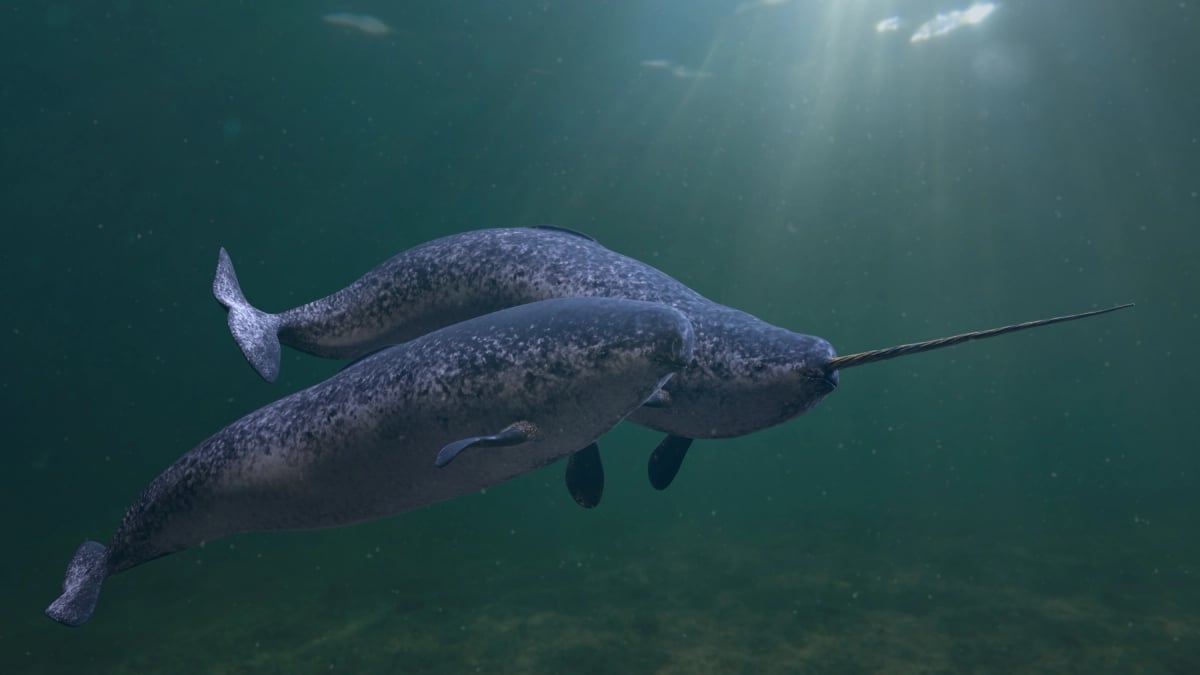
The narwhal (Monodon monoceros) is a medium-sized Arctic whale that stands apart from every other animal on Earth thanks to the male's extraordinary tusk. That tusk is not a horn but a left incisor tooth that spirals outward through the upper lip and can reach up to three meters in length. It is packed with millions of nerve endings, which suggests it plays a role in sensing the surrounding environment. Narwhals spend their lives in the waters around Canada, Greenland and Russia, favoring deep fjords and areas of pack ice. They are remarkable divers, regularly reaching depths beyond 1,500 meters to hunt Greenland halibut, Arctic cod, squid and shrimp. They travel in pods and communicate through a rich repertoire of clicks and whistles. Females live longer than males on average, and the species can survive for up to 50 years in the wild.
Habitat and distribution
Narwhals are creatures of the high Arctic, spending their lives in some of the coldest and most remote waters on the planet. Their range centers on the waters around Greenland, the Canadian Arctic Archipelago and the northern coast of Russia. They favor deep fjords, open leads between ice sheets and areas of dense pack ice, where pressure from human activity remains low. Each year they follow a seasonal pattern, moving to coastal bays and inlets during summer and retreating to offshore waters covered by heavy ice in winter. These migrations can cover hundreds of kilometers. The vast majority of the world population, estimated at roughly 170,000 individuals, spends at least part of the year in Canadian and Greenlandic waters, making those regions especially important for the survival of the species.
The spiral tusk
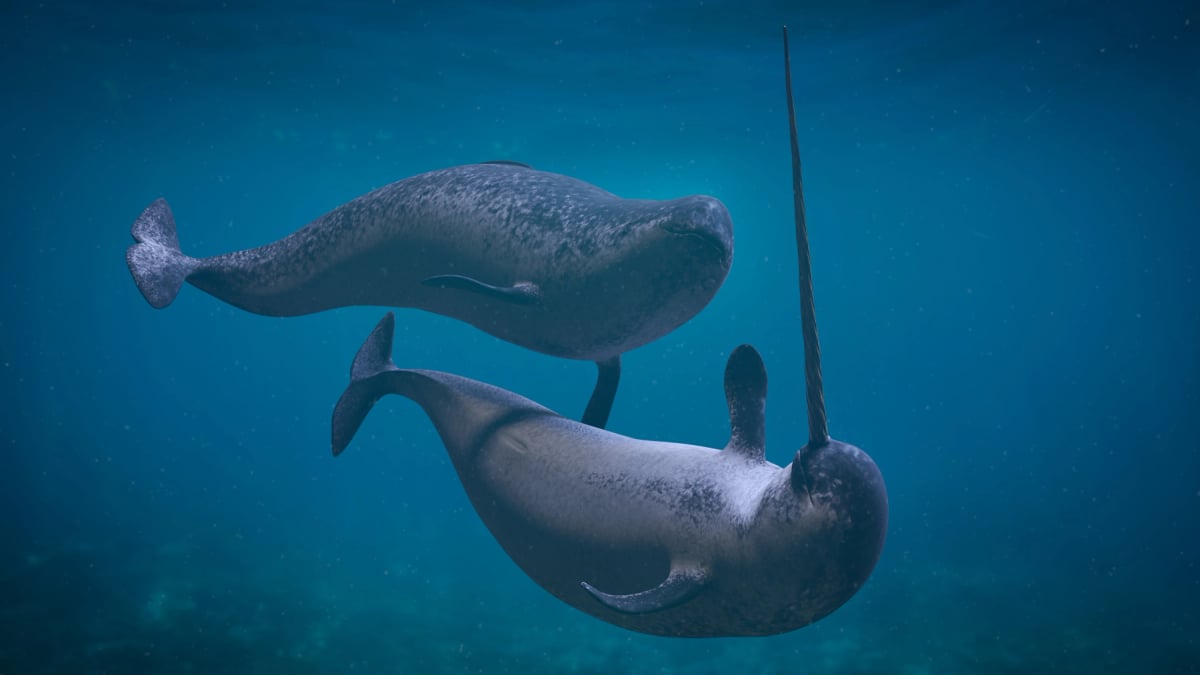
Perhaps no feature in the animal kingdom causes more curiosity than the narwhal's tusk. It is not a horn at all. It is the animal's upper left incisor tooth, which in males pierces through the lip and grows in a left-handed spiral that can reach up to three meters in length. The tusk is hollow at the base and is threaded with millions of nerve endings that connect directly to the outside water, leading scientists to believe it functions as a sensory organ capable of detecting changes in temperature, salinity and pressure. Males are sometimes seen crossing tusks at the surface in a behavior called tusking, which may relate to social ranking. A small number of females also grow tusks, though these are shorter and less common. Very rarely, a male grows two.
Feeding habits
When it comes to finding food, narwhals are extraordinary athletes of the deep. They regularly dive beyond 1,500 meters, and some dives have been recorded at close to 1,800 meters, making them among the deepest divers of any marine mammal. Their main prey is Greenland halibut, which they pursue on or near the seafloor, along with Arctic cod, squid and shrimp depending on the season. Down in the darkness under thick ice, they rely on echolocation, producing rapid clicks that bounce off objects and return as echoes, painting a sound picture of everything around them. Narwhals do not have teeth for chewing. Instead, they suction prey directly into their mouths. Feeding activity peaks in winter, when they gather in dense ice zones where halibut concentrations are highest.
Behavior and social life
Social bonds are central to how narwhals live. They travel in pods that typically number between five and twenty individuals, though larger aggregations of several hundred have been observed during seasonal migrations. Pods tend to be organized by age and sex, with females and young often grouping separately from adult males. Communication within the group relies on a rich set of sounds: clicks used for echolocation, whistles and pulsed calls thought to carry social information. Narwhals are not known for acrobatic surface displays like some other whale species, but males do engage in tusking at the surface, slowly crossing their tusks together in what researchers interpret as a form of social interaction rather than outright combat. Females live longer than males on average, and individuals of both sexes can reach 50 years of age in the wild.
Conservation
The IUCN currently lists the narwhal as Near Threatened, a status that reflects real and growing pressures on the species. Climate change is the most significant concern. As Arctic sea ice retreats and thins, narwhals lose the stable ice habitat they depend on, and new shipping routes and industrial operations are opening in waters that were previously inaccessible. Noise pollution from vessels interferes with echolocation and communication. Narwhals are also hunted by Inuit communities in Canada and Greenland, a practice with deep cultural roots that is managed through regulated quotas aimed at keeping harvests within sustainable limits. Oil and gas exploration in Arctic regions adds further pressure. Protecting narwhals over the long term will require international cooperation on both climate policy and the careful management of Arctic waters.
Researched and written by Juan Pablo. Sources: IUCN Red List, scientific literature and regional field guides. Last updated: .
Technical factsheet






Frequently Asked Questions
What does a narwhal eat?
Narwhals feed mainly on Greenland halibut, Arctic cod, squid and shrimp. They do most of their hunting in winter, diving to extraordinary depths to find prey beneath thick ice. Because they have no teeth for chewing, they suction food directly into their mouths. Their hunting relies entirely on echolocation, using rapid clicks to locate prey in the pitch darkness of the deep ocean.
How deep can a narwhal dive?
Narwhals are among the deepest divers of any marine mammal. They regularly go beyond 1,500 meters, and some individuals have been recorded reaching close to 1,800 meters. They make these extreme dives in winter, plunging under dense pack ice to hunt Greenland halibut near the seafloor. The ability to hold their breath and navigate in total darkness makes them remarkable survivors in one of the harshest environments on Earth.
What is the narwhal's tusk made of?
The tusk is actually a tooth, specifically the upper left incisor, which grows through the lip in a left-handed spiral and can reach up to three meters. It is hollow at the base and filled with millions of nerve endings connected to the surrounding water. This leads scientists to believe it works as a sensory organ, picking up changes in temperature, salinity and pressure rather than serving as a weapon.
Where do narwhals live?
Narwhals live in the cold waters of the high Arctic, mainly around Greenland, the Canadian Arctic Archipelago and the northern coast of Russia. They prefer deep fjords and areas with heavy pack ice, where human activity is limited. In summer they move into coastal bays, and in winter they head to offshore areas under thick ice. The largest share of the world population spends time in Canadian and Greenlandic waters.
Are narwhals endangered?
The IUCN lists narwhals as Near Threatened. They face serious pressure from climate change, which is shrinking the sea ice they depend on. Melting ice also opens Arctic waters to more ships and industrial activity, bringing noise that disrupts their communication and echolocation. Regulated hunting by Inuit communities and the expansion of oil and gas exploration in the Arctic add to the challenges the species faces.
How long do narwhals live?
Narwhals can live up to 50 years in the wild, which is a long life for a marine mammal of their size. Females generally outlive males. They travel in pods organized by age and sex, and strong social bonds seem to play an important role in their survival. Scientists study their tusks much like tree rings to estimate age, as layers of tissue build up over the course of an individual's life.
Do female narwhals have a tusk?
Most female narwhals do not grow a tusk, but a small number do. When they have one, it is shorter and less pronounced than a male's. The tusk is mainly a feature of males, and very rarely a male grows two. What drives tusk growth in some females but not others is still not fully understood, making it one of the many intriguing mysteries that researchers continue to study in this species.