Red billed Streamertail
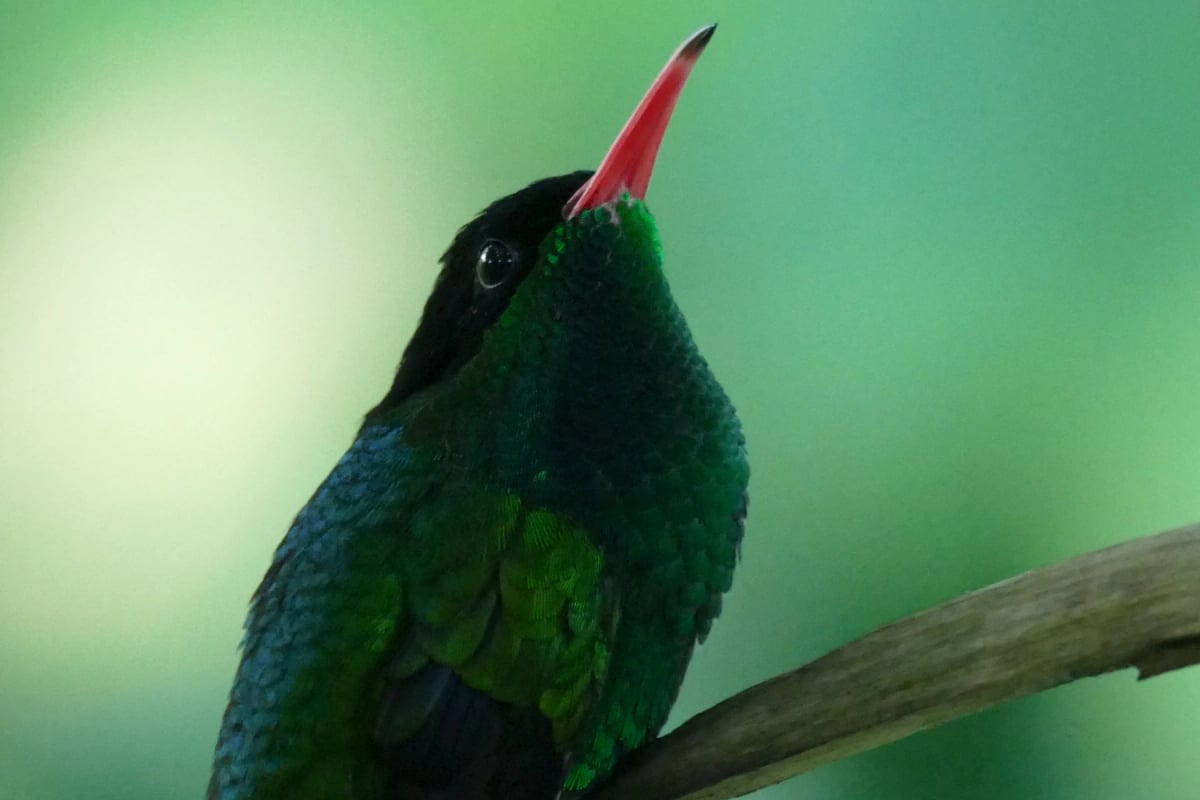
The red billed streamertail, known in Jamaica as the doctor bird, is the island's national bird and one of the most striking hummingbirds in the Caribbean. It lives nowhere else on Earth and is the most abundant hummingbird in Jamaica, found almost everywhere except the far eastern tip, where its close relative, the black billed streamertail, takes over. Adult males glow emerald green, with a velvety black crest, a coral red bill tipped with black, and two long tail streamers of 10 to 13 centimeters that ripple behind them in flight and bring their total length to 22 to 25 centimeters. Females are smaller, about 10.5 centimeters, with white underparts spotted with green and no streamers. The species thrives from sea level to about 1,500 meters, in forests, coffee and banana farms, and gardens. Nectar fuels its fast wingbeats, while small insects supply protein. Both sexes defend flower patches fiercely. The IUCN lists it as Least Concern.
Habitat and range
Found nowhere else on the planet, the red billed streamertail is entirely restricted to the island of Jamaica, and it is the most abundant hummingbird there. It covers almost the whole island, with one exception: the far east, in the parishes of Portland and St. Thomas, belongs to the black billed streamertail. The two meet in the Rio Grande valley, between the Blue Mountains and the John Crow Mountains, where bill color changes from red to black over just a few kilometers. Within its range the red billed streamertail thrives in an impressive variety of environments: humid montane forest, lowland forest, second growth, coffee and banana farms, flowering hedgerows, and coastal gardens. Birds have been recorded from sea level up to about 1,500 meters, and some move up and down the mountains with the seasons, following the flowers. Urban parks and hotel gardens full of ornamental plants have given the species even more room, which is why visitors often see one within hours of arriving on the island.
Appearance and dimorphism
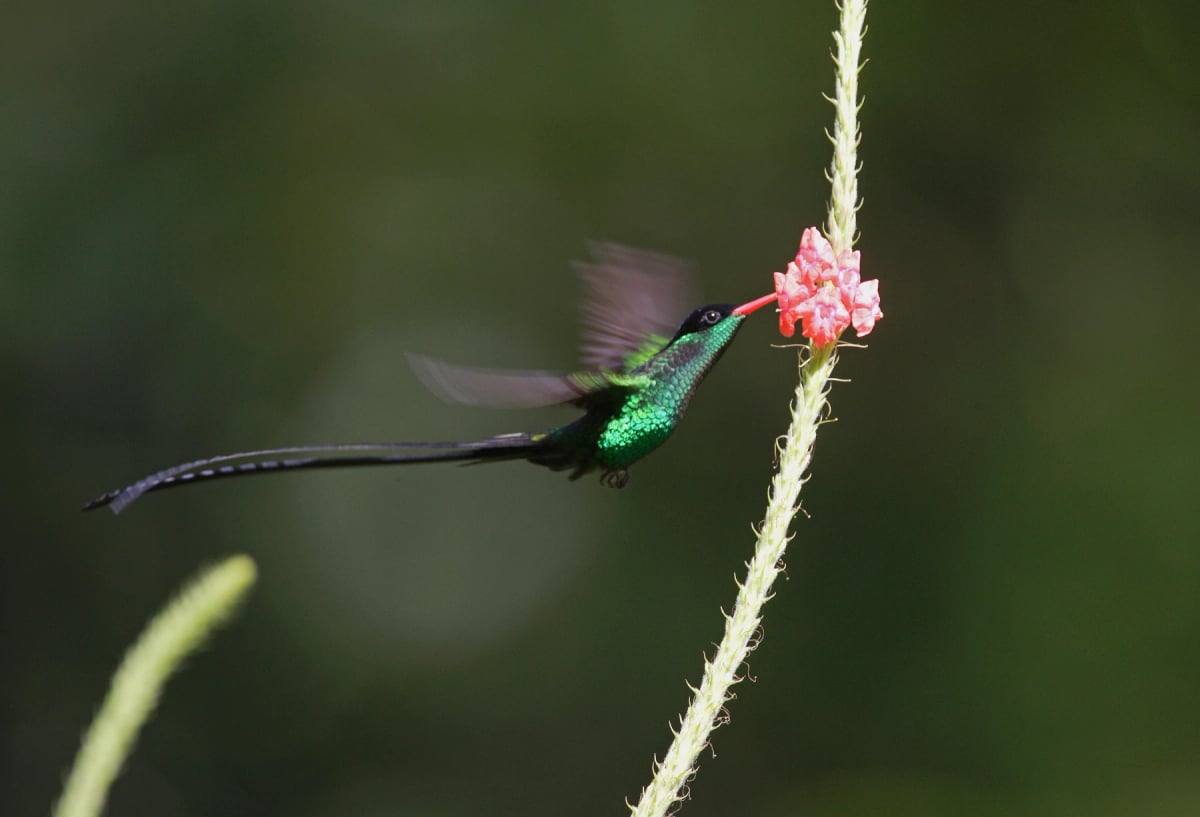
Few Caribbean birds are as instantly recognizable as the adult male red billed streamertail. His body feathers glow a metallic emerald green, the crown and velvety crest are black, and the bill is a bold coral red tipped with black. The most striking feature of all is the pair of tail streamers: two outer tail feathers that grow 10 to 13 centimeters long, about as long as the rest of the bird, so that a male measures 22 to 25 centimeters in total while weighing only 4 to 6.5 grams. The streamers twist and flutter behind the bird in flight, creating an effect that is hard to forget. The male's wings also make a distinctive whirring or humming sound as he flies. Females look quite different. They are about 10.5 centimeters long, have bronze green upperparts and white underparts dotted with green spots, and carry no streamers. Their bill is red too, but duller than the male's. Young males develop the streamers gradually as they mature.
Red billed vs black billed streamertail
Jamaica actually has two streamertail hummingbirds. For a long time they were treated as a single species, but most authorities, including the IUCN, now split them. The red billed streamertail, Trochilus polytmus, covers almost the whole island. The black billed streamertail, Trochilus scitulus, lives only in the far east, in the parishes of Portland and St. Thomas, around the John Crow Mountains. The two look almost identical, with the same emerald green plumage and the same long tail streamers in the males, and the easiest way to tell them apart is the one in their names: the red billed has a coral red bill with a black tip, while the black billed has an all black bill. The black billed is also slightly smaller. The two ranges meet along the Rio Grande valley, where they interbreed and bill color shifts from red to black over only a few kilometers. Research published in 2025 by Smithsonian scientists suggests that females there prefer males with a fully red or fully black bill over hybrids with mixed colors, which may help keep the two species apart. Both are listed as Least Concern.
Diet
Nectar is the cornerstone of the red billed streamertail's diet, and the bird visits a wide range of flowering plants to obtain it. One native shrub, Besleria lutea, is a particular favorite, but it also feeds at native bromeliads and forest flowers, and takes garden plants and ornamental blossoms just as readily. To feed, the bird hovers in front of a bloom and inserts its bill deep into the flower while its tongue laps up the sugary liquid inside. It also has a clever shortcut: it steals nectar through holes that bananaquits have pierced at the base of long flowers, reaching food its bill could not otherwise get to. Because nectar offers very little protein, small insects make up the rest of the diet. These are caught in the air or picked from leaves and bark, techniques known as hawking and gleaning. Hummingbird feeders filled with sugar water are popular across Jamaica, and streamertails visit them eagerly. This combination of sugar and protein gives the bird the energy it needs to sustain its remarkably rapid wingbeats throughout the day.
Behavior
Territorial defense is a central part of daily life for streamertails, and unlike many hummingbirds, both males and females hold territories. A bird will claim a patch of flowering plants and spend a great deal of energy chasing off rival hummingbirds and other nectar feeding visitors with fast, direct aerial pursuits. These chases come with sharp, buzzing calls that make the bird easy to locate even in dense vegetation. During courtship, males perform swooping display flights in front of females, showing off the full length of those trailing tail feathers to the best effect, and the whirring of their wings adds to the show. Outside of the breeding season, birds tend to be more solitary, and some move to different elevations as flowering seasons change. Like many hummingbirds, streamertails can enter a state of reduced metabolic activity called torpor on cool nights, lowering their body temperature significantly to conserve the energy reserves they need to survive until morning.
Nesting and breeding
Streamertails breed mainly between January and May, and a female may raise up to three broods in a single year. As in other hummingbirds, the male plays no part after courtship: the female builds the nest, incubates the eggs, and raises the chicks on her own. The nest is a tiny, soft cup of fine plant fibers bound together with spider silk and decorated on the outside with bits of lichen, which help it blend in with the branch. She usually places it on a thin twig or vine about 1 to 3 meters above the ground. The clutch is always two white eggs, each about the size of a small bean. Incubation takes 17 to 19 days, and the chicks hatch naked and helpless. The female feeds them a mix of regurgitated nectar and small insects, and they leave the nest after 19 to 24 days. Spider silk lets the nest stretch as the young grow, so the same cup can hold two full sized fledglings just before they fly.
Cultural significance
The red billed streamertail is Jamaica's national bird, and the island treats it with genuine pride. Locally it goes by the name "doctor bird," and the most popular explanation for the nickname, repeated by the Jamaica Information Service, is that the male's erect black crest and long black tail streamers look like the top hat and long tailcoat that doctors used to wear. Another theory says the name comes from the way the bird lances flowers with its bill, like a doctor with a scalpel. Long before either idea, the Arawaks, the Taíno people who lived on Jamaica before Europeans arrived, called it the "God bird" and believed it carried the souls of the dead, and the bird still holds a place in Jamaican folklore and song. Visitors also know it as the swallow tail hummingbird. Its image appears on souvenirs, tourist materials, and the logos of Jamaican businesses, and it is woven into the national identity in a way that few other animals achieve anywhere in the world, making it far more than a biological curiosity.
Conservation
The IUCN classifies the red billed streamertail as Least Concern, reflecting a population that remains common and widespread across Jamaica. No global count exists, but it is the most abundant hummingbird on the island, and its readiness to live in gardens, farms, and parks suggests that habitat loss is unlikely to threaten it seriously. That reassuring status does not mean the species faces no pressure at all. Deforestation in the island's interior reduces the areas of flowering forest that support many birds, especially in the mountains. Predation by introduced animals, particularly rats and feral cats, is a risk for nests and eggs, and the small Indian mongoose, released on Jamaican sugar plantations in 1872 to control rats, has become a serious problem for much of the island's native wildlife. Hurricanes can strip flowers from whole regions for weeks, forcing hummingbirds to move or turn to feeders. Efforts to protect native forest, such as the Blue and John Crow Mountains National Park, benefit the streamertail alongside many other species, and its status as the national bird earns it goodwill across Jamaica.
Researched and written by Juan Pablo. Sources: IUCN Red List, scientific literature and regional field guides. Last updated: .
Technical factsheet


Frequently Asked Questions
What is the difference between the red billed and black billed streamertail?
The main difference is the bill. The red billed streamertail has a coral red bill with a black tip, while the black billed streamertail has an all black bill and is slightly smaller. Otherwise they look almost the same, and the males of both species carry the famous long tail streamers. They also live in different parts of Jamaica: the red billed covers nearly the whole island, while the black billed is found only in the far east, in Portland and St. Thomas. Where their ranges meet, along the Rio Grande valley, the two interbreed.
How big is the red billed streamertail?
Adult males measure 22 to 25 centimeters from bill to the tip of the streamers, but 10 to 13 centimeters of that are the two long tail feathers, so the body itself is small. Males weigh only 4 to 6.5 grams, about the same as a sheet of paper. Females are about 10.5 centimeters long and weigh 3 to 6 grams, since they have no streamers. Even without its tail, the streamertail is a medium sized hummingbird, larger than the tiny vervain hummingbird that also lives in Jamaica.
How many eggs does the red billed streamertail lay?
Like almost all hummingbirds, the red billed streamertail lays exactly two small white eggs. The female builds the nest alone, a tiny cup of plant fibers held together with spider silk and covered with lichen, usually 1 to 3 meters above the ground. She incubates the eggs for 17 to 19 days and feeds the chicks until they leave the nest, 19 to 24 days after hatching. Most nesting happens between January and May, and a female can raise up to three broods in a year.
Where is the best place to see the doctor bird in Jamaica?
Almost anywhere with flowers. The red billed streamertail is the most common hummingbird in Jamaica and often turns up in hotel gardens, parks, and flowering hedges soon after visitors arrive. Places with hummingbird feeders are especially good, since the birds come to them eagerly and can be seen at close range. Rocklands Bird Sanctuary near Montego Bay is famous for letting visitors feed streamertails from a small bottle held in the hand. To see the black billed streamertail as well, head to the far east of the island, around Portland and the John Crow Mountains.
Is the doctor bird only found in Jamaica?
Yes. The red billed streamertail is endemic to Jamaica and lives nowhere else in the wild, and the same is true of its close relative, the black billed streamertail. Jamaica actually has three endemic hummingbirds: the two streamertails and the Jamaican mango. Its fourth hummingbird, the tiny vervain hummingbird, is shared with Hispaniola. Because it is found only on the island and appears in its folklore, the doctor bird was a natural choice as Jamaica's national bird.
What does the red billed streamertail eat?
Nectar is the main food source, gathered from a wide variety of flowers, including the native shrub Besleria lutea, bromeliads, and garden ornamentals. Because nectar provides sugar but little protein, the bird also catches small insects by snatching them from the air or picking them off leaves. It will even steal nectar through holes that bananaquits pierce at the base of long flowers. This mix of energy rich nectar and protein from small prey keeps the bird fueled through a full day of rapid wingbeats.
Where does the red billed streamertail live?
This species is found only in Jamaica, making it a true island endemic, and it covers almost the whole island except the far east, where the black billed streamertail lives instead. It is remarkably adaptable and thrives from coastal gardens and banana farms all the way up into montane forests at about 1,500 meters. Urban parks and hotel gardens with plenty of flowering plants have given it even more room, so it remains the most commonly seen hummingbird in Jamaica.
Why is the streamertail called the "doctor bird"?
The nickname "doctor bird" is deeply rooted in Jamaican tradition. The most popular explanation, repeated by the Jamaica Information Service, is that the male's erect black crest and long black tail streamers resemble the top hat and long tailcoat that doctors used to wear. Another theory links the name to the way the bird lances flowers with its bill, like a doctor with a scalpel. The true origin is still debated, but the name has stuck for centuries and appears throughout Jamaican songs, poetry, and storytelling.
How long are the tail feathers of the male streamertail?
The two outer tail feathers of an adult male grow 10 to 13 centimeters long, about as long as the rest of the bird, which brings his total length to 22 to 25 centimeters even though he weighs only a few grams. These ribbon shaped streamers twist and flutter as the bird flies, making it one of the most distinctive hummingbirds in the Caribbean. Young males do not have them at first, and the feathers develop gradually as the birds reach full maturity.
Is the red billed streamertail endangered?
No. The IUCN lists the species as Least Concern, and it is the most abundant hummingbird in Jamaica. It adapts well to gardens, farms, and parks, so habitat loss is not considered a serious threat. That said, the bird does face some pressures: deforestation reduces the flowering forest in the mountains, hurricanes can strip flowers for weeks, and introduced animals such as rats and feral cats can raid nests. Protecting native forest remains the most important step for keeping the species secure.
How do streamertails behave around other birds?
Streamertails are strongly territorial, and both males and females defend favored flower patches, chasing away rival hummingbirds and other nectar feeding birds with fast, direct aerial pursuits. These confrontations are usually announced by sharp, buzzing calls. During the breeding season, males also perform swooping display flights to impress females. Outside of breeding periods, the birds are largely solitary and go about their daily feeding routines independently.
Do streamertails sleep like other birds?
Not exactly. Like many hummingbirds, streamertails can enter a state called torpor on cool nights. During torpor, the bird's body temperature drops significantly and its heart rate slows way down, which conserves the energy reserves it needs to survive until morning. This matters because hummingbirds burn through fuel so quickly during the day that they cannot afford to keep their metabolism running at full speed overnight.