Green Pheasant
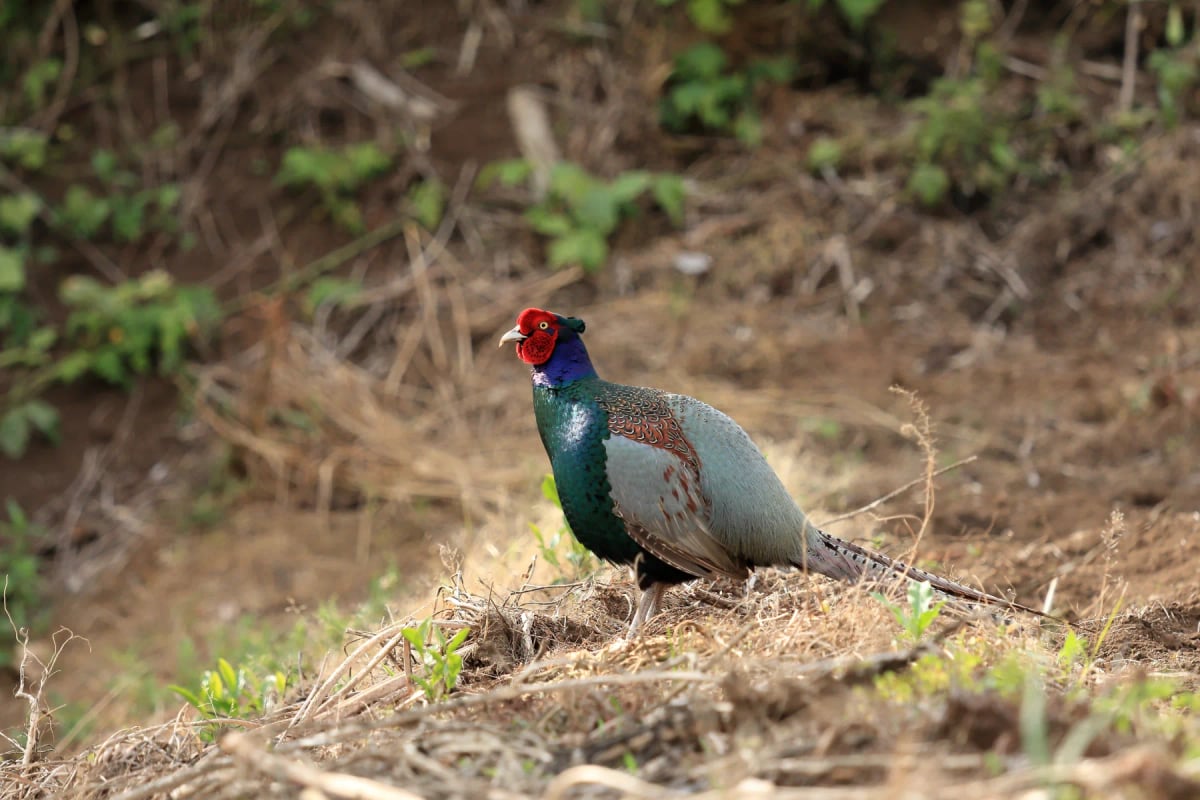
The green pheasant is Japan's national bird and one of the two pheasants found only in Japan, native to Honshu, Shikoku, Kyushu, and nearby smaller islands. Males are striking birds, with a deep glossy green neck, breast, and belly, a purple and blue sheen on the head, bare red skin around the eyes, and a long barred tail. Females wear mottled brown tones that make them nearly invisible among grasses and low scrub during nesting. This pheasant favors open, varied country: rice paddies, grasslands, forest edges, and riverside thickets all suit it well. It forages on the ground for seeds, grain, berries, worms, and insects throughout the year. In spring, each male crows loudly and drums his wings to hold a territory and may pair with several females, and each female lays six to fifteen eggs in a hollow on the ground. Some authorities treat it as a subspecies of the common pheasant. It was also introduced to Hawaii, where it lives wild on several islands. It is one of Japan's legal game birds, and although its numbers are declining, the IUCN lists it as Least Concern.
Habitat and range
The green pheasant is native to Japan, where it lives on the three main southern islands, Honshu, Shikoku, and Kyushu, and on many smaller islands nearby. It has also been introduced to some of the Izu Islands. Three subspecies are recognized, spread from north to south: the northern green pheasant, the Pacific green pheasant, and the southern green pheasant. Rather than deep forest, it prefers open and varied landscapes where food and cover are both close at hand. Rice paddies bordered by hedgerows, grassy riverbanks, the edges of woodland, cultivated fields, and low shrubby thickets are all typical haunts. It mostly stays at lower elevations, though it can appear in hilly terrain where suitable habitat exists. Outside Japan, green pheasants were released in Hawaii, where they now live wild on several islands, including Hawaii Island, Maui, and Kauai, often mixing with introduced ring necked pheasants. Attempts to establish the species in mainland North America failed. This adaptability to farmland and countryside has helped it remain a familiar bird across much of rural Japan.
Appearance
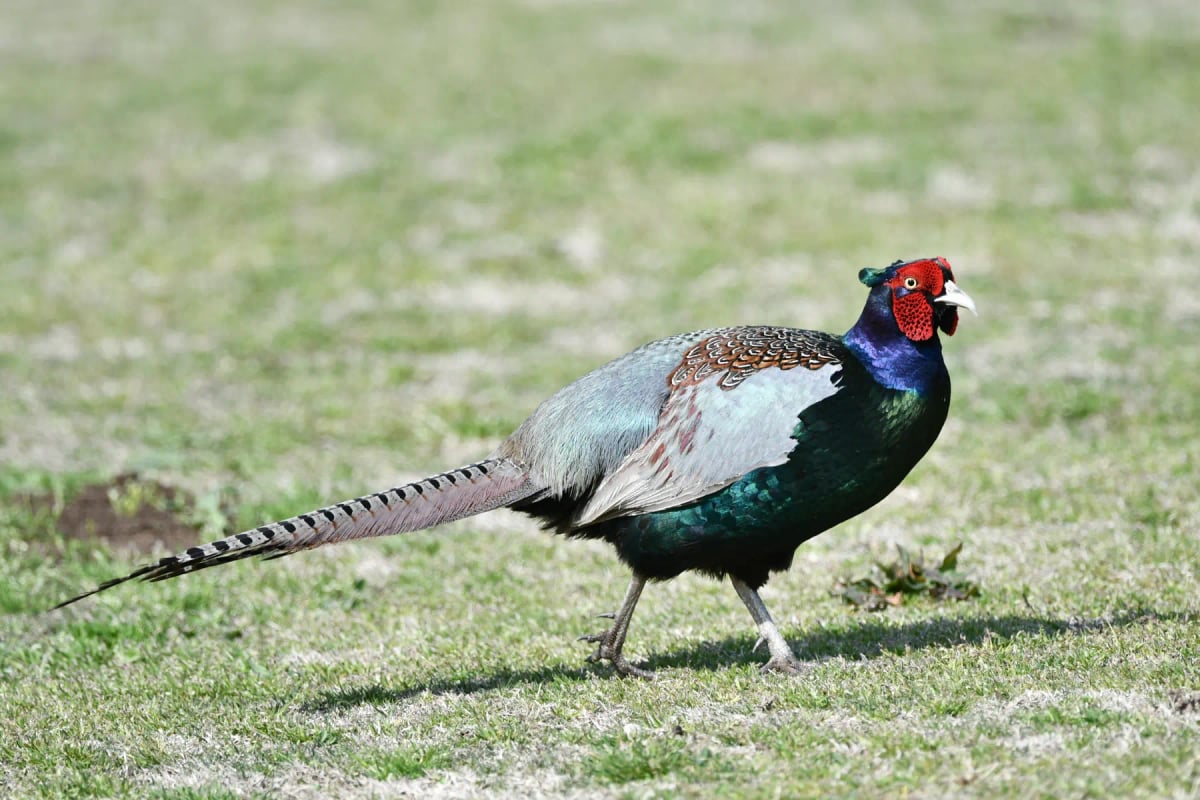
Few birds in Japan are as immediately eye catching as an adult male green pheasant. His neck, breast, and belly are a deep, glossy bottle green that gives the species its name, while the head shows purple and blue tones and short ear tufts, and the bare skin around his eyes is bright red, becoming even more vivid and swollen during the breeding season. His back is a mix of green, gray, and brown, and his long, barred tail makes up a large part of his total length of about 75 to 90 centimeters. Females are far more subdued, about 55 to 60 centimeters long and dressed in mottled shades of brown, buff, and black, with darker markings than the females of the common pheasant. That understated pattern is highly effective camouflage when a hen is sitting on her nest among dry grasses or leaf litter. Chicks hatch covered in striped, buff and brown down and can walk and feed themselves almost immediately.
Green pheasant vs common pheasant
The green pheasant is a close relative of the common or ring necked pheasant, the famous game bird of Europe, Asia, and North America, and some taxonomic authorities treat it as a subspecies of it, under the name Phasianus colchicus versicolor. Others, including the IUCN, consider it a separate species endemic to Japan. The two look alike in shape and size, but the males are easy to tell apart. A male common pheasant usually has a coppery orange breast and flanks with dark markings and, in many forms, a white ring around the neck. A male green pheasant has no neck ring, and his neck, breast, and belly are a solid dark green, with a more bluish gray rump and back. Females are harder to separate, though green pheasant hens are darker and more heavily marked. Where the two meet, they interbreed freely: common pheasants were introduced to Hokkaido and Tsushima, where the green pheasant does not naturally live, and hybrids have been reported both on game farms and in Hawaii. Japan also has a second endemic pheasant, the copper pheasant, a forest bird with rich copper red plumage and a very long tail.
Diet
Green Pheasants spend a large part of each day foraging on the ground, working their way methodically through fields, paddies and scrubby margins. Their diet shifts with the seasons. Plant matter makes up the bulk of what they eat: seeds of grasses and wild plants, cereal grains gleaned from cultivated fields, berries, shoots and leaves. Insects and other small invertebrates become especially important during spring and summer, providing protein that is critical for breeding adults and growing chicks alike. Young birds rely heavily on insects in their earliest weeks. The species scratches at soil and leaf litter with its feet to uncover food, much like a chicken, and will also pluck berries and soft plant material directly from low vegetation.
Behavior and reproduction
Breeding runs from March to June, when males become highly vocal and visible. Each male stakes out a territory and announces it with a loud, harsh two note crow, usually followed by a rapid drumming of the wings that can be heard far across the fields, especially at dawn. Males are polygynous, meaning a single male may mate with more than one female within his territory, and rival males can fight fiercely, jumping and striking with their spurs. The female takes on all nesting duties alone. She scrapes a shallow hollow in the ground, usually concealed beneath tall grass or a bush, and lines it with dry leaves and stems. Clutches contain between six and fifteen eggs, which she incubates for 23 to 25 days. The chicks leave the nest very soon after hatching and follow their mother as she leads them to food, a family scene that Japanese tradition sees as a symbol of harmony and maternal care. Outside the breeding season the birds are quieter and more secretive, running into cover rather than flying when disturbed.
Japan's national bird
The green pheasant, called kiji in Japanese, was chosen as Japan's national bird in 1947 by the Ornithological Society of Japan, a choice that reflects how deeply it is woven into the country's culture. It appears in the Man'yōshū, the eighth century anthology of Japanese poetry, and an old Japanese saying uses it as an image of parental love, and one of the reasons given for choosing it was the sight of a mother walking with her chicks, seen as a symbol of family harmony. In the beloved folktale of Momotarō, the Peach Boy, the pheasant is one of the hero's three animal companions, together with a dog and a monkey, on his journey to defeat the ogres of Onigashima. Japanese folklore also says that pheasants cry out before an earthquake. The bird appeared on the back of Japan's 10,000 yen note, and it is a recurring motif in traditional painting, ceramics, and textile design. Being a national bird has not made it untouchable, though: the green pheasant is one of Japan's 29 legal game birds, and it can be hunted in season with a license.
Conservation
The IUCN assesses the green pheasant as Least Concern, but its population is thought to be declining. Because the species adapts well to farmland and rural landscapes, traditional agriculture has not harmed it in the way it has affected many other birds, and the mosaic of paddies, field edges, and woodland in the Japanese countryside suits it very well. The pressures come from changes to that countryside. The abandonment of farmland as rural Japan ages and empties, the intensification of farming, including pesticides that reduce the insects chicks depend on, and the spread of towns and roads all remove nesting cover and food. Hunting is legal under regulated seasons, and farm reared pheasants are released for hunting in some areas, which raises questions about mixing with wild birds. In Hawaii, green pheasants interbreed with introduced ring necked pheasants, blurring the line between the two. Overall, however, the green pheasant is not considered at risk, and it remains a familiar sight and sound in the Japanese countryside.
Where it is found
The Green Pheasant can be found in places such as:
Researched and written by Juan Pablo. Sources: IUCN Red List, scientific literature and regional field guides. Last updated: .
Technical factsheet







Frequently Asked Questions
Is the green pheasant the same as the common pheasant?
Not quite, although they are very close relatives. Some taxonomic authorities treat the green pheasant as a subspecies of the common or ring necked pheasant, while others, including the IUCN, consider it a separate species found only in Japan. The males are easy to tell apart: the green pheasant has a solid dark green neck, breast, and belly and no white neck ring, while the common pheasant usually has a coppery breast and often a white collar. The two interbreed freely where they meet.
Are there green pheasants in Hawaii?
Yes. Green pheasants were released in Hawaii as game birds and now live wild on several islands, with records from Hawaii Island, Maui, and Kauai. They often mix and interbreed with ring necked pheasants, which were introduced to the islands too, so many birds there are hybrids. Hawaii is the only place outside Japan where the species has established itself, as attempts to introduce it in mainland North America did not succeed.
Can green pheasants fly?
Yes, but they prefer to run. Like other pheasants, the green pheasant spends almost all its time on the ground and usually escapes danger by running quickly into tall grass or scrub. When pressed, it bursts into the air with a loud clatter of wings, flies fast and low for a short distance, often a few hundred meters, then glides down and runs again. It also flies up into trees to roost at night, out of reach of ground predators.
What is the green pheasant called in Japanese?
In Japanese, the green pheasant is called kiji, written with the kanji 雉. The name appears in some of the oldest Japanese texts, and an older poetic form, kigishi or kigisu, is found in the Man'yōshū anthology. Kiji is also the word used in the Momotarō folktale, in which the hero is helped by a dog, a monkey, and a pheasant. There is a well known Japanese saying about the bird, which roughly means that even a pheasant would not be shot if it did not cry out, a warning that speaking up can get you into trouble.
Where can you see green pheasants in Japan?
Green pheasants are widespread in the countryside of Honshu, Shikoku, and Kyushu, so the best places to look are rural areas with a mix of rice paddies, grassy riverbanks, farm fields, and woodland edges. Spring, from March to June, is the easiest time, because the males stand in the open and crow loudly, especially early in the morning. They can also be seen along rivers and on the edges of cities, and in large parks with open grassland. Outside the breeding season they are shyer and hide in tall vegetation.
What does the Green Pheasant eat?
Green Pheasants forage on the ground and eat a wide variety of foods depending on the season. Seeds, cereal grains, berries, leaves and shoots make up most of their diet. They also eat insects and other small invertebrates, particularly in spring and summer when protein is essential for breeding adults and young chicks. They scratch at soil and leaf litter with their feet to uncover hidden food, much like a domestic chicken.
Where does the Green Pheasant live?
The green pheasant is native only to Japan, where it lives across Honshu, Shikoku, and Kyushu and on smaller nearby islands, and it has been introduced to some of the Izu Islands. It prefers open landscapes such as rice paddies, grassy riverbanks, forest edges, and rural farmland rather than dense forest, mostly at lower elevations. Outside Japan, it was released in Hawaii and now lives wild on several islands there. It does not naturally occur on Hokkaido or Tsushima, where the common pheasant was introduced instead.
Is the Green Pheasant endangered?
No, the green pheasant is not endangered. The IUCN lists it as Least Concern, although its population is thought to be declining. It adapts well to farmland and rural countryside, which has helped it live alongside people. The main pressures are the abandonment and intensification of farmland, pesticides that reduce the insects its chicks need, urban development, and regulated hunting, since it is one of Japan's 29 legal game birds. None of these threaten the species as a whole for now, and it remains a common sight in rural Japan.
Why is the Green Pheasant Japan's national bird?
The Ornithological Society of Japan chose the green pheasant as the national bird in 1947. The choice reflects how closely the species is tied to Japanese culture: it appears in the eighth century Man'yōshū poetry anthology, in traditional paintings, and in the famous folktale of Momotarō, where it helps the hero fight ogres. The sight of a mother pheasant walking with her chicks was also seen as a symbol of family harmony. It is one of only two pheasants found only in Japan, and it appeared on the back of the 10,000 yen note.
How does the Green Pheasant reproduce?
Breeding takes place from March to June. Males crow loudly and drum their wings to establish territories and may mate with several females in the same season. The female handles all nesting duties on her own. She digs a shallow hollow in the ground, hides it under tall grass or a bush, and lines it with dry plant material. She lays six to fifteen eggs and incubates them for 23 to 25 days. The chicks leave the nest very shortly after hatching and follow their mother to find food.
What does a male Green Pheasant look like?
The male green pheasant is one of the most striking birds in Japan. His neck, breast, and belly are a deep glossy green, his head shows purple and blue tones with small ear tufts, and the bare skin around his eyes is bright red, becoming even more vivid in the breeding season. He has a long, barred tail that makes up a large part of his total length of about 75 to 90 centimeters. Unlike many common pheasants, he has no white neck ring. Females are far more modestly patterned in brown and buff.
Does the Green Pheasant make noise?
Yes, particularly the males during the breeding season. Each male lets out a loud, harsh two note crow at dawn to announce his territory to rival males and attract females. He often follows these calls with a rapid drumming of his wings. The calls carry well across open fields and paddies. Outside of the breeding season, Green Pheasants tend to be quieter, though they will still vocalize when alarmed or disturbed.