Southern Right Whale
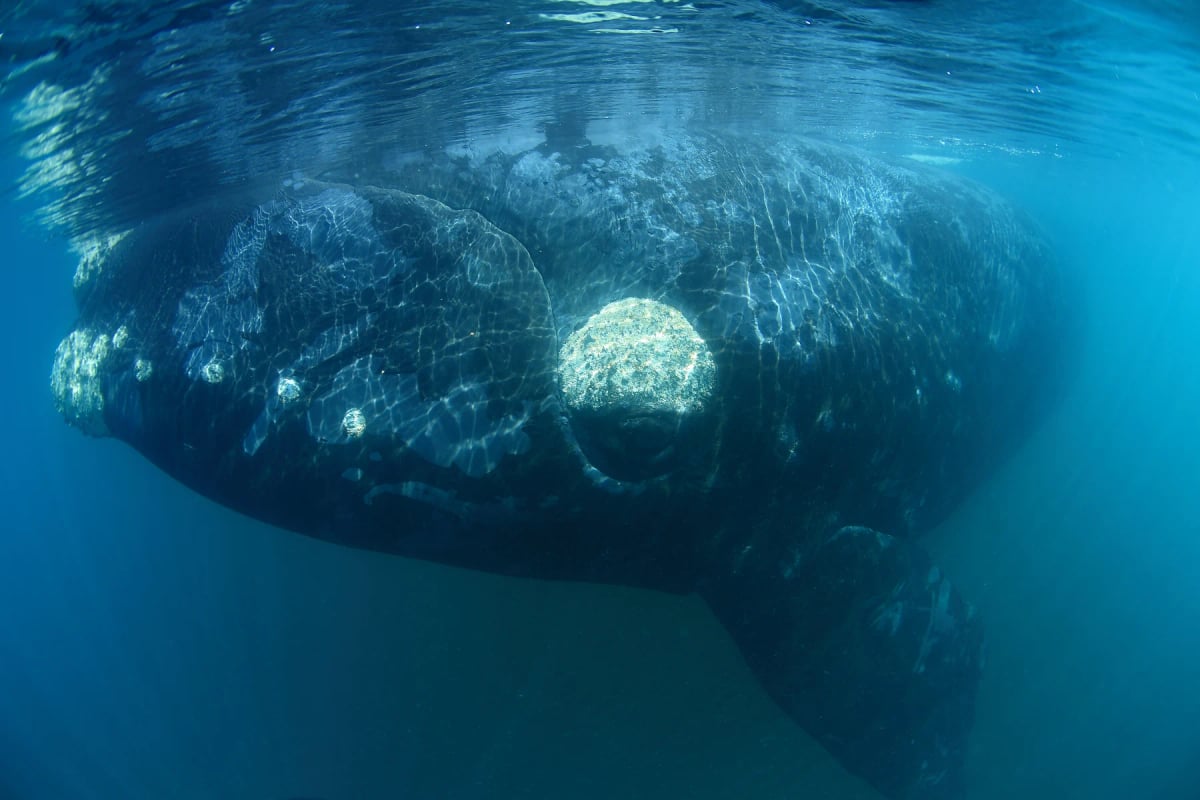
The southern right whale is one of the largest animals on Earth, reaching up to 17 metres in length and 80 tonnes in weight. It belongs to the baleen whale group and lives entirely in the Southern Hemisphere. Three features make it unmistakable: rough, pale growths called callosities on the head, the complete absence of a dorsal fin, and a V-shaped blow that can rise up to 5 metres when it surfaces. Each winter, females travel to sheltered coastal bays in Argentina, South Africa, Australia and New Zealand to give birth and nurse their calves. Once summer arrives, most whales head south to feed on dense swarms of copepods and krill in cold subantarctic seas. Centuries of commercial whaling brought the species close to extinction, but under international protection the population has climbed back to around 12,000 individuals. Ship strikes and entanglement in fishing gear remain the most serious threats today.
Identification
Few whales are as easy to recognize as the southern right whale. The most striking feature is the callosities, which are raised, rough patches of hardened skin scattered across the head, around the mouth, and above the eyes. These growths appear cream or white because colonies of whale lice, called cyamids, live on them. The body is mostly black, very broad, and noticeably rounded, with no dorsal fin at all along the back. At the surface, the blow is one of the best field marks of any large whale: it shoots upward in a clear V shape and can reach around five metres in height. Adults grow to about 15 to 17 metres in length and can weigh up to 80 tonnes, making them among the heaviest animals alive today.
Habitat and distribution
Southern right whales spend their lives entirely within the Southern Hemisphere, following a seasonal pattern that takes them between warm coastal nurseries and cold feeding grounds. Each winter, pregnant females and mothers with newborn calves gather in sheltered bays and inlets along the coasts of Argentina, Uruguay, South Africa, Australia, and New Zealand. These calm, shallow waters provide protection from predators and rough seas. As summer approaches, most of the population moves south into the subantarctic and Antarctic waters of the Southern Ocean, where food is plentiful. Smaller numbers have been recorded at places such as Brazil, Namibia, Mozambique, and the waters around the Falkland Islands and French Southern Territories. The species does not regularly cross the equator, remaining tied to the cold and temperate seas of the south.
Behavior
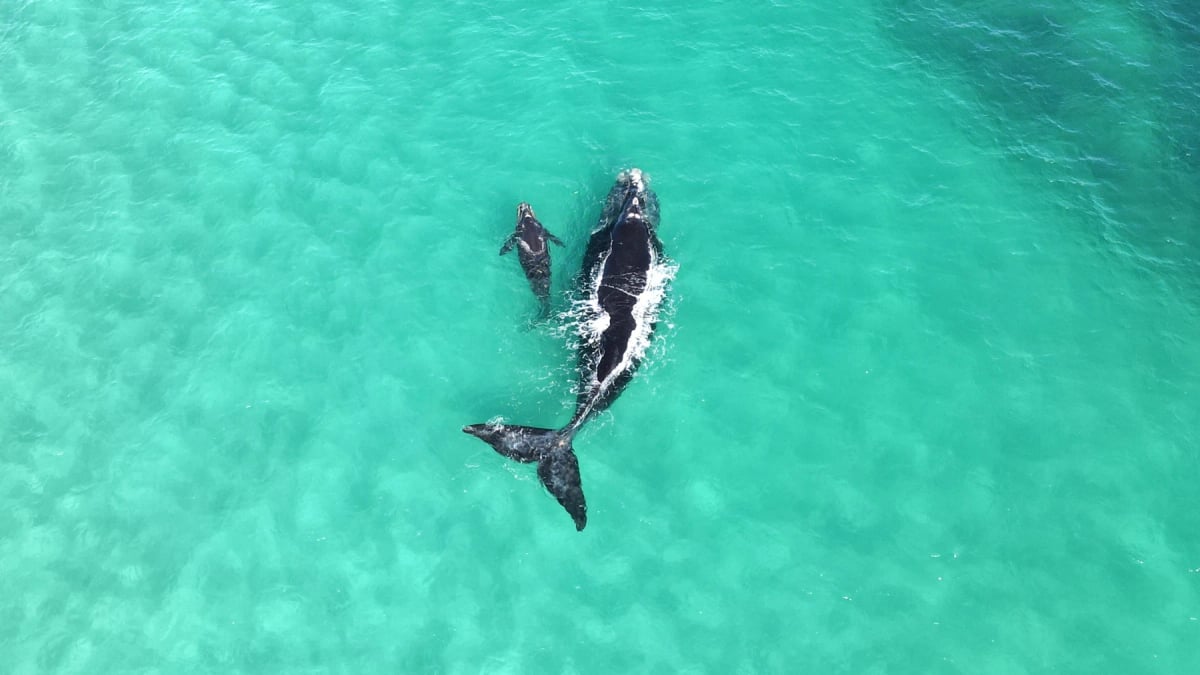
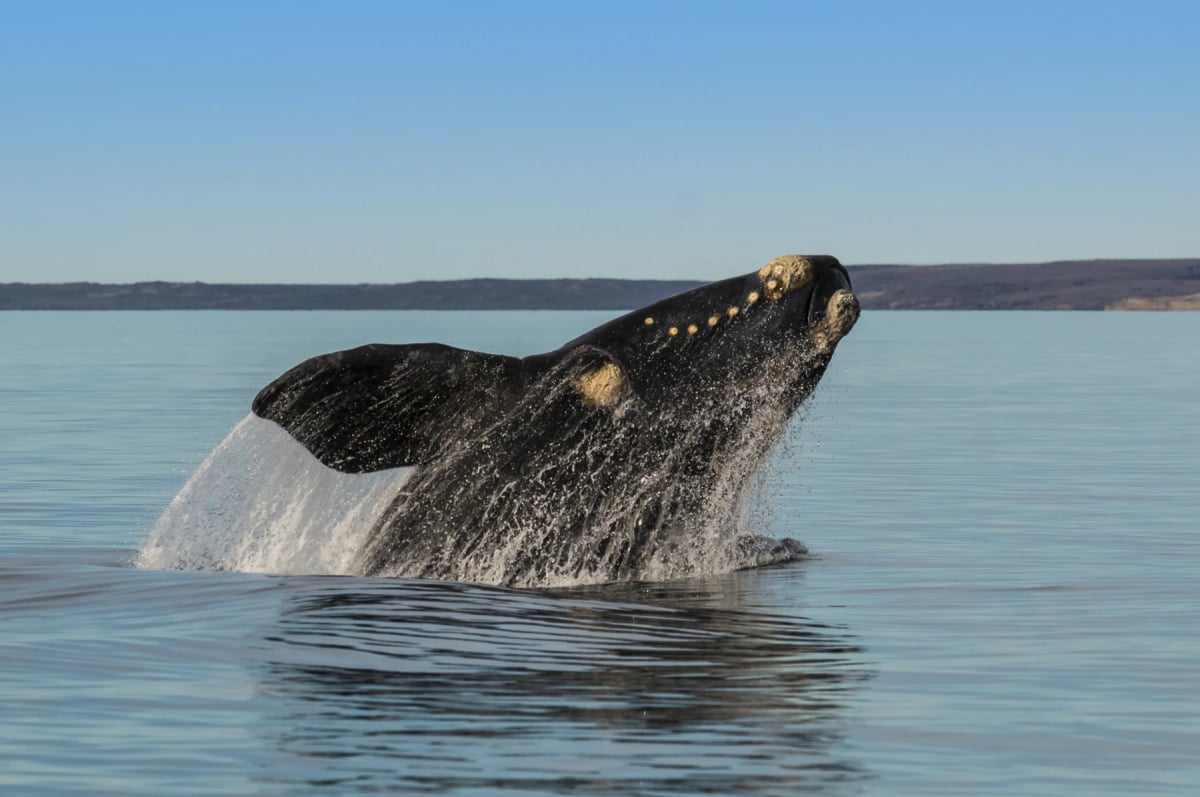
Watching a southern right whale near shore is an unforgettable experience. These animals are naturally curious and will often approach boats without any encouragement, sometimes lingering alongside for several minutes. They are well known for spectacular acrobatic displays: breaching, which involves launching the entire body clear of the water, is seen regularly, as are tail slaps and sailing, where the whale holds its flukes upright in the wind like a sail. Mothers with calves are especially active in sheltered bays, and calves practice their own breaches from an early age. Despite their enormous size, southern right whales are slow swimmers, typically moving at around five to seven kilometres per hour. Males compete for females in large mating groups, relying on sperm competition rather than direct fighting.
Diet
Unlike toothed whales, which hunt individual prey, southern right whales are filter feeders that rely on their baleen plates to eat. Instead of teeth, their mouths are lined with hundreds of long, flexible plates made of keratin, the same material as human fingernails. When feeding, a whale swims slowly through dense concentrations of small animals with its mouth open, then closes the jaws and pushes water out through the gaps in the baleen, trapping the prey inside. The main food sources are copepods, which are tiny crustaceans barely a few millimetres long, along with krill and other small zooplankton. Feeding happens mainly in the cold, productive waters of the Southern Ocean during summer, when plankton blooms are at their peak. A single whale can consume over a tonne of zooplankton in a day during these feeding seasons.
Conservation
Commercial whalers targeted this species heavily for centuries, valuing it for its thick blubber, long baleen plates, and the ease with which it could be caught, since it is slow and floats when dead. By the early twentieth century, the global population had collapsed to just a few hundred individuals. International protection, granted in 1935 for the South Atlantic population and extended more broadly in later decades, allowed numbers to begin recovering. Today the population stands at roughly 12,000 animals and continues to grow. The IUCN lists the species as Least Concern overall, though the southwestern Atlantic subpopulation is considered the healthiest. The main threats now are collisions with large vessels and entanglement in fishing gear, both of which can be fatal. Noise pollution and the effects of climate change on prey availability are also monitored closely by researchers.
Where it is found
The Southern Right Whale can be found in places such as:
Researched and written by Juan Pablo. Sources: IUCN Red List, scientific literature and regional field guides. Last updated: .
Technical factsheet







Frequently Asked Questions
Why is the southern right whale called a 'right' whale?
Whalers once considered it the 'right' whale to hunt because it swims slowly, floats when killed and stays close to shore. Those traits made it easy to catch from small boats, which is exactly why hunting nearly wiped the species out. Today that same name serves as a reminder of how close these animals came to extinction before international protection arrived in the 20th century.
How big does a southern right whale get?
Adults typically reach between 13 and 17 meters in length and can weigh up to 80 tonnes, making them one of the largest animals on Earth. Females tend to be slightly larger than males, which is unusual among mammals. A newborn calf already measures around 4 to 6 meters at birth and gains weight rapidly during its first months of nursing.
What do southern right whales eat?
Southern right whales feed almost entirely on tiny crustaceans called copepods and krill. They swim slowly through dense swarms with their mouths open, letting water flow through their baleen plates, which act like a sieve to trap food. Most of their feeding happens in cold subantarctic waters during summer, where these small creatures gather in enormous concentrations near the surface.
Where can you see southern right whales?
The best places to spot them are the coastal waters of Argentina, South Africa, Australia and New Zealand, where they gather from around June to November to give birth and nurse their calves. Península Valdés in Argentina and Hermanus in South Africa are two of the most famous whale watching destinations in the world. They also appear off Uruguay, Brazil, Namibia and several subantarctic islands.
What are the main threats to southern right whales today?
Despite their recovery from whaling, southern right whales still face serious dangers. Ship strikes are one of the biggest risks, since these whales swim slowly and spend a lot of time near busy coastal waters. Getting tangled in fishing gear is another major concern, as it can cause injuries or drowning. Noise from vessels can also disrupt their communication, which relies heavily on sound over long distances.
How do southern right whales communicate?
Like other large whales, southern right whales produce a range of low frequency sounds to communicate across long distances in the ocean. They use moans, groans and belch like calls that can travel for many kilometers through the water. Mothers and calves also stay in close contact through sound. Underwater noise from boat traffic is a growing concern because it can mask these calls and make communication much harder.
How long do southern right whales live?
Southern right whales are believed to live for at least 50 to 70 years, and possibly longer. Scientists track individuals over decades by studying the unique pattern of callosities on each whale's head, which works like a fingerprint. Some well known whales in Argentina and South Africa have been followed for over 40 years, giving researchers a rare window into their long lives and reproductive histories.