Spider Monkey
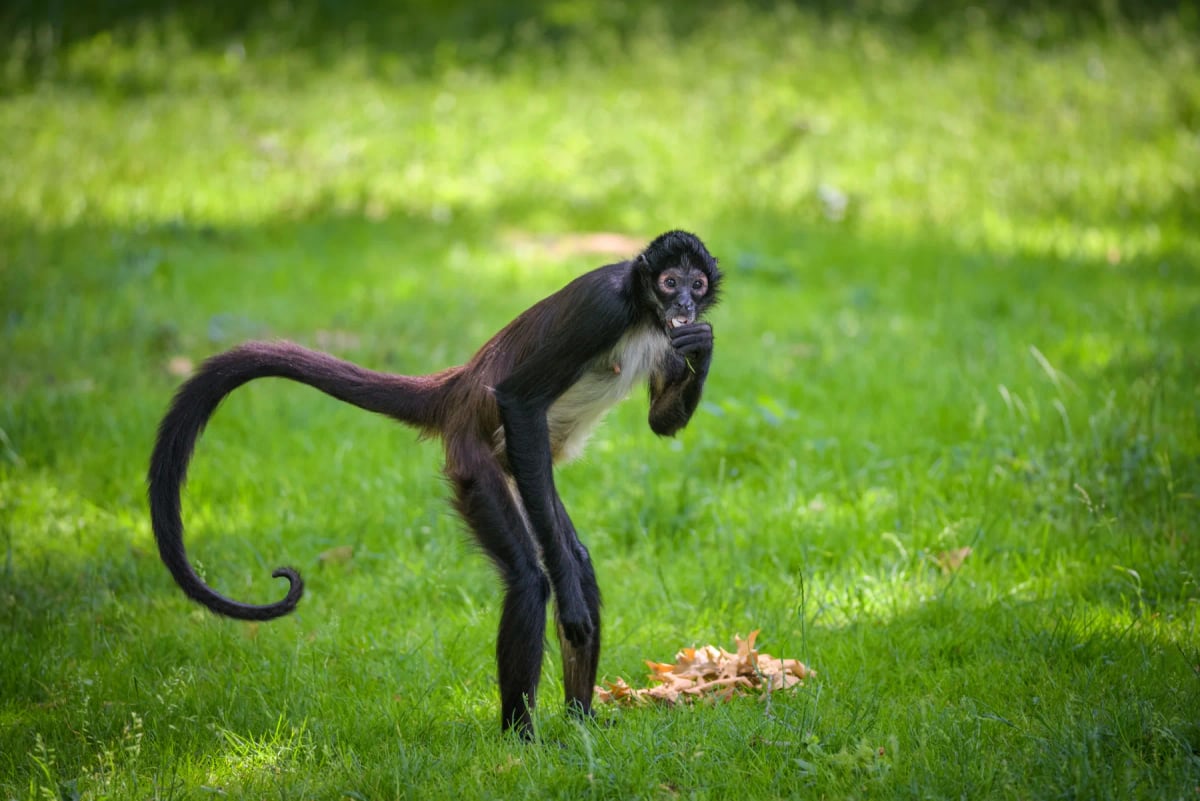
Spider monkeys are large primates of the New World, ranging from southern Mexico through Central America to Brazil and Bolivia. They live in mature tropical and subtropical forests, moving through the canopy with arms built for brachiation and a prehensile tail that grips branches as reliably as any hand. This tail is often longer than the body itself. Ripe fruit makes up most of their diet, though they also eat leaves, flowers, and bark. Because they swallow seeds whole and travel far each day, they are among the most important seed dispersers in the Americas. They live in groups that split into smaller foraging parties and reunite throughout the day, a system known as fission-fusion. Females give birth only once every two to four years, which means populations recover very slowly after decline. Most species in the genus Ateles are listed as Endangered.
Habitat and distribution
Spider monkeys range across a broad stretch of the Americas, from the rainforests of southern Mexico and Central America down through Colombia, Venezuela, and the Amazon Basin to Bolivia and Brazil. They depend almost entirely on mature, undisturbed tropical and subtropical forest, where the canopy is tall enough and connected enough for them to travel efficiently. Unlike many other primates, they are poor survivors in degraded or patchy habitat, since they need large, continuous areas to find the ripe fruit that makes up most of their diet. They tend to use the upper and middle levels of the forest, rarely descending to the ground. In areas where old forest has been cleared for agriculture or cattle ranching, populations quickly disappear.
Diet
Ripe fruit is the cornerstone of the spider monkey's diet, making up roughly 80 percent of what they eat throughout the year. When fruit is scarce, they turn to young leaves, flowers, and occasionally bark to fill the gap. Because they swallow many seeds whole and cover large distances each day, sometimes more than 10 kilometres, they deposit those seeds far from the parent tree. This makes them one of the most effective seed dispersers in tropical forests across the Americas, helping to regenerate the very forest they depend on. Their preference for large, fleshy fruits means they interact closely with dozens of tree species, and the loss of spider monkeys from a forest can noticeably reduce the ability of that forest to renew itself.
Distinctive features
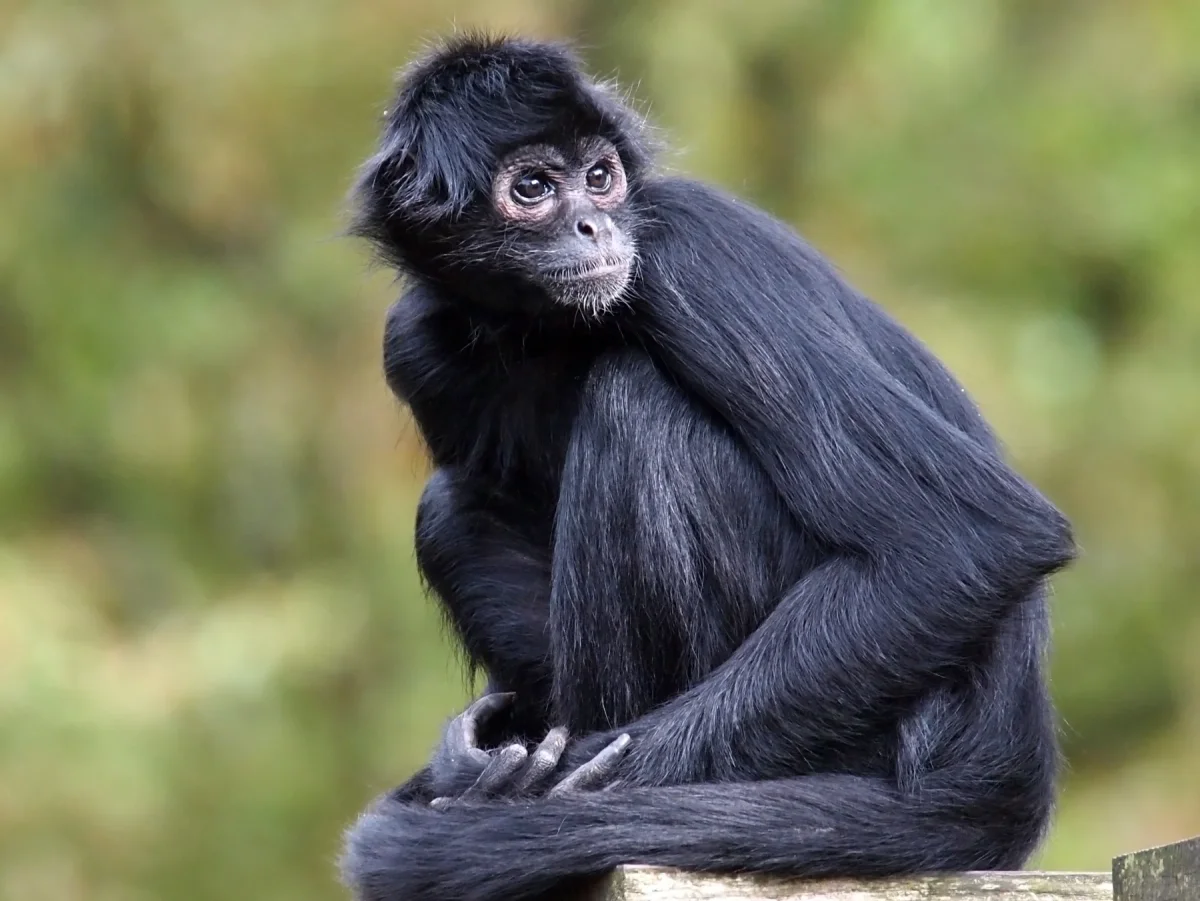
Few primates are as immediately recognizable as the spider monkey. Their arms are exceptionally long relative to the body, and their hands have reduced thumbs that allow them to hook effortlessly over branches during brachiation, the hand over hand swinging that carries them through the canopy at speed. The prehensile tail is perhaps their most impressive feature. It can support the animal's full weight and is sensitive enough to pick up small objects. The underside near the tip is bare skin, which provides grip in the same way a fingertip does. Adults typically weigh between 6 and 9 kilograms, with females slightly smaller than males on average. Their coats vary from black and brown to reddish and buff depending on the species.
Behavior
Social life in spider monkeys revolves around a system called fission-fusion, where a larger community of up to 30 individuals regularly breaks into smaller parties to forage and then comes back together again. The size of each subgroup on any given day tends to reflect how much food is available: when fruit is plentiful, larger parties form; when it is scarce, animals spread out to reduce competition. Females with young tend to forage in smaller, quieter groups. Spider monkeys communicate through a range of calls, including loud whoops that carry through the forest and help separated groups stay aware of each other's location. They are highly intelligent animals with strong social bonds, and individuals have been observed grieving and showing care toward injured companions.
Conservation
The outlook for spider monkeys is serious. The IUCN lists most species in the genus Ateles as Endangered, and some, such as the brown-headed spider monkey of Ecuador, as Critically Endangered. The two greatest threats are the destruction of mature forest for agriculture and cattle ranching, and hunting for bushmeat. Their situation is made more difficult by their slow reproduction rate. Females give birth only once every two to four years, so a population that has been reduced by hunting or habitat loss takes many years to recover even under the best conditions. They are also captured for the illegal pet trade. Protecting large areas of continuous forest and enforcing existing hunting laws are the most urgent steps needed to give populations a chance to survive over the long term.
Where it is found
The Spider Monkey can be found in places such as:
Researched and written by Juan Pablo. Sources: IUCN Red List, scientific literature and regional field guides. Last updated: .
Technical factsheet






Frequently Asked Questions
Why are they called spider monkeys?
The name comes from the way they look when hanging from branches. With their extremely long arms, legs, and prehensile tail all stretched out in different directions, they resemble a giant spider. Their tail alone can be longer than their body, and they use it to grip branches as confidently as any of their four limbs.
What do spider monkeys eat?
Spider monkeys are mainly fruit eaters, and ripe fruit makes up the bulk of their diet. They also consume leaves, flowers, bark, and insects when fruit is scarce. Because they swallow seeds whole and travel great distances each day, they scatter those seeds across the forest, helping new trees grow in places far from the parent plant.
How do spider monkeys move through the trees?
They travel mainly by brachiation, swinging hand over hand beneath branches at impressive speed. Their hook-shaped fingers are perfectly built for gripping, and their prehensile tail acts as a safety anchor whenever they need extra support. This style of movement lets them cover large stretches of forest canopy without ever coming down to the ground.
Where do spider monkeys live?
Spider monkeys range from southern Mexico through Central America all the way down to Brazil and Bolivia in South America. They prefer mature tropical and subtropical forests with tall, continuous canopy cover. They tend to avoid areas where trees have been removed or disturbed, since they depend on large, connected stretches of forest to find enough food.
Are spider monkeys endangered?
Yes, most species within the genus Ateles are listed as Endangered on the IUCN Red List. The biggest threats they face are the loss of forest to agriculture and logging, as well as hunting for bushmeat. Because females give birth only once every two to four years, populations recover very slowly once numbers start to drop.
How do spider monkeys communicate?
They are among the most vocal primates in the Americas. They use a wide range of calls, screams, and barks to warn group members about predators, coordinate movement through the forest, and keep in touch with individuals in different subgroups. They also communicate through body postures and facial expressions, which carry important social signals within the group.
Do spider monkeys make good pets?
No. Spider monkeys have complex social, dietary, and physical needs that cannot be met in a home environment. They require vast areas of forest canopy to move through and thrive only in the company of others of their kind. In many countries where they live, keeping them as pets is also illegal. Capturing wild individuals further harms already struggling populations.