Orangutan
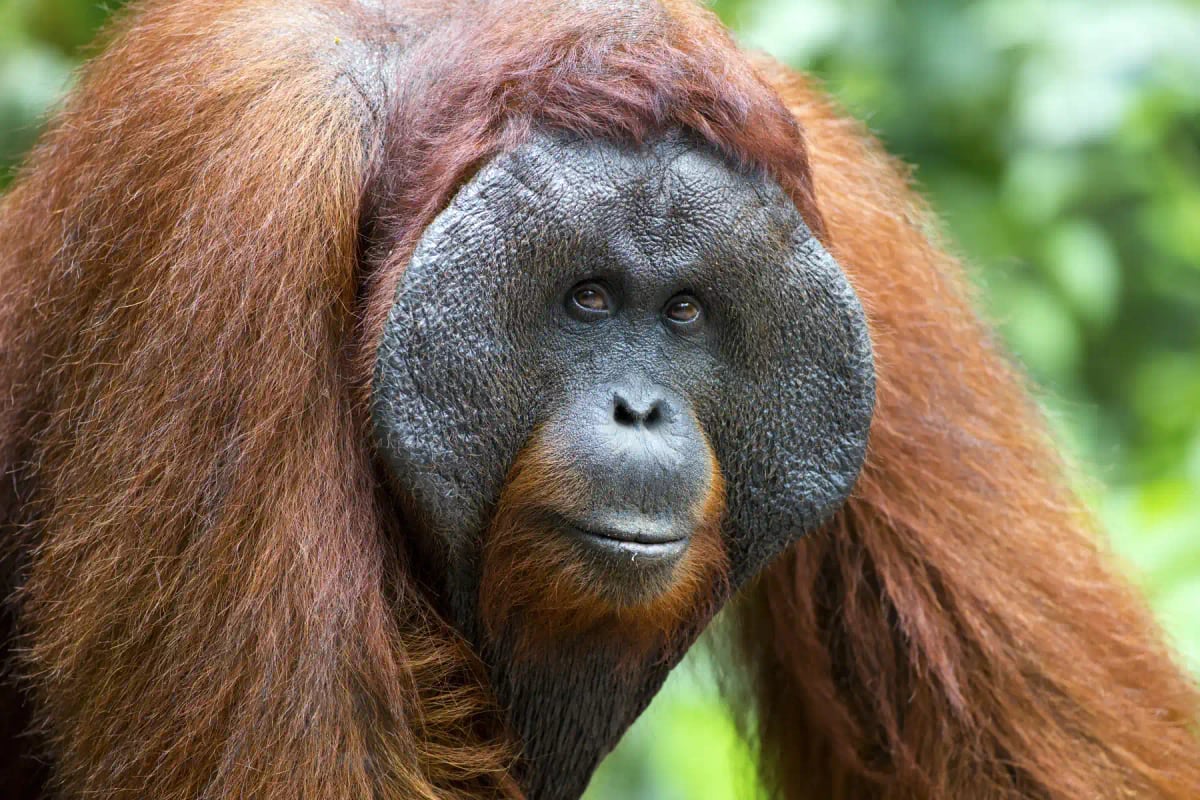
Orangutans are the only great apes native to Asia, living in the rainforests of Borneo and Sumatra. They spend most of their lives in the trees, using arms that can span more than two meters to swing and climb through the canopy. Reddish brown fur, expressive faces, and remarkable intelligence set them apart from all other primates. Their diet centers on fruit, though they also eat leaves, bark, flowers, and insects. Females raise a single offspring over a period of up to eight years, giving orangutans one of the slowest rates of reproduction among all mammals. Three species are recognized: the Bornean, Sumatran, and Tapanuli orangutan, and all are critically endangered. Habitat loss driven by palm oil farming, illegal logging, and wildfires, along with poaching, continues to push their populations toward collapse.
Habitat and range
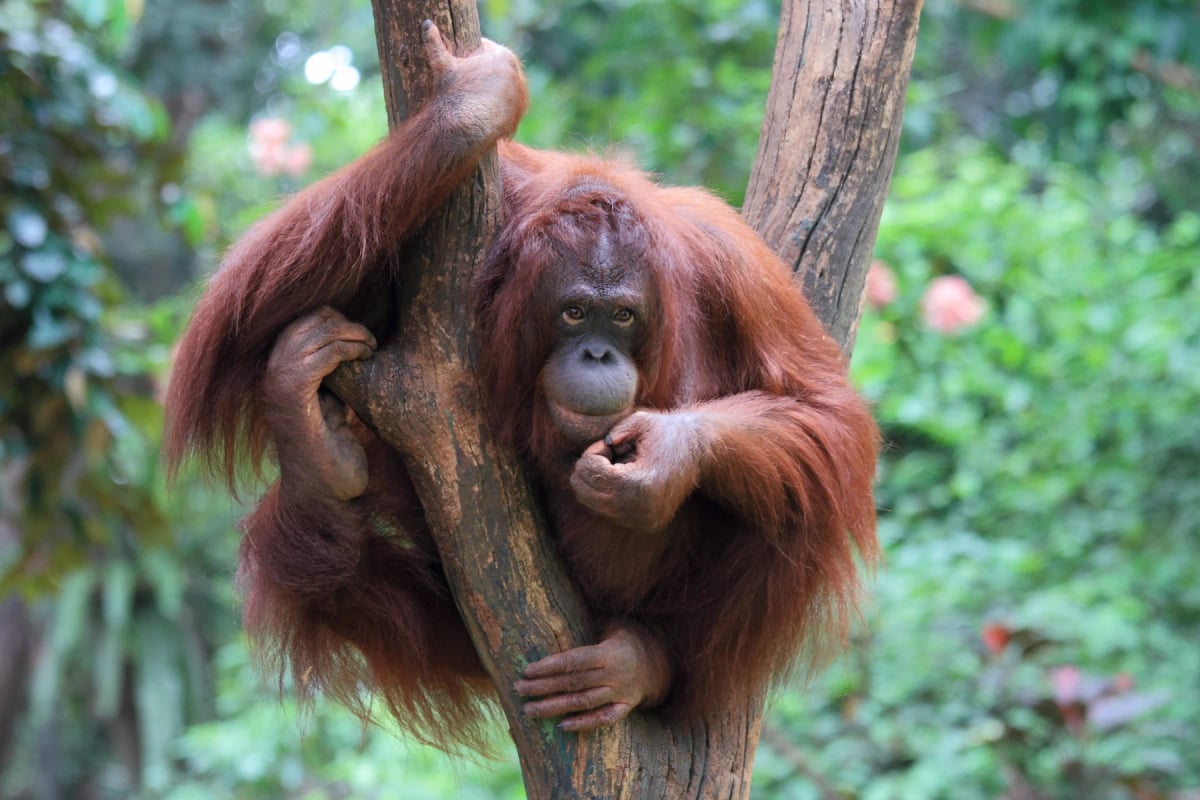
Orangutans live in the tropical rainforests of two large Southeast Asian islands: Borneo and Sumatra. Bornean orangutans occupy a wider range of forest types, from lowland peat swamp forests to forests on hillsides and lower mountain slopes. Sumatran and Tapanuli orangutans are found only in the northern part of Sumatra, in forests that are increasingly fragmented. All three species depend on tall, closed canopy forest where fruit trees are abundant. They build fresh sleeping nests high in the branches every night. As forests shrink due to agricultural expansion and logging, orangutans are pushed into smaller and more isolated patches of habitat, making it harder for populations to remain connected and healthy.
Diet
Fruit makes up the largest share of an orangutan's diet, and they will travel considerable distances through the canopy to find ripe figs, durians, mangosteens, and other forest fruits. When fruit is hard to come by, they turn to young leaves, shoots, bark, and the pith of certain plants. Insects, especially ants and termites, provide an additional source of protein. Orangutans have a strong memory for where particular trees grow and when those trees are likely to fruit, which helps them plan routes through the forest. In Sumatra, they have also been observed eating slow lorises on rare occasions, showing that their diet can be more flexible than once thought.
Social behavior
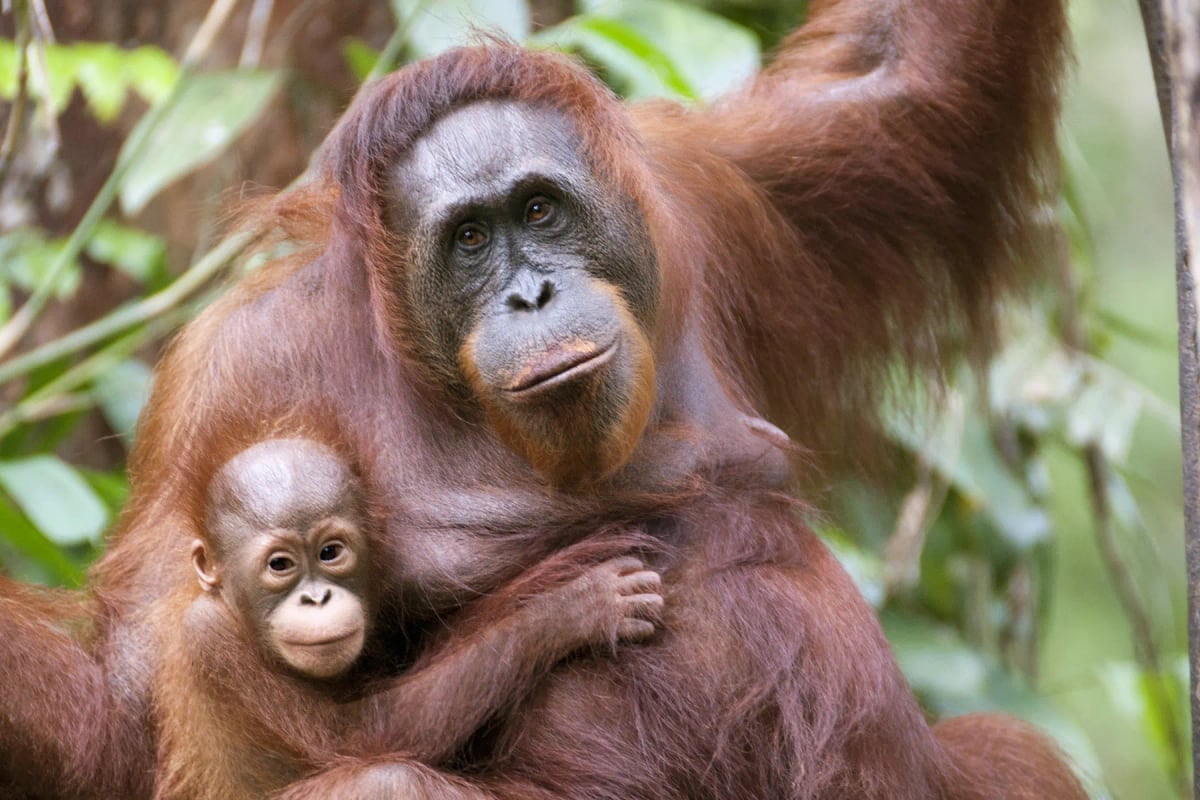
Unlike gorillas or chimpanzees, orangutans spend most of their lives alone. Adult males are especially independent and tend to avoid one another, communicating over long distances through deep, resonant calls known as long calls, which can carry through the forest for up to a kilometer. Females are less territorial and may tolerate the company of other females and their young from time to time. The closest social bond in orangutan society is between a mother and her offspring, who stay together for several years. Young orangutans learn everything they need to survive, from finding food to building nests, by watching and copying their mothers. This extended period of learning is one reason why orangutans rank among the most intelligent animals on the planet.
Reproduction
No mammal on Earth reproduces more slowly than the orangutan. Females give birth to a single infant roughly every seven to nine years, and the bond between mother and young is among the longest of any animal. Infants nurse for several years and continue to stay close to their mothers even after weaning. Females do not reach sexual maturity until around 12 to 15 years of age. Males come in two distinct forms: large flanged males, who have wide cheek pads and produce long calls, and smaller unflanged males. Both forms are capable of reproducing, but their strategies differ. Because each female raises so few offspring over a lifetime, the loss of even a small number of adults has a serious effect on the size of future populations.
Threats
Across Borneo and Sumatra, the destruction of forest is the greatest danger orangutans face. Enormous areas of rainforest have been cleared to make way for oil palm plantations, paper pulp operations, and smallholder agriculture over recent decades. Fires, often set deliberately to clear land, have burned through vast stretches of habitat, killing animals directly and destroying the food sources they depend on. Orangutans that wander into agricultural areas are sometimes killed by farmers who see them as a threat to crops. Poaching and the illegal trade in live animals, particularly infants taken to be kept as pets, add further pressure. Because orangutans reproduce so slowly, even relatively low rates of adult mortality can cause a population to shrink steadily over time.
Conservation
All three orangutan species are listed as Critically Endangered on the IUCN Red List. Efforts to protect them involve a combination of approaches. Governments and conservation organizations have established protected areas across Borneo and Sumatra, including Gunung Leuser National Park and Tanjung Puting National Park, which provide vital refuges. Rehabilitation centers rescue orphaned and injured orangutans, nurse them back to health, and where possible return them to the forest. Corridor projects work to reconnect isolated patches of forest so that animals can move between them. Consumer pressure for certified sustainable palm oil has also grown as a way of reducing the damage that agriculture causes to remaining habitat. The survival of orangutans over the long term will depend on keeping large areas of intact forest standing.
Researched and written by Juan Pablo. Sources: IUCN Red List, scientific literature and regional field guides. Last updated: .
Technical factsheet


Frequently Asked Questions
Are orangutans endangered?
Yes, all three orangutan species are listed as Critically Endangered on the IUCN Red List. Bornean, Sumatran, and Tapanuli orangutans have all suffered dramatic population declines due to deforestation, wildfires, and poaching. Because females give birth only once every seven to nine years, populations recover very slowly. Even small increases in adult deaths can cause numbers to fall steadily, making their situation one of the most urgent in wildlife conservation today.
Where do orangutans live?
Orangutans are found only on two islands in Southeast Asia: Borneo and Sumatra. They live in tropical rainforests, spending nearly all their time up in the tree canopy. Bornean orangutans occupy a broader range of forest types, while Sumatran and Tapanuli orangutans are restricted to the northern forests of Sumatra. All three species need large areas of intact forest with plenty of fruit trees to survive.
How intelligent are orangutans?
Orangutans are among the most intelligent animals on Earth. They use sticks as tools to extract insects from tree bark and leaves to shelter from rain. Young orangutans spend years learning skills by watching their mothers closely. Studies have shown they can plan ahead, solve puzzles, and even communicate using symbols in research settings. Their ability to learn and adapt is comparable to that of chimpanzees and gorillas.
How long do orangutans live?
In the wild, orangutans typically live between 35 and 45 years. In zoos and sanctuaries, where they receive regular food and veterinary care, some individuals have reached their mid-50s. Their lifespan is closely tied to the health of the forest they live in. Orangutans that lose access to good habitat tend to be in poorer condition and face a shorter life as a result.
What do orangutans eat?
Fruit is the foundation of the orangutan diet. They search the canopy for figs, durians, mangosteens, and dozens of other forest fruits. When fruit is scarce, they eat young leaves, bark, plant shoots, and insects such as ants and termites. Orangutans have an impressive memory for where fruit trees grow and when each one is likely to produce ripe fruit, which helps them navigate the forest efficiently.
Why are orangutans solitary animals?
Orangutans live mostly alone because the forest cannot easily support large groups in one area. Fruit, their main food source, grows in scattered patches and is not always abundant. Spreading out across the forest allows each individual to find enough to eat without competing with others. Adult males claim large territories and warn rivals away with powerful long calls that can travel up to a kilometer through the trees.
How many orangutans are left in the wild?
Current estimates put the total wild population at roughly 100,000 to 120,000 Bornean orangutans, around 13,000 Sumatran orangutans, and fewer than 800 Tapanuli orangutans. The Tapanuli orangutan, discovered as a distinct species in 2017, is considered the most at risk of all great apes. All three populations have declined sharply over recent decades, and numbers continue to fall in areas where deforestation has not been stopped.