Rooster
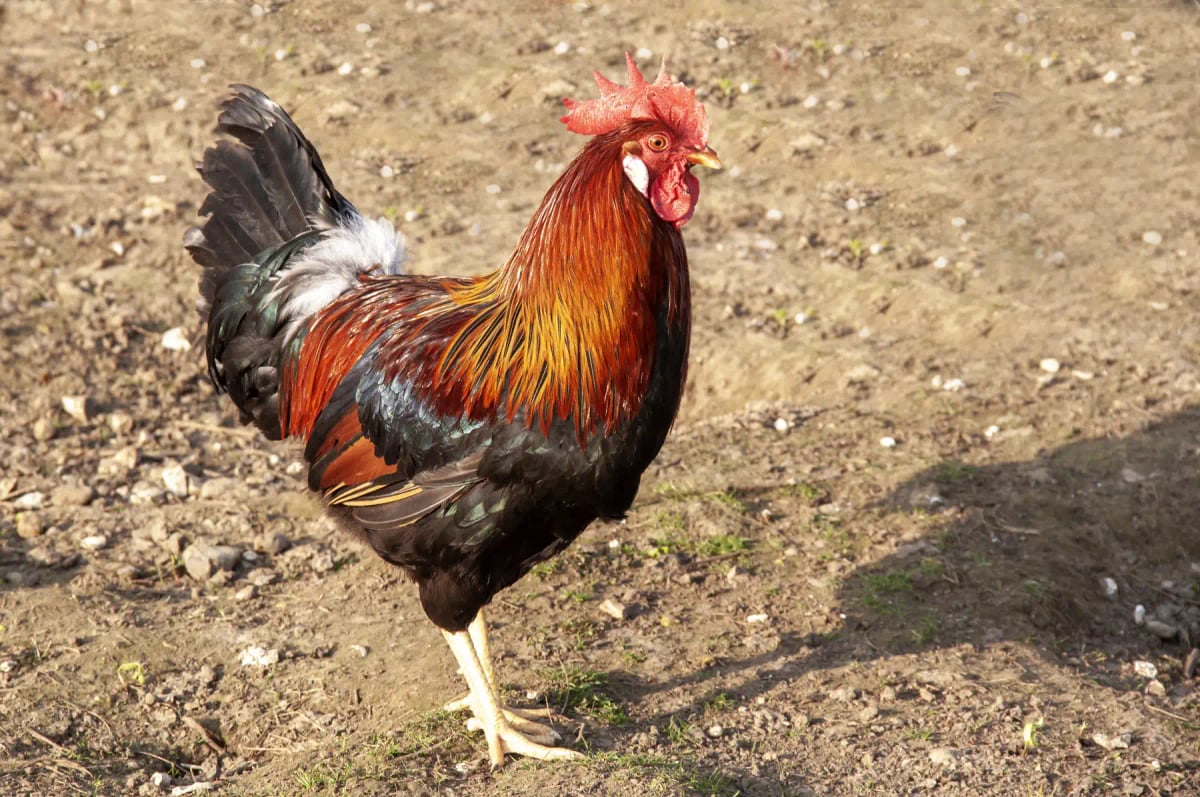
The rooster is the adult male of the domestic chicken, a bird descended from the red junglefowl of Southeast Asia. Archaeological evidence points to domestication about 3,500 years ago in what is now Thailand, where rice and millet fields drew wild junglefowl close to people. Today chickens live on every inhabited continent, and roosters are easy to recognize by their red comb, wattles, long pointed neck feathers, sweeping tail plumes and leg spurs. Their crowing at dawn is not simply a reaction to sunlight: it follows an internal circadian rhythm, and in a flock the top ranking male crows first. Roosters are territorial, guard their hens from threats and eat seeds, grains, insects and small invertebrates. In France, the Gallic rooster has been a national symbol for centuries, and the bird also holds a place in Chinese, Latin American and Mediterranean traditions.
Domestication
Domestic chickens descend from the red junglefowl, a wild bird of the forests of Southeast Asia. For years the rooster's domestication was dated to 8,000 years ago or more, but a 2022 study that reviewed chicken bones from more than 600 archaeological sites showed that many of those early finds were misidentified or came from younger layers. The oldest clearly domestic chicken remains come from Ban Non Wat, in central Thailand, and date to roughly 1650 to 1250 BC. The researchers link the process to rice and millet farming: grain fields and stores drew junglefowl out of the trees and into villages, and from there chickens spread with farmers across Asia, the Middle East, Europe and, much later, the Americas. Along the way roosters became fixtures of rural life, serving as living alarm clocks, flock guardians and objects of cultural pride. Selective breeding has since produced hundreds of breeds, developed for size, temperament, egg laying or plumage.
Rooster or hen: how to tell them apart
A rooster is simply a male chicken; a hen is the female. Young males under a year old are called cockerels, and young females are pullets. In most breeds the differences are easy to see once the birds are a few months old. Roosters are larger, with a taller comb and longer wattles, and they grow long, pointed, glossy feathers on the neck (hackles) and the lower back (saddle), while hens have short, rounded ones. The rooster also has sickle feathers, the long curved plumes that arch over his tail, and sharp spurs on the back of the legs that he uses when fighting. Behavior gives him away too: roosters crow, stand guard with their heads up while the flock feeds, and call hens over to food. Hens do not need a rooster to lay eggs; he is only needed if the eggs are to be fertilized and hatch. On rare occasions a hen whose single working ovary is damaged can develop male traits and even start to crow.
Behavior and why roosters crow
What most people know about roosters is their crowing, but there is more to it than a simple response to sunrise. Research in Japan showed that crowing follows an internal circadian rhythm: roosters kept in constant dim light still crowed at roughly the same time each day, just before the dawn they expected. The same team found that crowing follows the pecking order. The highest ranking rooster always crows first, and the others wait their turn in descending order of rank, even though subordinate males are fully able to crow earlier. The call announces territory and warns rival males to keep their distance. It is also remarkably loud. A crow measures about 100 decibels at one meter and more than 130 decibels at the rooster's own ear, and when he opens his beak wide to crow his ear canals partly close, which protects his hearing. Beyond crowing, roosters use postures and calls to assert dominance, place themselves between threats and their hens, and court females with tidbitting, repeatedly picking up and dropping food to draw their attention. They forage on seeds, grains, insects and small invertebrates.
Popular rooster breeds
Hundreds of chicken breeds exist, and the rooster of each one looks strikingly different. The Rhode Island Red, developed in Rhode Island and Massachusetts in the late 1800s, has deep mahogany feathers and has been the official state bird of Rhode Island since 1954. The Leghorn comes from Tuscany and takes its English name from the port of Livorno, where birds were shipped to North America in the 1820s; the brown Leghorn rooster, with a large single comb, orange hackles and a glossy black tail, is one of the classic farmyard images. The Wyandotte, created in New York and Ontario in the 1870s and named after the Wyandot people, has a low rose comb and laced feathers, and the blue laced red variety pairs chestnut feathers with slate blue edges. The Silkie, an old breed from China, is covered in soft fluffy plumage that looks like fur and has black skin and bones and five toes on each foot instead of four. At the extremes, bantam roosters can weigh well under a kilogram, while Jersey Giant and Brahma roosters reach about 5.5 to 6 kilograms.
The Gallic rooster, symbol of France
Few animals are as deeply tied to a nation's identity as the rooster is to France. The link starts with a Latin pun: gallus means both rooster and inhabitant of Gaul, the Roman name for the region. French kings of the Renaissance began to use the bird as a sign of courage and fighting spirit, but it was the French Revolution that turned it into an emblem of the nation, stamped on coins and on the seal of the Directory. Napoleon rejected it in favor of the imperial eagle, arguing that the rooster had no strength and could not represent an empire like France. The bird came back under the July Monarchy and the Second Republic and has stayed since the Third Republic. It is not one of the official emblems named in the French Constitution, yet the Gallic rooster, le coq gaulois, crowns the Grille du Coq gate of the Élysée Palace garden, tops church weathervanes across the country and appears on the jerseys of French national sports teams. Its link with dawn, alertness and standing its ground made it a natural fit for a nation that values those qualities.
Global presence
As a domesticated bird, the rooster has traveled alongside human civilization across every corner of the globe. There is no inhabited continent where chickens are absent, and with more than 25 billion of them alive at any time they outnumber people more than three to one, and the rooster, as the male of the species, shares that reach entirely. Beyond its practical role on farms and in rural households, the rooster carries deep cultural weight in many parts of the world. In Chinese tradition, the rooster is one of the twelve animals of the zodiac, representing punctuality, honesty, and confidence. Across Latin America and the Mediterranean, it features prominently in folklore, religious imagery, and local festivals. In parts of West Africa and the Caribbean, the rooster holds ceremonial significance in traditional spiritual practices. This combination of agricultural utility and cultural meaning has made the rooster one of the most recognized birds in human history, appearing in art, mythology, and daily life across countless societies.
Researched and written by Juan Pablo. Sources: IUCN Red List, scientific literature and regional field guides. Last updated: .
Technical factsheet











Frequently Asked Questions
Is a rooster a chicken?
Yes. A rooster is an adult male chicken, the same species (Gallus gallus domesticus) as the hen, which is the adult female. Young males under about a year old are called cockerels, and a castrated male raised for meat is a capon. In British English the adult male is often called a cock. So when people say rooster chicken, they simply mean a male chicken, not a different kind of bird.
Why is the rooster the symbol of France?
It comes from a Latin pun: gallus means both rooster and Gaul, the Roman name for the land that became France. Renaissance kings used the bird as a sign of courage, and the French Revolution made it an emblem of the nation. Napoleon replaced it with the eagle, but it returned in the 1800s. Today the Gallic rooster appears on the jerseys of French sports teams and on a gate of the Élysée Palace garden.
How loud is a rooster's crow?
Very loud. A 2017 study measured a rooster's crow at about 100 decibels at a distance of one meter, similar to a jackhammer, and more than 130 decibels at the entrance of the bird's own ear. Roosters avoid damaging their hearing because, when they open their beak fully to crow, part of the ear canal closes and soft tissue covers the eardrum. Birds can also regrow damaged hair cells in the inner ear, something mammals cannot do.
Do hens need a rooster to lay eggs?
No. Hens lay eggs whether or not a rooster is present, usually close to one egg a day in their most productive years. The rooster's role is to fertilize the eggs so that chicks can develop and hatch. Eggs sold in supermarkets almost always come from flocks without roosters, so they are unfertilized. A fertilized egg that is refrigerated and never incubated will not develop into a chick.
What is the biggest rooster breed?
The Jersey Giant, developed in New Jersey in the late 1800s, is usually named the largest chicken breed, with standard weights for roosters around 6 kilograms (13 pounds). The Brahma, sometimes called the king of chickens, is close behind at about 5.5 kilograms (12 pounds) and can look even bigger because of its tall stance and feathered legs. At the other extreme, bantam roosters of breeds like the Serama weigh under half a kilogram.
Why do roosters crow in the morning?
Roosters crow because of an internal body clock, not just because the sun comes up. Research has confirmed that they crow at roughly the same time each morning even in constant dim light. The main purpose of crowing is to claim territory and signal to rival males that the space is taken. It also reflects rank: in a group of roosters, the most dominant one always crows first and the others follow in order of their position in the pecking order.
What do roosters eat?
Roosters are omnivores that spend much of their day foraging on the ground. Their diet includes seeds, grains, insects, worms, and small invertebrates. They are not picky eaters and will peck at almost anything edible they come across. On farms, they are usually fed a balanced poultry feed that covers their nutritional needs, but given open space they instinctively scratch and search the soil for food.
How long do roosters live?
In a typical farm or backyard setting, a rooster lives between 5 and 8 years on average. Some individuals can reach 10 to 15 years under very good care. Their lifespan depends on factors like breed, diet, living conditions, and how much stress they face from other birds or predators. Roosters kept away from conflict and given proper nutrition tend to live significantly longer than those in crowded or competitive environments.
Are roosters aggressive?
Roosters can be territorial and protective, especially when they feel that their flock is threatened. They use postures, feather displays, and vocalizations to assert dominance before resorting to physical confrontation. Some individuals are naturally calmer than others, and the breed plays a big role in temperament. Roosters raised with regular human contact from a young age tend to be far less aggressive toward people than those with little handling.
Do roosters appear in any cultural traditions around the world?
The rooster holds a remarkable place in cultures across the globe. In China, it is one of the twelve animals of the zodiac, associated with honesty and confidence. Across Latin America and the Mediterranean, it appears in folklore and religious imagery. In parts of West Africa and the Caribbean, the rooster carries ceremonial importance in traditional spiritual practices. In France, the Gallic rooster has served as a national symbol of courage and vigilance for centuries.
Where do domestic roosters originally come from?
The domestic rooster descends from the red junglefowl, a wild bird native to the forests of Southeast Asia. A 2022 study of bones from about 600 archaeological sites placed the first clearly domestic chickens in central Thailand around 3,500 years ago, where rice and millet farming drew junglefowl close to villages. From there, chickens spread along with farmers and traders into South Asia, China, the Middle East, Europe and eventually the Americas. Today the rooster is found on every inhabited continent.