Dugong
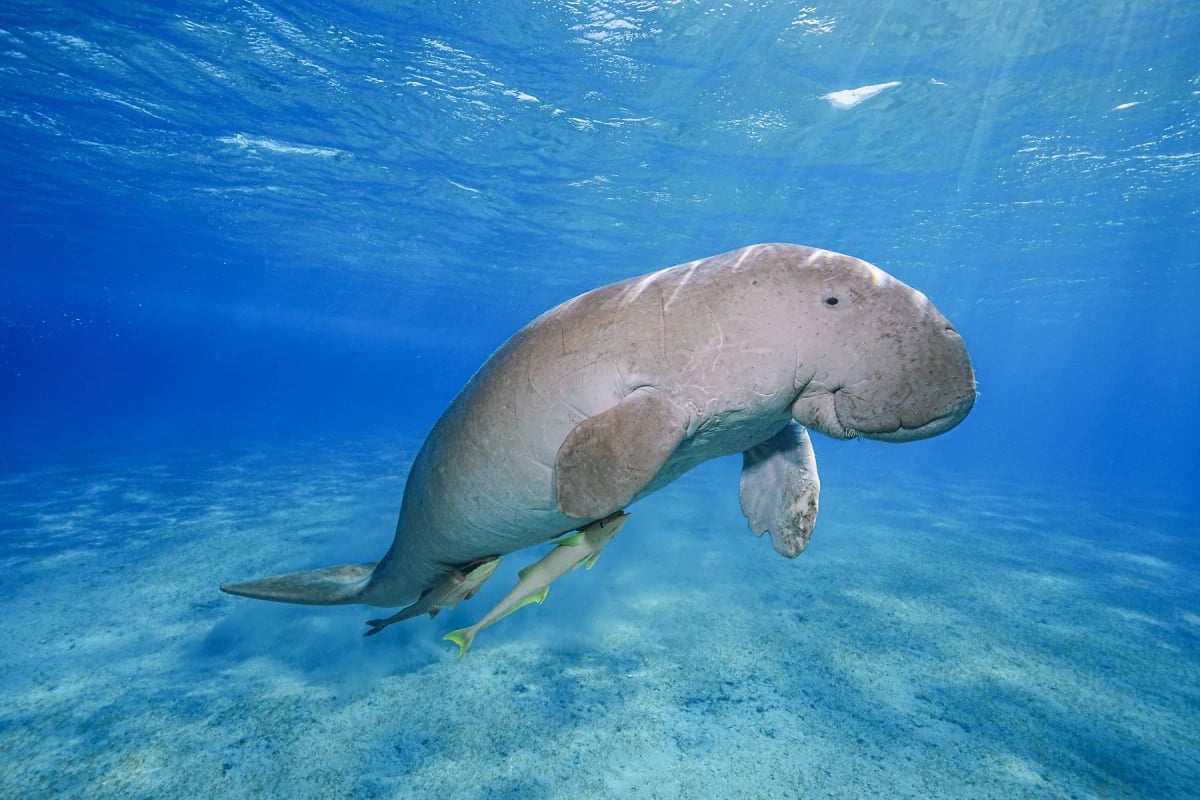
The dugong (Dugong dugon) is the only living member of the family Dugongidae and one of just four surviving species in the order Sirenia, which also includes the three manatee species. It roams warm, shallow coastal waters stretching from East Africa and the Red Sea across the Indian Ocean to the western Pacific. Adults typically grow to between 2.4 and 3 metres and weigh up to 420 kg, with a distinctly fluked tail that sets them apart from manatees at a glance. Dugongs graze almost entirely on seagrass, uprooting whole plants with their bristled, downward-angled snouts and leaving behind characteristic feeding trails on the seafloor. They are slow breeders, raising just one calf every three to seven years, which makes population recovery difficult. The IUCN currently lists the dugong as Vulnerable, with threats ranging from boat strikes and net entanglement to the widespread loss of seagrass beds.
Habitat and distribution
Dugongs are found across a vast stretch of warm coastal ocean, from the eastern shores of Africa and the Red Sea through the Indian Ocean and into the western Pacific. Their range touches more than 40 countries, with Australia holding by far the largest population, particularly in the waters off Queensland and the Northern Territory. They stick almost exclusively to shallow bays, sheltered lagoons, and coastal flats where seagrass grows in abundance, rarely venturing deeper than 10 metres during feeding. However, they are capable of much deeper dives when crossing open water between feeding grounds. Water temperature matters greatly to them, and they tend to avoid areas that drop below around 18 degrees Celsius for extended periods, which shapes where they can survive.
Diet
Seagrass makes up almost the entire diet of a dugong, making it one of the few large mammals to rely so completely on a single type of plant. Using a broad, bristled snout that angles downward, a dugong digs into the seafloor to pull up whole plants, roots and all. This leaves distinctive bare furrows across the seabed that researchers use to track their feeding activity. Dugongs prefer species of seagrass that are low in fibre and high in nitrogen, such as those in the genus Halophila. An adult may consume around 40 kilograms of seagrass each day. Because they return to the same meadows repeatedly, their grazing actually stimulates new plant growth, which makes them an important part of the coastal ecosystems they depend on.
Behavior
For most of the time, dugongs live alone or in small, loosely connected groups, though aggregations of hundreds of individuals have been recorded in areas where seagrass is especially plentiful. They are gentle and generally unhurried animals, spending much of their day grazing and surfacing every one to two minutes to breathe. Despite their calm appearance, dugongs undertake substantial movements between feeding areas and can travel hundreds of kilometres when food becomes scarce or water temperatures shift. They communicate using chirps, whistles, and bark-like sounds. Calves stay close to their mothers for up to 18 months, learning feeding routes and resting spots. Males sometimes gather around females during mating periods, competing with one another through displays rather than outright fights.
Conservation
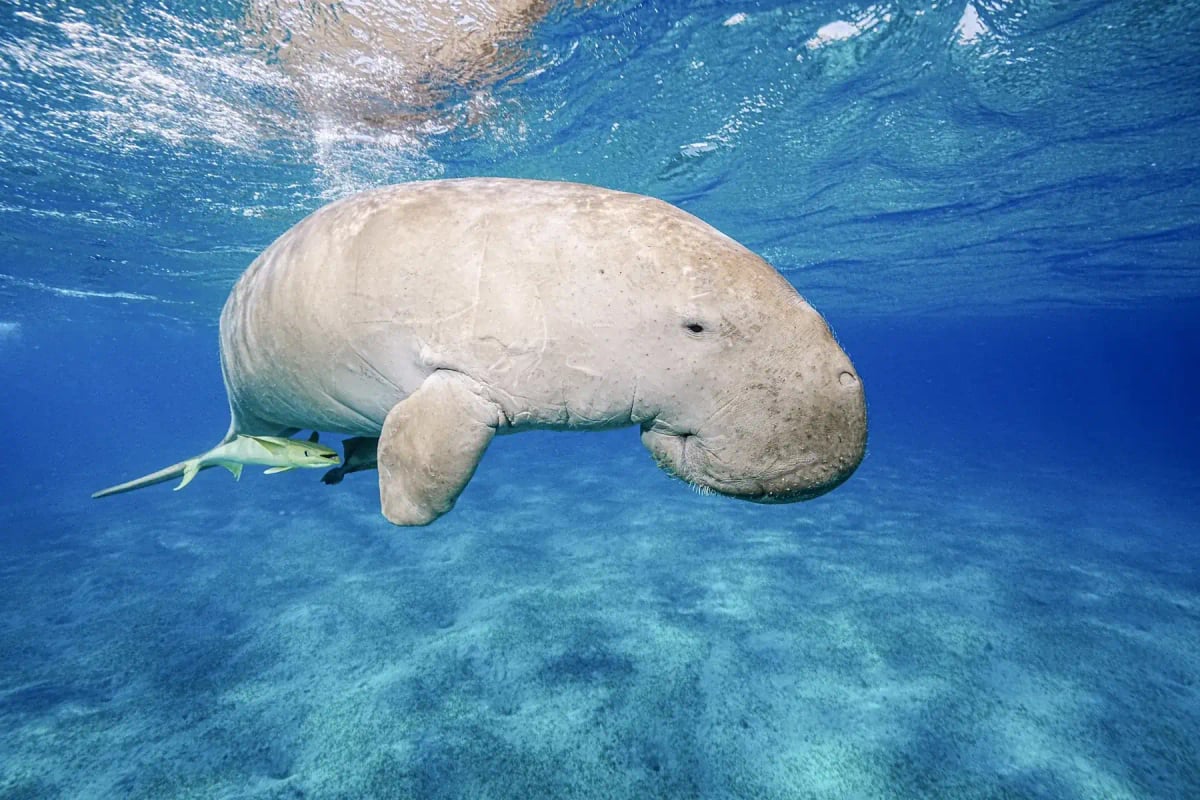
The IUCN lists the dugong as Vulnerable, and populations across much of its range are declining. The biggest threats come from the loss of seagrass beds, which are disappearing due to coastal development, runoff from agriculture, and damage caused by boat propellers and anchors. Dugongs themselves are also struck by vessels and drowned in fishing nets, particularly gillnets set near the coast. Their extremely slow rate of reproduction makes recovery from any population drop a process that takes decades. In several countries, including India and the Philippines, local populations have collapsed to very small numbers. Legal protections exist in most range countries, but enforcement is uneven. Australia has invested heavily in monitoring through aerial surveys, which remain the most reliable way to count dugongs across large areas of ocean.
Relation to manatees
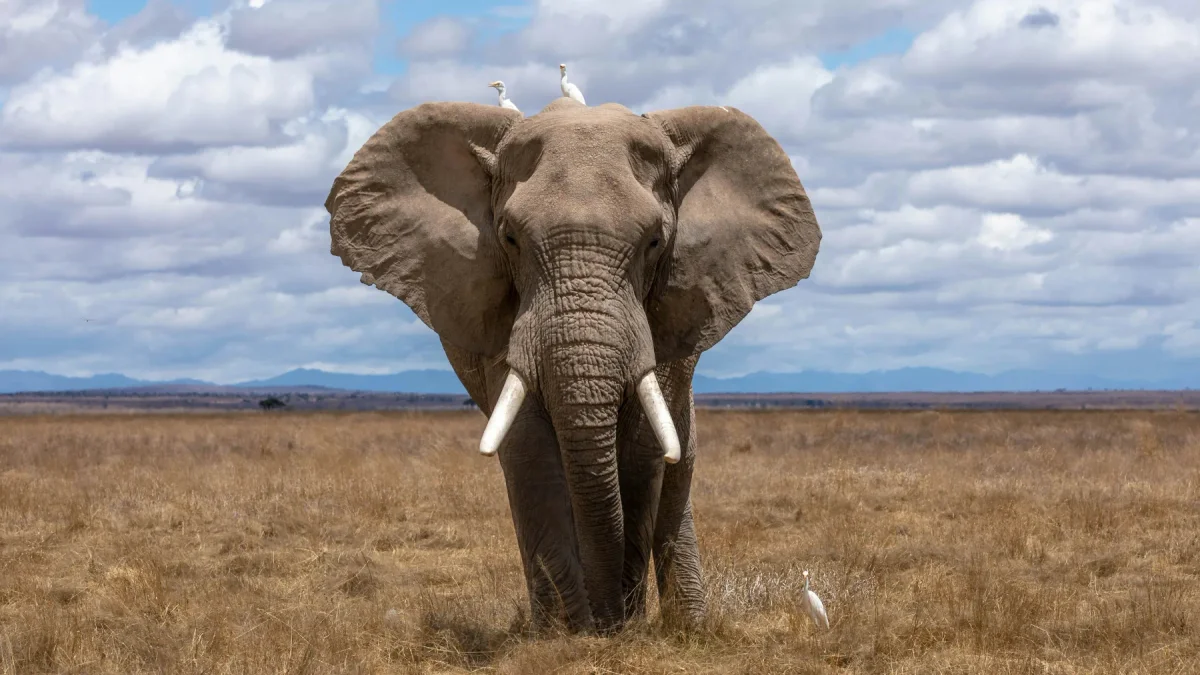
Both dugongs and manatees belong to the order Sirenia, an ancient group of aquatic mammals that share a distant ancestor with elephants and hyraxes. Within that order, dugongs are the sole living members of the family Dugongidae. The three manatee species, the West Indian, Amazonian, and West African, belong to a separate family called Trichechidae. One of the easiest ways to tell them apart is the tail: a dugong has a fluked, forked tail much like a dolphin, while a manatee has a broad, paddle-shaped one. Dugongs are also more strictly marine, while some manatees regularly enter rivers and freshwater systems. The closest known relative of the dugong was Steller's sea cow, a much larger sirenian that was hunted to extinction by 1768.
Where it is found
The Dugong can be found in places such as:
Researched and written by Juan Pablo. Sources: IUCN Red List, scientific literature and regional field guides. Last updated: .
Technical factsheet

Frequently Asked Questions
What do dugongs eat?
Dugongs eat almost nothing but seagrass, making them one of the few large mammals with such a narrow diet. They use their broad, bristled snouts to dig up whole plants from the seafloor, roots included. They prefer species that are low in fibre and high in nitrogen. An adult dugong can eat around 40 kilograms of seagrass in a single day.
Where do dugongs live?
Dugongs live in warm, shallow coastal waters across more than 40 countries, from East Africa and the Red Sea through the Indian Ocean to the western Pacific. They favor sheltered bays, lagoons, and coastal flats where seagrass grows well. Australia has by far the largest population, especially around Queensland and the Northern Territory. They tend to avoid water that stays below about 18 degrees Celsius.
Are dugongs endangered?
The IUCN classifies the dugong as Vulnerable, and populations in many parts of its range are declining. The main threats include the loss of seagrass beds, collisions with boats, and drowning in fishing nets. Because dugongs breed very slowly, raising just one calf every three to seven years, it takes decades for a population to recover. In countries like India and the Philippines, numbers have dropped to very low levels.
How long do dugongs live?
Dugongs can live for 70 years or more, making them one of the longest-lived marine mammals of their size. Scientists determine their age by counting growth layers in their tusks, much like counting rings in a tree. Despite their long lifespan, their survival over the long term is threatened by how slowly they reproduce, since losing even a small number of adults each year can push a local population into decline.
Are dugongs related to elephants?
Yes, surprisingly. Dugongs belong to the order Sirenia, a group of aquatic mammals that share a distant common ancestor with elephants and hyraxes. This makes elephants among the closest living relatives of dugongs, even though the two animals look nothing alike today. Over millions of years, the ancestors of dugongs moved into the sea and gradually lost their hind limbs, evolving into the fully aquatic animals we see now.
How is a dugong different from a manatee?
The easiest way to tell them apart is the tail. A dugong has a forked, fluked tail like a dolphin, while a manatee has a broad, rounded, paddle-shaped one. Dugongs are also strictly marine animals, whereas some manatees live in rivers and freshwater. Both belong to the order Sirenia, but they split into separate families millions of years ago. The dugong is the only surviving member of its family, Dugongidae.
Do dugongs make sounds?
Yes, dugongs communicate using a range of sounds including chirps, whistles, and bark-like calls. While they are not as vocal as dolphins or whales, sound plays an important role in how they stay in contact, especially between mothers and their calves. Calves remain close to their mothers for up to 18 months, and researchers believe vocal communication helps them stay bonded during that period as they learn feeding routes together.