Striped Hyena
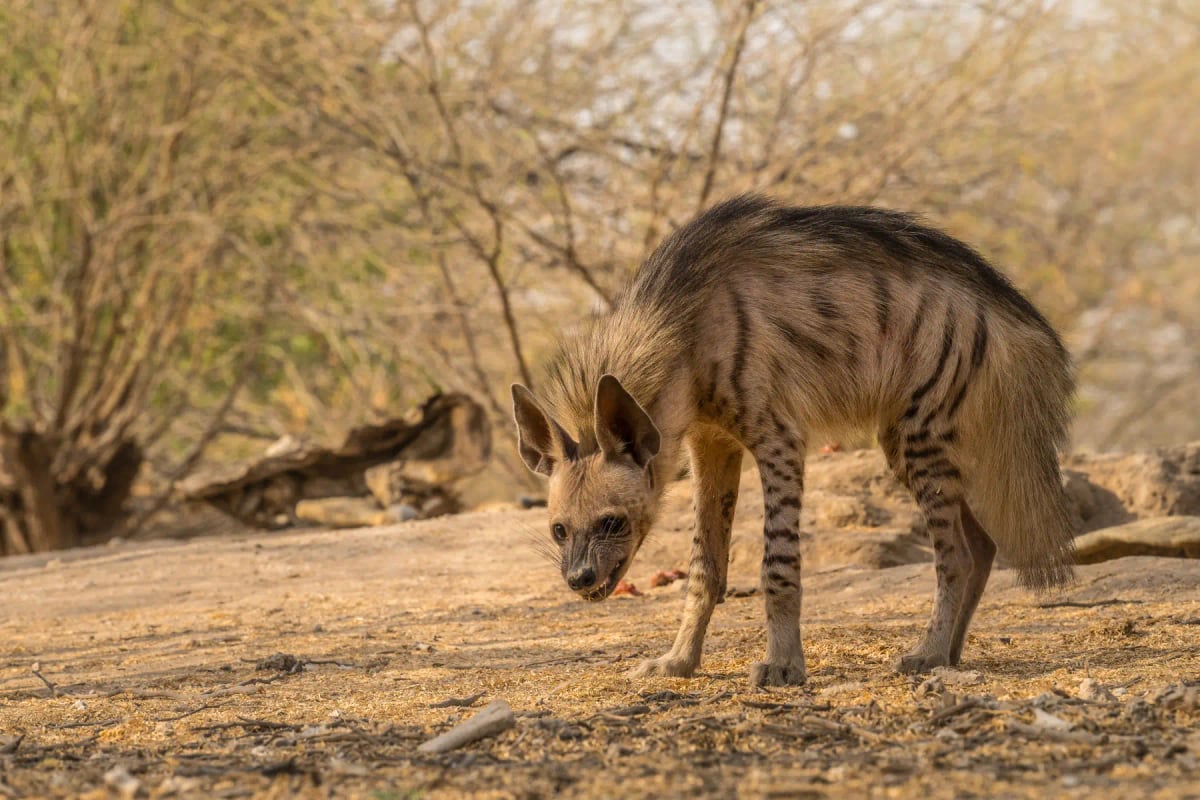
The striped hyena (Hyaena hyaena) is a medium-sized carnivore of the family Hyaenidae, ranging across North and East Africa, the Middle East, and South Asia. Its coarse gray coat is marked with bold black stripes, and a mane of long hair runs from the neck to the base of the tail. When threatened, that mane stands erect, making the animal look noticeably larger. Unlike the spotted hyena, this species is quiet and secretive, spending the day in caves or dense thickets and venturing out after dark. It is primarily a scavenger, crushing bones that most predators leave behind, but it also eats fruit, insects, and small vertebrates. It usually lives alone or in pairs. The IUCN lists it as Near Threatened, with populations declining due to habitat loss, persecution, and hunting for use in traditional medicine.
Habitat and distribution
Striped hyenas are remarkably adaptable and occupy a wide range of environments, from dry savannas and thornbush scrublands to rocky hillsides, open woodland, and semi-arid plains. They are found across a broad band of territory stretching from West and East Africa through the Middle East and into South Asia, reaching as far east as India and Nepal. They tend to avoid true deserts with little cover and are rarely found in dense tropical forest. Wherever they live, access to caves, rocky crevices, or dense thickets is important, as these animals rely on sheltered dens to rest through the day. Elevations of up to around 3,300 metres have been recorded in some parts of their range.
Diet
Food for the striped hyena comes from a surprisingly varied range of sources. Carrion forms the backbone of its diet, and its powerful jaws can crush large bones that other predators leave untouched, giving it access to the nutritious marrow inside. It also eats insects, wild fruit, and agricultural crops on occasion, and will take small vertebrates such as lizards, frogs, and rodents when the opportunity arises. Near human settlements, it frequently raids rubbish dumps and feeds on livestock carcasses. This flexibility with food is one reason the species has managed to persist across such a wide range of habitats. Striped hyenas tend to carry food back to their den rather than consume it entirely at the site where they find it.
Behavior
After dark is when the striped hyena truly comes to life. It spends the daylight hours hidden in a den and sets out at night to forage, sometimes covering considerable distances in a single outing. Most individuals live alone or in pairs, though family groups of up to seven animals have been observed sharing a territory. Communication relies on scent more than sound. Glands near the tail produce secretions used to mark territory, and individuals also perform a behavior called pasting, pressing those glands against grass stems and rocks. Unlike the spotted hyena, this species is largely silent and rarely vocalizes. When threatened, it raises its mane, arches its back, and may feign death as a last resort.
Appearance
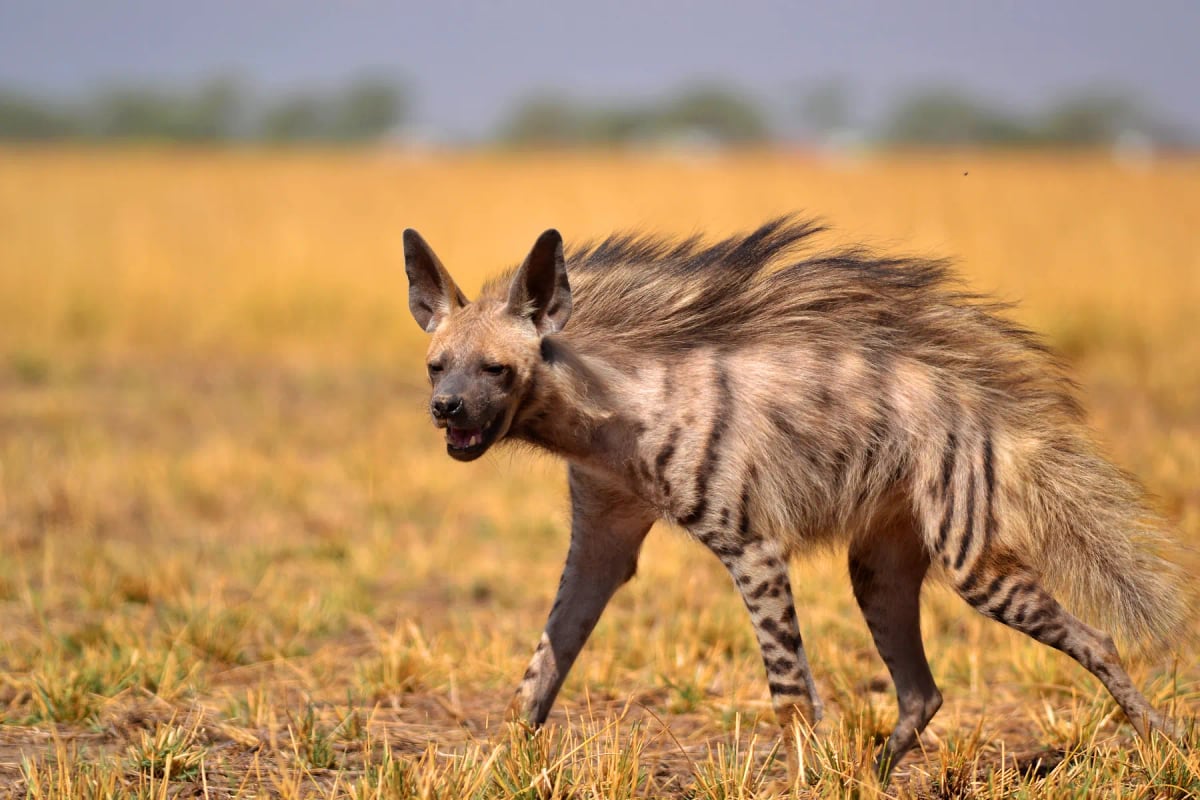
In terms of size, the striped hyena sits between a large domestic dog and a small lion. Adults typically weigh between 22 and 55 kilograms, with males and females being similar in size. The coat is coarse and ranges from pale gray to yellowish gray, crossed by bold black stripes on the body and legs. The face is dark, with a black throat patch that is especially prominent. A long mane of stiff hair runs from the back of the head all the way to the base of the tail. When the animal feels threatened, muscles along the back pull that mane upright, adding as much as a third to the animal's apparent height. The legs are long and the hindquarters slope noticeably downward, a build shared with other members of the hyena family.
Conservation
The IUCN classifies the striped hyena as Near Threatened, and the overall trend in its population is downward. Across much of its range it faces a combination of pressures that are difficult to separate. Habitat loss driven by agricultural expansion reduces the wild land available to the species. Persecution is widespread, partly because farmers fear attacks on livestock and partly because of unfounded superstitions. Hunting for body parts used in traditional medicine and folk practices is an additional threat in several countries. Road collisions also kill a significant number of animals each year. Despite legal protection in some countries, enforcement is often limited. Greater public awareness, coexistence programmes between farmers and wildlife managers, and stronger anti-poaching measures are all considered important for the survival of this species over the long term.
Where it is found
The Striped Hyena can be found in places such as:
Researched and written by Juan Pablo. Sources: IUCN Red List, scientific literature and regional field guides. Last updated: .
Technical factsheet


Frequently Asked Questions
What does a striped hyena eat?
Striped hyenas are mainly scavengers. They feed on carrion and are strong enough to crush bones that lions and leopards leave behind, getting to the rich marrow inside. They also eat fruit, insects, lizards, and rodents. Near villages, they raid rubbish dumps and feed on livestock carcasses. This varied diet is a big part of why they survive across so many different environments.
Where do striped hyenas live?
Striped hyenas are found across a wide stretch of the world, from West and East Africa through the Middle East and all the way to India and Nepal. They prefer dry, open landscapes like savannas, rocky hillsides, and scrublands, and they avoid thick tropical forest. They always stay close to caves or dense thickets where they can shelter during the day, and they have been recorded at altitudes of up to around 3,300 metres.
Are striped hyenas dangerous to humans?
Striped hyenas are shy, secretive animals that avoid contact with people whenever they can. They are nothing like the bold spotted hyena. Attacks on humans are extremely rare. They are far more likely to flee than to confront anything larger than themselves. That said, they do occasionally take small livestock, which brings them into conflict with farmers and herders in parts of Africa and Asia.
Why do striped hyenas raise their mane?
The long mane that runs from the back of a striped hyena's neck to its tail is not just for show. When the animal feels threatened, muscles along the spine pull the mane straight up, which can add roughly a third to its apparent size. This is a bluff, meant to make the hyena look far more imposing to a predator or rival. It is one of the most striking defense tricks in the animal kingdom.
Are striped hyenas endangered?
The IUCN classifies the striped hyena as Near Threatened, and numbers are going down across most of its range. The main pressures are habitat loss from farming expansion, persecution by people who fear or distrust the animal, and hunting for body parts used in traditional medicine. Road collisions also take a toll. While the species is legally protected in some countries, the rules are often hard to enforce in practice.
Do striped hyenas live in groups or alone?
Striped hyenas are mostly solitary. You will typically find them on their own or living in a pair. Occasionally, a family group of up to seven animals shares a territory, but that is not the norm. They communicate mainly through scent, marking their territory with secretions from glands near the tail in a behavior known as pasting. Unlike spotted hyenas, they are quiet animals and almost never make calls that you can hear from a distance.
What is the difference between a striped hyena and a spotted hyena?
These two are quite different animals despite sharing a family. The spotted hyena is larger, lives in big social clans, and is one of Africa's top predators. The striped hyena is smaller, largely solitary, and much more of a scavenger. Striped hyenas are also far quieter and more timid, while spotted hyenas are famously vocal and bold. The striped species also has a much wider range, extending into Asia, while the spotted hyena is found only in Africa.