Macaroni Penguin
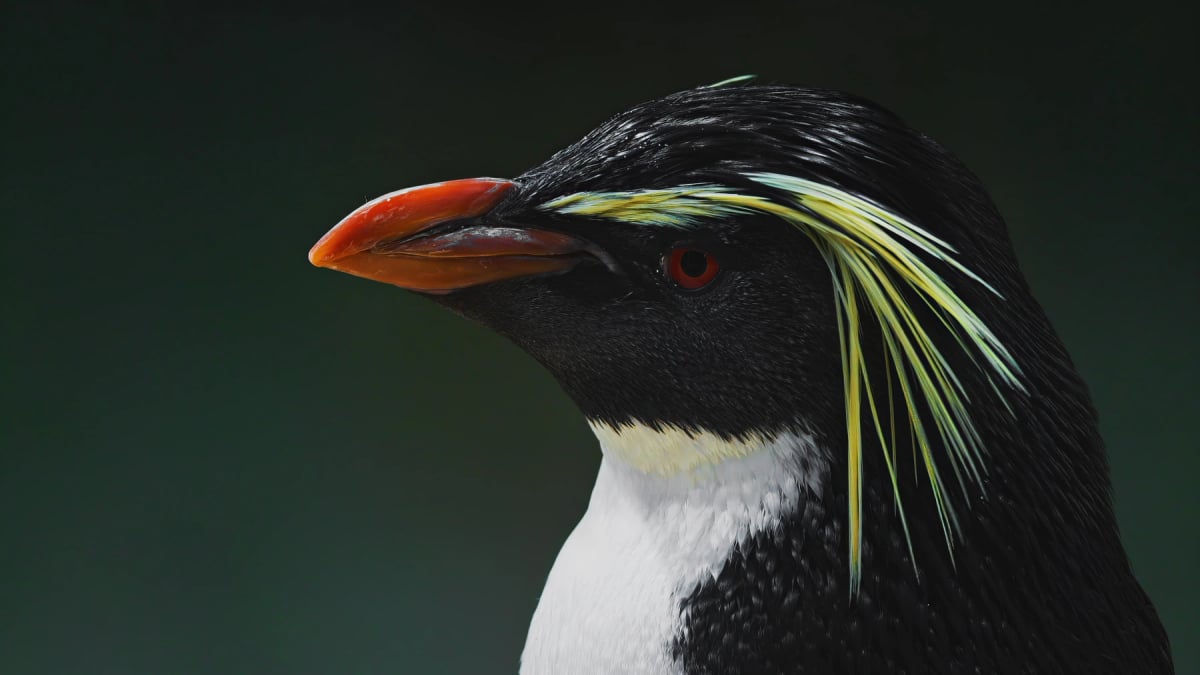
The macaroni penguin is one of the most numerous penguin species on Earth, with breeding colonies spread across subantarctic islands, remote islands off southern Chile and the northern tip of the Antarctic Peninsula. Its most striking feature is a bold crest of golden orange feathers that meets in the middle of the forehead and fans out above each eye, making it instantly recognizable among its neighbors. Adults measure about 70 cm from bill to tail and typically weigh between 3 and 6.5 kg, with males slightly heavier than females. At sea, they are powerful swimmers that dive repeatedly to catch krill, squid, and small fish, sometimes reaching depths beyond 100 meters. Pairs return to the same nesting sites each year and lay two eggs, though in most cases only the second, larger egg is successfully raised to a chick. Despite a global population of around 6.3 million breeding pairs, persistent declines tied to shifts in prey availability and changing ocean conditions have led the IUCN to classify this species as Vulnerable.
Habitat and distribution
Macaroni penguins breed on a wide ring of subantarctic islands around the Southern Ocean. The biggest strongholds are the Crozet Islands, with about 2.2 million pairs, and the Kerguelen Islands, with about 1.8 million, both part of the French Southern Territories. Heard Island and South Georgia follow with roughly a million pairs each. Smaller colonies sit on Marion and Prince Edward Islands in South African waters, on Bouvet Island, the South Sandwich and South Orkney Islands, the South Shetlands and the northern tip of the Antarctic Peninsula. In South America they nest on remote islands off southern Chile, such as Diego Ramírez and Ildefonso, and a few pairs breed in the Falkland Islands, the northern edge of their range. They favor steep, rocky slopes and clifftops, where they pack together in some of the largest seabird colonies on the planet. Outside the breeding months they are highly pelagic: they leave land for about six months and roam the open Southern Ocean, and some reach the waters off Argentina. Colonies are usually close to the shoreline, so adults can reach productive feeding waters without long overland walks, which matters enormously when chicks need to be fed regularly.
What do macaroni penguins eat?
Antarctic krill makes up the overwhelming majority of what macaroni penguins eat: during the breeding season it is more than 90 percent of their food. They also take squid and small fish such as myctophids, or lanternfish, especially when krill is less available. Foraging trips while they are raising chicks tend to be relatively short, while birds heading out in winter can travel vast distances and stay at sea for months. They are accomplished divers, routinely reaching depths of around 100 meters and occasionally going deeper in pursuit of prey, and a single bird may complete hundreds of dives in a day. Scientists have estimated that the species as a whole eats around 9.2 million tonnes of krill a year, more than any other seabird. That sheer volume makes the macaroni penguin one of the most significant predators in the Southern Ocean food web, and it also explains why changes in krill numbers hit it so hard.
Breeding and life cycle
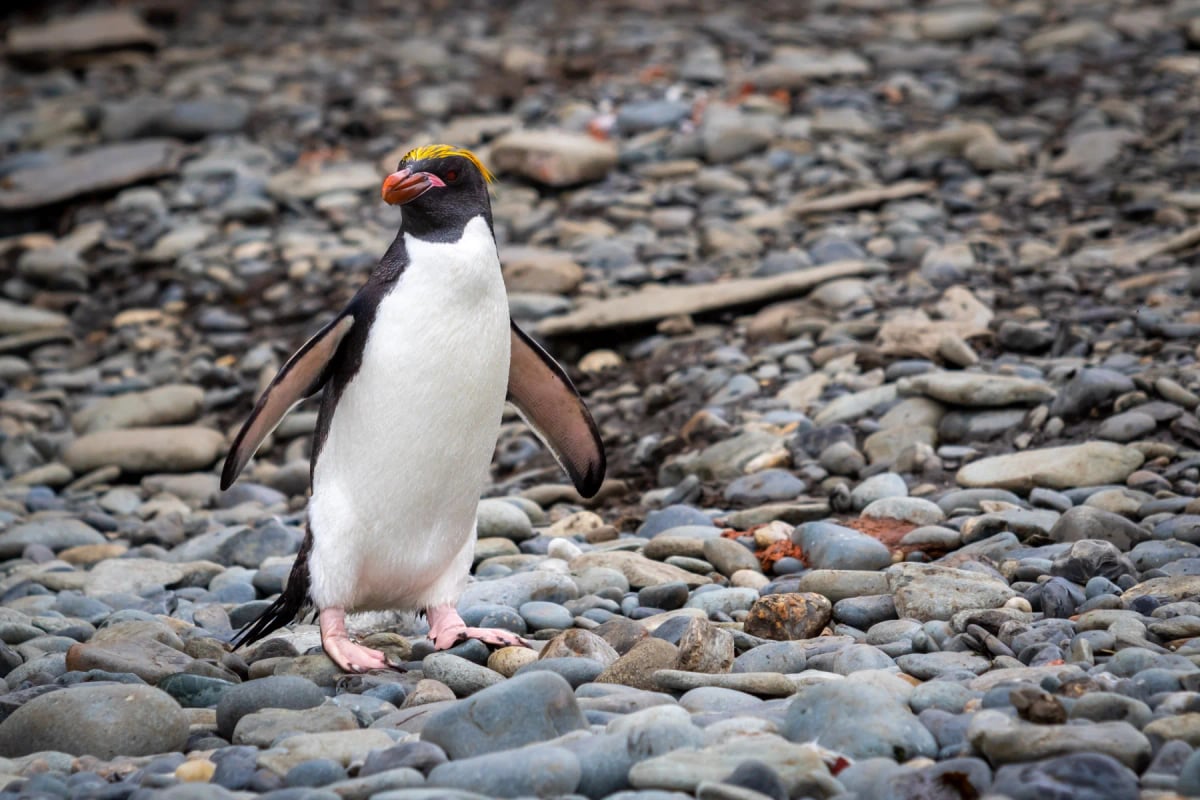
The macaroni penguin's year begins in late October, when adults come ashore and pairs return reliably to the same patch of ground they used before; around three quarters of pairs breed together again. Eggs are laid in early November. Each female lays two, but the first egg is noticeably smaller and is almost always lost, leaving the larger second egg to be raised. Both parents share incubation over roughly 34 to 35 days. For the first weeks after hatching the male guards the chick while the female brings food, and later the chick joins a crèche with other young birds while both parents fish. Chicks fledge at around 60 to 70 days old, in late summer. Adults then spend a few weeks on land replacing their feathers before heading out to sea for about six months of winter. Young birds stay at sea for several years: females usually start breeding at about five years old and males at six or later. In the wild, macaroni penguins can live 15 to 20 years. Mates find each other in the dense, noisy colonies through calls and visual recognition, reinforcing the pair bond with displays each season.
Size and appearance
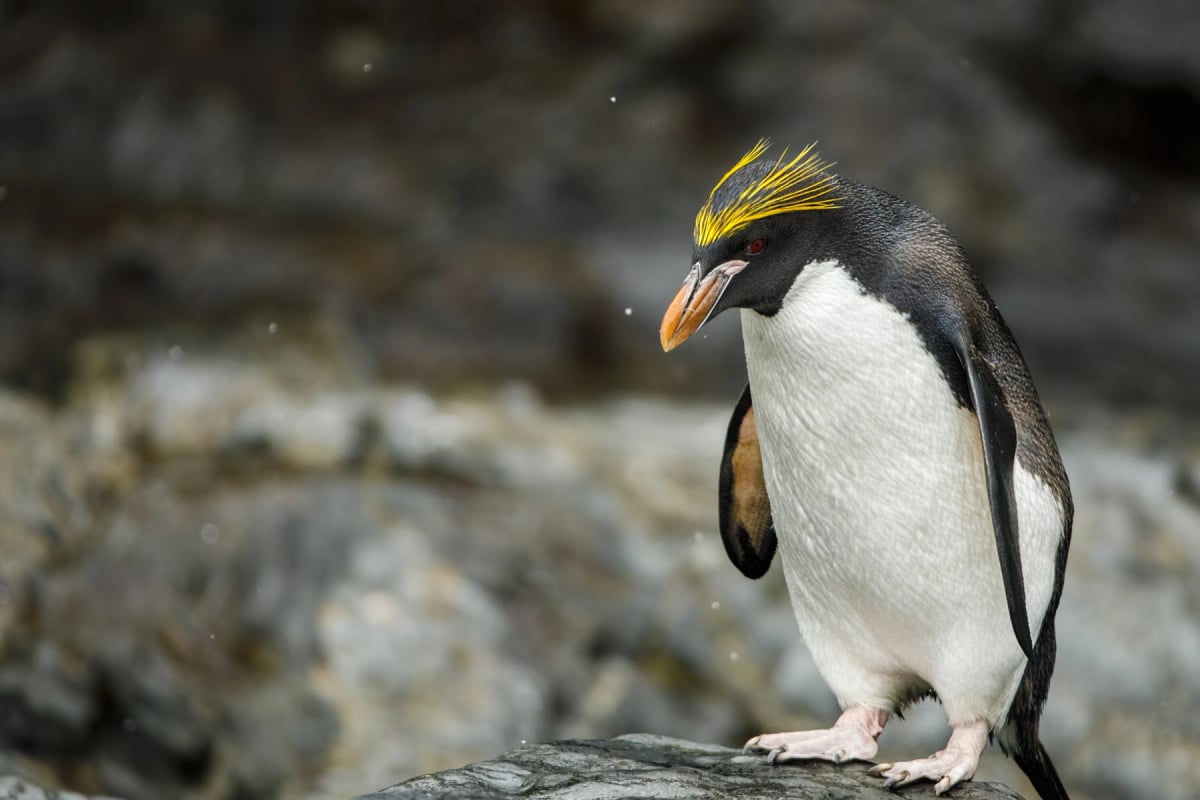
The macaroni penguin is among the largest of the crested penguins. Adults measure about 70 cm from bill to tail, although standing upright on land they look shorter, around half a meter or a little more. Males weigh roughly 3.3 to 6.4 kg and females 3.2 to 5.7 kg, and the weight of each bird changes a lot through the year: they are heaviest just before the molt, when they fatten up to survive weeks on land without eating, and lightest after it. Few seabirds are as easy to identify. The crest of vivid golden orange feathers starts in the middle of the forehead, where the plumes from both sides meet, and sweeps back above the eyes. The rest of the head and the back are jet black, while the underside is clean white, the classic countershading that helps penguins blend in from above and below when swimming. The bill is large, reddish brown, and noticeably robust, well suited to gripping slippery prey, and males have a heavier bill than females. Red eyes and a patch of pink skin at the base of the bill add more color to an already vivid face.
Why is it called the macaroni penguin?
The name has nothing to do with pasta, at least not directly. In 18th century England, a "macaroni" was a young man who dressed in an extravagant, Italian inspired style after traveling around Europe, with tall wigs, bright colors and showy accessories. The word became slang for anyone flashy and overdressed, and it even turns up in the old American song Yankee Doodle. English sailors who met these penguins in the Falkland Islands in the early 1800s thought the bird's loud golden crest looked just like that over the top fashion, and the nickname stuck. The scientific name tells a similar story in a more serious tone. Eudyptes chrysolophus, given by the German naturalist Johann Friedrich von Brandt in 1837, comes from Greek words meaning "good diver" and "golden crest". In Spanish the bird is usually called pingüino macaroni, and in Argentina and Chile it is also known as pingüino de penacho anaranjado, or orange plumed penguin.
Conservation
The IUCN classifies the macaroni penguin as Vulnerable, a status confirmed in its 2020 assessment, which reflects a sustained population decline over recent decades despite total numbers still running into the millions. The global population is estimated at around 6.3 million breeding pairs, but some of the biggest colonies have shrunk sharply: the South Georgia population fell by about half between the mid 1970s and the mid 1990s, and on Marion Island breeding pairs dropped from about 416,000 to 278,000 between 1994 and 2013, a loss of a third in less than twenty years. Research points to shifts in the availability of krill as a central concern. Warming ocean temperatures and changes in sea ice extent affect where and how abundantly krill congregates, which in turn forces penguins to travel farther and dive harder to meet their energy needs. Competition with commercial krill fisheries operating in the Southern Ocean adds further pressure. Breeding success can fall sharply in years when food is scarce during the chick rearing period. Conservation efforts focus on monitoring population trends, protecting key foraging areas, and managing fishing activity around the most important breeding islands.
Where it is found
The Macaroni Penguin can be found in places such as:
Researched and written by Juan Pablo. Sources: IUCN Red List, scientific literature and regional field guides. Last updated: .
Technical factsheet


Frequently Asked Questions
How long do macaroni penguins live?
Macaroni penguins can live about 15 to 20 years in the wild. Life is hardest at the start: after leaving the colony, young birds spend several years at sea and many do not survive their first winter. Those that make it start breeding late compared with many birds, females at around five years old and males at six or later. Once they settle into a colony, adults return to the same spot season after season, and about three quarters of pairs stay together from one year to the next.
What is the difference between a macaroni penguin and a rockhopper penguin?
Both are crested penguins with yellow plumes, and in the Falkland Islands and southern Chile they even nest side by side, but they are easy to tell apart up close. The macaroni penguin is bigger, about 70 cm long against roughly 55 cm, and has a heavier bill. The key is the crest: on the macaroni penguin the golden orange plumes start in the middle of the forehead, where both sides meet, while the rockhopper has a thin yellow stripe that begins above each eye and never joins in the center, plus a spiky black crest on top.
Is the royal penguin a type of macaroni penguin?
They are extremely close relatives. The royal penguin looks almost the same as the macaroni penguin, with the same golden crest, but its face and throat are white or pale gray instead of black. It breeds only on Macquarie Island, south of Australia. The two lines split around 1.5 million years ago, and some scientists treat the royal penguin as a subspecies of the macaroni penguin, while others, including BirdLife International, list it as a separate species.
What eats macaroni penguins?
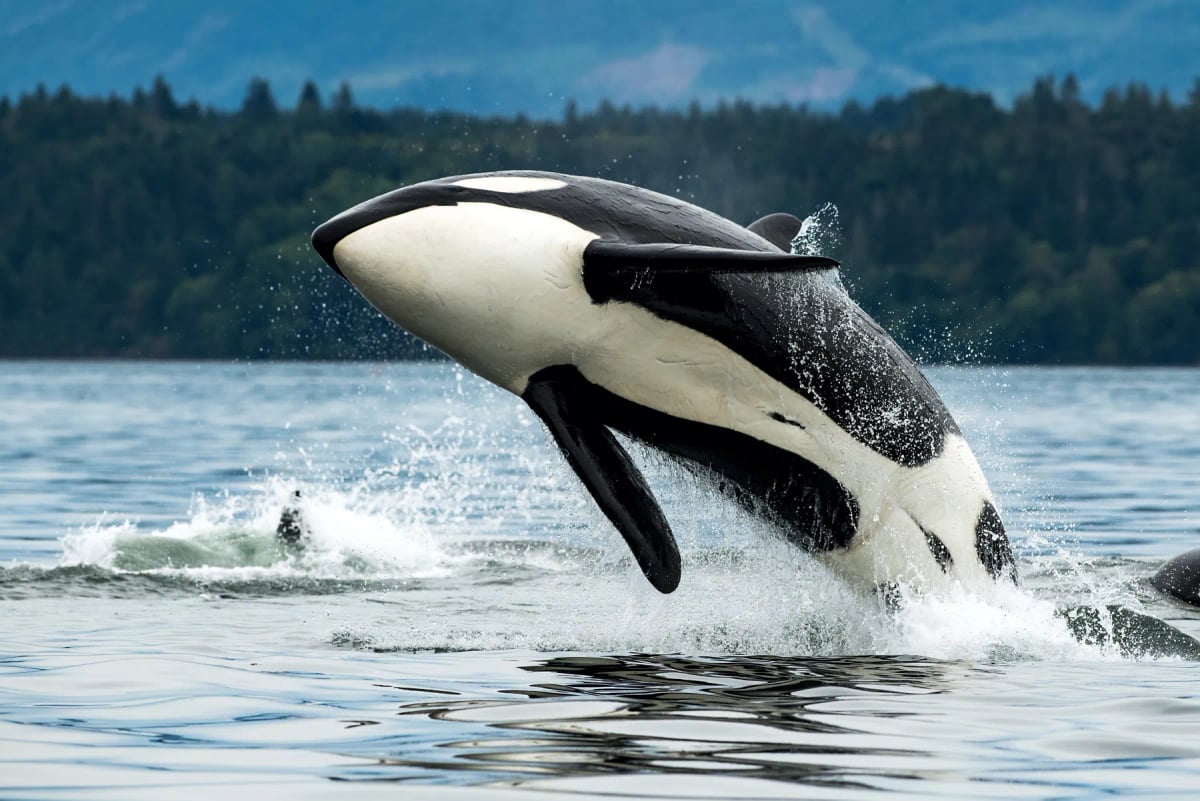
At sea, adult macaroni penguins are hunted by leopard seals, Antarctic fur seals and orcas, which often wait near the colonies where birds enter and leave the water. On land, adults have few enemies, but eggs and chicks are at risk from skuas and giant petrels, which patrol the edges of the colonies looking for an unguarded nest. Nesting in huge, packed groups is part of their defense: a chick surrounded by thousands of adults is much harder for a predator to reach.
Where do macaroni penguins go in winter?
After the breeding season and the molt, macaroni penguins leave their islands and spend about six months entirely at sea, without coming ashore. Tracking studies have shown that some birds cover more than 10,000 kilometers during that time, spreading out across the open Southern Ocean to feed. Birds from different colonies use different parts of the ocean, and some reach the waters off Argentina. They return to the same colony in late October to start breeding again.
Why do macaroni penguins have yellow feathers on their heads?
Those bright golden orange feathers form a crest that the birds use during courtship and social displays. Penguins with more vivid crests tend to be seen as stronger partners, so the feathers play a real role in attracting a mate. They also make macaroni penguins instantly recognizable in huge, crowded colonies where standing out, rather than blending in, is actually useful.
How deep can macaroni penguins dive?
Macaroni penguins routinely dive to around 100 meters and can go even deeper when chasing prey. A single bird may complete hundreds of dives in one day. Their bodies are built for this, with dense bones that help them sink quickly and the ability to slow their heart rate to conserve oxygen during each plunge into cold Southern Ocean waters.
Where do macaroni penguins live?
During the breeding season, macaroni penguins gather on subantarctic islands such as the Crozet and Kerguelen Islands, Heard Island, South Georgia and Marion Island, as well as on the South Shetlands and the northern tip of the Antarctic Peninsula. In South America they breed on remote islands off southern Chile, and a few pairs nest in the Falkland Islands. For the rest of the year they live entirely at sea, roaming widely across the Southern Ocean, with some reaching the waters off Argentina. They are not found in the Arctic or anywhere in the Northern Hemisphere.
Are macaroni penguins endangered?
The IUCN lists them as Vulnerable. Although millions of individuals still exist, the population has been declining for decades. The main concern is a reduction in krill, their primary food source, linked to warming oceans and changes in sea ice. When krill becomes harder to find, penguins must travel farther to feed, which puts pressure on breeding pairs trying to raise chicks.
Why do macaroni penguins only raise one chick if they lay two eggs?
The first egg laid is significantly smaller than the second and rarely survives the early days of incubation. Scientists believe the first egg may function as a spare in case something happens to the second before it is laid. Once the larger egg is in the nest, the smaller one is typically lost. It is an unusual strategy, but it is consistent across the species.
How many macaroni penguins are there in the world?
The global population is estimated at around 6.3 million breeding pairs, which still makes the macaroni penguin one of the most numerous penguin species on Earth. Most of them nest on just a handful of islands: the Crozet Islands hold about 2.2 million pairs, the Kerguelen Islands about 1.8 million, and Heard Island and South Georgia roughly a million each. However, those numbers have dropped considerably over the past few decades, with South Georgia losing about half its birds between the 1970s and the 1990s, which is why the species is now considered Vulnerable.