Eurasian Magpie
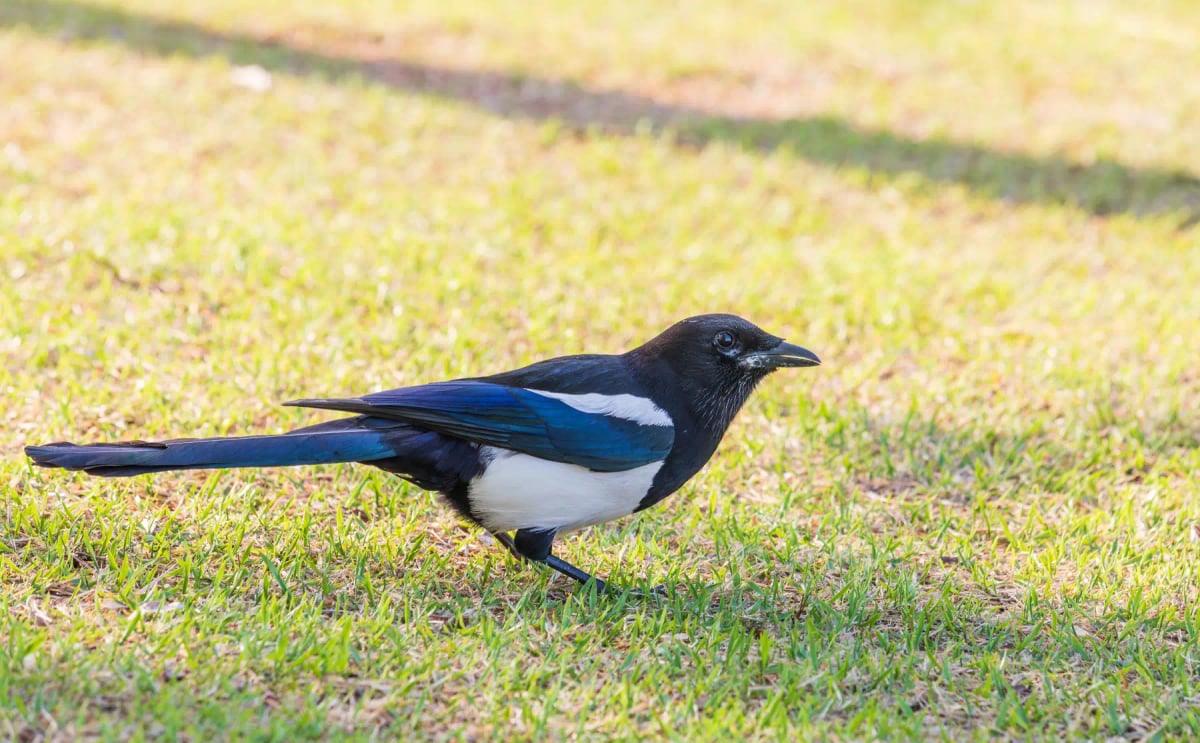
The Eurasian magpie (Pica pica) is one of the most intelligent birds on Earth and a well-known member of the crow family. Its plumage is a bold mix of black and white, with wings and a long tail that shimmer in blue and green when the light catches them. It lives across a vast range from Western Europe to the Pacific coast of Asia, making its home in farmland, woodland edges, parks, and gardens. Magpies eat almost anything they can find: insects, seeds, berries, small animals, eggs, and carrion. They cache food and remember where they put it. In controlled experiments, they are one of the very few animals outside the mammals that can recognize their own reflection in a mirror, a sign of a level of self-awareness that has fascinated scientists for decades.
Habitat and distribution
Few birds match the Eurasian magpie's range. It stretches from Portugal and Spain in the west all the way to the Pacific coast of Japan and the Korean Peninsula in the east, covering most of Europe, Russia, Central Asia, and large parts of China and Mongolia. Within this enormous territory, magpies settle wherever open ground meets scattered trees or shrubs. They are especially at home along woodland edges, hedgerows, farmland, riverbanks, and in parks and gardens within towns and cities. They tend to avoid dense forest interiors and high mountain terrain above the treeline. Their ability to thrive alongside humans has actually helped them expand into suburban and urban areas across much of their range, making them one of the most familiar wild birds in European towns.
Diet
Magpies will eat almost anything edible they come across. Their diet shifts with the seasons: invertebrates such as beetles, caterpillars, and earthworms make up a large share of what they eat in spring and summer, while berries, seeds, and plant matter become more important as autumn arrives. They also take carrion, raid the nests of other birds for eggs and chicks, and occasionally catch small mammals such as voles. One particularly useful habit is food caching. Magpies hide surplus food under leaves or in the soil and return to retrieve it later, relying on precise spatial memory to find what they stored. Studies have shown they can also detect when another individual is watching and will return to move their cache to a safer spot.
Behavior and intelligence
Among birds, the Eurasian magpie stands out for its mental abilities. In 2008, researchers at the University of Frankfurt confirmed that magpies can recognize their own reflection in a mirror, passing the mark test that had previously been considered a benchmark limited to great apes, dolphins, and elephants. They are also skilled problem solvers, capable of using tools in some contexts and learning from watching others. Socially, they live in loose groups outside the breeding season, and pairs that bond tend to stay together across multiple years. Magpies are noisy and alert, producing a rapid chattering call that serves as an alarm. They pay close attention to the behavior of other species, often following potential predators through their territory to mob them and drive them away.
Breeding
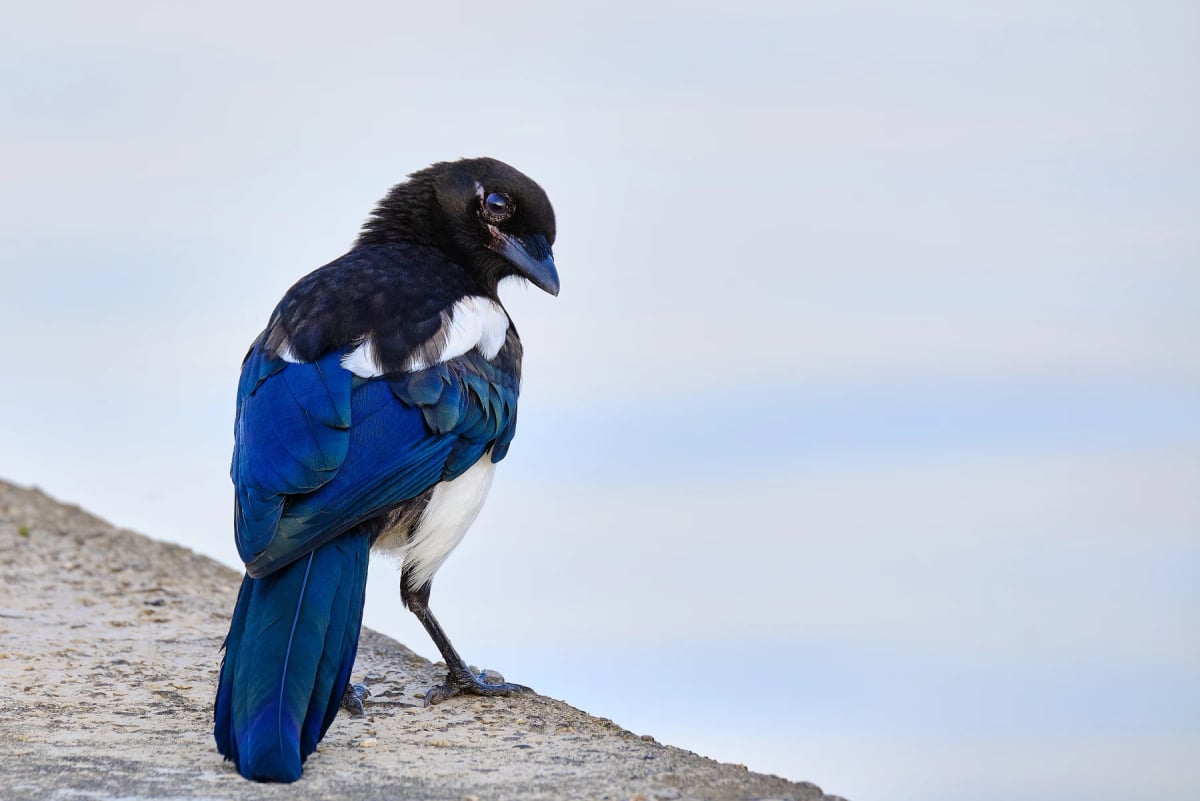
Eurasian magpies pair up early in the year and begin nest construction well before laying. Their nests are among the most substantial of any European bird: large domed structures made from sticks, with a mud cup inside lined with fine roots and grass, and a protective roof of thorny branches that helps guard the eggs from predators. Nests are typically built high in tall trees or dense shrubs. The female lays between five and eight eggs, and incubation lasts around 21 to 22 days, carried out mainly by the female while the male brings food. Once the eggs hatch, both parents share the work of feeding the chicks. The young leave the nest at around 26 to 31 days old but continue to receive some care from the adults for several weeks after.
Conservation
With a global population estimated in the tens of millions and a range spanning two continents, the Eurasian magpie is listed as Least Concern on the IUCN Red List. Its numbers are broadly stable, and in many areas the species has benefited from the spread of suburban environments. That said, magpies do face localized pressures. In parts of the United Kingdom and other European countries, gamekeepers and farmers have historically controlled magpie numbers, citing predation of songbird nests. Scientific reviews have not found strong evidence that magpie activity causes measurable declines in songbird populations at a wider scale. Persecution, shooting, and trapping continue in some rural areas, but these do not threaten the species overall. Habitat loss remains a concern in parts of Central Asia where agricultural and land use change is ongoing.
Where it is found
The Eurasian Magpie can be found in places such as:
Researched and written by Juan Pablo. Sources: IUCN Red List, scientific literature and regional field guides. Last updated: .
Technical factsheet











Frequently Asked Questions
What do Eurasian magpies eat?
Magpies eat a wide variety of foods, including insects, earthworms, berries, seeds, carrion, and the eggs and chicks of other birds. They also catch small mammals on occasion. One clever habit they have is hiding surplus food in the ground or under leaves and coming back to collect it later. They rely on strong spatial memory to find their caches, and they will move them if they suspect another magpie is watching.
Where do Eurasian magpies live?
Eurasian magpies are found across a huge range, from Portugal and Spain in the west to Japan and the Korean Peninsula in the east. They favour open areas with scattered trees, such as farmland, parks, gardens, hedgerows, and woodland edges. They tend to avoid dense forests and high mountain terrain. They have adapted very well to life alongside humans and are a common sight in towns and cities throughout Europe.
Can magpies really recognize themselves in a mirror?
Yes, and it is one of the most remarkable things about them. In 2008, scientists at the University of Frankfurt showed that Eurasian magpies can pass the mirror test, meaning they understand that the reflection they see is themselves and not another bird. This ability was previously thought to be exclusive to great apes, dolphins, and elephants, making the magpie one of the very few birds known to show this level of self-awareness.
Are Eurasian magpies endangered?
No, the Eurasian magpie is listed as Least Concern by the IUCN. Its global population runs into the tens of millions and is broadly stable. In many areas it has actually expanded thanks to the growth of suburban environments. There are some local pressures, including persecution by gamekeepers in parts of Europe, but these do not put the species as a whole at risk. Habitat loss in parts of Central Asia is worth monitoring over time.
Why do magpies make so much noise?
Magpies are naturally alert birds and use their loud, rapid chattering call mainly to signal danger. When they spot a predator, such as a hawk or a fox, they will call repeatedly and often follow the animal through their territory to mob it and drive it away. This behaviour also alerts other nearby birds to the threat. They are generally more vocal in spring during the breeding season, when competition for territory increases.
How do magpies build their nests?
Magpies build some of the most impressive nests of any bird in Europe. They construct large, domed structures from sticks with a cup of mud inside, lined with fine roots and grass. A roof of thorny branches covers the top to protect the eggs from predators. Nests are usually placed high in tall trees or dense shrubs. A single nest can take several weeks to complete and may be reused or rebuilt in the same spot in following years.
Do magpies really steal shiny objects?
This is one of the most widespread beliefs about magpies, but studies suggest it is largely a myth. Research published in 2014 by the University of Exeter found that magpies are actually wary of unfamiliar objects, including shiny ones, rather than attracted to them. The idea likely took hold because magpies are curious and intelligent birds that investigate their surroundings closely, but there is no solid scientific evidence that they collect or hoard objects that glitter.