Addax
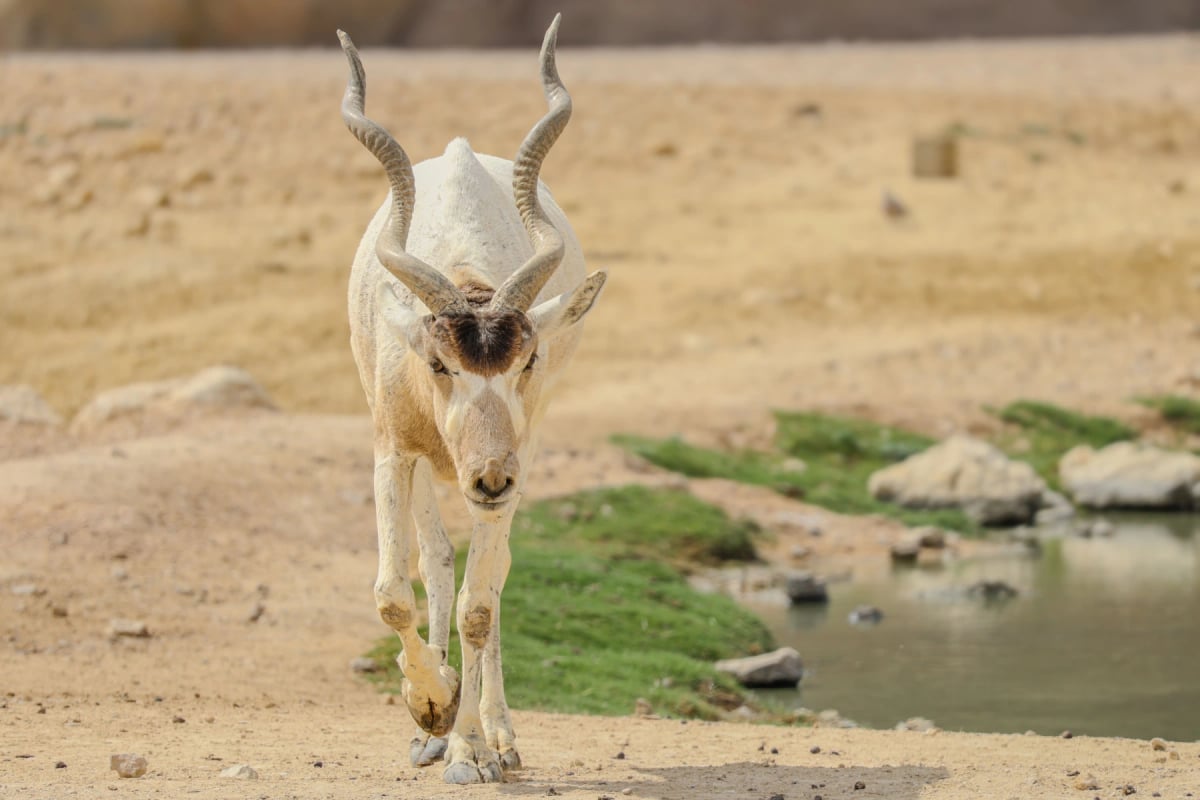
The addax (Addax nasomaculatus), also called the addax antelope, white antelope or screwhorn antelope, is a critically endangered antelope of the Sahara Desert. It has long horns that twist in two to three spirals, a coat that turns almost white in summer and wide hooves made for loose sand. It can go a long time without drinking, taking the moisture it needs from the plants it eats. Once found across the whole Sahara, it was hunted to the brink: in 2016 a survey of its last stronghold in Niger found only three animals. Today it lives free only in Niger and Chad, where herds bred in captivity have been released since 2020 and are now giving birth in the wild.
What is an addax antelope?
The addax is a large desert antelope and the only living species in the genus Addax. It belongs to the same group as the oryxes and the sable and roan antelopes, and from a distance it is often mistaken for an oryx. The name is very old: the Roman writer Pliny the Elder recorded it in the first century, saying it was what people in Africa called a wild animal with twisted horns. The scientific name nasomaculatus means spotted nose, after the tuft of brown hair on its forehead and the white X that crosses its face. In English it is also called the white antelope, for its pale summer coat, and the screwhorn antelope, for its corkscrew horns.
Addax size, horns and appearance
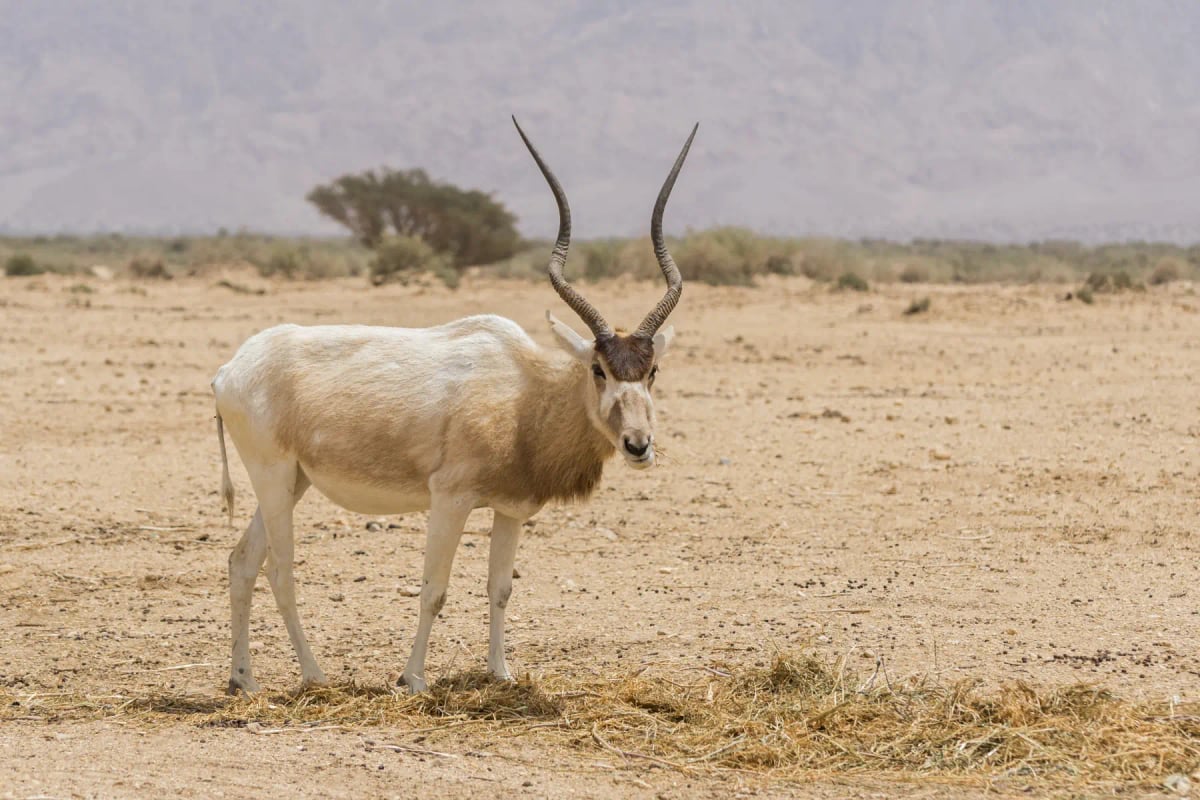
Males stand 105 to 115 centimeters at the shoulder and weigh 100 to 125 kilograms; females are a little smaller, at 95 to 110 centimeters and 60 to 90 kilograms. Both sexes carry long, slender horns that twist outward in two to three spirals: 55 to 80 centimeters in females and 70 to 85 centimeters in males, with exceptional males reaching about 109 centimeters. The coat is grayish brown in winter and fades to almost white in summer, while the legs, rump and belly stay white all year. A tuft of dark brown hair grows on the forehead, and the face is crossed by white markings that form an X between the eyes. The body is stocky, the legs are short and the tail is short, with a tuft at the tip.
Where do addax live?
The addax once lived across almost the entire Sahara, from Mauritania and Western Sahara in the west to Egypt and Sudan in the east, and north to the desert edges of Morocco, Algeria, Tunisia and Libya. The IUCN now lists it as extinct in all of those countries and possibly extinct in Mauritania. Only two countries still have addax living free: Niger, where the last native animals hang on in the Termit and Tin Toumma National Nature Reserve, and Chad, where herds have been reintroduced to the Ouadi Rimé-Ouadi Achim Game Reserve and, since 2023, to the Ennedi Natural and Cultural Reserve. Its habitat is true desert: sandy plains, gravel flats and dune fields with sparse grass, where it wanders nomadically to follow the rain and the fresh growth it brings.
How do addax survive in the desert?
The addax is built for Saharan life in every detail. Its coat shifts from nearly white in summer, reflecting intense solar radiation, to grayish brown in winter, absorbing warmth during cooler months. Wide, flat hooves distribute its weight across loose sand without sinking. Instead of drinking free water, it extracts moisture from grasses and succulents, aided by kidneys that concentrate urine to cut water loss to a minimum. It can also tolerate its own body temperature rising several degrees, reducing the need to sweat and conserving precious internal fluids through the hottest part of the day.
Behavior and social life
Addax are nomadic animals, drifting across the desert to follow rain and the vegetation it brings. They move mainly at night and during the cooler hours around dawn and dusk, resting in shallow scrapes in the sand during peak heat. Herds are small, typically guided by a dominant male, though group composition shifts as animals converge on food sources. Despite their size, addax are not fast runners, which makes them vulnerable to persistent hunters and vehicles. During the rut, males become competitive, using their long spiral horns in pushing contests to assert dominance over rivals.
Why are addax endangered, and how many are left?
The IUCN lists the addax as Critically Endangered. Its slow pace and its habit of staying in one area made it easy prey for hunters with rifles and vehicles, who wiped it out across North Africa during the twentieth century. In Niger, its last stronghold, oil exploration opened roads and camps in the Termit desert, and the IUCN linked poaching to the military personnel guarding the oil installations. A survey in March 2016 found only three addax there, and another in 2017 found six; patrols have since reported small groups, the largest of 13 animals in 2019. The IUCN's 2016 assessment estimated fewer than 100 left in the wild. The hope comes from Chad: since 2020, addax bred in Abu Dhabi have been released into the Ouadi Rimé-Ouadi Achim reserve, 115 by 2023, and with the calves born there more than 130 now roam free. Thousands more live in zoos around the world.
Researched and written by Juan Pablo. Sources: IUCN Red List, scientific literature and regional field guides. Last updated: .
Technical factsheet








Frequently Asked Questions
Is the addax extinct?
No, but it came very close. The IUCN lists the addax as Critically Endangered, the last category before Extinct in the Wild. It is already extinct in Morocco, Algeria, Tunisia, Libya, Egypt, Sudan and Western Sahara, and possibly extinct in Mauritania. Native addax survive only in Niger's Termit and Tin Toumma reserve, where surveys in 2016 and 2017 found just three and six animals. In Chad, herds bred in captivity have been released since 2020 and are now breeding on their own.
How long do addax live?
Nobody knows exactly how long addax live in the wild, because so few remain and they roam some of the most remote desert on Earth. In zoos they usually live around 19 years, and some individuals have passed 25. Life in the Sahara is much harder: droughts, scarce food, predators that take calves and, above all, hunting mean that wild addax very likely live shorter lives than their relatives in captivity.
What is the difference between an addax and an oryx?
They are close relatives and share the same desert, but they are easy to tell apart by their horns. The addax has horns that twist in spirals, while the scimitar oryx, the oryx of the Sahara, has long horns that curve backward like a saber. The addax is stockier, with a brown tuft on its forehead and a coat that turns almost white in summer; the scimitar oryx is white with a reddish brown neck. Both are being reintroduced in Chad's Ouadi Rimé-Ouadi Achim reserve.
Where can you see an addax?
Seeing a wild addax is almost impossible. The last native animals live in a remote part of Niger's Termit and Tin Toumma reserve, and the reintroduced herds roam the Ouadi Rimé-Ouadi Achim and Ennedi reserves in Chad, areas with very little tourism and difficult access. The easiest place to see one is a zoo: thousands of addax live in zoos in Europe, North America and the Middle East, and many take part in breeding programs that send animals back to Africa.
Are addax fast?
No. Unlike gazelles, the addax is a slow, heavy antelope that avoids running, because sprinting in the desert heat wastes water and energy it cannot easily replace. That strategy works against natural predators in open sand, but not against people. A hunter on a camel, a horse or in a truck can easily catch up with one, and this weakness is one of the main reasons the species disappeared from most of the Sahara so quickly in the twentieth century.
What does the addax eat?
The addax is a herbivore that feeds on grasses, herbs, and succulents across the Sahara. It targets vegetation with high moisture content, which allows it to survive without drinking free water. It moves nomadically across the desert to find food wherever rain triggers new growth. In captivity, addax receive hay, grasses, and specially formulated pellets. Their digestive system efficiently extracts nutrients from sparse, tough desert vegetation.
What are the addax's spiral horns used for?
Both male and female addax carry long spiral horns that usually measure 55 to 85 centimeters and can reach about 109 centimeters in exceptional males. During the breeding season, males use them in pushing and wrestling contests to establish dominance and access to females. Outside the rutting period, addax are generally calm. Historically, the combination of slow running speed and impressive horns made the addax a prized trophy, contributing significantly to the hunting pressure that drove the species to the edge of extinction.