Dusky Langur
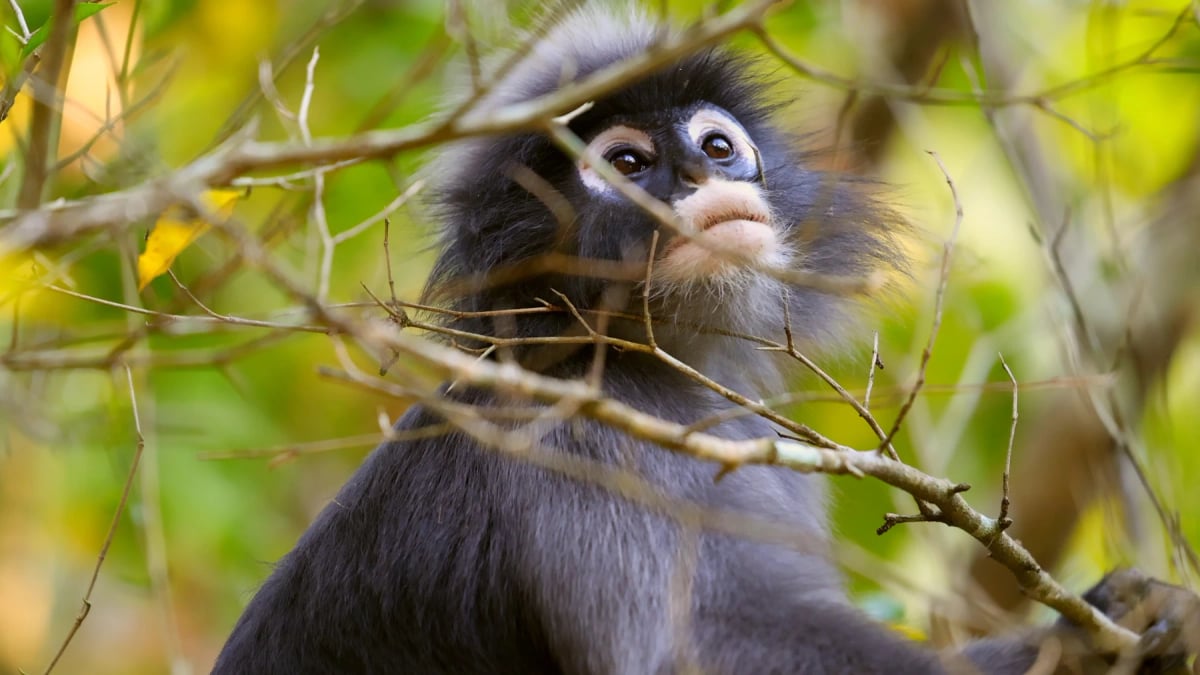
The dusky langur (Trachypithecus obscurus) is a leaf-eating monkey found in the forests of southern Thailand, Myanmar and Peninsular Malaysia. Adults are dressed in dark grey fur with bright white rings around the eyes and pale lips, a look that makes them instantly recognizable. Newborns, by contrast, arrive with vivid orange coats that gradually fade to grey over the first few months of life. This species is almost entirely arboreal, spending its days moving through the forest canopy in search of young leaves, shoots, flowers and occasional fruit. Groups follow a one-male structure, with a single adult male living alongside several females and their young. Habitat loss through deforestation and pressure from hunting remain the main threats to populations across its range, which is why the IUCN lists it as Near Threatened.
Habitat and distribution
Dusky langurs are found across a relatively compact range that takes in southern Thailand, parts of Myanmar and the length of Peninsular Malaysia, including some offshore islands. They thrive in a variety of forested environments, from undisturbed primary rainforest to secondary growth that has regrown after clearing. Rocky terrain does not deter them. Populations are regularly spotted near limestone hill forests, and some groups make use of coastal mangroves and plantations on the edges of their range. Elevation is rarely a limiting factor in the lowlands, though the species is most commonly encountered below 1,000 metres. Their ability to persist in degraded and fragmented forest patches has helped them survive in landscapes where many other primates have disappeared, though continued clearance is steadily reducing the habitat available to them.
Diet
Leaves form the backbone of the dusky langur's diet, with young leaves preferred over mature ones because they are easier to digest and richer in protein. Shoots, flowers and unripe fruit round out their daily intake, and ripe fruit is taken opportunistically when the season allows. Like other members of the langur family, this species has a specialised stomach divided into chambers that ferment tough plant material with the help of bacteria. This digestive system lets them process foliage that would be toxic or unusable to most other animals. The need to find fresh, tender growth means groups often travel considerable distances through the canopy each day. Mineral intake is also thought to play a role in food selection, with some populations visiting soil or clay deposits to supplement their diet.
Behavior and social life
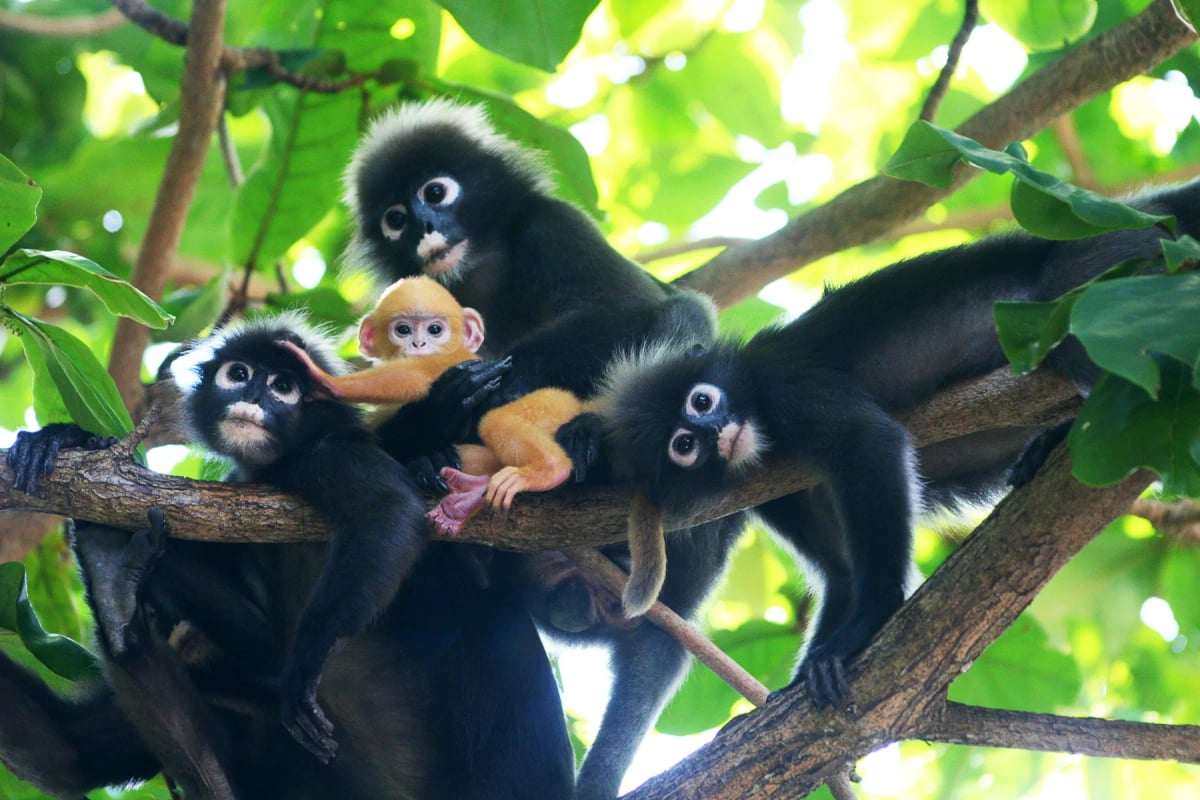
Social life revolves around tight groups typically made up of one adult male, several females and their offspring, though all-male bachelor groups also exist and occasionally challenge resident males for control of a troop. Activity peaks in the morning and again in the late afternoon, with long rest periods in between to allow digestion of their leafy meals. Dusky langurs are almost entirely arboreal, moving through the canopy on all fours and leaping confidently between branches. Grooming is a regular part of daily life and helps cement relationships within the group. Vocalisations carry well through the forest and are used to keep the troop together, signal alarm and advertise territory. When a new male takes over a group, infanticide of unweaned young has been recorded, a behaviour documented in several other langur species as well.
Reproduction
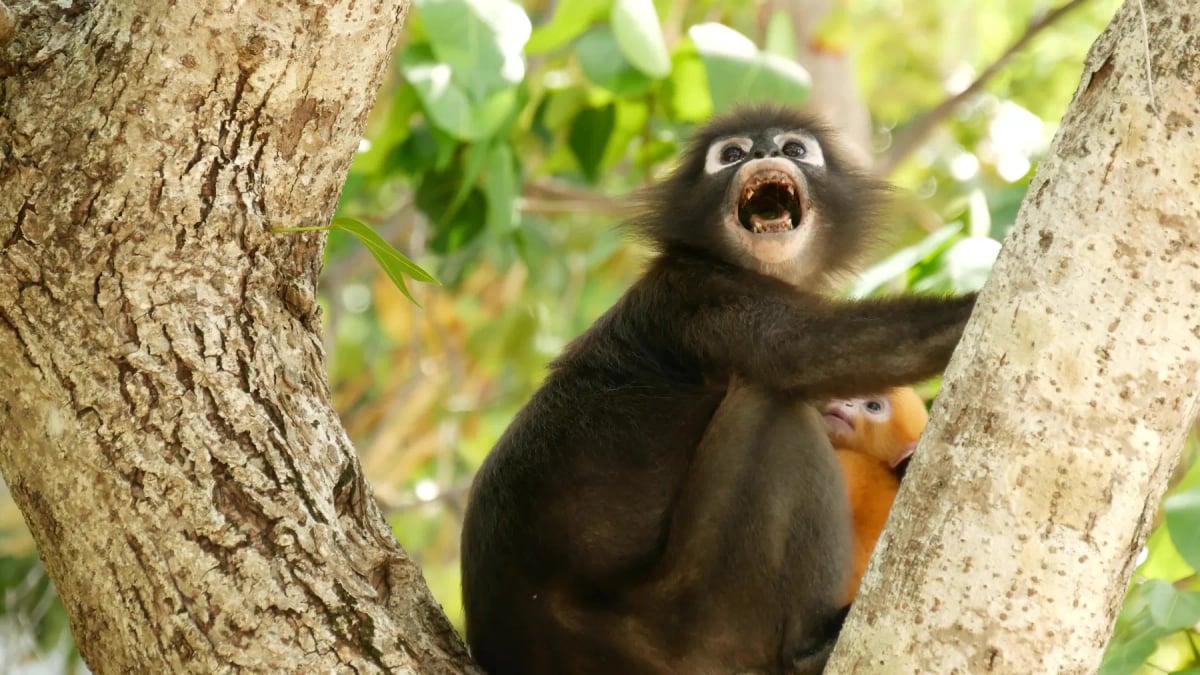
Births in dusky langurs can occur at any time of year, though there is some evidence of seasonal peaks tied to the availability of young leaves for nursing mothers. Females carry a single infant through a gestation period of roughly 150 to 160 days. The newborn arrives with a coat of vivid orange fur, a colour thought to stimulate interest and care from adult females in the group. This practice of shared infant care, sometimes called allomothering, is common in langurs and gives mothers periods of rest while other females handle and carry the young. The striking orange coat fades to the grey of adults within the first few months of life. Young langurs stay close to their mothers for an extended period and take several years to reach full social and sexual maturity.
Conservation
The IUCN lists the dusky langur as Near Threatened, reflecting real and ongoing pressure on populations across its range. The clearance of lowland forest for agriculture, rubber and palm oil plantations has removed large areas of suitable habitat in Thailand, Myanmar and Malaysia. Hunting for meat and for use in traditional medicine adds further pressure, as does the illegal pet trade, which targets orange newborns in particular. Road networks cut through forests and isolate groups from one another, reducing the chances of survival over the long term for smaller populations. The species does persist in several national parks and wildlife reserves, where enforcement offers at least partial protection. Greater investment in habitat corridors to reconnect fragmented forest patches, alongside stricter control of hunting, would give populations across the region a much stronger footing.
Researched and written by Juan Pablo. Sources: IUCN Red List, scientific literature and regional field guides. Last updated: .
Technical factsheet





Frequently Asked Questions
What do dusky langurs eat?
Dusky langurs are primarily leaf eaters, with a strong preference for young, tender leaves over mature ones. They also eat shoots, flowers and unripe fruit, and will take ripe fruit when it is available. Their stomach is divided into chambers that use bacteria to break down tough plant matter, letting them digest foliage that would be harmful to most other animals. Some groups also visit clay or soil deposits to top up their mineral intake.
Why are dusky langur babies orange?
Newborn dusky langurs are born with a coat of vivid orange fur, which is a striking contrast to the dark grey of the adults. The orange colour is thought to grab the attention of adult females in the group, encouraging them to help carry and care for the infant. This shared care, known as allomothering, gives the mother time to rest and recover. The bright coat fades to grey within the first few months of life.
Where do dusky langurs live?
Dusky langurs are found in southern Thailand, parts of Myanmar and throughout Peninsular Malaysia, including some offshore islands. They live in a range of forested environments, from untouched rainforest to secondary growth and even areas near plantations. They are most common below 1,000 metres in elevation. Their ability to adapt to degraded and fragmented forest has helped them hold on in areas where other primates have struggled to survive.
Are dusky langurs endangered?
The dusky langur is currently listed as Near Threatened on the IUCN Red List. While it is not yet classified as endangered, populations are under real pressure from deforestation, hunting for meat and traditional medicine, and the illegal pet trade. The clearing of lowland forest for agriculture and plantations has removed large stretches of habitat across its range. Without stronger protections and efforts to reconnect fragmented forest patches, the species could face a more serious outlook.
How do dusky langurs behave in groups?
Dusky langurs live in groups led by a single adult male, alongside several females and their young. Bachelor groups of males without a troop also exist and sometimes compete with resident males for control. The animals are most active in the morning and late afternoon, resting during the middle of the day to digest their food. Grooming is an important social activity, and loud calls help the group stay together and warn of danger.
What are the main threats to dusky langurs?
The biggest threat to dusky langurs is the loss of forest habitat, as lowland areas across Thailand, Myanmar and Malaysia are cleared for agriculture and plantations. Hunting for meat and for use in traditional medicine also takes a toll on populations. The illegal pet trade is another serious problem, with orange newborns especially targeted. Roads that cut through forested areas isolate groups from each other, making it harder for smaller populations to survive over the long term.
Can dusky langurs live outside of forests?
Dusky langurs are highly dependent on trees and spend almost all of their time in the canopy, so they cannot survive far from forested land. That said, they are more flexible than many primates and can make use of secondary forest, forest edges near plantations and even coastal mangroves. Some groups have been spotted in areas disturbed by human activity. However, they still need a connected stretch of trees to find enough food and move safely.