Grey Crowned Crane
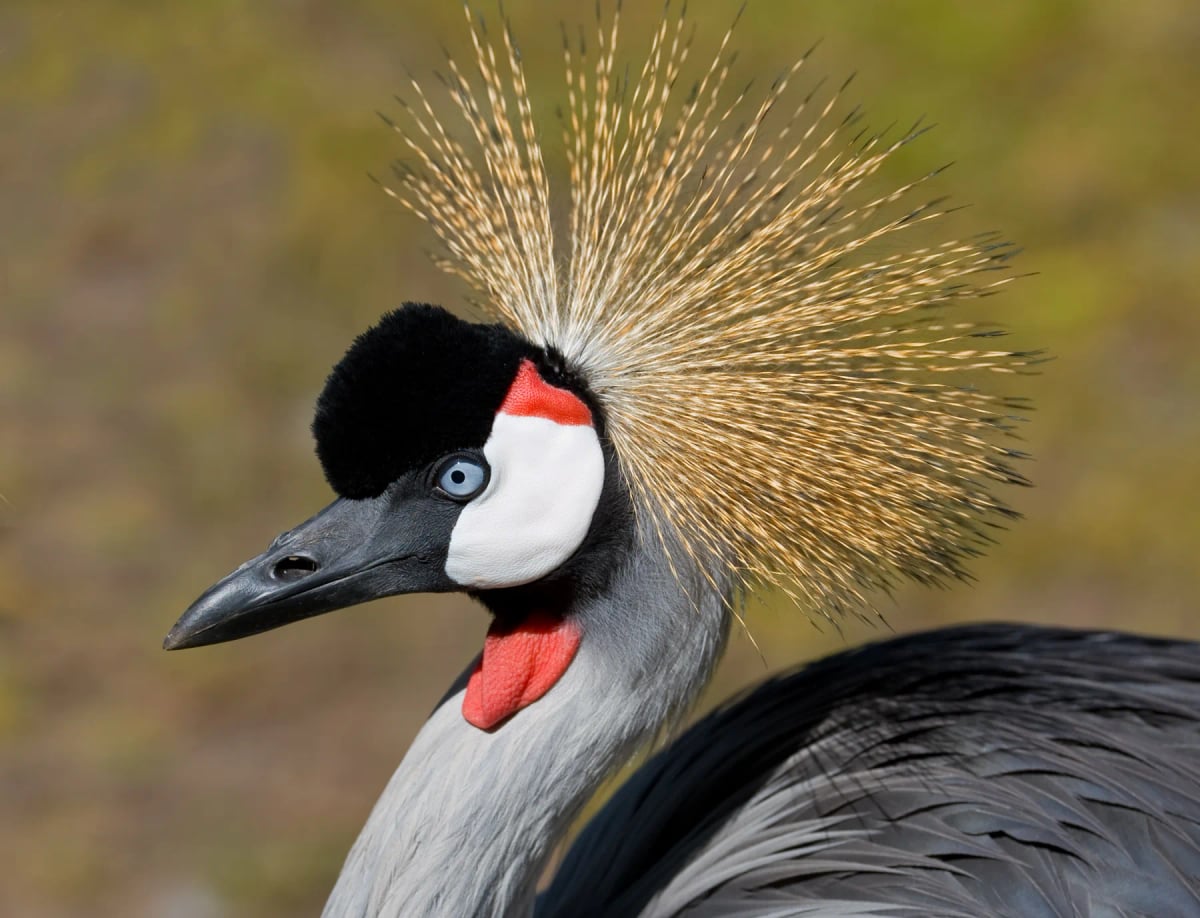
The grey crowned crane, also called the crested crane or African crowned crane, is one of Africa's most recognizable birds. It wears a crown of stiff golden feathers on its head and has a grey body, long dark legs, white wing patches, a white cheek with a red patch above it and a small red pouch under the chin that it can inflate when calling. It lives across eastern and southern Africa, from Uganda and Kenya to South Africa, in wetlands, moist grasslands and farmland, where it eats seeds, grain, insects, frogs and small reptiles. Together with its close relative the black crowned crane, it is the only crane that can perch and roost in trees, thanks to a long hind toe, although it builds its nest on the ground in wetlands. Pairs are famous for their dancing, leaping, bowing and calling. The species is listed as Endangered, with about 26,500 to 33,500 birds left, threatened by wetland loss, power lines and illegal capture for the pet trade.
Size and appearance: the golden crown
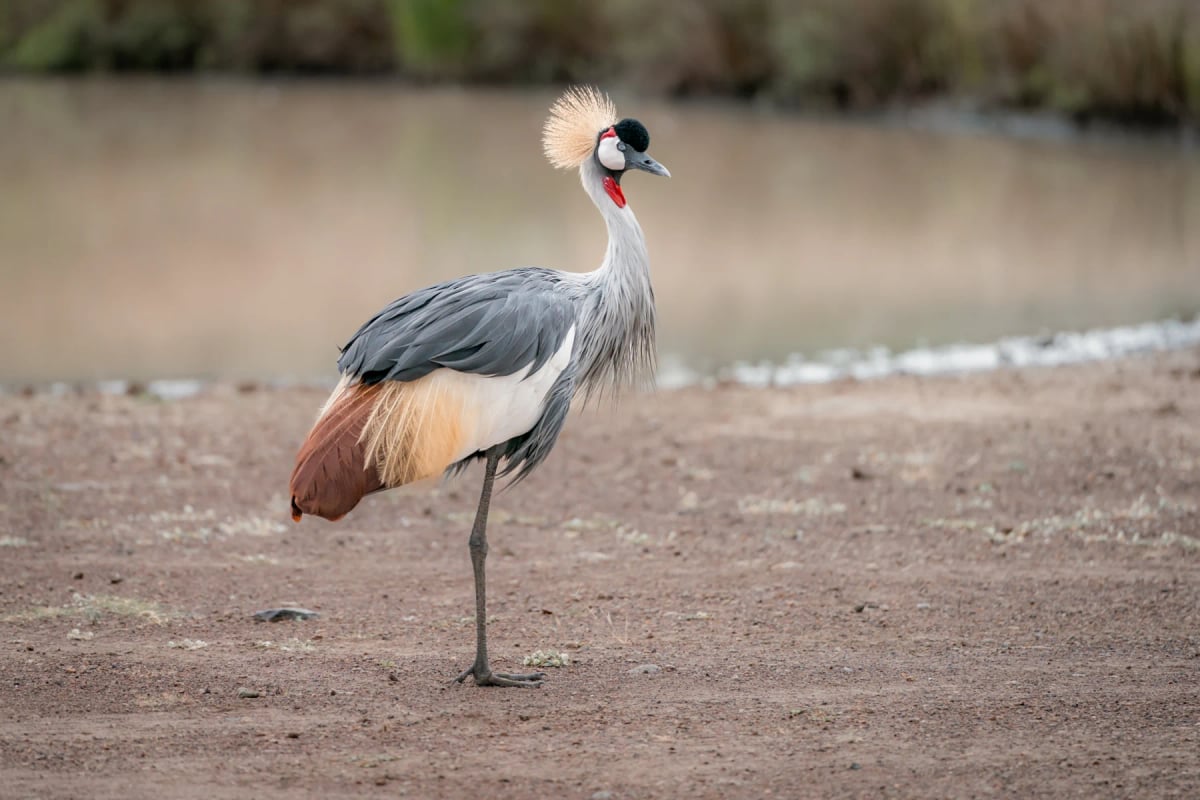
Few birds in Africa are as eye catching as the grey crowned crane. Its most famous feature is the crown of stiff, straw colored feathers that fans out from the back of the head like a sunburst, the reason it is also called the crested crane. Below a black velvety forehead, the cheeks are white with a bright red patch at the top, and a small red pouch hangs under the chin, which the bird inflates when it makes its booming call. The body and neck are pale grey, and the wings are mostly white with golden brown and chestnut feathers that show best in flight. The legs are long and black. Males and females look alike, although males are slightly bigger. Adults stand about one meter tall, weigh 3 to 4 kilograms and have a wingspan of about 180 to 200 centimeters. Young birds are browner, with a smaller crown and a grey, feathered face. The grey crowned crane also has a feature almost no other crane shares: a long hind toe that lets it grip branches, so it can perch and sleep in trees.
East African and South African crowned cranes
The grey crowned crane has two subspecies. The East African crowned crane (Balearica regulorum gibbericeps) lives from eastern Congo, Uganda and Kenya south to Tanzania and is the larger and more numerous of the two. It is easy to tell by the bigger red patch at the top of its white cheek, which forms a small bare wattle. The South African crowned crane (Balearica regulorum regulorum) lives from Angola and Zambia south to South Africa, and has a smaller red patch. Its closest relative is the black crowned crane (Balearica pavonina) of West and Central Africa, from Senegal to Ethiopia. The two look very similar, with the same golden crown, but the black crowned crane has a dark body and neck, and its white cheek patch is topped with pink and red in a different pattern. The ranges of the two species barely overlap, around Uganda and Kenya. Crowned cranes belong to an ancient branch of the crane family. Their ancestors lived in Europe and North America millions of years ago, and unlike other cranes they have a short windpipe, so their calls are softer honks and booms rather than the loud trumpeting of their relatives.
Diet
Grey crowned cranes are opportunistic feeders with a broad diet that shifts depending on what the habitat offers. They pick through shallow water and muddy ground for insects, frogs, small fish, and other tiny vertebrates. On drier ground they eat grass seeds, roots, and cultivated grain, and they readily move onto plowed fields after harvest, where exposed seeds are easy to find. This flexibility makes them well suited to a landscape that includes both wild wetlands and farmland. They forage by walking slowly and pecking at the ground, sometimes stamping their feet to disturb insects hidden in the soil. Foraging usually takes place in the morning and late afternoon. Family groups and small flocks often feed together, keeping a loose watch for eagles and other predators while they search for food.
Dance, roosting and nesting
One of the most striking things about grey crowned cranes is how they communicate through movement. Pairs dance by leaping into the air, bowing, spreading their wings and running in circles, and they call to each other with a deep booming sound made by inflating the red pouch under the chin, followed by honking calls. Dancing happens all year, not only in the breeding season, and young birds dance too, which helps them form bonds. Grey crowned cranes spend the night perched in tall trees near water, which keeps them safe from ground predators such as jackals and wild cats. Their nests, however, are on the ground: pairs build a round platform of grass and sedges hidden in tall vegetation in marshes or at the edge of wetlands, and only very rarely nest in a tree. The breeding season follows the rains. The female lays two to four eggs, and both parents incubate them for about a month. The chicks can walk and swim within hours and follow their parents through the marsh, but they need two to three months before they can fly. Outside the breeding season cranes gather in flocks, sometimes of more than a hundred birds, around farmland and reliable wetlands.
National symbol
Uganda has chosen the grey crowned crane as its national bird, and the species appears prominently on both the country's flag and its coat of arms. The bird has been part of the flag since Uganda gained independence in 1962, depicted in a standing pose at the center of the design. Its selection reflects a deep cultural connection between the people of Uganda and this graceful bird, which has long been a familiar presence in the country's wetlands and open grasslands. Across the wider region, the crane carries symbolic meaning in various communities, often associated with prosperity, good fortune, and longevity. Its striking appearance and confident bearing made it a natural choice as an emblem. Conservation efforts in Uganda are partly motivated by pride in protecting a creature that carries such strong national and cultural significance.
Conservation
The grey crowned crane is listed as Endangered on the IUCN Red List. It was moved up from Vulnerable in 2012 after steep declines, and today the world population is estimated at about 26,500 to 33,500 birds, including 17,700 to 22,300 mature individuals. The trend is still downward, with losses of at least half over the last 45 years, and the sharpest falls in East Africa. The main threat is the loss of wetlands, drained for farming, overgrazed or flooded by dams, which destroys the marshes where the cranes nest. Chicks and adults are also taken illegally to be kept in gardens and hotels as ornamental birds or status symbols, a trade that removes breeding birds from the wild. Collisions with power lines, poisoning and the heavy use of pesticides add to the pressure. There is good news too. In Rwanda, an amnesty launched in 2014 let people hand over captive cranes without penalty; hundreds were rescued and many released in Akagera National Park, and the wild population rose from 487 birds in 2017 to about 1,300 in recent counts. Similar work on wetland protection, power line marking and community education is under way in Uganda, Kenya and South Africa.
Where it is found
The Grey Crowned Crane can be found in places such as:
Researched and written by Juan Pablo. Sources: IUCN Red List, scientific literature and regional field guides. Last updated: .
Technical factsheet












Frequently Asked Questions
Is the crested crane the same as the grey crowned crane?
Yes. Crested crane is the name used for the grey crowned crane in Uganda and much of East Africa, and it also goes by grey crested crane, gray crowned crane in American spelling, and African crowned crane. All of these refer to the same species, Balearica regulorum. The East African crowned crane is its northern subspecies, found from Uganda and Kenya to Tanzania.
What is the difference between grey and black crowned cranes?
They are two closely related species with the same golden crown. The grey crowned crane has a pale grey body and neck, white cheeks with a red patch above, and lives in eastern and southern Africa. The black crowned crane has a dark grey to black body and neck, a cheek patch that is white below and pink to red above, and lives in the Sahel and savannas of West and Central Africa, from Senegal to Ethiopia.
How many grey crowned cranes are left?
The IUCN estimates that about 26,500 to 33,500 grey crowned cranes remain in the wild, of which roughly 17,700 to 22,300 are mature adults. Numbers have fallen by at least half over the past 45 years, mostly in East Africa, which is why the species was listed as Endangered in 2012. Uganda, Kenya and Tanzania still hold the largest numbers, and Rwanda's population has grown to about 1,300 birds thanks to a program that rescued captive cranes.
What sound does a grey crowned crane make?
Grey crowned cranes make two main sounds. The first is a low, booming call made by inflating the red pouch under the chin, often given by pairs during displays. The second is a honking call, a two note 'ya-hoo' that carries over wetlands and grasslands. Their calls are softer than those of other cranes, because crowned cranes have a short, straight windpipe instead of the long, coiled one that gives other cranes their loud trumpeting voice.
Can grey crowned cranes perch in trees?
Yes, and that makes them unusual. Grey crowned cranes and their relatives the black crowned cranes are the only cranes that can perch in trees, thanks to a long hind toe that lets them grip branches. They use this to roost high above the ground at night, safe from predators such as jackals and wild cats. Their nests, however, are usually built on the ground in wetlands, hidden among tall grass and sedges.
What does the grey crowned crane eat?
Grey crowned cranes eat a wide variety of foods. They pick up insects, frogs, small fish, and tiny vertebrates from shallow water and muddy ground. On drier land they feed on grass seeds, roots, and grain, and they often move onto plowed fields after harvest to collect exposed seeds. They sometimes stamp their feet on the ground to flush out hidden insects before picking them up.
Where does the grey crowned crane live?
The grey crowned crane is found across eastern and southern Africa, in countries such as Uganda, Kenya, Tanzania, South Africa, and Zambia, among others. It favors wetlands, moist grasslands, and farmland near water. It is especially common in areas with shallow lakes, marshes, and river floodplains. The species is the national bird of Uganda, where it remains one of the most familiar birds in the landscape.
Why is the grey crowned crane endangered?
The species is listed as Endangered because its numbers have fallen by at least half over the past 45 years, to about 26,500 to 33,500 birds. The main threats are the draining of wetlands for farming, illegal capture of chicks and adults to be kept as ornamental birds, collisions with power lines, and pesticides that poison birds and reduce their food. Several of these pressures act at the same time, which makes recovery difficult, although Rwanda shows it is possible.
Why do grey crowned cranes dance?
Their dancing is a form of communication. Bonded pairs leap into the air, bow, spread their wings, and call out loudly to strengthen their relationship. These displays happen throughout the year, not just during the breeding season. Young birds also dance, which seems to help them develop social bonds and practice for future courtship. It is one of the most spectacular behaviors seen in any bird found in Africa.
What is the golden crown on the grey crowned crane's head?
The golden crown is a fan of stiff, bristle like feathers that grows from the top of the bird's head. It is one of the most recognizable features of any bird in Africa. The crown is not just for show. Birds use it during social interactions and displays to communicate with one another. Both males and females have the same golden crown, which is why it can be hard to tell the two apart just by looking at them.
How long do grey crowned cranes live?
Grey crowned cranes are long lived birds. Wild adults are thought to live for more than 20 years, and in zoos some have lived beyond 30. They form long lasting pair bonds and often stay with the same mate for many years. Because they breed slowly, raising only a few chicks when conditions are good, their populations take a long time to recover when numbers fall, which is one reason why conservation efforts are so important for this species.