Bactrian Camel
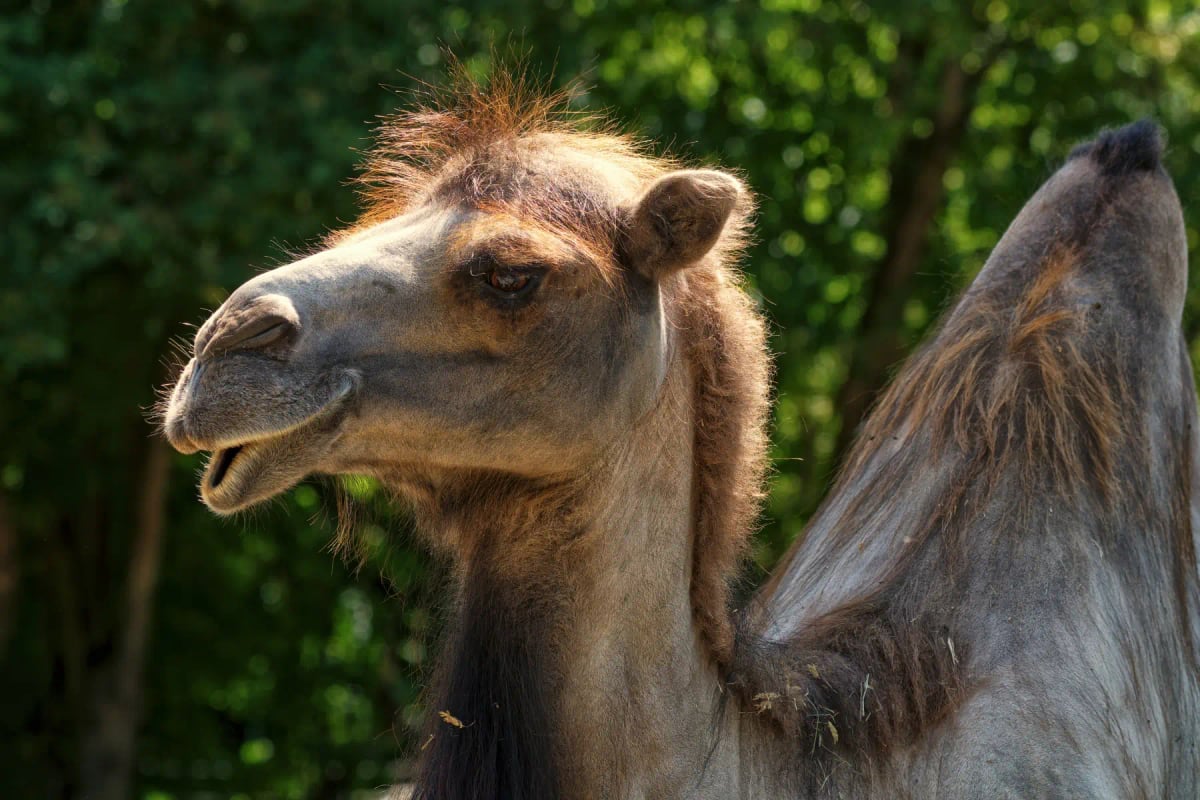
The Bactrian camel is a two-humped camel native to the steppes and cold deserts of Central Asia, and the only camelid species used by humans that retains a large domesticated population across multiple countries. It has been a pillar of nomadic life and overland trade since before 2500 BC, enabling the movement of goods along the Silk Road across some of the most extreme landscapes on Earth. Built for punishment, it tolerates scorching summers, freezing winters, and months without adequate food or water. Its two humps store fat rather than water, providing energy reserves during lean periods. Today, over one million domesticated Bactrian camels are kept across Central Asia, with the largest populations in Mongolia, China, Kazakhstan, and Russia. A separate species, the wild Bactrian camel (Camelus ferus), survives in tiny numbers in the Gobi Desert and is Critically Endangered.
Habitat and distribution
Domesticated Bactrian camels are found across a broad arc of Central and East Asia, from Iran and Afghanistan in the west through the steppes of Kazakhstan, Russia's Kalmykia region, and Uzbekistan, to Mongolia and northwestern China in the east. They thrive in cold deserts, rocky mountain foothills, flat arid plains, and open steppe, tolerating altitudes above 3,000 metres in some areas. Mongolia and China hold the largest populations, followed by Kazakhstan and Russia. Smaller populations exist in Kyrgyzstan, Turkmenistan, Iran, Pakistan, and India's Ladakh region. The closely related wild Bactrian camel (Camelus ferus) is confined to remote parts of the Mongolian Gobi and China's Taklimakan and Lop Nur deserts.
Diet
Bactrian camels are adaptable grazers and browsers capable of eating vegetation that most other livestock cannot process. Their diet includes dry grasses, thorny shrubs, halophytes, woody branches, and even dried bones or leather when food is extremely scarce. They can consume saltwater and tolerate salt concentrations that would be lethal to other mammals. Their split upper lip allows them to strip leaves from thorny plants without injury. In domesticated settings they are typically fed hay, grain, and whatever local vegetation is available, but their natural foraging instincts remain strong even after generations of captivity.
Adaptations to extreme environments
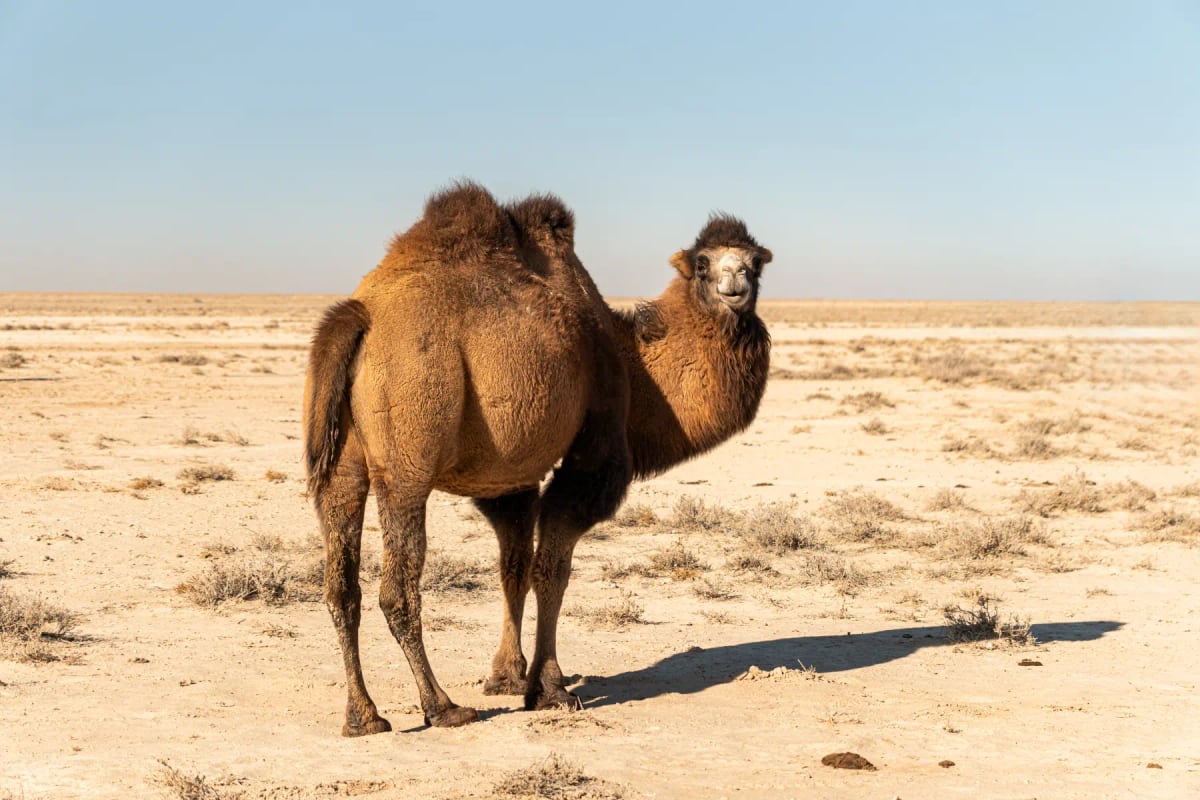
Few large mammals match the Bactrian camel's tolerance for environmental extremes. Its two humps store fat reserves of up to 36 kg each, which are metabolized during periods of food scarcity, causing the humps to lean and soften before recovering when conditions improve. A thick double-layered coat, which can be shed in large clumps during warm months, insulates the animal during winters that can reach minus 40 degrees Celsius. Its nostrils can seal almost completely against sandstorms, and its eyes have double rows of eyelashes and a transparent third eyelid. Wide, padded hooves prevent sinking in sand or snow.
Uses by humans
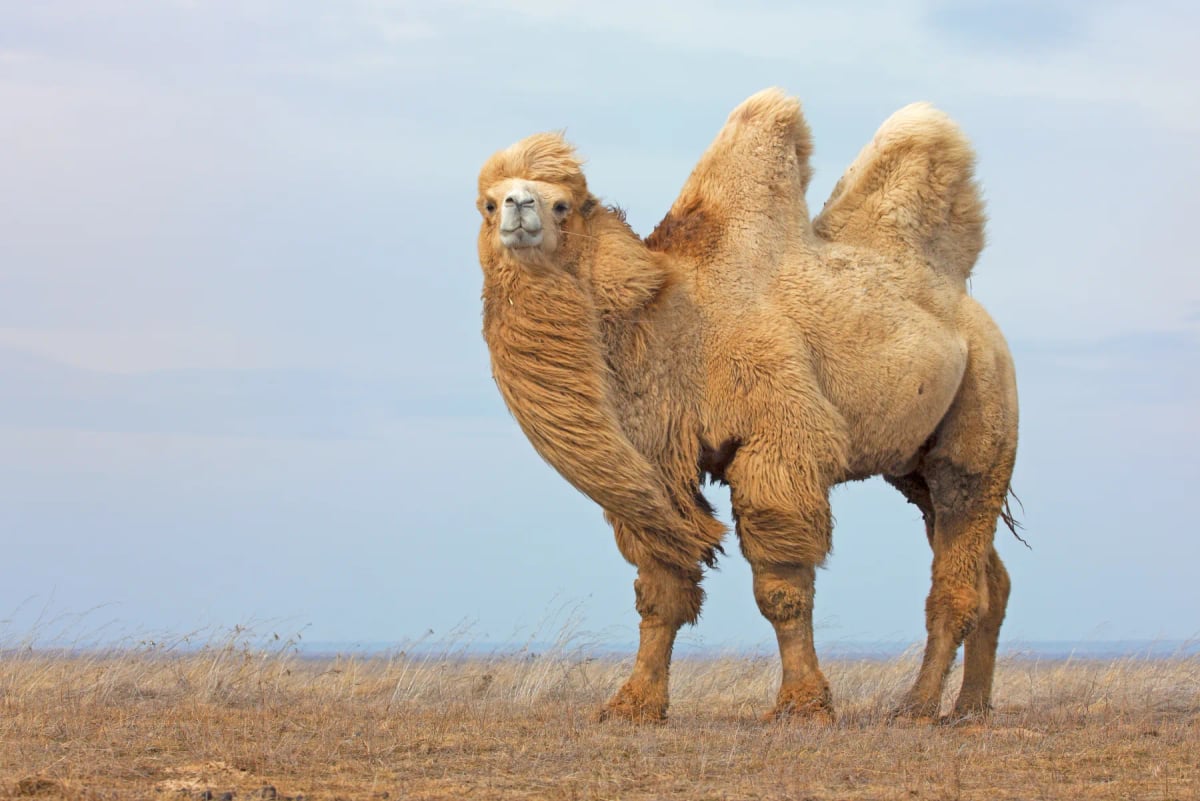
The Bactrian camel has been central to human life in Central Asia for at least 4,500 years. As a pack animal it can carry loads of 170 to 250 kg across terrain that wheeled vehicles cannot navigate, and it remains the primary means of transport for some nomadic communities in Mongolia and China. Beyond transport, it provides a rich and nutritious milk consumed fresh or fermented, wool harvested once a year that is valued for its fineness and warmth, meat that is a staple in some regions, and hides used for leather. In Mongolia, camel wool and milk are also traded commercially, making the animal an important part of the rural economy.
Wild relatives and conservation
The domesticated Bactrian camel is abundant and faces no conservation concern. However, its wild relative, the wild Bactrian camel (Camelus ferus), is a genetically distinct species classified as Critically Endangered by the IUCN, with an estimated population of only a few hundred to 2,000 individuals. Wild populations survive in the Mongolian Gobi Desert and in China's Xinjiang and Lop Nur regions. Key threats include illegal hunting, competition with domestic livestock for water, hybridization with domesticated camels, and the expansion of industrial mining into protected areas. A dedicated nature reserve exists in Xinjiang, and Mongolia's Great Gobi Reserve Area offers additional protection.
Where it is found
The Bactrian Camel can be found in places such as:
Researched and written by Juan Pablo. Sources: IUCN Red List, scientific literature and regional field guides. Last updated: .
Technical factsheet





Frequently Asked Questions
What is the difference between a Bactrian camel and a dromedary?
The most visible difference is the number of humps: Bactrian camels have two, while dromedaries have one. Bactrian camels are also stockier, heavier, and have a thicker coat suited to cold desert winters, whereas dromedaries are built for hot, arid climates. They also differ in range: Bactrian camels come from Central Asia, while dromedaries are native to the Arabian Peninsula and North Africa. The two are separate species, though hybrids exist and are sometimes used as working animals in parts of Central Asia.
Do Bactrian camel humps store water?
No, this is a common misconception. The humps of a Bactrian camel store fat, not water. Each hump can hold up to 36 kg of fat, which the animal metabolizes for energy during periods when food is scarce. When these reserves are depleted, the humps shrink, lean to one side, and become soft. They recover their firm, upright shape once the camel feeds adequately again. The camel's ability to go long periods without water comes from highly efficient kidneys and the capacity to rehydrate very quickly when water is available.
Are there still wild Bactrian camels?
Yes, but very few. The wild Bactrian camel (Camelus ferus) is a genetically distinct species from the domesticated form and is classified as Critically Endangered by the IUCN. Estimates place the surviving wild population at between a few hundred and 2,000 individuals, living in the remote Gobi Desert of Mongolia and in the Xinjiang and Lop Nur regions of China. Key threats include illegal hunting, competition with livestock for water sources, hybridization with domestic camels, and industrial encroachment on protected areas.
How long can a Bactrian camel go without water?
Bactrian camels can survive for several weeks without drinking water under normal conditions, and in winter they can go even longer by absorbing moisture from the vegetation they eat. When they do reach water, they can drink up to 130 liters in a single session to rapidly restore their hydration. Their bodies manage water loss far more efficiently than most mammals, reducing urine output and tolerating higher body temperatures before sweating. This combination of traits makes them uniquely suited to life in the cold deserts and steppes of Central Asia.
What role did Bactrian camels play in the Silk Road?
Bactrian camels were the primary means of transport along the Silk Road for centuries. Their ability to carry heavy loads of 170 to 250 kg, endure extreme temperatures, and travel long distances without water made them irreplaceable for merchants crossing the deserts and mountain passes of Central Asia. Caravans of hundreds or even thousands of camels moved silk, spices, glassware, and other goods between China, Central Asia, Persia, and the Mediterranean world. Without the Bactrian camel, overland trade between East and West at that scale would not have been possible.
Where are most Bactrian camels found today?
The largest populations of domesticated Bactrian camels are found in Mongolia, with around 430,000 individuals, followed by China with approximately 270,000, and Kazakhstan with around 200,000. Russia's steppe regions, particularly Kalmykia and Astrakhan, hold roughly 100,000. Smaller but established populations exist in Uzbekistan, Turkmenistan, Afghanistan, Iran, Pakistan, and India's Ladakh region. In total, the global domesticated population exceeds one million animals. They remain working livestock in many of these areas, used for transport, milk, wool, and meat.