Pronghorn
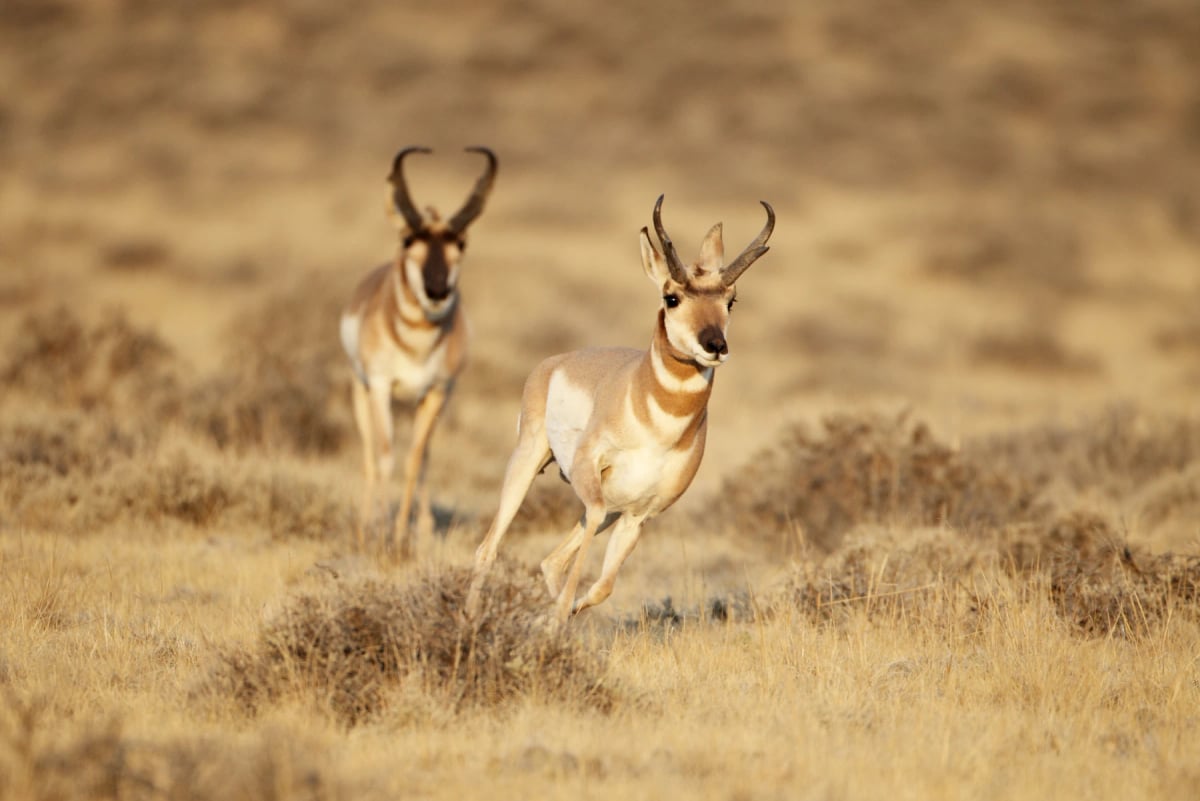
The pronghorn (Antilocapra americana), often called the pronghorn antelope or American antelope, is North America's most extraordinary runner and the only living member of a family that dates back millions of years. Despite its names, it is not a true antelope: its closest living relatives are the giraffe and the okapi. It can reach about 88 km/h (55 mph) and, unlike the cheetah, it keeps up around 56 km/h for kilometers thanks to an oversized windpipe, large lungs and a heart built for endurance. It is the only animal in the world with forked horns and the only one that sheds the outer sheath of its horns every year. Its tan coat contrasts with bright white patches on the rump, throat and sides, and it flares the rump hairs as a warning signal. Across western North America it lives in open grasslands, sagebrush flats and desert shrublands. Pronghorns gather in herds in winter, males defend breeding territories each autumn, and some herds follow ancient migration routes hundreds of kilometers long.
Is the pronghorn an antelope?
No, despite being called the pronghorn antelope, the American antelope or the prong antelope. True antelopes belong to the cattle family and live in Africa and Asia. The pronghorn is the only surviving member of its own family, the Antilocapridae, which once held around a dozen kinds of pronghorn-like animals across North America, some with four or even six horns. Its closest living relatives are the giraffe and the okapi. Early European settlers called it an antelope because of its slim build and speed, and the name stuck: Lewis and Clark described it for science in 1804 and still wrote about it as a goat or antelope. The name pronghorn comes from the forward-pointing prong on the male's horns. In Mexico, the only Spanish-speaking country where it lives, it is called berrendo, and its scientific name, Antilocapra americana, means American antelope goat.
Pronghorn horns: forked, and shed every year
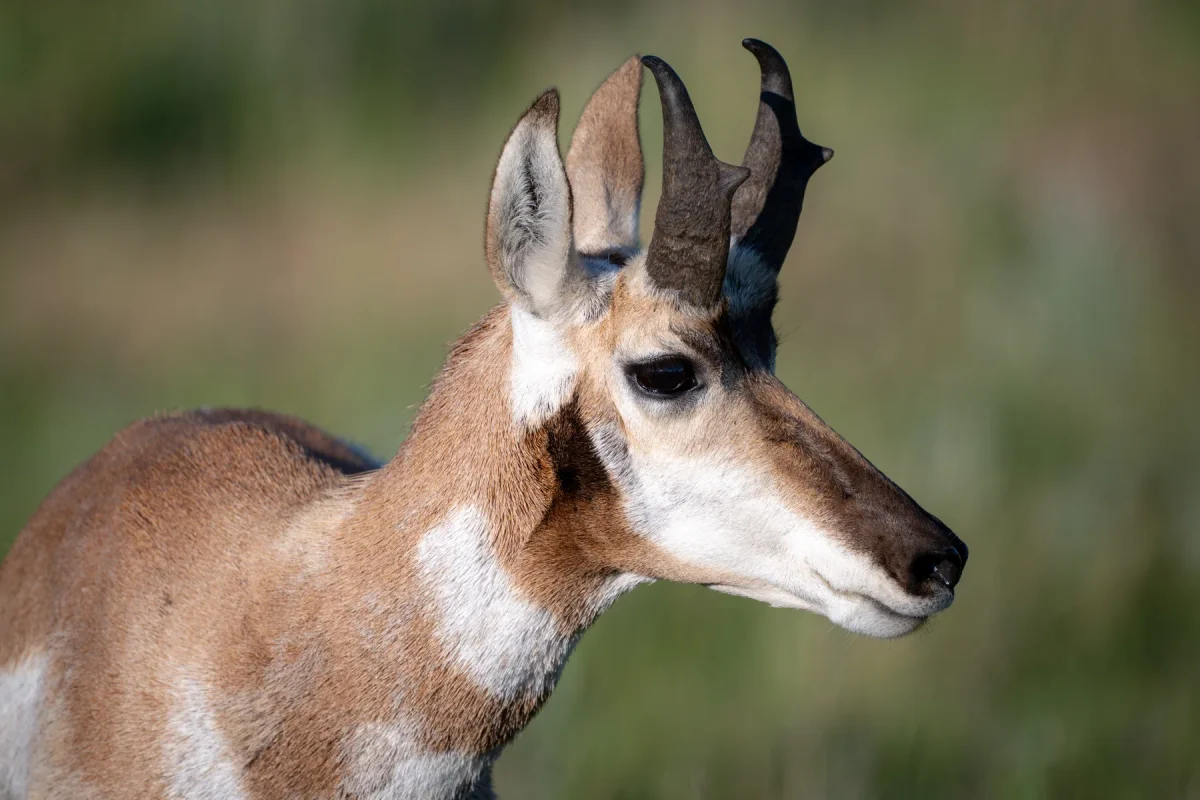
The pronghorn's horns are unlike those of any other animal. Like the horns of cattle, goats and antelopes, they have a core of bone covered by a sheath of keratin, the same material as fingernails. But the pronghorn is the only animal with forked horns, and the only one that sheds the outer sheath every year. After the autumn rut, in October or November, the black sheath loosens and falls off, leaving a short bony core covered in skin and hair. A new sheath grows over it through winter and spring and is fully hard by summer. Males carry horns usually 25 to 43 centimeters long that curve backward at the tips, with a flat prong pointing forward about halfway up. The current Boone and Crockett world record, taken in New Mexico in 2013, had horns of about 47 centimeters. Females often grow horns too, but they are short, usually just a few centimeters, and rarely have a prong. Antlers, by contrast, are solid bone and are shed whole, as in deer and moose.
Where do pronghorn live?
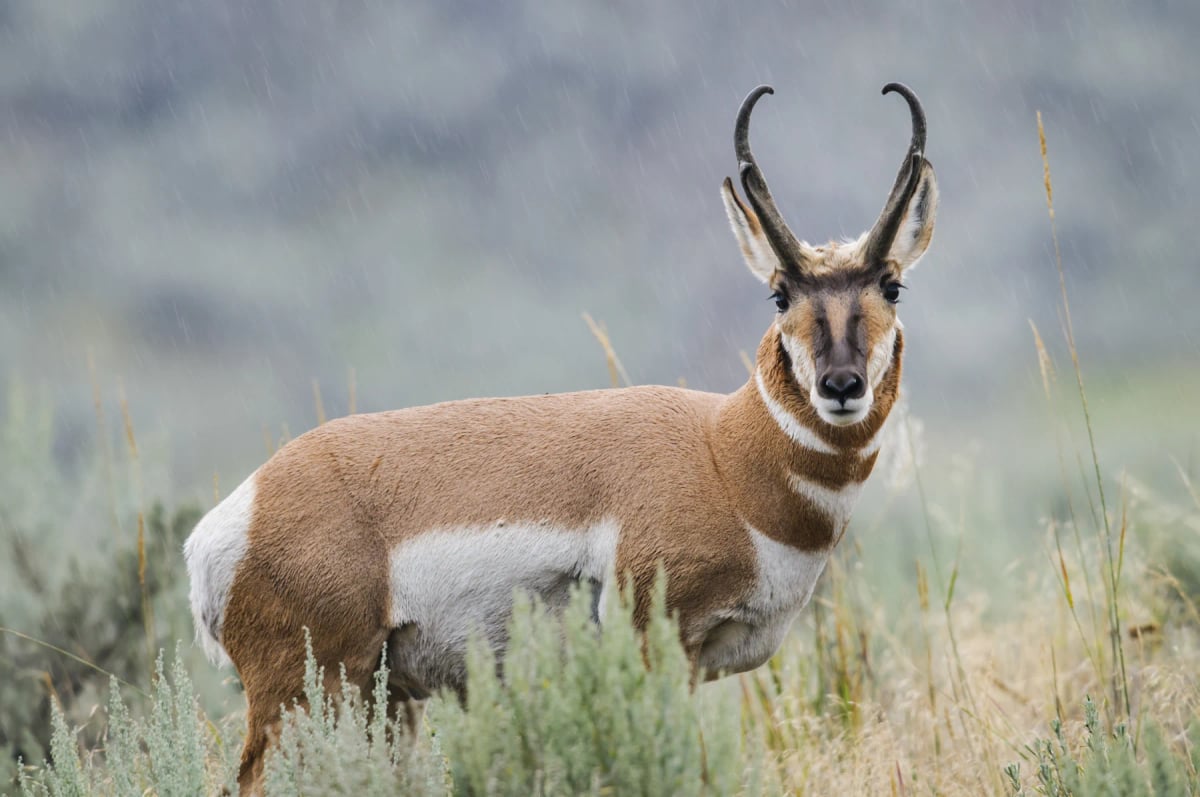
Pronghorn are native only to North America, and they are creatures of wide open spaces. They live in the grasslands, sagebrush flats and desert shrublands of the West, from the prairies of southern Alberta and Saskatchewan in Canada, through the Great Plains and the Great Basin of the United States, to the deserts of northern Mexico. Wyoming has more pronghorn than any other state, and Montana, Colorado, South Dakota, Nevada, New Mexico and Oregon also hold large herds. In California they survive mainly on the Modoc Plateau in the northeast, and in Texas in the Trans-Pecos and the Panhandle. In Mexico, small populations live in Sonora, Baja California Sur and the grasslands of Chihuahua. They once reached Manitoba, Minnesota, Iowa and Washington, where the IUCN now considers them possibly extinct. Pronghorn need terrain with good visibility in every direction, so they avoid forests and tall vegetation, and in snowy areas they move to lower ground in winter.
How fast can a pronghorn run?
Few animals on Earth can match the pronghorn when it comes to speed combined with the ability to keep going. It is the fastest land animal in the Americas, reaching about 88 km/h (55 mph) in short bursts. More impressive is its stamina: it can hold around 56 km/h for about 6 kilometers, far longer than a cheetah, which tires after a few hundred meters. This endurance comes from a set of traits that work together: an oversized windpipe, lungs several times larger than expected for an animal of its size, a big heart, and muscles packed with mitochondria. Its light legs and cushioned, pointed hooves also reduce the energy cost of each stride. Biologists believe this capacity evolved alongside fast predators that are now extinct, such as the American cheetah, Miracinonyx. Today no predator in North America can keep pace with a healthy adult pronghorn running across open ground, which is why coyotes, bobcats and eagles focus on the fawns.
What do pronghorn eat?
Pronghorns are browsers and grazers, and what they eat shifts with the seasons. Sagebrush makes up a large part of their diet through the winter months, as it stays accessible even when snow covers other plants. In spring and summer, they shift toward grasses, forbs, and flowering plants that offer higher nutritional value. In drier desert regions, cacti and other succulent plants also provide both food and moisture. Pronghorns are selective feeders, choosing the most nutritious parts of a plant rather than consuming it whole. Because they do not have upper front teeth, they tear vegetation by pressing it between their lower teeth and a tough pad on their upper jaw. They obtain most of their water needs from the plants they eat, though they will drink from streams and water sources when available.
Behavior
Active mainly during daylight hours, pronghorns are alert and highly social animals. Outside of the breeding season, they gather in herds that can number in the dozens or even hundreds, moving together across the landscape in search of food. Each autumn, males compete for breeding territories, using vocalizations, scent marking, and physical displays to challenge rivals. Serious fights do occur but are less common than posturing and chasing. One of the pronghorn's most recognizable behaviors is the flaring of the white hairs on its rump when alarmed, a visual signal that alerts nearby animals to potential danger. Pronghorns also follow migration routes used for thousands of years. The best known, the Path of the Pronghorn in Wyoming, runs roughly 190 to 240 kilometers each way between the Upper Green River Basin and Grand Teton National Park, one of the longest land migrations in the lower 48 states, and in 2008 it became the first federally designated wildlife migration corridor in the United States.
Are pronghorn endangered?
Not as a species. The story of the pronghorn is one of dramatic decline followed by a genuine recovery. Before European settlement there may have been more than 30 million pronghorn, as many as the bison. Market hunting, fencing and the plowing of the prairies cut them to only tens of thousands by the early 1900s. Hunting laws, refuges such as Hart Mountain in Oregon and Sheldon in Nevada, and decades of moving animals back into empty ranges brought them back to roughly one million, and the IUCN lists the species as Least Concern. Some subspecies are a different story. The Sonoran pronghorn of Arizona and Sonora fell to just 21 animals in the United States in 2002, after a drought; captive breeding and water points helped it recover to about 211 there by late 2022, but it remains endangered. The peninsular pronghorn of Baja California Sur numbers only a few hundred, many in protected enclosures in El Vizcaíno. Fences are a constant threat: pronghorn rarely jump and instead crawl under wire, so woven-wire fences block migration. Hard winters can also kill many, as in Wyoming in 2022 and 2023.
Where it is found
The Pronghorn can be found in places such as:
Researched and written by Juan Pablo. Sources: IUCN Red List, scientific literature and regional field guides. Last updated: .
Technical factsheet





Frequently Asked Questions
What eats a pronghorn?
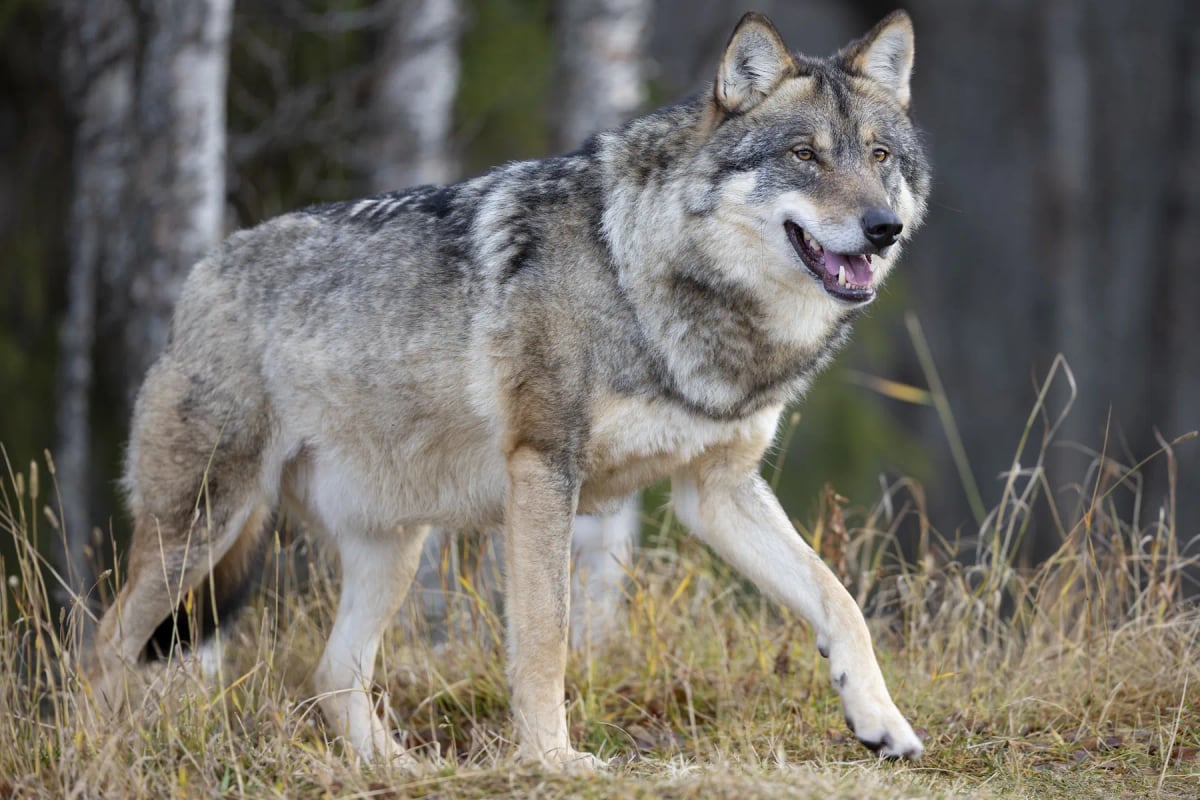
Adult pronghorns are hard to catch, so most predation falls on fawns. Coyotes are the main predator of fawns across much of the range, and bobcats and golden eagles also take many in their first weeks. Wolves and mountain lions can kill adults, usually by ambush or in deep snow, where the pronghorn's speed is useless. In some areas, more than half of the fawns born each year are lost to predators, which is why does hide their young in tall grass and keep them apart from each other.
Why don't pronghorn jump fences?
Pronghorns evolved on open plains with nothing to jump over, so they almost never leap, even though they could physically clear a fence. Instead, they crawl under the bottom wire. That works with barbed wire if the lowest strand is high enough, but woven-wire fences, fences along highways and wires set close to the ground stop them completely, and many die tangled or trapped during winter storms. Wildlife agencies and ranchers now raise the bottom wire to about 46 centimeters and use smooth wire so pronghorns can slip under.
What is a baby pronghorn called?
A baby pronghorn is called a fawn. Does give birth in May or June, often to twins, after a pregnancy of about eight months. Fawns weigh around 3 to 4 kilograms and are grayish brown, which helps them stay hidden. For their first weeks they lie still in the grass while the mother feeds nearby and returns to nurse them a few times a day. They grow quickly: within a few days they can stand and walk well, and after a few weeks they can outrun most predators and join a herd.
How good is a pronghorn's eyesight?
Excellent. Pronghorns have very large eyes, about 5 centimeters across, set far out on the sides of the head, which gives them a field of view of around 320 degrees. They can pick up movement several kilometers away, and their eyes sit high enough that they can keep watching for danger while their heads are down feeding. This sharp vision, combined with speed, is their main defense on open plains. It also explains why they avoid forests and tall brush, where a predator could get close without being seen.
Where can you see pronghorn?
The easiest place is Wyoming, where pronghorns are often seen from the road across sagebrush country. In national parks, look for them in Yellowstone near the North Entrance and the Lamar Valley, in Grand Teton in summer, in Wind Cave National Park and Custer State Park in South Dakota, and on Antelope Island in Utah. Hart Mountain National Antelope Refuge in Oregon was created for them in 1936. In Canada, southern Alberta and Saskatchewan offer good chances, and in Mexico, El Vizcaíno and El Pinacate protect the rare subspecies.
Why do pronghorns flare the white patch on their rump?
That white patch is a communication tool. When a pronghorn senses danger, it raises the long white hairs on its rump, creating a bright flash that is visible from a great distance across open terrain. This signals other pronghorns nearby to stay alert or flee. The animal also releases a scent at the same time, adding a second layer to the warning. It is a fast and effective way to alert the whole herd without making a sound.
How long do pronghorns live?
In the wild, pronghorns usually live up to about 10 years, and a few reach 12 to 15. Females tend to live slightly longer than males, which wear themselves down defending territories during the rut. Predators such as coyotes, bobcats, golden eagles, wolves and mountain lions are a constant pressure, especially on fawns during their first weeks of life. Harsh winters with deep snow and fences that trap animals also take a toll. Pronghorns are not commonly kept in zoos, as they are nervous and difficult to keep in captivity.