Sperm Whale
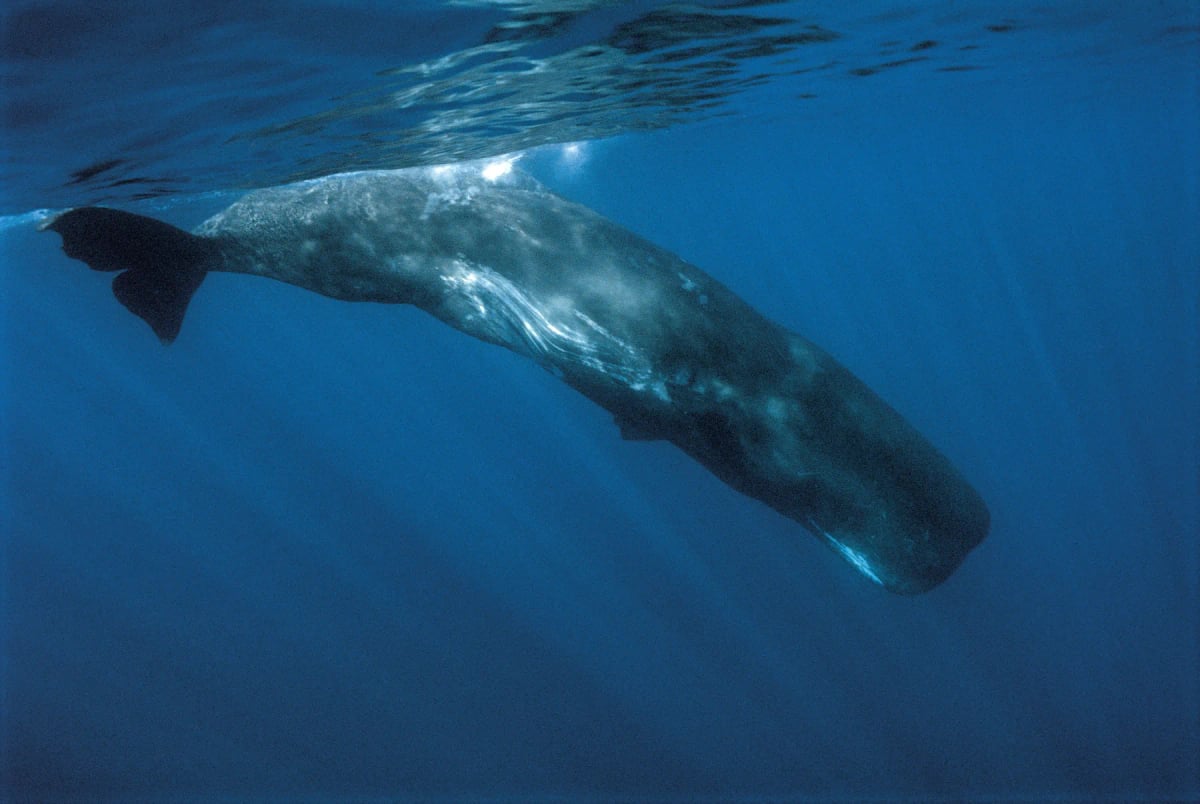
The sperm whale is the largest toothed predator on Earth and one of the deepest diving mammals, capable of descending beyond two thousand meters in search of squid. Its enormous squared head, which can make up a third of its body, houses the spermaceti organ, a mass of waxy oil that once made the species the main target of the whaling industry. Males reach around 16 meters and 40 tonnes, considerably larger than females. Sperm whales live in matrilineal groups of females and young, while adult males wander alone toward cold polar waters and return to the tropics to breed. They communicate through patterns of clicks called codas, which differ between clans and function much like a shared cultural identity across enormous stretches of ocean.
How big is a sperm whale?
The sperm whale is the largest toothed animal on Earth, and the difference between the sexes is greater than in almost any other whale. Adult males usually measure 15 to 16 meters long, with the biggest close to 18, and can weigh around 45 tonnes, while females reach about 11 meters and 15 tonnes. A newborn calf is already about 4 meters long and close to a tonne. The huge, square head makes up about a third of the body and holds the spermaceti organ and the largest brain of any animal, close to 8 kilograms. Under it hangs a narrow lower jaw with 18 to 26 pairs of thick conical teeth, each weighing up to a kilogram, which fit into sockets in the upper jaw, where there are almost no visible teeth. The skin is dark gray and wrinkled behind the head, almost like a prune, and instead of a dorsal fin there is a low hump followed by a row of bumps toward the tail. Even the breath is unique: the single blowhole sits at the front left of the head, so the blow shoots forward and to the left at an angle, which lets whale watchers recognize a sperm whale from far away.
Why is it called a sperm whale?
The English name comes from a mistake made by early whalers. When they cut open the head of a sperm whale they found a huge cavity full of a milky white, waxy oil that turns solid when it cools, and they thought it was the whale's semen. They called it spermaceti, from Latin words meaning seed of the whale, and the animal became the spermaceti whale, later shortened to sperm whale. In fact the spermaceti organ has nothing to do with reproduction: it is part of the system the whale uses to produce and focus its powerful clicks, and it may also help with buoyancy during deep dives. That oil burned with a clean, bright light, which is why candles and lamps made from it lit homes and cities in the eighteenth and nineteenth centuries and why the species was hunted so hard. The Spanish name cachalote probably comes from a word for a big head, used by Portuguese and Galician fishermen, and the scientific name points the same way: Physeter macrocephalus means blower with a big head.
Where are sperm whales found?
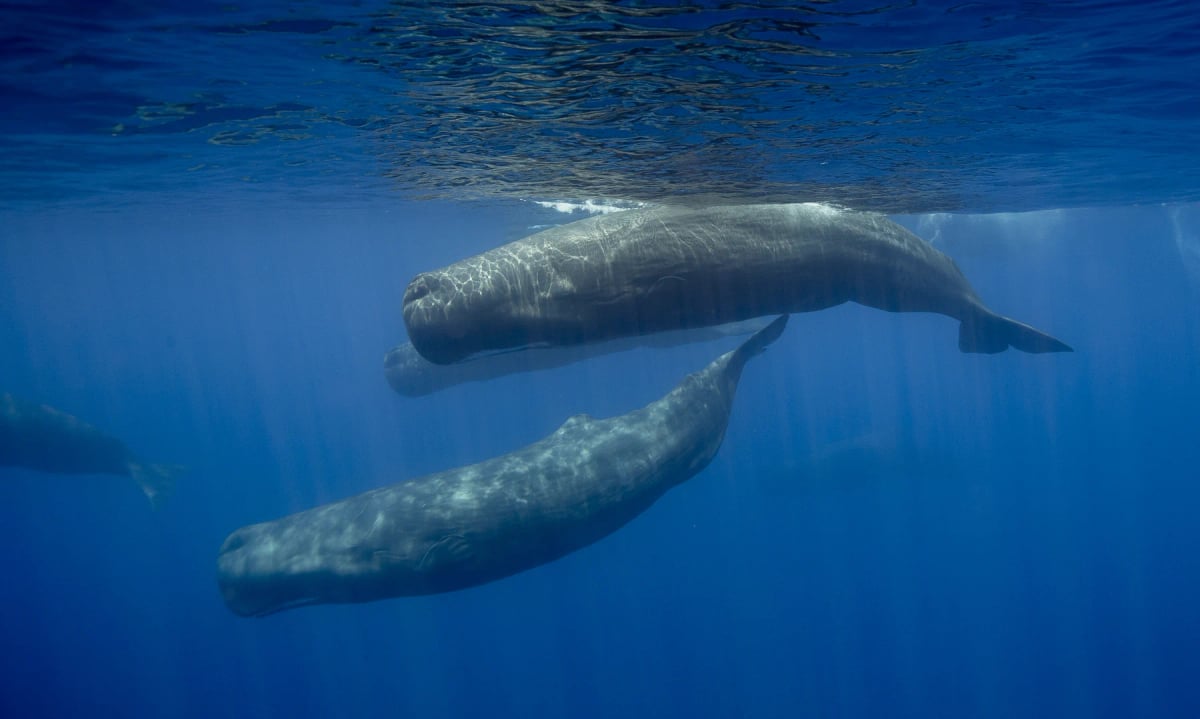
Sperm whales live in every ocean, but they follow depth rather than latitude: they need water more than a thousand meters deep, so they gather near submarine canyons, steep continental slopes and oceanic islands. That is why the best places to see them are those where deep water comes close to shore. Females and their young stay all year in warm and temperate seas, rarely beyond about forty degrees of latitude, and can be seen in the Azores, around Hawaii, in the Gulf of California, off Sri Lanka and in the Caribbean island of Dominica, which created a reserve for them in 2023. Adult males travel alone toward the poles to feed and return to the tropics only to breed, so the famous sperm whales of Kaikōura in New Zealand, Andenes in Norway, Rausu in Japan, Snæfellsnes in Iceland and Sitka in Alaska are almost all males. The Mediterranean has its own small population, found in the Ligurian Sea, the Strait of Gibraltar and the Hellenic Trench off Greece. Other good places are Albany in Western Australia, Muscat in Oman, the Canary Islands and Kamchatka. Whale watching boats usually find them by listening for their clicks with hydrophones before they surface.
What do sperm whales eat?
Squid make up the bulk of the sperm whale's diet, from small species taken by the hundreds to the giant and colossal squid that live in the deep ocean. An adult can eat close to a tonne of food a day. Much of what science knows about these deep sea animals comes from stomach contents and from the circular scars that squid suckers leave on whale skin, since the encounters themselves happen far beyond the reach of observation. Sperm whales also take deep water fish such as rays, sharks and anglerfish when squid is scarce. Hunting happens in total darkness, guided entirely by echolocation, and a single foraging dive can last around forty five minutes. Populations off Alaska and Chile learned to strip fish from longlines, a habit that creates real friction with commercial fishing fleets.
Behavior and social life
Female sperm whales live in stable units of around ten animals, usually related, that stay together for decades and cooperate in raising calves. Because a calf cannot follow its mother to feeding depth, other members of the group take turns staying at the surface with it, a form of babysitting rarely seen in the ocean. Adult males leave these groups in adolescence and spend most of their lives alone or in loose bachelor associations. Communication runs on codas, short rhythmic patterns of clicks that vary between clans in the same way accents vary between human communities, and calves take years to learn the pattern of their own group. Sperm whales also sleep in a striking way, hanging vertically near the surface in small clusters, motionless and head up, for short periods at a time.
Built for the deep
Diving beyond two thousand meters requires a body built around the problem. Sperm whales collapse their lungs on descent to avoid absorbing nitrogen, store oxygen in muscle rather than air, and slow the heart to route blood only to the brain and vital organs. The spermaceti organ in the head, filled with waxy oil, focuses the most powerful biological sound ever measured, a click used both to map the darkness and, some researchers argue, to stun prey. Dives commonly last forty five minutes, with records exceeding two hours. The head is also a battering structure: the thick fibrous case behind the forehead absorbs enormous impact, which is what allowed the whale that sank the whaleship Essex in 1820 to survive its own collision and inspire the story of Moby Dick.
Livyatan, pygmy sperm whales and other relatives
The sperm whale is the only living member of its family, but it has a few relatives. The closest are the pygmy sperm whale and the dwarf sperm whale, two small whales of the genus Kogia that reach only about 3.5 and 2.7 meters. They share the square head, the narrow lower jaw and a small spermaceti organ, live in deep tropical and temperate waters, and are rarely seen alive; most of what is known about them comes from strandings. When frightened they can release a cloud of dark reddish liquid from the gut, a trick compared to the ink of a squid. In the past the family was much more varied. Livyatan melvillei, named after the biblical Leviathan and Herman Melville, the author of Moby Dick, lived about nine to ten million years ago off what is now Peru. It was a sperm whale of roughly 14 to 18 meters, but unlike today's species it had huge teeth in both jaws, some more than 30 centimeters long, among the largest teeth of any animal that ever lived, and it probably hunted other whales. Its fossil skull was found in the Pisco desert in 2008.
How many sperm whales are left?
Nobody knows exactly how many sperm whales there are, because they spend most of their lives deep underwater and far from shore. Estimates range from about 300,000 to more than 700,000, still well below the numbers before whaling. The sperm whale was the main target of the whaling industry for more than two centuries, first for the oil of its head and body, later for industrial lubricants, and hundreds of thousands were killed in the twentieth century alone, before commercial hunting ended in the 1980s. The IUCN lists the species as Vulnerable, a status confirmed in 2019, and the small Mediterranean population, only a few hundred animals, as Endangered. Recovery is slow because females give birth to a single calf only every four to six years, and in some places, such as Dominica, family groups have been shrinking. The threats today are different from the harpoon: collisions with large ships, entanglement in fishing nets, plastic bags and debris swallowed by mistake, and underwater noise from shipping, sonar and seismic surveys, which can interfere with the clicks the species depends on to find food. In 2023 Dominica created the world's first reserve dedicated to sperm whales.
Where it is found
The Sperm Whale can be found in places such as:
Researched and written by Juan Pablo. Sources: IUCN Red List, scientific literature and regional field guides. Last updated: .
Technical factsheet


















Frequently Asked Questions
Was Moby Dick a sperm whale?
Yes. The white whale of Herman Melville's novel, published in 1851, is a sperm whale, and the story was inspired by real events: the sinking of the whaleship Essex by a sperm whale in the Pacific in 1820, and an albino sperm whale nicknamed Mocha Dick, which was said to have fought off many whalers near the island of Mocha, off Chile. Melville had worked on a whaling ship himself.
How many teeth does a sperm whale have?
A sperm whale has about 36 to 52 large conical teeth, all of them in the narrow lower jaw, each up to about 20 centimeters long and a kilogram in weight. The upper jaw has only sockets where the lower teeth fit. Oddly, the teeth do not seem essential for eating: sperm whales with broken or missing teeth have been found well fed, which suggests they mostly suck their prey in.
What is ambergris?
Ambergris is a waxy substance that forms in the intestine of some sperm whales, probably to protect the gut from the sharp beaks of the squid they eat. It is expelled and can float at sea for years before washing ashore, where it hardens and develops a sweet, earthy smell. Perfumers have prized it for centuries to fix scents, and a large piece can be worth a fortune, although many countries now restrict its trade.
How long do sperm whales live?
Sperm whales can live 60 to 70 years, and probably more. Their age is estimated from growth layers in their teeth, much like the rings of a tree. Females usually have their first calf at about 9 years old and then one every four to six years, and they nurse each calf for two years or more, one of the slowest reproductive rates of any mammal.
How deep can a sperm whale dive?
Sperm whales routinely dive beyond a thousand meters and have been recorded past two thousand, among the deepest dives of any mammal; only Cuvier's beaked whale, recorded close to 3,000 meters, is known to go deeper. A typical foraging dive lasts around forty five minutes, and some exceed an hour. They manage it by collapsing their lungs, storing oxygen in their muscles and blood rather than in air, and slowing the heart.
Do sperm whales really fight giant squid?
Encounters do happen, though nobody has ever filmed one. The evidence comes from giant and colossal squid beaks found in whale stomachs and from circular sucker scars on the heads of many adults. Those scars are real but often exaggerated in popular accounts: the whale is vastly larger and the outcome is rarely in doubt. Most of the squid eaten are far smaller species.
Are sperm whales dangerous to humans?
Not in practice. There are no confirmed cases of a sperm whale killing a swimmer or diver, and encounters in the water are generally calm. The historical exceptions come from whaling, when harpooned animals defended themselves and sank several ships, including the Essex in 1820. Modern risk is limited to the animal's size and to boats approaching too closely.
Why was the sperm whale hunted so heavily?
Because of the spermaceti in its head, a waxy oil that burned cleanly and lit cities before petroleum, and later served as a premium industrial lubricant used in everything from machinery to spacecraft. Ambergris, a rare substance formed in the intestine and prized by perfumers, added further value. Hunting ran for over two centuries and only ended with the whaling moratorium of the 1980s.