Green Tree Python
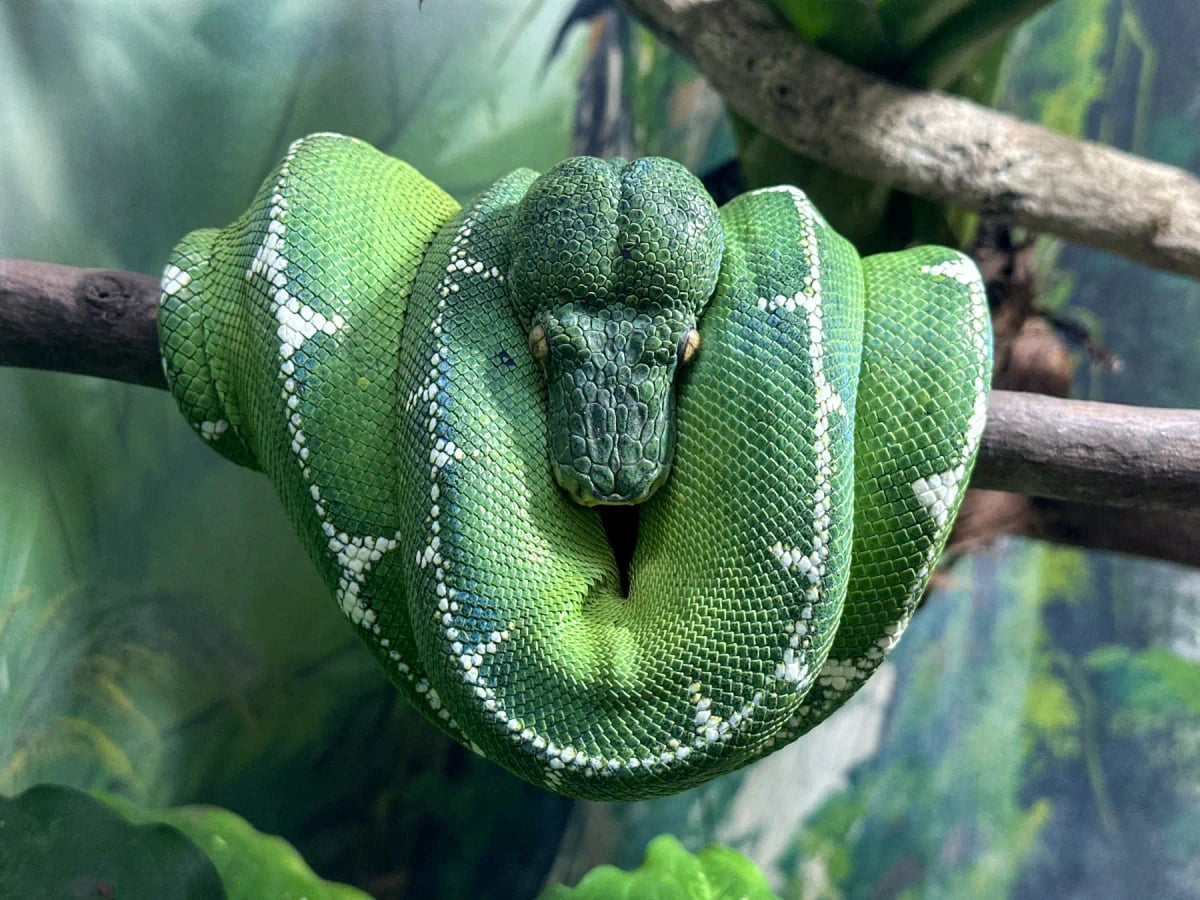
The green tree python is a non-venomous constrictor native to the rainforests of New Guinea, Indonesia, and northern Australia. It spends almost its entire life off the ground, draping itself over branches in a loose coil with its head resting at the center — a posture so distinctive it makes the species instantly recognizable. Its brilliant green scales, sometimes flecked with white, blue, or yellow, provide near-perfect camouflage in the forest canopy. Juveniles are strikingly different, hatching in bright yellow or red before gradually shifting to green as they mature. Mostly active at night, this python hunts birds, lizards, and small mammals by striking from its perch with great precision. It is harmless to people. The main threats it faces are habitat clearance and collection for the exotic pet trade, which affect certain island populations more than others.
Habitat and distribution
The green tree python calls the tropical rainforests of New Guinea, Indonesia, and the Cape York Peninsula in northern Australia home. Within these forests, it lives almost exclusively up in the trees, favoring the mid to upper canopy where branches are thick and leafy enough to conceal a coiled snake entirely. It tends to select perches at a consistent height above the ground, often returning to the same branch day after day. Humid lowland forests are its preferred environment, though it also turns up in forest edges and secondary growth in some parts of its range. Different island populations can vary noticeably in color and size, reflecting how isolated groups have developed independently over time.
Appearance
Few snakes are as visually striking as the green tree python. Adults are covered in vivid green scales that blend seamlessly into the forest canopy, and many individuals carry a scattering of white, blue, or yellow markings along the spine. The head is large and distinctly angular relative to the neck, and the eyes are prominent with vertical pupils suited to low light. One of the most recognizable things about this species is its resting posture: it drapes itself over a branch in a loose coil and tucks its head right at the center, creating a shape that looks almost sculptural. Juveniles look nothing like adults at first, hatching in bright yellow or brick red before slowly transitioning to green over their first year or two of life.
Diet
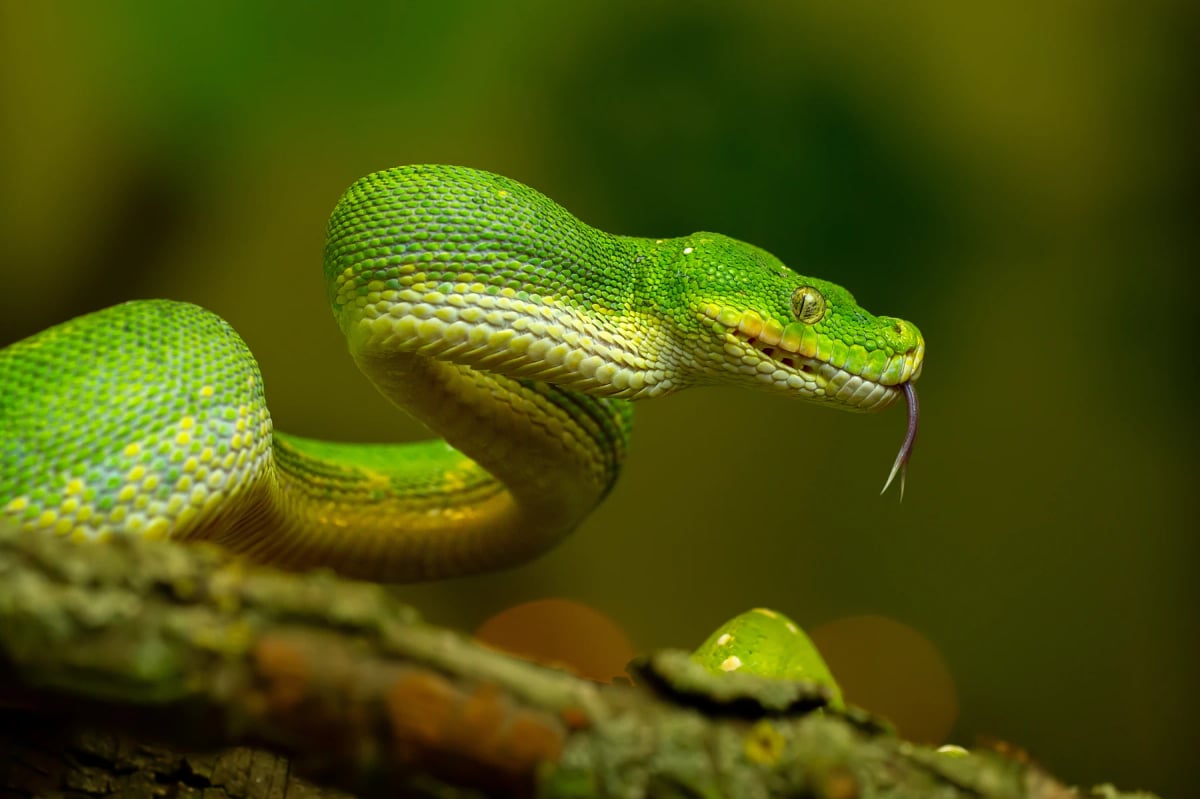
Patience is at the heart of how the green tree python feeds. It anchors itself to a branch with its prehensile tail, hangs the front part of its body downward, and waits for prey to come within range. When something suitable passes below, it strikes with remarkable speed and accuracy, seizing the animal in its jaws before constricting. Birds and lizards make up a large portion of its diet, and small mammals are taken as well. Juveniles rely more heavily on lizards and invertebrates early in life, gradually shifting their preferences as they grow. The python locates warm prey in the dark using heat-sensitive pits arranged along its lips, which detect the infrared radiation given off by living animals.
Behavior
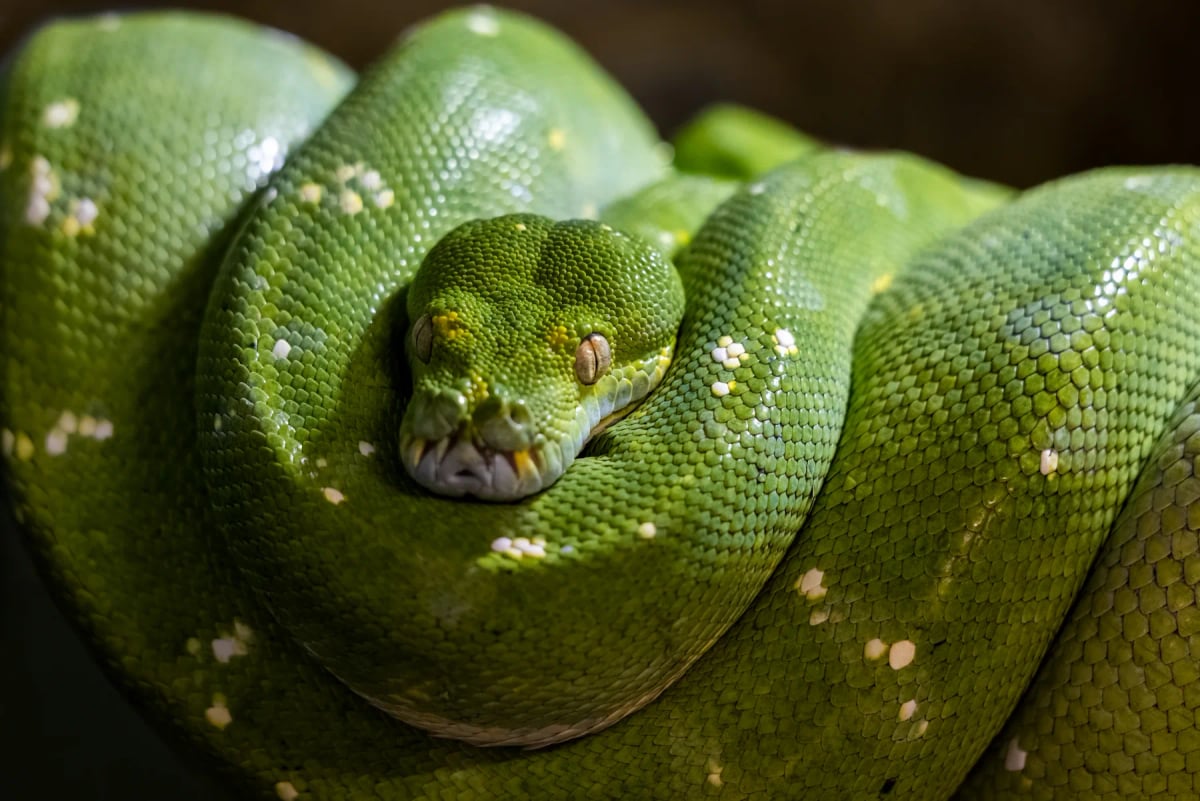
Throughout the day, the green tree python stays almost completely still, perched in its signature coiled posture on a favored branch. This stillness is not just rest. It conserves energy and keeps the snake hidden from both predators and prey. Once night falls, the python becomes a different animal altogether, moving through the canopy and along lower branches in search of a meal. It is a solitary species and does not tolerate the company of other pythons outside of the breeding season. When threatened, it may gape its mouth open as a warning, though it rarely bites unless handled roughly. Its prehensile tail gives it a secure grip on branches and allows it to move between perches with surprising ease.
Conservation
The IUCN currently assesses the green tree python as Least Concern, reflecting the fact that its overall population remains reasonably stable across much of its range. That said, the picture is not entirely positive. Deforestation driven by agriculture and logging continues to reduce the area of suitable habitat, particularly in parts of Indonesia and Papua New Guinea. The collection of wild individuals for the exotic pet trade is a serious and ongoing pressure, one that falls hardest on smaller, more isolated island populations that cannot easily recover from repeated losses. Some countries regulate the export of this species, but enforcement varies considerably. Captive breeding programs have reduced, though not eliminated, the demand that drives wild collection, and the species remains heavily sought after by collectors worldwide.
Where it is found
The Green Tree Python can be found in places such as:
Researched and written by Juan Pablo. Sources: IUCN Red List, scientific literature and regional field guides. Last updated: .
Technical factsheet


Frequently Asked Questions
Is the green tree python venomous?
No, the green tree python is not venomous at all. It is a constrictor, meaning it catches prey by wrapping around it and squeezing rather than injecting venom. While it has large teeth and can deliver a painful bite if it feels threatened, it poses no danger to people from a toxicological standpoint. It is considered completely harmless to humans in the wild.
Why do baby green tree pythons change color?
Juvenile green tree pythons hatch in bright yellow or brick red, which is completely different from the vivid green of adults. Scientists believe these colors may help young snakes blend into their own microhabitats closer to the ground, where light and vegetation differ from the upper canopy. As they grow and move higher into the trees, their scales gradually shift to green over the course of their first year or two of life.
Where does the green tree python live?
The green tree python is native to the tropical rainforests of New Guinea, parts of Indonesia, and the Cape York Peninsula in northern Australia. It spends almost all of its life up in the trees rather than on the ground, preferring the mid to upper canopy of humid lowland forests. It can also be found along forest edges and in areas of secondary growth in certain parts of its range.
What does the green tree python eat?
Green tree pythons feed mainly on birds, lizards, and small mammals. They hunt at night by anchoring their tail to a branch, dangling the front of their body downward, and striking at prey with great speed and accuracy. They find warm animals in the dark using heat-sensitive pits along their lips, which pick up infrared radiation. Young pythons tend to eat more lizards and invertebrates before shifting to larger prey as they grow.
Is the green tree python endangered?
The IUCN currently lists the green tree python as Least Concern, meaning it is not considered endangered overall. However, certain island populations face real pressure from deforestation and collection for the exotic pet trade. Smaller, isolated groups are particularly vulnerable because they cannot recover easily from repeated losses. The species remains heavily sought after by collectors worldwide, which makes regulation and enforcement an important part of keeping populations stable.
Why does the green tree python sit in that coiled posture on branches?
That looped posture, with the body draped over a branch and the head resting at the center, serves several purposes at once. It distributes the snake's weight evenly, making it more comfortable and secure during long periods of rest. It also keeps the snake compact and well camouflaged among leaves. As a bonus, this position puts the head close to the branch, ready to strike at prey passing below with minimal movement.
Can the green tree python be kept as a pet?
Green tree pythons are kept in captivity around the world and are considered highly desirable among reptile enthusiasts. However, they are not beginner pets. They require precise humidity, temperature, and lighting conditions, and they can be defensive in temperament. Importantly, wild collection for the pet trade remains a genuine conservation concern for some populations. Anyone considering one should ensure it comes from a reputable captive breeding program rather than from the wild.