Kookaburra
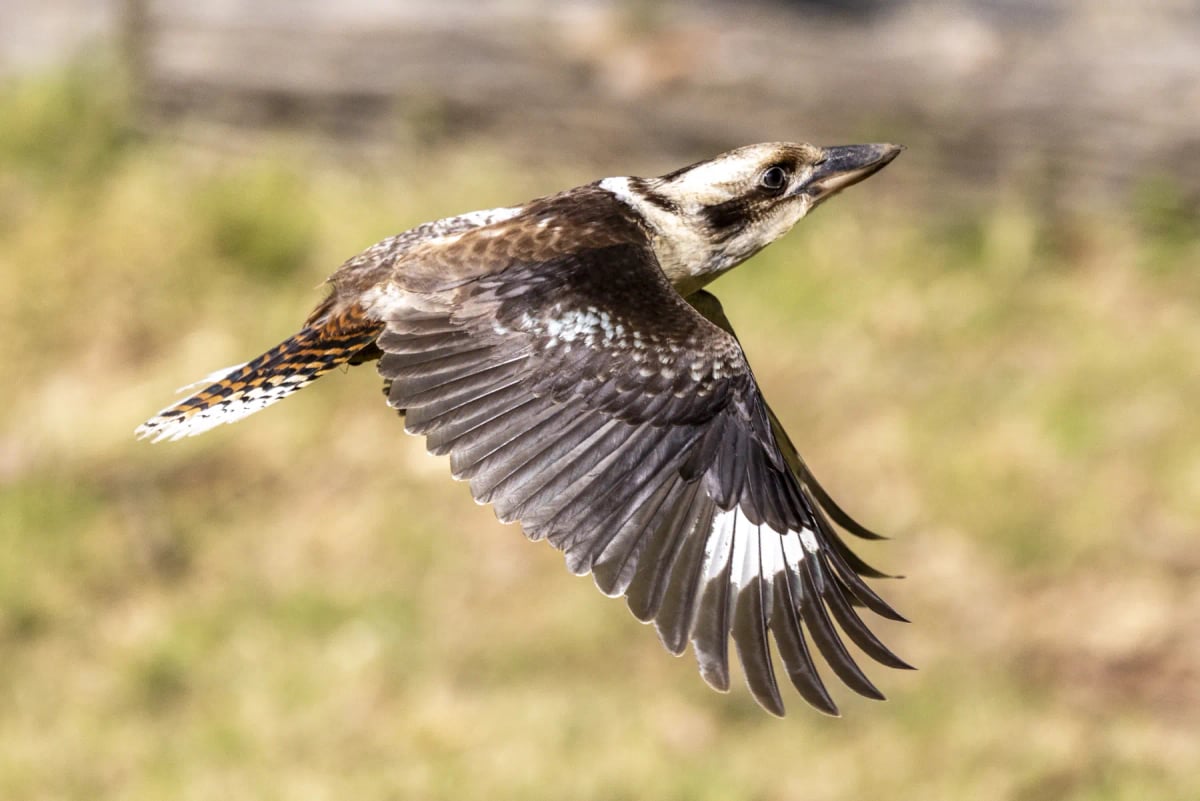
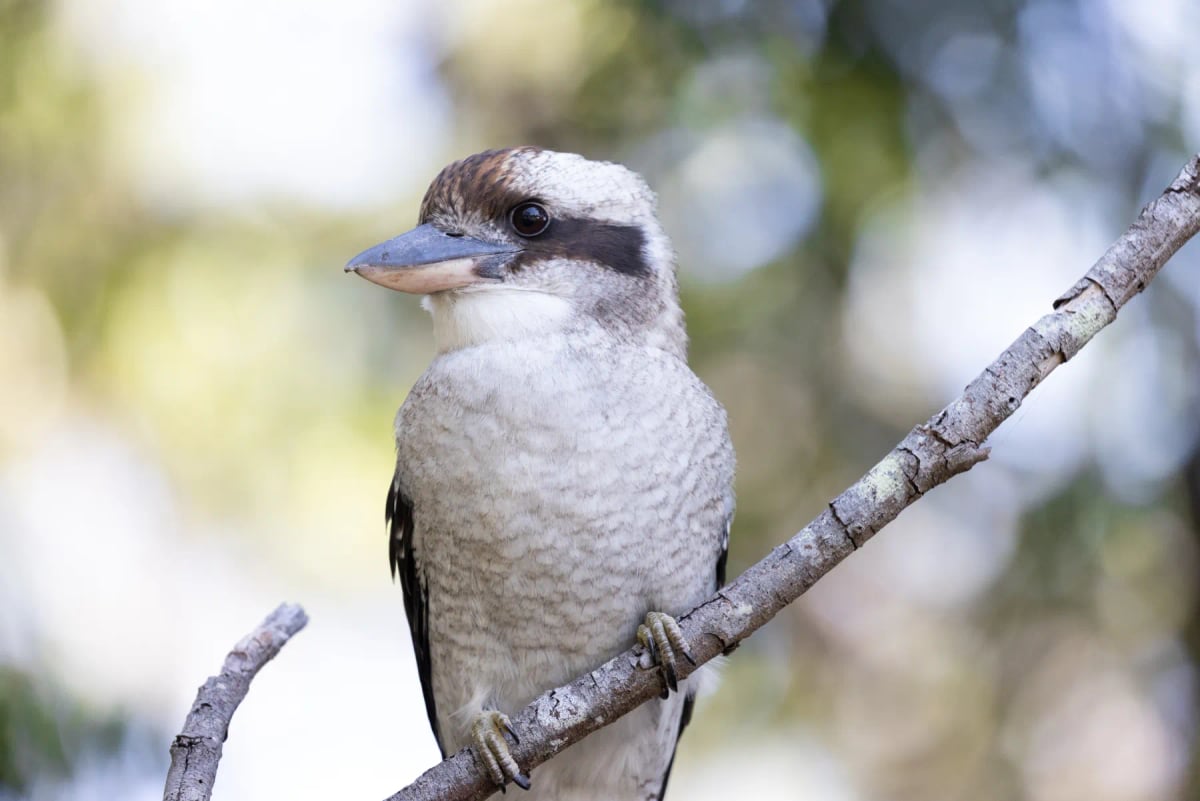
The laughing kookaburra is the heaviest kingfisher in the world, a stocky bird 41 to 47 centimeters long, native to the forests and woodlands of eastern Australia, from Cape York to Victoria. It was later introduced to southwestern Australia, Tasmania, and the north of New Zealand's North Island. Its plumage is cream white and brown, with a dark stripe through each eye, a barred rufous tail, and pale blue patches on the wings. Unlike most kingfishers, it rarely hunts fish. Instead, it perches on branches and drops onto snakes, lizards, large insects, mice, and even small birds, beating prey against the perch before swallowing it. It lives in family groups in which grown young help their parents raise new chicks, and the whole family calls together at dawn and dusk to defend its territory. That rolling, laughing call, which gave the bird the nickname bushman's clock, is one of the most famous sounds of the Australian bush. The IUCN lists it as Least Concern.
Types of kookaburra: laughing, blue winged and more
There are five kinds of kookaburra, all large kingfishers of the genus Dacelo, and they live only in Australia and New Guinea. The laughing kookaburra is the famous one, the species this page is about and the one heard in films and songs. Its closest rival is the blue winged kookaburra, the bird most people mean when they search for a blue kookaburra. It lives in northern Australia and southern New Guinea, has much more blue on the wings and rump, a pale eye, and a call that sounds more like a harsh cackle than a laugh. Males have a blue tail and females a rufous one. The two species overlap in parts of Queensland. The other three live in New Guinea and nearby islands: the rufous bellied kookaburra of the rainforests, with an orange belly; the spangled kookaburra of southern New Guinea and the Aru Islands, with a spotted head; and the shovel billed kookaburra, a dark brown bird with a short, broad bill that digs for earthworms in the forest floor, which was moved into Dacelo only recently. The laughing kookaburra is the largest of all of them.
Habitat and range
The laughing kookaburra is native to eastern mainland Australia, from Cape York Peninsula in the far north down to Cape Otway in Victoria. It thrives in eucalypt forests, open woodlands, and anywhere tall trees border open ground, a mix that gives it high perches and clear ground below to hunt on. People then moved it well beyond that area. It was released in Western Australia from the late 1800s and is now common around Perth and in the southwest, it was taken to Tasmania from 1906, and in New Zealand Governor Sir George Grey released birds on Kawau Island, north of Auckland, in 1866. The New Zealand population is small, perhaps 500 birds or fewer, living between Whangarei and the Waitakere Ranges. Across its range, the species adapts readily to farmland edges, suburban gardens, golf courses, and city parks, as long as big trees with hollows are available for nesting and roosting. It avoids dense rainforest and the arid interior. Kookaburras do not migrate: a family keeps the same territory year round, often for many years.
Diet
Hunting from a perch is the kookaburra's signature technique. It sits still on a branch, fence post, or wire, watches the ground below, then drops suddenly onto its target. Prey includes large insects, earthworms, lizards, snakes, mice, and other small mammals, frogs, and occasionally the nestlings of other birds. Snakes about a meter long have been recorded as prey, including venomous species, which the kookaburra grabs behind the head. Once it seizes something, it beats it repeatedly against the branch or another hard surface to kill it and break its bones, and it may drop larger prey from a height, before swallowing it whole. Despite belonging to the kingfisher family, fish rarely appear in its diet, although it has been known to take goldfish from garden ponds. The species is an opportunist and has learned to take scraps near campsites and picnic areas, but meat from people, especially minced meat, lacks the bones and fur its body needs, so a diet of natural prey keeps it in the best condition.
The kookaburra's laugh
Few sounds in the natural world are as recognizable as the call of the laughing kookaburra. One bird starts with a low, hiccuping chuckle, then throws its head back and bursts into a rolling, raucous laugh, and the rest of the family joins in, creating a chorus that can carry for kilometers across the bush. The main purpose is territorial. Groups call most intensely at dawn and dusk to announce their presence to neighboring families, and a laugh from one group often sets off the next one, so the sound travels from territory to territory. That regular morning and evening chorus earned the bird the nickname bushman's clock. The call also keeps family members in touch and reinforces their bonds. It is not fully instinctive: young kookaburras learn the full laugh from their parents after leaving the nest, practicing clumsy versions before they get it right. The call is so iconic that it has been used for decades in films and TV shows set in jungles all over the world, from Africa to South America, where no kookaburra has ever lived.
Family life and breeding
Laughing kookaburras form pairs that usually last for life, and they are cooperative breeders: a pair is often helped by up to five grown offspring from earlier years, which stay home instead of leaving to find their own territory. The helpers defend the territory, sit on the eggs, and bring food to the chicks. The nest is a hollow in a large old tree, often a eucalypt, or a burrow dug into a termite nest in a tree, with no lining. The usual clutch is three white eggs, laid a day or two apart, and incubation takes 24 to 26 days. Because the eggs hatch one after another, the oldest chick is bigger, and life in the nest can be brutal: the first chicks sometimes attack their youngest sibling, which can die when food is short. The young leave the nest at 32 to 40 days old but depend on the family for weeks more, and many stay on for years as helpers. This arrangement lets a family hold a good territory for a long time, and helps explain why kookaburras are so loyal to one place.
Behavior with humans
Living alongside people has made the kookaburra one of Australia's boldest wild birds. In parks, campgrounds, and backyard gardens, individuals quickly learn that humans carry food and will approach with surprising confidence. Snatching a sausage from a barbecue or diving onto a plate at a picnic table is not unusual behavior for a bird that already hunts by sudden attack. Despite this boldness, kookaburras pose no real threat to people. They are not aggressive without cause, and a respectful distance is all that is needed. Feeding them regularly is discouraged, as it can make birds dependent on handouts and disrupt their natural diet. The best way to enjoy a kookaburra close up is simply to sit quietly outside in the morning and wait for one to land nearby on its own terms.
Cultural significance
Throughout Australian culture, the kookaburra holds a special place that few other animals can claim. Its name comes from guuguubarra, its name in Wiradjuri, an Aboriginal language of New South Wales, and early settlers also called it the laughing jackass. For many Aboriginal peoples, the bird's call at dawn signals the start of a new day, and traditional stories from several groups link it to the rising of the sun. The children's round "Kookaburra Sits in the Old Gum Tree," written by teacher Marion Sinclair in the early 1930s, carried the bird far beyond Australia, and it led to one of the country's most famous copyright cases: in 2010 a federal court ruled that the flute riff in Men at Work's 1981 hit "Down Under" copied part of the song and ordered 5% of royalties paid to its owners. A kookaburra named Olly was one of the three mascots of the Sydney 2000 Olympic Games, and the bird has appeared on stamps, on the Perth Mint's Kookaburra silver coins, and as the name of the Australian company whose Kookaburra balls are used in Test cricket. For visitors, hearing the call for the first time is often one of the most memorable moments of a trip to Australia.
Conservation
The laughing kookaburra is listed as Least Concern on the IUCN Red List, and its overall population is considered stable. It remains one of the most common and familiar birds of eastern Australia, and it has fared better than many native birds in the face of habitat change, largely because it tolerates farmland, parks, and suburbs with ease, as long as mature trees remain. Nest hollows in old trees are essential for breeding, and a eucalypt can take a century or more to form a hollow big enough, so clearing large old trees is a real local problem. Introduced predators such as cats and foxes take young birds on the ground, and cars and collisions with windows kill many adults in towns. Wildlife carers also see kookaburras sick from eating too much minced meat from people, which is why feeding them is discouraged. Outside its native range, the story is the opposite: in southwestern Australia and Tasmania the introduced kookaburras prey on native lizards, frogs, and nestlings, and they compete with local birds for tree hollows, so biologists see them as a threat to local wildlife there. Its adaptability and wide distribution mean it faces no immediate risk as a species.
Researched and written by Juan Pablo. Sources: IUCN Red List, scientific literature and regional field guides. Last updated: .
Technical factsheet

Frequently Asked Questions
Why is it called a kookaburra?
The name comes from guuguubarra, the bird's name in Wiradjuri, an Aboriginal language of central New South Wales, which imitates its call. Early European settlers had other names for it: laughing jackass, because the call reminded them of a braying donkey, and bushman's clock, because families call so reliably at dawn and dusk. In Spanish it is called cucaburra. The scientific name, Dacelo novaeguineae, is an anagram of alcedo, Latin for kingfisher, plus a reference to New Guinea.
Why is its scientific name novaeguineae if it does not live in New Guinea?
Because of a mistake. The German naturalist Johann Hermann named the species in 1783 based on a description by the French explorer Pierre Sonnerat, who wrongly said the bird came from New Guinea. In reality the laughing kookaburra lives only in Australia, plus the places where people introduced it. New Guinea does have kookaburras of its own, but they are other species, such as the rufous bellied and spangled kookaburras, and the blue winged kookaburra of the south.
How long do kookaburras live?
Wild laughing kookaburras can live for well over a decade. The Australian Bird and Bat Banding Scheme recorded one bird still alive 15 years and nearly 3 months after it was banded, and since it was already an adult then, it was older still. In captivity, the record is 26.8 years. Many young birds die in their first year, but adults that hold a good territory with their family can live a long time, often in the same patch of trees.
Are there kookaburras in New Zealand?
Yes, but only a few. Governor Sir George Grey released laughing kookaburras on Kawau Island, north of Auckland, in 1866, and other releases around the country failed. The survivors spread to the nearby mainland, and today perhaps 500 birds or fewer live in a narrow area between Whangarei and the Waitakere Ranges. They are an introduced species there, and many New Zealanders have never seen or heard one in the wild.
Why doesn't the kookaburra eat fish if it is a kingfisher?
Kingfishers are a big family, and many of its members, the tree kingfishers, live away from water and hunt on land. The kookaburra is one of them. Its long, heavy bill works like a pair of tongs for grabbing lizards, snakes, insects, and mice on the ground, and its hunting style, dropping from a perch, suits open woodland rather than rivers. It will take a fish now and then, and some raid goldfish from garden ponds, but fish are a tiny part of its diet.
What does a kookaburra eat?
Kookaburras eat lizards, large insects, earthworms, mice, and snakes. They hunt by sitting still on a branch or fence, watching the ground, then dropping suddenly onto their prey. Before swallowing anything, they beat it against a hard surface to kill it. Despite being kingfishers, they rarely eat fish. They are opportunists and will also snatch food scraps near picnic areas and campsites.
Can a kookaburra really kill a snake?
Yes. Kookaburras are capable predators of snakes, including venomous ones. They seize the snake behind the head and beat it hard against a branch to subdue it. Snakes about a meter long have been recorded as prey. The bird's thick bill and fast strike give it a real advantage. It is one of the reasons kookaburras are respected as tough, capable hunters in the Australian bush.
Why do kookaburras laugh?
That famous call is not laughter in any emotional sense. It is a territorial signal. Family groups call together at dawn and dusk to let neighboring groups know the area is occupied. One bird starts with a low chuckle and the others join in, creating a chorus that carries for kilometers, and one family's laugh often sets off the next. The call also strengthens bonds between family members, and young birds have to learn it from their parents. It just happens to sound remarkably like a group of people laughing loudly.
Where do kookaburras live?
Laughing kookaburras are native to eastern Australia, from Cape York to Victoria. People introduced them to southwestern Australia, Tasmania, and the north of New Zealand's North Island, where a small population survives. They favor open woodlands, eucalypt forests, and areas near farmland or suburbs where large trees are available. Despite the scientific name novaeguineae, they do not live in New Guinea. They do not migrate and tend to stay in the same territory throughout the year.
Are kookaburras endangered?
No. The laughing kookaburra is listed as Least Concern on the IUCN Red List, and its population is stable. It has adapted well to landscapes changed by people like parks, gardens, and farmland. The main local pressures are the loss of old trees with hollows needed for nesting, and predation by introduced cats and foxes. Overall, though, it is one of Australia's most secure and widespread birds.
Do kookaburras steal food from people?
They absolutely do. Kookaburras near campgrounds and parks have learned that humans carry food, and they are bold enough to snatch a sausage straight from a barbecue or swoop onto a plate at a picnic table. This behavior comes naturally to a bird that already hunts by sudden attack. It is entertaining but best discouraged, as regular handouts can make the birds dependent and throw off their natural diet.
How big is a kookaburra?
The laughing kookaburra is the heaviest kingfisher in the world, outweighing even Africa's giant kingfisher. Adults are 41 to 47 centimeters long, and unusually, females are larger than males: they average about 352 grams against 307 grams for males. They have a stocky build, a big head, and a long, powerful bill. Most of the body is cream white and brown, with a dark stripe across each eye and pale blue patches on the wings. Their size and strong bill are key to hunting large prey like snakes and lizards.