Cape Petrel
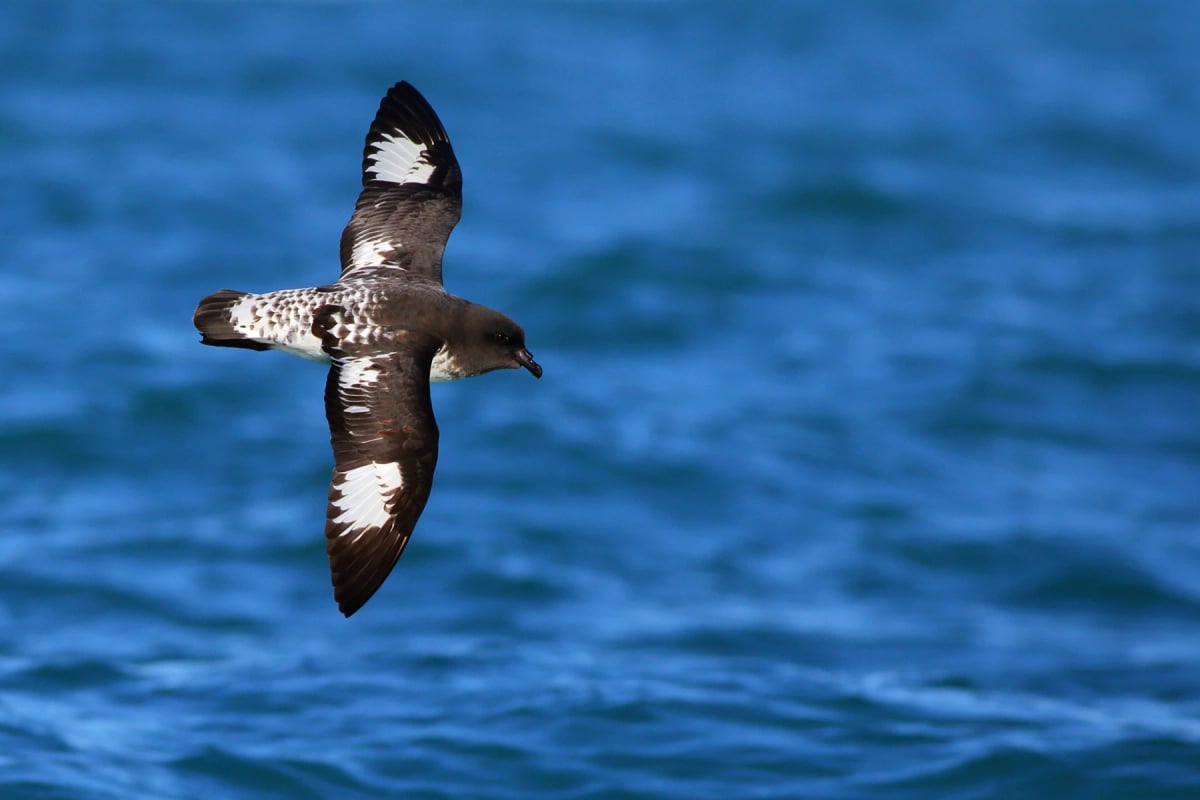
The Cape petrel (Daption capense), also called the pintado petrel or Cape pigeon, is one of the most familiar seabirds of the Southern Ocean, instantly recognizable by its bold black and white checkered upperparts, white belly, and short dark bill. It belongs to the petrel family and flies low over the waves with bursts of stiff wingbeats and long glides. It feeds mainly on krill, squid, and small fish, snatching prey from the water or diving shallowly. Outside the breeding season it roams vast stretches of the southern oceans, sometimes reaching the coasts of South America, southern Africa, and Australia. Breeding takes place on rocky cliffs of Antarctica and sub-Antarctic islands, including New Zealand's southern islands, where each pair lays a single egg and raises one chick per season. Colonies can be extremely dense and noisy. The species is abundant across its range and is currently listed as Least Concern by the IUCN.
Cape petrel, pintado petrel or Cape pigeon?
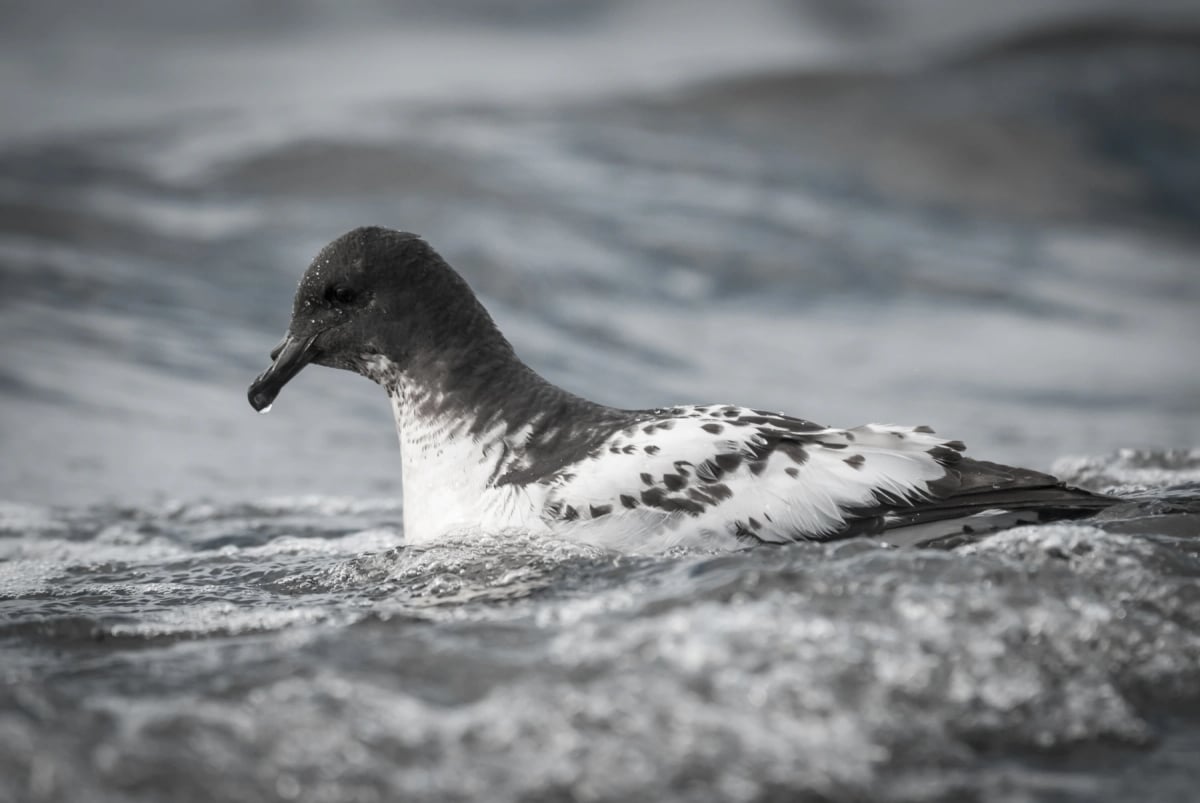
This seabird has collected several names from the sailors who met it. Cape petrel refers to the Cape of Good Hope, off southern Africa, where ships rounding the continent saw it in large numbers; its scientific name, Daption capense, means the Cape one. The name pintado petrel comes from the Spanish and Portuguese word pintado, painted, a perfect description of its checkered black and white back. Old sailors also called it the Cape pigeon, because flocks pecked at scraps around ships like pigeons in a town square, and because of its stocky, pigeon like shape on the water. In Spanish it is known as petrel del Cabo, petrel pintado or damero del Cabo, the word damero meaning checkerboard. The species is the only member of the genus Daption. Two subspecies are recognized: Daption capense capense breeds around Antarctica and on most sub-Antarctic islands, while Daption capense australe, sometimes called the Snares Cape petrel, breeds only on New Zealand's sub-Antarctic islands and is a little darker.
Appearance
Among the seabirds of the Southern Ocean, the Cape petrel is one of the easiest to identify at a distance. Its upperparts display a bold pattern of black and white patches arranged in a checkered design across the wings and back, while the underparts are white with dark margins on the tail and flight feathers. The head is dark brown to black, contrasting with the pale belly. The bill is short and dark, typical of tube-nosed seabirds in the family Procellariidae. In flight it alternates bursts of stiff, rapid wingbeats with long glides low over the waves, showing two large white patches on each upper wing. It is about 35 to 42 centimeters long, with a wingspan of 81 to 91 centimeters, a little larger than a pigeon. Adults of both sexes look alike, and juveniles closely resemble adults from an early age.
Habitat and distribution
Few seabirds are as closely tied to the Southern Ocean as the Cape petrel. It breeds on rocky cliffs and ledges across Antarctica and sub-Antarctic islands, including South Georgia, the South Sandwich Islands, Heard Island, and the Kerguelen archipelago. Colonies are also found along the Antarctic Peninsula, the South Orkney and South Shetland Islands, Bouvet Island and New Zealand's sub-Antarctic islands, such as the Snares, Bounty, Antipodes, Auckland and Campbell Islands. Outside the breeding season, birds disperse widely across cold and temperate waters of the Southern Hemisphere, regularly reaching the coasts of South America, southern Africa, Australia, and New Zealand. They tend to favor productive waters where cold currents concentrate prey near the surface. Vagrants occasionally appear as far north as equatorial latitudes, though such records are rare. The species is strongly associated with cold, nutrient-rich waters rather than tropical or warm seas.
Diet
Antarctic krill forms the backbone of the Cape petrel's diet, supplemented by squid, small fish, crustaceans, and carrion when available. To capture prey, birds either seize items from the water surface while in flight or make shallow plunges below the surface. They are opportunistic feeders and readily gather around fishing vessels and whale carcasses, where food becomes easy to access. Large, noisy flocks often form at productive feeding sites, sometimes alongside other petrels, albatrosses, and prions. Feeding activity can intensify at night, when many prey species migrate toward the surface. The availability of krill is particularly critical during the chick-rearing period, as parents must deliver high-energy meals to support rapid growth in their single offspring.
Behavior
Sociability defines much of the Cape petrel's daily life. Birds congregate in large, boisterous groups at feeding sites and are well known for shadowing ships across hundreds of kilometers of open ocean, scavenging scraps thrown overboard. On the breeding cliffs, pairs reunite at the same nest site year after year, reinforcing their bond through mutual preening and calling. Nests are simple scrapes on bare rock or narrow ledges, and each pair raises just one chick per season. When threatened at the nest, Cape petrels defend themselves by projecting a stream of stomach oil at intruders, an effective deterrent shared by many members of the petrel family. Colonies are vocal and active, particularly during the hours around dusk and dawn.
Conservation
With a global population estimated in the millions, the Cape petrel is currently listed as Least Concern on the IUCN Red List. Its abundance and wide distribution place it among the most secure seabirds of the Southern Ocean. That said, the species is not entirely free of threats. Longline fishing operations pose a risk, as birds can become hooked while attempting to take bait. Introduced predators such as rats and cats have caused problems at some island colonies, though many core breeding sites remain relatively undisturbed. Changes in ocean temperature associated with climate change could alter the distribution and abundance of Antarctic krill, which is central to the bird's diet. Monitoring of breeding colonies and bycatch reduction measures in fisheries remain important for ensuring the species stays secure over the long term.
Where it is found
The Cape Petrel can be found in places such as:
Researched and written by Juan Pablo. Sources: IUCN Red List, scientific literature and regional field guides. Last updated: .
Technical factsheet











Frequently Asked Questions
How big is a Cape petrel?
The Cape petrel is a medium-sized seabird, about 35 to 42 centimeters long with a wingspan of 81 to 91 centimeters, and it weighs roughly 350 to 520 grams, a little more than a large pigeon. It looks compact and stocky on the water, with a rounded head and a short, dark bill topped by the tube shaped nostrils typical of petrels. Males and females look the same. In flight, its long wings and bold checkered pattern make it seem larger than it is.
Does the Cape petrel breed in New Zealand?
Yes. A subspecies, Daption capense australe, sometimes called the Snares Cape petrel, breeds only on New Zealand's sub-Antarctic islands, including the Snares, Bounty, Antipodes, Auckland and Campbell Islands, and on the Chatham Islands. It nests on cliff ledges and in crevices in colonies, and it is slightly darker than the Antarctic birds. Outside the breeding season, Cape petrels of both subspecies are seen off both main islands of New Zealand, often following fishing boats and ferries.
Can you see Cape petrels in Africa?
Yes. Although it breeds far to the south, around Antarctica, the Cape petrel is named after the Cape of Good Hope, and in the southern winter it is common off the coasts of South Africa and Namibia, reaching north to Angola and Mozambique. Pelagic boat trips from Cape Town regularly find it behind fishing trawlers, together with albatrosses, shearwaters and other petrels. It stays offshore and is rarely seen from land except during storms.
What eats Cape petrels?
Adult Cape petrels have few enemies at sea, but at the breeding colonies eggs and chicks are at risk. Skuas are the main predators, patrolling the cliffs and taking eggs and small chicks whenever a nest is left unguarded, and sheathbills also scavenge around colonies. The petrels defend their nests by spitting a jet of foul smelling stomach oil at intruders. On some islands, introduced rats and cats have also taken eggs and chicks, which is why rat eradication projects help seabirds like this one.
What is the difference between a Cape petrel and an Antarctic petrel?
Both are black or brown and white petrels of the Southern Ocean, but their patterns are different. The Cape petrel has a checkered back, with black and white patches mixed across the upper wings and back, and a black head. The Antarctic petrel, Thalassoica antarctica, is chocolate brown above with a broad, clean white band across the rear of the wings and a white tail tipped brown, without any checkered pattern. The Antarctic petrel also stays much closer to the pack ice, while the Cape petrel ranges far north into temperate waters.
What does the Cape petrel eat?
Antarctic krill makes up the largest share of the Cape petrel's diet, but it also eats squid, small fish, and crustaceans. Birds snatch prey from the surface while flying or make shallow dives to catch it. They are opportunistic and will gather around fishing boats and whale carcasses to scavenge. During the chick-rearing period, parents rely heavily on krill to deliver the energy their single chick needs to grow quickly.
Where does the Cape petrel live?
The Cape petrel breeds on rocky cliffs across Antarctica and sub-Antarctic islands, including South Georgia, the Kerguelen archipelago and New Zealand's sub-Antarctic islands. Outside the breeding season, it roams widely across cold and temperate waters of the Southern Hemisphere, reaching the coasts of South America, southern Africa, Australia, and New Zealand. It strongly favors waters that are cold and rich in nutrients, where prey concentrates near the surface.
How does the Cape petrel fly?
The Cape petrel flies low over the sea with bursts of quick, stiff wingbeats followed by long glides on straight, outstretched wings, banking and tilting with the wind over the waves. Like albatrosses and other petrels, it uses the wind rising off the waves to save energy, which lets it travel huge distances over the open ocean. Seen from above, its checkered black and white pattern and two large white wing patches make it easy to recognize even at a distance.
Why do Cape petrels follow ships?
Cape petrels are well known for trailing vessels across hundreds of kilometers of open ocean. They do this primarily to scavenge scraps and discarded fish thrown overboard by crews. Ships also create turbulence that can bring prey closer to the surface, making feeding easier. This behavior has made the species very familiar to sailors in the Southern Ocean for centuries, and it often forms large, noisy flocks around vessels.
How do Cape petrels defend their nests?
When an intruder approaches the nest, Cape petrels have a striking defense: they project a stream of stomach oil directly at the threat. This oil is produced in their digestive system and can foul the feathers of other birds, reducing their ability to stay warm and fly. It also has a strong, unpleasant smell. This defense mechanism is common across the petrel family and is effective against both predators and rival birds.
Is the Cape petrel endangered?
No, the Cape petrel is listed as Least Concern by the IUCN, with a global population estimated in the millions. Its wide range and large numbers make it one of the most secure seabirds of the Southern Ocean. However, it does face some risks, including accidental capture on longline fishing hooks and predation by introduced animals such as rats and cats at certain island colonies. Climate change and its effect on krill is also a concern worth monitoring.
How many eggs does a Cape petrel lay?
A Cape petrel lays just one egg per breeding season. Both parents take turns incubating the egg and later feeding the chick by regurgitating food. Nests are simple scrapes on bare rock or narrow cliff ledges, with no elaborate construction. Pairs are known to return to the same nest site year after year. The chick grows relatively quickly thanks to the energy-rich meals its parents bring, primarily consisting of krill and other prey from nearby waters.