Squirrel Monkey
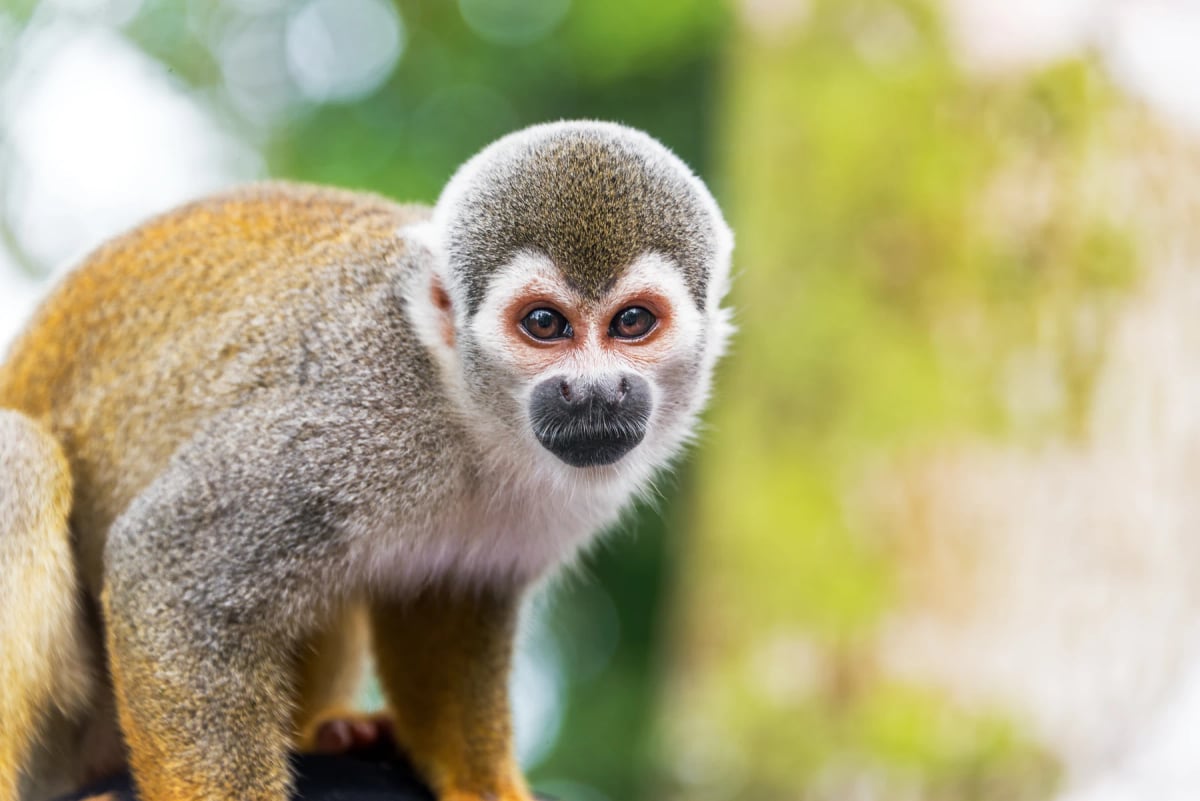
Squirrel monkeys belong to the genus Saimiri and are among the smallest primates in the Americas. They are instantly recognizable by their white facial mask, olive or golden fur on the back, and a long tail used for balance rather than gripping. They live in lowland tropical forests from Panama to the Amazon basin and form some of the largest primate groups in the Neotropics, with troops that commonly number between 20 and 75 individuals and occasionally exceed 100. Active from sunrise to sunset, they forage across all levels of the forest in search of insects, ripe fruit, flowers, and the occasional small lizard or frog. Their large brain relative to body size makes them quick learners, and they use a rich repertoire of calls to coordinate movement and warn of predators such as hawks and snakes.
Habitat and distribution
Squirrel monkeys occupy a broad stretch of the American tropics, from the forests of Panama south through Colombia, Venezuela, and the Guianas, and deep into the Amazon basin across Peru, Brazil, and Bolivia. They do best in lowland tropical rainforest, where a dense canopy and abundant fruiting trees keep them well fed year round. Gallery forests along rivers are also important, as these corridors connect patches of habitat and allow troops to move safely between feeding areas. Although they are capable of surviving in secondary forest and forest edges, intact primary forest provides the richest food supply. Different species within the genus Saimiri show clear regional preferences: the common squirrel monkey is widespread in Amazonia, while the Central American squirrel monkey is restricted to the Pacific coast of Costa Rica and Panama.
Diet
Food is at the center of almost every waking hour for a squirrel monkey. Insects make up a large share of the daily diet, with the monkeys scanning leaves and bark for grasshoppers, caterpillars, beetles, and spiders. Ripe fruit provides quick energy and is sought across all levels of the forest canopy. When fruit is scarce during drier months, flowers and nectar become more important. Small vertebrates such as lizards and tree frogs are eaten opportunistically and add a useful boost of protein. Because squirrel monkeys lack a prehensile tail, they rely on their sharp eyesight and agile limbs to catch fast prey among the branches. Their foraging style is restless and constant. A troop can cover a considerable distance in a single day while working through the forest in search of the next meal.
Behavior
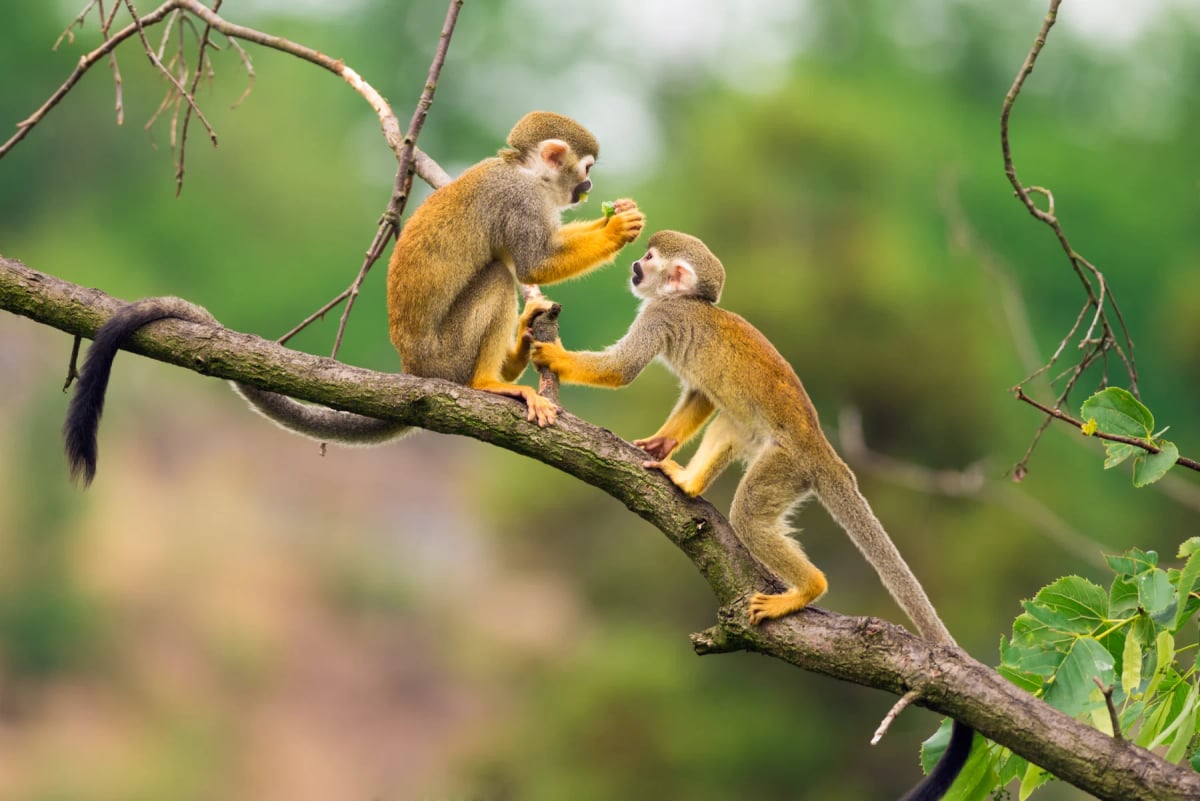
From sunrise to sunset, squirrel monkeys are rarely still. Troops that commonly number between 20 and 75 individuals move together through the forest, foraging at every level from the understory to the upper canopy. Communication plays a constant role in keeping the group together. Researchers have identified a wide range of vocalizations used for different situations, from soft contact calls that keep troop members in touch to loud alarm calls that alert the group to hawks or snakes overhead. Squirrel monkeys have one of the largest brains relative to body size of any primate, which helps explain their ability to learn quickly and adapt their foraging routes to seasonal changes in food availability. At night, the troop gathers to sleep in dense vegetation, huddling together for warmth in the cooler highland areas of their range.
Social role
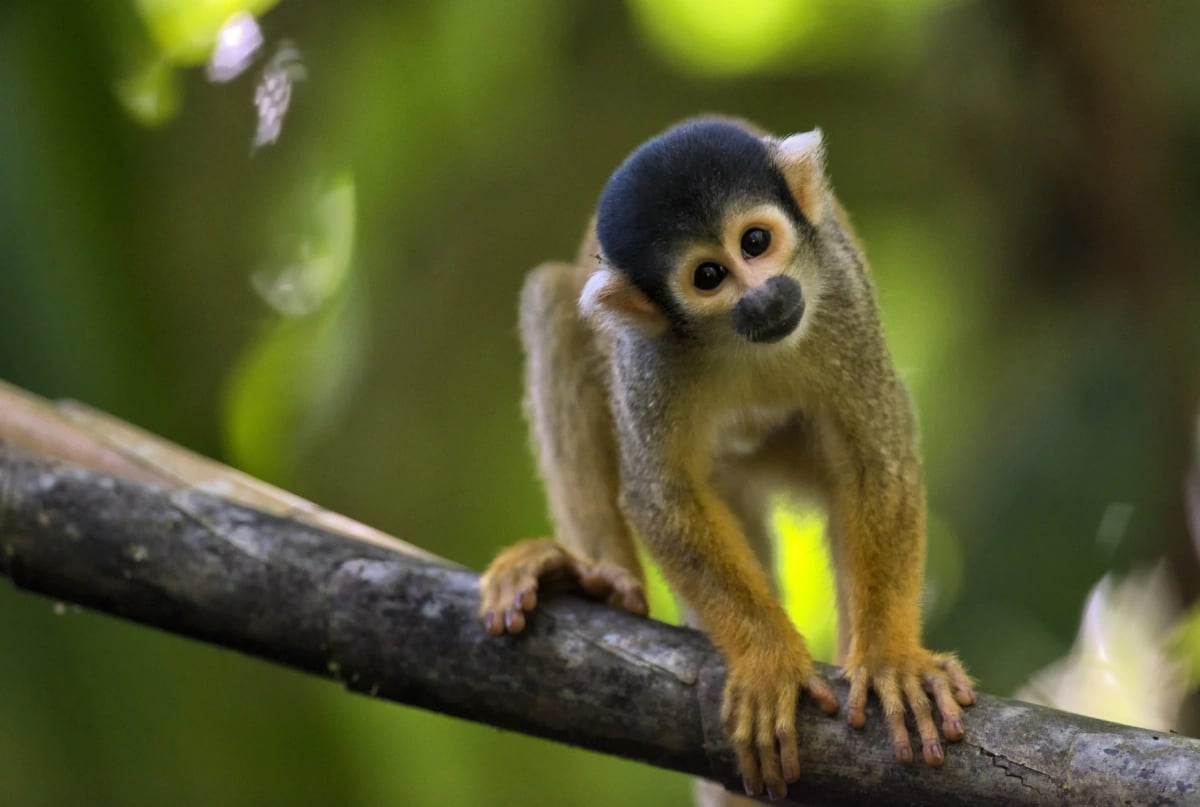
Group life is the foundation of survival for squirrel monkeys. Females form the stable core of every troop. They remain in the group where they were born and build lasting bonds with related females, cooperating in the care of young and in keeping watch for danger. Males, by contrast, leave their birth group when they reach maturity and join other troops, which reduces inbreeding and introduces new genetic variation. During the breeding season, males compete intensely for mating opportunities, and dominant males often gain considerable weight beforehand, a trait known as seasonal fatting. Troops also mix temporarily with other species, particularly capuchins, which can improve collective vigilance against predators. The size of a troop offers real safety in numbers. With many pairs of eyes scanning the canopy and surrounding vegetation, threats are spotted and called out before they can get close.
Conservation
The IUCN lists most squirrel monkey species as Least Concern, a reflection of their wide range and generally large populations. That status does not mean they face no pressure. Deforestation driven by agriculture and cattle ranching continues to shrink and fragment the tropical forests they depend on, and smaller isolated populations can struggle to maintain healthy numbers over time. In some parts of their range, squirrel monkeys are captured for the pet trade or for use in biomedical research, a practice that once affected wild populations significantly. Legal protections have reduced but not eliminated this threat. The Central American squirrel monkey, found only on the Pacific coast of Costa Rica and Panama, is listed as Vulnerable due to its restricted range and ongoing habitat loss. Keeping large areas of forest connected and intact is the most effective way to protect the genus as a whole.
Where it is found
The Squirrel Monkey can be found in places such as:
Researched and written by Juan Pablo. Sources: IUCN Red List, scientific literature and regional field guides. Last updated: .
Technical factsheet





Frequently Asked Questions
What do squirrel monkeys eat?
Squirrel monkeys eat a wide variety of foods. Insects such as grasshoppers, beetles, and caterpillars make up a large part of their diet, alongside ripe fruit and flowers. When the chance arises, they will also catch small lizards and tree frogs for extra protein. They forage constantly throughout the day, moving through all levels of the forest to find enough food to fuel their active lifestyle.
Where do squirrel monkeys live?
Squirrel monkeys are found across the tropical forests of Central and South America, from Panama south through Colombia, Venezuela, and the Guianas, all the way into the Amazon basin in Peru, Brazil, and Bolivia. They prefer lowland rainforest with a dense canopy, but they also use gallery forests along rivers. One species, the Central American squirrel monkey, is restricted to the Pacific coast of Costa Rica and Panama.
How big are squirrel monkeys?
Squirrel monkeys are among the smallest primates in the Americas. Most adults weigh between 750 grams and 1.1 kilograms, roughly the weight of a large apple or a small bottle of water. Despite their small size, they are fast, agile, and remarkably energetic. Their tail is longer than their body, but it cannot grip branches. Instead, they use it for balance as they move through the trees.
Do squirrel monkeys live in groups?
Yes, squirrel monkeys are highly social and live in troops that usually number between 20 and 75 individuals, though some groups exceed 100. Females stay with the group they were born into for their entire lives, while males leave at maturity to join other troops. Living in large groups helps them spot predators such as hawks and snakes quickly and keeps every member of the troop safer.
Are squirrel monkeys endangered?
Most squirrel monkey species are listed as Least Concern by the IUCN, meaning their populations are generally stable across their wide range. However, deforestation and the pet trade still put real pressure on them. The Central American squirrel monkey is the exception. It is listed as Vulnerable because it only lives in a small area of Costa Rica and Panama and continues to lose habitat to agriculture and development.
Why do squirrel monkeys have such large brains?
Squirrel monkeys have one of the largest brains relative to body size of any primate, and that brain power pays off in daily life. It helps them remember where fruiting trees are, adapt their foraging routes as seasons change, and learn quickly from experience. They also manage a rich set of vocalizations to communicate with their troop. In short, a bigger brain helps them survive in a complex and ever-changing forest environment.
Can squirrel monkeys be kept as pets?
Squirrel monkeys are wild animals and do not make suitable pets. They have complex social needs that cannot be met outside a large troop, and they require a diet and environment that are nearly impossible to replicate at home. Capturing them for the pet trade has historically harmed wild populations. In many countries within their range, keeping squirrel monkeys as pets is illegal, and international wildlife trade laws also restrict their sale and transport.