The Turul
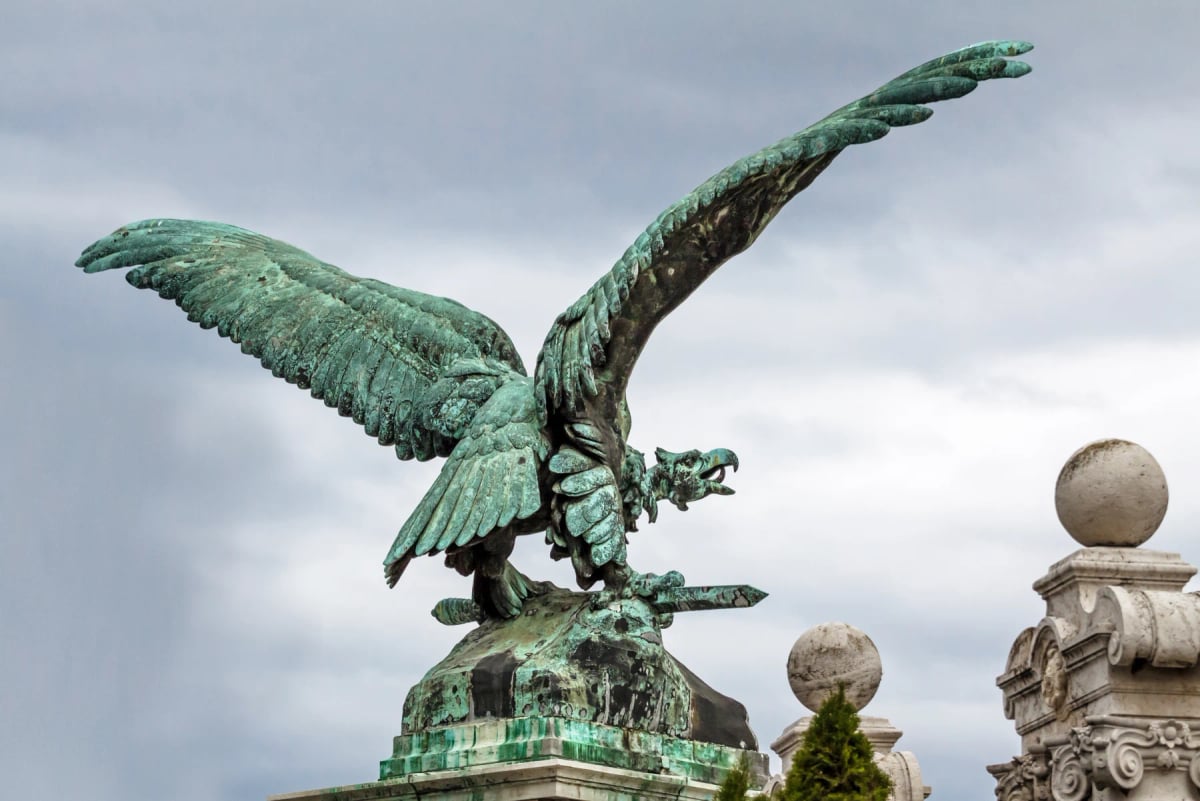
The turul is the mythical bird of prey at the heart of Hungarian legend and one of the most important national symbols of Hungary. Medieval chronicles tell how a turul appeared in a dream to Emese, foretelling that great kings would descend from her son Álmos, which made the bird the ancestor of the Árpád dynasty, the first royal house of Hungary. Later tradition also says it guided the Magyar tribes to their new home in the Carpathian Basin. It is usually shown as a large falcon with its wings spread, often holding a sword in its talons, and scholars think it was inspired by a real bird, most likely the saker falcon of the steppes. The word itself probably comes from a Turkic name for a bird of prey. The turul has no biological existence, but it is everywhere in Hungary: on the six meter statue at Buda Castle, on the monument at Tatabánya with its 15 meter wingspan, the largest bird statue in Europe, and in the emblems of the Hungarian Defence Forces and other state bodies. For many Hungarians it stands for origin, destiny, and protection, although its use by nationalist groups has also made it a contested symbol.
What is the turul?
The turul is a mythical bird from Hungarian tradition, a giant bird of prey that plays the role of divine messenger and ancestor in the origin stories of the Hungarian people. It is almost always depicted as a falcon, although some artists have given it the look of an eagle, and in art it usually appears with its wings spread wide, sometimes wearing a crown and often holding a sword in its talons. In old Hungarian, turul was the name of a particular kind of falcon, and the word itself most likely comes from Turkic languages, where toğrul or toġrïl meant a medium to large bird of prey. Scholars have linked the legendary bird to several real species, including the goshawk and the gyrfalcon, but the most popular candidate is the saker falcon, a powerful hunter of the Eurasian steppes that the nomadic ancestors of the Hungarians knew well and used for falconry. The turul is not a real animal and does not live in any country, which is why it does not appear on the map, but it is included here because it is the animal most closely tied to Hungary's identity.
The legend of Emese's dream
The best known turul story is told in the Gesta Hungarorum, a Latin chronicle written around 1200 to 1230 by an unknown author known as Anonymus. According to the chronicle, while Emese, the wife of the chieftain Ügyek, was pregnant, a divine vision came to her in a dream in the form of a falcon, which seemed to make her pregnant. In the dream a rushing stream sprang from her womb and grew into a great river, but not in her own land, and this was read as a prophecy that glorious kings would come from her line. Her son was named Álmos, from the Hungarian word álom, dream, so his name can be understood as the dreamt one. Álmos led the Hungarian tribes westward, and his son Árpád completed the conquest of the Carpathian Basin at the end of the ninth century. The river growing in a foreign land was taken to mean the new homeland. Later retellings of the legend add that turul birds flew ahead of the migrating Hungarians and showed them the way to their new homeland.
The turul and the Árpád dynasty
Because of Emese's dream, the Árpád dynasty, which ruled Hungary from the conquest of the Carpathian Basin until 1301, was also called the Turul dynasty, and its members were said to belong to the Turul clan. For nomadic peoples of the steppe, a bird of prey as a clan ancestor was a familiar idea, and historians see the turul as a totem, a sacred animal from which the ruling family claimed its origin and its right to rule. Medieval chroniclers also linked the bird to Attila the Hun, whom they presented as an ancestor of the Hungarian kings: according to the chronicles, Attila carried a crowned falcon on his shield and banner, and the Hungarians used it as their military emblem until the time of Prince Géza in the tenth century. After the country became Christian under Géza's son, King Stephen I, the turul faded from official symbols, but it survived in legends and chronicles and returned with force in the nineteenth century, when Hungarian nationalism looked back to the country's pagan origins for symbols of identity.
Turul statues in Hungary
The turul became a favorite subject of public art around 1896, when Hungary celebrated the thousandth anniversary of the Magyar conquest. That year, bronze turul birds were placed on top of the pillars of the new Liberty Bridge in Budapest, where they still perch today, their wings spread over the Danube. The most visited statue stands at Buda Castle: created by the sculptor Gyula Donáth and unveiled in 1903, it shows a huge turul about six meters tall, clutching a sword, on the railing above the Danube near the funicular, and it is one of the most photographed spots in Budapest. The largest of all is in Tatabánya, a city west of Budapest. Built in 1907 on a hilltop, it has a wingspan of about 15 meters and is considered the largest bird statue in Europe, visible from the motorway below. Smaller turul figures can be found on memorials, gates, and public buildings in towns across Hungary and in Hungarian communities in neighboring countries.
Is the turul Hungary's national animal?
Hungary has no national animal chosen by law, but when people ask what the national animal of Hungary is, the answer they usually get is the turul. No other creature is so closely tied to the story of the Hungarian nation, and the bird appears in many official emblems today, including those of the Hungarian Defence Forces, the Counter Terrorism Centre, and the Constitution Protection Office, the country's domestic intelligence service. It is also used by schools, sports clubs, and businesses, and it is a popular motif in tattoos and souvenirs. Because the turul is a myth, Hungarians also point to real animals as national symbols. The saker falcon is often described as the real bird behind the legend, and in 2004 the Hungarian parliament passed a resolution recognizing native Hungarian animal breeds as part of the national heritage; among the best known are the Hungarian grey cattle, the Mangalica pig, and the vizsla. So while the turul is the symbolic national animal, Hungary's national pride also includes these living animals.
The real bird behind the myth: the saker falcon
If the turul had a living model, it was most likely the saker falcon, a large falcon of open grasslands that ranges from central Europe across the steppes of Central Asia to Mongolia and China. Sakers are powerful hunters that take ground squirrels and birds with fast, low attacks, and they have been prized in falconry for thousands of years, including by the nomadic peoples from whom the Hungarians descend. Today the real bird is in trouble. The IUCN lists the saker falcon as Endangered because of a very rapid decline across its range, driven by the loss of steppe habitat, electrocution on power lines, poisoning, and illegal trapping for falconry. Hungary, however, is one of the success stories. The Hungarian population fell to an estimated 30 pairs around 1980, but thanks to conservation work, including artificial nest boxes fitted on high voltage pylons with the help of the national power grid operator, it grew to about 240 pairs by 2010, and in recent years between 175 and 200 pairs have nested in the country. In a sense, protecting the saker is also protecting the bird that inspired Hungary's oldest legend.
A symbol with a complicated past
Like many national symbols, the turul has not always been used in harmless ways. Between the two world wars, a nationalist student federation called the Turul Association took its name and became known for antisemitic campaigns at Hungarian universities, and during the twentieth century far-right movements adopted the bird as an emblem. Because of this history, the turul still divides opinion. For many Hungarians it is simply an ancient symbol of the nation's origins, found on bridges, castles, and military badges, while others see in it echoes of exclusion and extremism. The debate became especially visible in 2005, when a turul memorial to World War II dead was unveiled in Budapest's 12th district: critics objected because some of the names honored on it were linked to the Arrow Cross, the fascist party that briefly ruled Hungary in 1944 and 1945. The discussion shows how a mythical bird from a medieval dream can still carry very different meanings today, depending on who uses it and how.
Researched and written by Juan Pablo. Sources: IUCN Red List, scientific literature and regional field guides. Last updated: .
Technical factsheet





Frequently Asked Questions
Is the turul a real bird?
No. The turul is a mythical bird from Hungarian legend and has never existed as a living species. It is usually shown as a large falcon, and the legend was probably inspired by real birds of prey that the ancestors of the Hungarians knew on the steppes of Eurasia, most likely the saker falcon, which still nests in Hungary today. In old Hungarian, the word turul was the name of a kind of falcon. So while the turul itself is imaginary, the bird that inspired it is very real.
What does the turul symbolize?
The turul symbolizes the origin and destiny of the Hungarian people. In the medieval legend, it appeared in a dream to Emese and announced that great kings would descend from her son Álmos, so it stands for the divine origin of the Árpád dynasty and of Hungary itself. Later stories about the turul guiding the tribes to the Carpathian Basin made it a symbol of guidance and of the homeland. Today it is also read as a sign of strength, protection, and national unity, although its use by nationalist groups means some people see it more critically.
Why does the turul hold a sword?
Many turul statues, including the famous one at Buda Castle, show the bird with a sword in its talons. The sword links the turul to Hungarian legends about the conquest of the Carpathian Basin and to Attila the Hun, whom medieval chroniclers presented as an ancestor of the Hungarian kings and whose banner was said to carry a crowned falcon. The sword turns the bird into a symbol of strength and of the right to defend the homeland.
Where can you see the turul in Budapest?
The most famous turul in Budapest stands at Buda Castle, on the railing above the Danube near the top of the funicular and the entrance to the palace. Created by Gyula Donáth and unveiled in 1903, the bronze bird is about six meters tall and clutches a sword. Four more turul birds perch on top of the pillars of Liberty Bridge, placed there for the millennium celebrations of 1896. Outside the capital, the biggest turul in the country stands on a hill in Tatabánya, about an hour west of Budapest, with a wingspan of about 15 meters.
Where does the word turul come from?
The word turul most likely comes from Turkic languages, where forms such as toğrul or toġrïl meant a medium to large bird of prey. The ancestors of the Hungarians lived for centuries alongside Turkic peoples on the steppes before reaching the Carpathian Basin, and Hungarian took many words from them. In old Hungarian, turul referred to one particular kind of falcon, and only later did the name become attached mainly to the legendary bird. The same Turkic word also appears as a personal name, carried by rulers such as the Seljuk sultan Tughril.