Fishing Cat
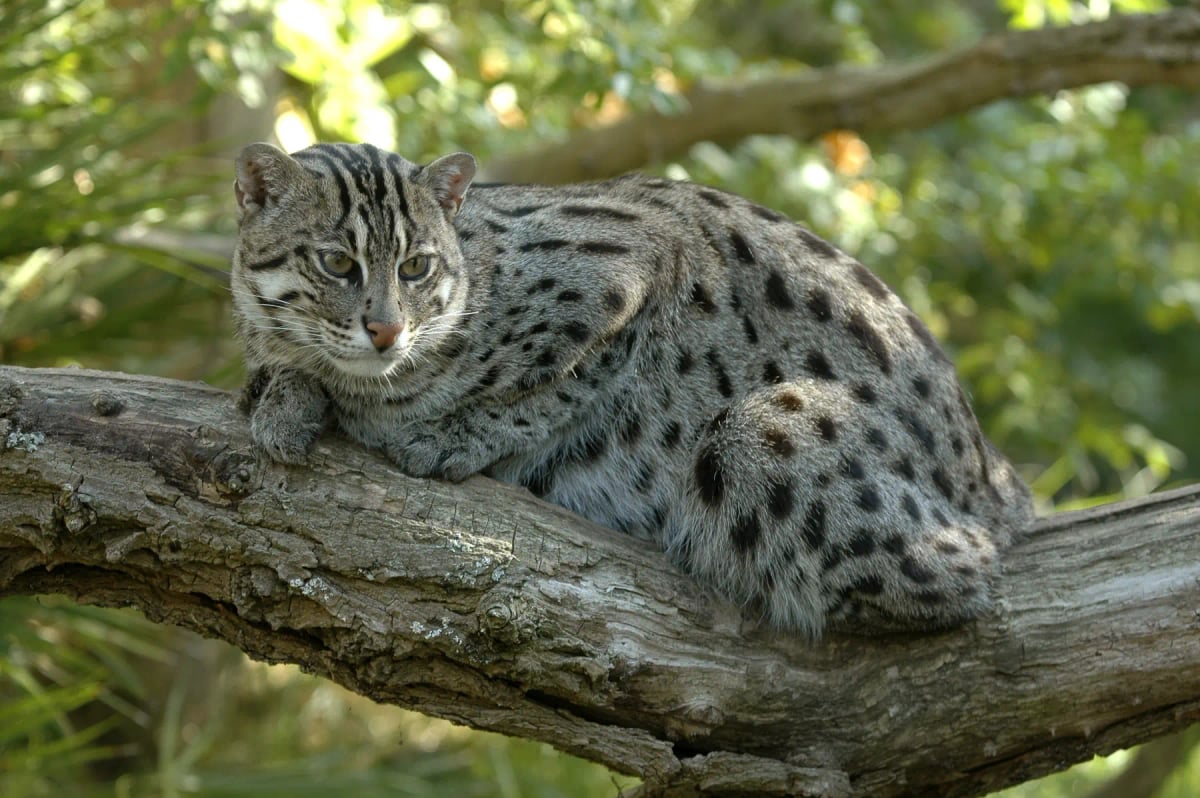
The fishing cat is a stocky, medium-sized wild cat native to South and Southeast Asia, built for life near water. Its legs are shorter than those of most felids, and its paws are partially webbed, giving it a real advantage when wading through shallows or paddering after prey. A dense, water-resistant coat of olive-grey fur marked with dark spots and stripes keeps it well suited to wetland environments. It feeds mainly on fish, which it scoops from the surface with a swift paw strike, but it also takes frogs, crustaceans, snakes, and the occasional small mammal or bird. Comfortable in rivers, swamps, and mangrove forests, this cat is a confident swimmer and has been recorded diving completely underwater. Wetland drainage, pollution, and human pressure have pushed the species into serious decline across much of its former range.
Habitat and distribution
Wetlands are the fishing cat's world. This species gravitates toward riverbanks, oxbow lakes, reed beds, swamps, and mangrove forests across a broad arc of South and Southeast Asia, including India, Sri Lanka, Nepal, Bangladesh, Myanmar, Thailand, and Cambodia. It keeps close to the water's edge almost everywhere it lives, rarely venturing into dry or elevated terrain. The Terai lowlands of Nepal and India, the Sundarbans delta shared by India and Bangladesh, and the wetland corridors of Sri Lanka represent some of its most important strongholds. Altitude and aridity both work against it, so populations thin out quickly above roughly 1,500 metres or in regions where permanent water is scarce. Habitat quality matters far more to this cat than sheer territory size.
Diet
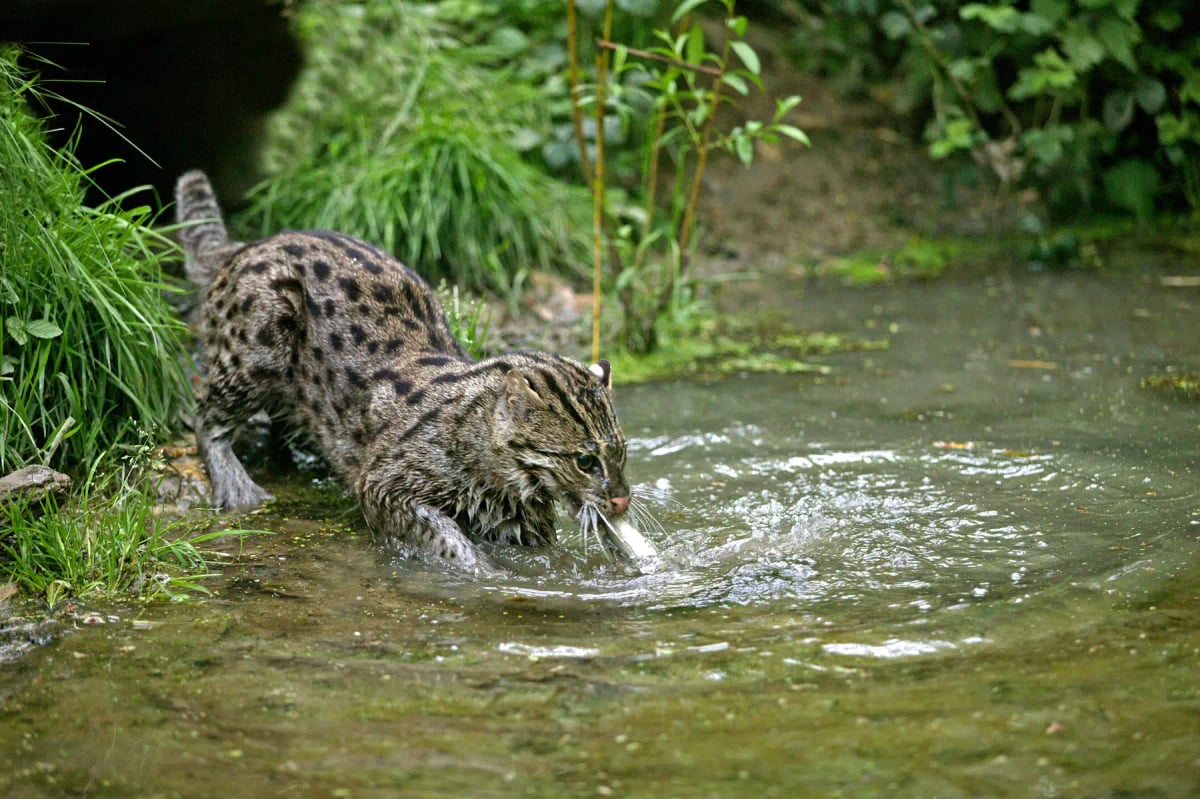
Fish make up the core of this cat's diet, and its body is genuinely built around catching them. It typically crouches at the water's edge and uses a rapid, precise paw strike to flick fish onto the bank, though it will wade into the shallows or swim when an opportunity demands it. Beyond fish, the fishing cat takes frogs, crustaceans, snakes, water birds, and the occasional small mammal such as a rodent or young deer. Studies using scat analysis have confirmed that prey choice shifts with season and local availability, so a cat living near a fish farm may feed very differently from one relying on a wild river system. This dietary flexibility is one reason the species can persist in a range of wetland types.
Behavior
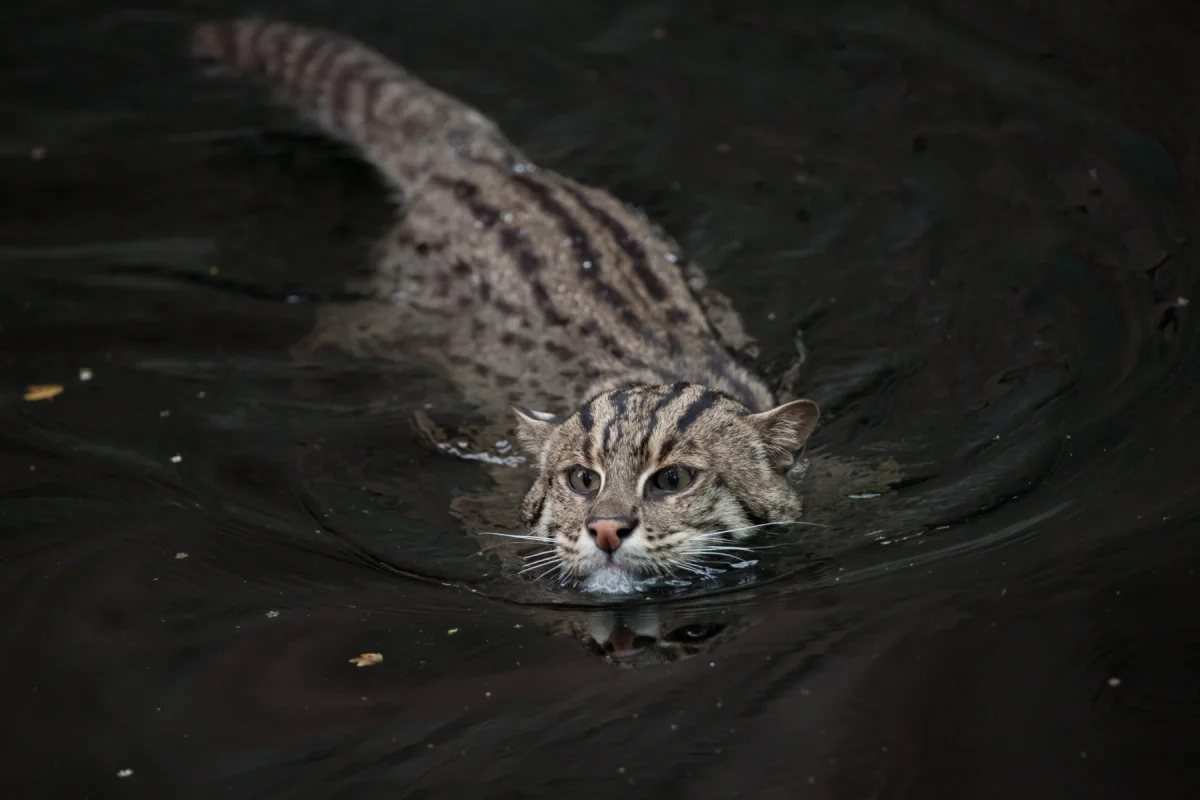
Unlike many cats that treat water as an obstacle, the fishing cat treats it as home territory. Adults are largely solitary, each holding a range that overlaps wetland edges, and they tend to be most active after dark. Camera trap studies have recorded individuals patrolling the same stretches of riverbank night after night, suggesting strong attachment to specific sites. Males hold larger ranges than females and will travel considerable distances between water bodies. When swimming, these cats move with real confidence, using their partially webbed front paws and a muscular, stocky frame to propel themselves efficiently. There are well documented reports of individuals diving beneath the surface to pursue prey, which sets the fishing cat apart from nearly all other members of the cat family.
Threats
Wetland loss sits at the top of the list of dangers facing this species. Across Asia, swamps and floodplains have been drained and converted for rice cultivation, aquaculture ponds, and urban development at a pace that has shrunk the fishing cat's usable habitat enormously. Pollution from agricultural runoff and industrial waste degrades water quality and reduces fish populations that the cat depends on. Hunting presents a serious additional pressure: fishing cats are killed for their fur, targeted by retaliatory killing when they raid fish ponds or poultry, and caught in traps set for other animals. In some parts of their range they are also taken for local consumption. The combination of shrinking habitat and direct persecution has caused population declines across much of South and Southeast Asia.
Conservation
The IUCN lists the fishing cat as Vulnerable, reflecting real and ongoing population declines. Protection of wetland systems is the single most important lever for the species, and several key sites within its range now fall inside national parks or wildlife reserves, including parts of the Sundarbans, Chitwan National Park in Nepal, and various protected areas in India and Sri Lanka. Organisations such as the Fishing Cat Conservation Alliance work directly with researchers and local communities to monitor populations and reduce conflict. Coexistence programs that compensate farmers for losses caused by fishing cats have shown promise in reducing retaliatory killing. Continued research using camera traps and GPS collars is helping scientists understand how these cats move through fragmented landscapes and what corridors they need to survive.
Relation with humans
People and fishing cats have shared wetland edges for centuries, and the relationship is complicated. In rural communities across Bangladesh, India, and Sri Lanka, these cats sometimes raid fish ponds or take backyard poultry, which leads to retaliatory killing that is one of the main causes of mortality outside protected areas. At the same time, certain communities in India and Sri Lanka hold a degree of cultural respect for the animal, which offers it some informal protection. In West Bengal, the fishing cat has even been adopted as the state animal, raising its public profile considerably. Conservation groups working in these regions have found that when local people are involved in monitoring efforts and receive support for losses, attitudes toward the cat tend to improve and incidents of persecution go down.
Where it is found
The Fishing Cat can be found in places such as:
Researched and written by Juan Pablo. Sources: IUCN Red List, scientific literature and regional field guides. Last updated: .
Technical factsheet







Frequently Asked Questions
Can fishing cats actually swim?
Yes, and they are genuinely good at it. Fishing cats have partially webbed front paws and a dense coat that resists water, which makes them confident in rivers and swamps. They do not just paddle along the surface either. There are well documented cases of these cats diving completely underwater to chase prey, something almost no other wild cat species is known to do.
What do fishing cats eat?
Fish are the foundation of their diet, caught with a quick, precise paw strike at the water's edge. But fishing cats are opportunistic hunters and will also eat frogs, crustaceans, snakes, water birds, and small mammals like rodents. What a cat eats can vary quite a bit depending on the season and what is available locally, which shows just how adaptable this species really is.
Where do fishing cats live?
Fishing cats are found across South and Southeast Asia, in countries including India, Sri Lanka, Bangladesh, Nepal, Myanmar, Thailand, and Cambodia. They stick closely to wetland environments such as riverbanks, swamps, reed beds, and mangrove forests. They rarely move into dry or high terrain. Some of the most important populations live in the Sundarbans delta and the Terai lowlands along the base of the Himalayas.
Are fishing cats endangered?
The IUCN currently lists the fishing cat as Vulnerable, which means it faces a serious risk of decline if the pressures on it continue. Wetland destruction, water pollution, and hunting have all pushed populations down across much of its range. It is not on the very edge of extinction, but the trend is worrying, and without continued protection of wetland habitats the situation could get significantly worse.
How big is a fishing cat?
Fishing cats are medium in size but noticeably stocky. Adults typically weigh between 5 and 16 kilograms, with males being considerably larger than females. They are roughly the size of a large domestic cat but with a much heavier, more muscular build, shorter legs, and a thicker neck. That compact, powerful body shape is well suited to moving through dense wetland vegetation and wading in shallow water.
Why are fishing cats threatened by fish farms?
Fish farms are a real source of conflict. Fishing cats sometimes enter aquaculture ponds to hunt, which causes financial losses for local farmers. In response, farmers often kill the cats to protect their livelihoods, and this retaliatory killing is one of the leading causes of mortality outside protected areas. Conservation programs that compensate farmers for losses have helped reduce these incidents in some regions.
Do fishing cats live alone or in groups?
Fishing cats are solitary animals. Each adult holds its own range along wetland edges, and males typically cover a larger area than females. They are most active at night, when they patrol riverbanks and shorelines, often returning to the same spots repeatedly. The only time fishing cats regularly spend time together is during mating or when a mother is raising her cubs.