Siamang
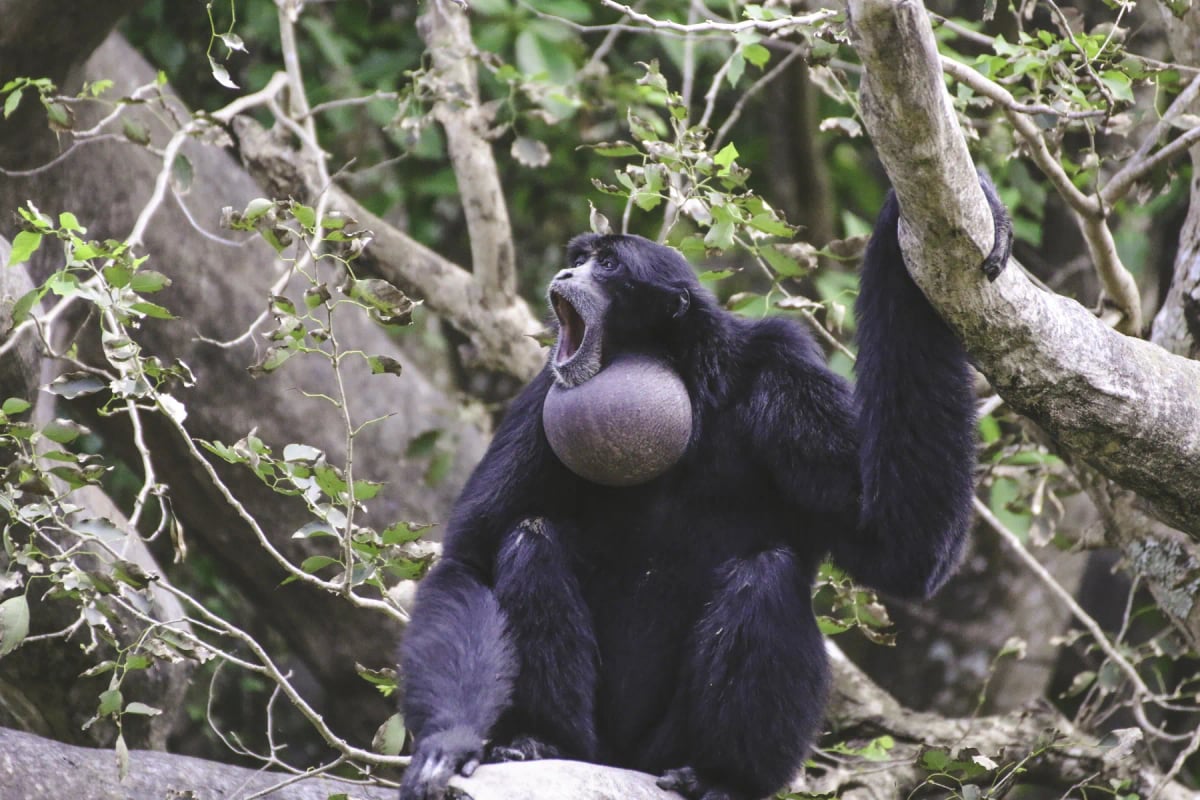
The siamang is the largest of all gibbons, native to the rainforests of Sumatra and the Malay Peninsula. It is covered in dense black fur and has arms so long they exceed its body length, making it a supremely agile brachiator through the canopy. A large throat sac, shared by both sexes, inflates like a balloon and acts as a resonating chamber for the loud, booming calls that pairs perform together each morning. These duets carry for several kilometers through the forest and serve to announce territory and reinforce the bond between mates. Siamangs live in tight family groups, with both parents sharing the care of young. Their diet centers on fruit and leaves, with flowers and the occasional insect rounding it out. Severe habitat loss driven by logging and the expansion of oil palm plantations has pushed the species to Endangered status on the IUCN Red List.
Habitat and range
Siamangs are found in two distinct parts of Southeast Asia: the island of Sumatra in Indonesia and the forests of Peninsular Malaysia. Within these regions, they occupy lowland and montane rainforests, generally preferring areas where tall trees grow close together and the canopy is thick enough to support a life spent almost entirely off the ground. They are most common in primary forest, though they can survive in some secondary growth where enough large trees remain. Siamangs rarely descend to the forest floor, relying instead on the upper and middle layers of the canopy for food, shelter, and movement. Their range has shrunk considerably as forests across Sumatra and the Malay Peninsula have been cleared for agriculture and development over recent decades.
Vocalizations
Few sounds in the rainforest are as striking as the morning calls of a siamang pair. Each day, bonded pairs perform coordinated duets that build gradually in complexity and volume, with both the male and female contributing distinct phrases to the overall song. The throat sac, present in both sexes, inflates to a size that can rival the animal's own head, acting as a resonating chamber that gives the calls their deep, booming quality. These vocalizations travel several kilometers through dense forest and serve more than one purpose: they alert neighboring groups to an occupied territory and help cement the relationship between mates. Younger family members sometimes join in, adding their voices to the chorus as they learn the patterns used by adults.
Diet
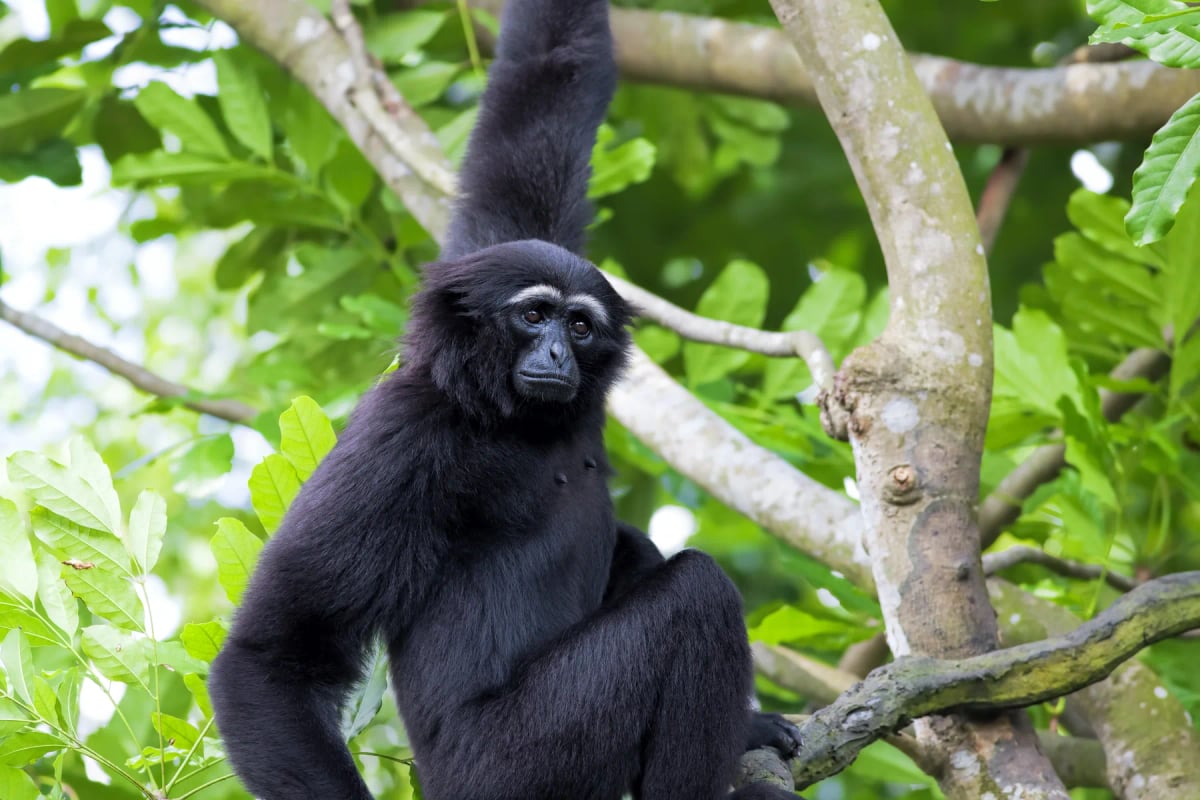
Fruit makes up the largest share of what a siamang eats, and the animal can spend a good part of each day moving through the canopy in search of ripe figs and other fruiting trees. Leaves are a reliable second source of nutrition, particularly young leaves that are easier to digest and richer in protein than mature foliage. Flowers contribute to the diet when they are seasonally available, and insects are taken opportunistically. Because siamangs depend on a wide variety of plant species to meet their nutritional needs throughout the year, they require large, intact areas of forest. Studies in Sumatra and Malaysia have found that a single family group may use a home range of roughly 20 to 50 hectares, visiting different parts of it as different food sources come into season.
Social behavior
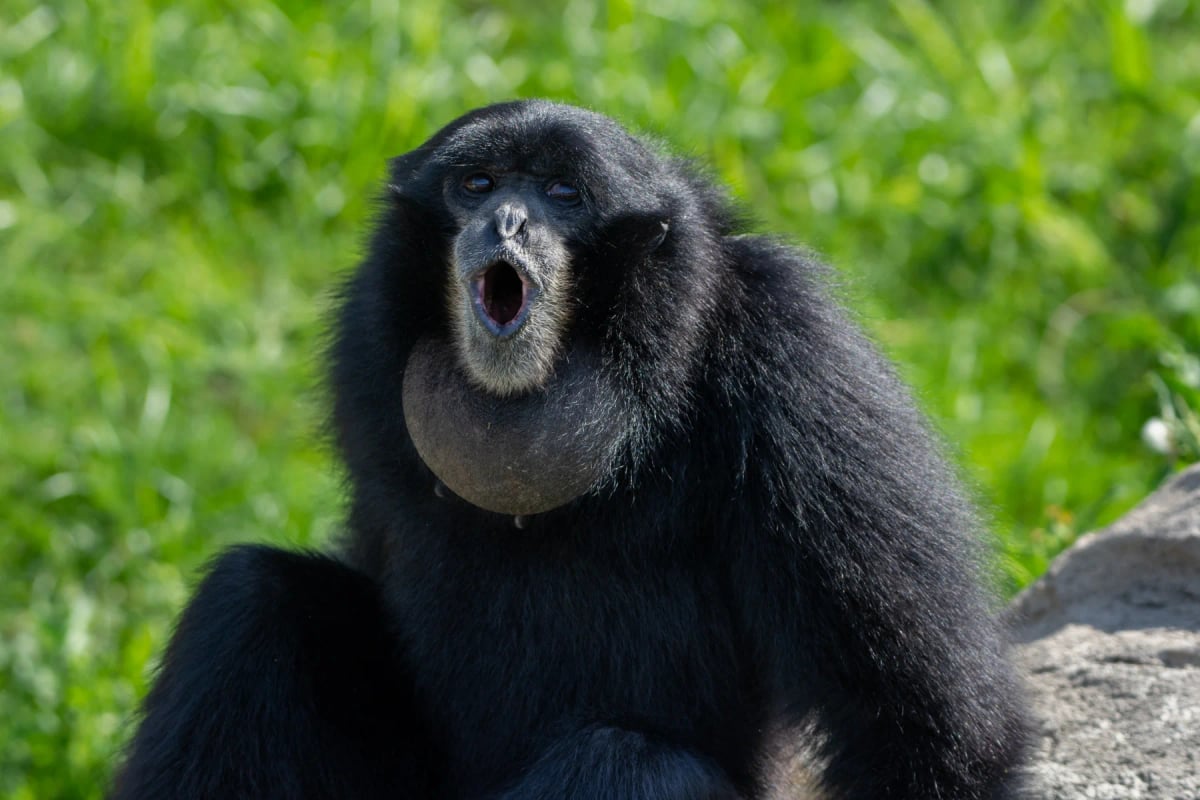
Family life is central to the siamang's existence. Groups typically consist of a mated pair and up to three or four of their offspring at different stages of development. What sets siamangs apart from many other primates is the level of involvement fathers show in raising young. Once an infant reaches about one year of age, the father takes on much of the carrying and direct care, freeing the mother to recover condition and eventually reproduce again. Grooming sessions between family members happen regularly and serve to maintain social bonds within the group. Young siamangs remain with their parents for several years, gradually learning the foraging routes, territorial boundaries, and vocal patterns that will help them survive independently once they reach maturity and eventually establish families of their own.
Threats
The greatest pressure facing siamangs today is the loss of the forest they depend on. Across Sumatra and the Malay Peninsula, large areas of lowland rainforest have been cleared to make way for oil palm plantations, timber operations, and agricultural expansion. Roads cut through previously intact forest, breaking it into patches too small to support viable populations. Siamangs cannot easily cross open ground, so once forest becomes fragmented, isolated groups have little opportunity to mix with others. On top of habitat loss, the illegal pet trade poses a serious threat. Adults are often killed so that their infants can be captured and sold. Hunters also target siamangs for bushmeat in some parts of their range, adding further pressure to populations that are already under stress from the destruction of their environment.
Conservation
Protecting what remains of the siamang's forest habitat is the most urgent conservation priority. The species is listed as En Peligro on the IUCN Red List, and its survival over the long term depends on maintaining large, connected blocks of rainforest. In Sumatra, protected areas such as Gunung Leuser National Park and Kerinci Seblat National Park provide some of the most important remaining refuges. In Malaysia, siamangs receive protection within Taman Negara and several state parks. Beyond protected areas, conservation organizations work with local communities to reduce illegal hunting and disrupt the wildlife trade. Rescue and rehabilitation centers care for confiscated individuals, though returning siamangs to the wild is a slow and difficult process. Raising awareness among local populations about the value of intact forest is seen as a key part of efforts to secure a future for this species.
Researched and written by Juan Pablo. Sources: IUCN Red List, scientific literature and regional field guides. Last updated: .
Technical factsheet

Frequently Asked Questions
What do siamangs eat?
Siamangs eat mostly fruit, with ripe figs being a particular favorite. Leaves, especially young ones that are easy to digest, make up a large part of their diet as well. They also eat flowers when available and occasionally catch insects. Because they need such a wide variety of food sources throughout the year, they depend on large areas of intact rainforest to survive.
Where do siamangs live?
Siamangs are found in two parts of Southeast Asia: the island of Sumatra in Indonesia and the forests of Peninsular Malaysia. They live in lowland and montane rainforests, spending almost their entire lives in the canopy. They prefer areas with tall, dense trees and are most common in primary forest, though they can also survive in some secondary forest where large trees are still standing.
Why do siamangs make such loud calls?
Siamangs are famous for their powerful, booming calls, which can travel several kilometers through the forest. Each morning, bonded pairs perform duets together, with both the male and female contributing their own phrases. These calls serve two main purposes: announcing their territory to neighboring groups and strengthening the bond between mates. They use a large throat sac that inflates like a balloon to amplify the sound.
Are siamangs endangered?
Yes, siamangs are listed as Endangered on the IUCN Red List. The biggest threat they face is the loss of their forest habitat, which has been cleared across large parts of Sumatra and Malaysia to make way for oil palm plantations and other agriculture. The illegal pet trade also harms the species, as adults are often killed so their infants can be captured and sold. Hunting for bushmeat adds further pressure.
How big is a siamang compared to other gibbons?
The siamang is the largest of all gibbons. Adults typically weigh between 10 and 14 kilograms, which is roughly twice the weight of most other gibbon species. Their arms are longer than their entire body, making them extremely agile when swinging through the canopy. That combination of size, strength, and reach makes the siamang an impressive and powerful presence in the rainforest.
Do both siamang parents care for their young?
Yes, and this is one of the things that makes siamangs stand out among primates. While mothers care for infants in the first year, fathers take on much of the carrying and direct care once the infant is around one year old. This gives the mother time to recover and eventually have another offspring. Young siamangs stay with their family group for several years before venturing off on their own.
Can siamangs walk on the ground?
Siamangs can walk on the ground but very rarely do so. They are built for life in the trees, with long arms and curved hands perfectly suited for swinging through the canopy. On the ground, they move awkwardly on two legs, holding their arms above their heads for balance. Because crossing open ground puts them at greater risk from predators, they almost always travel through the trees instead.