Southern Lapwing
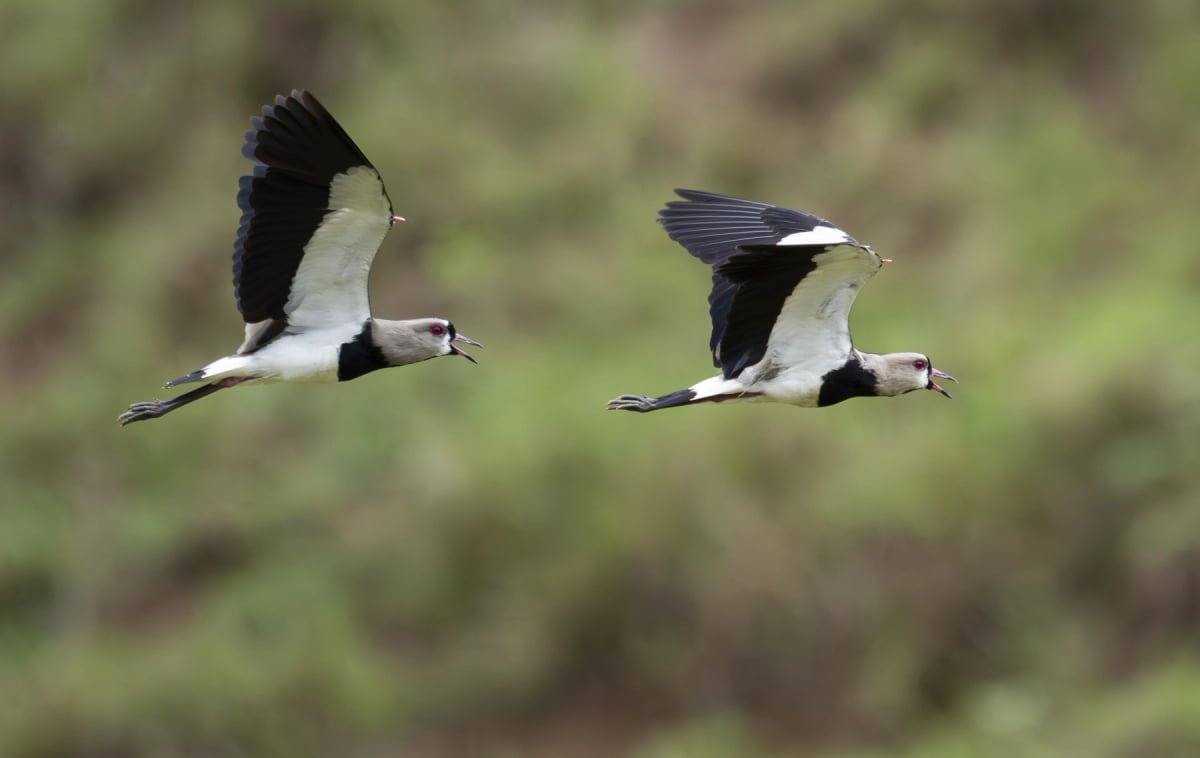
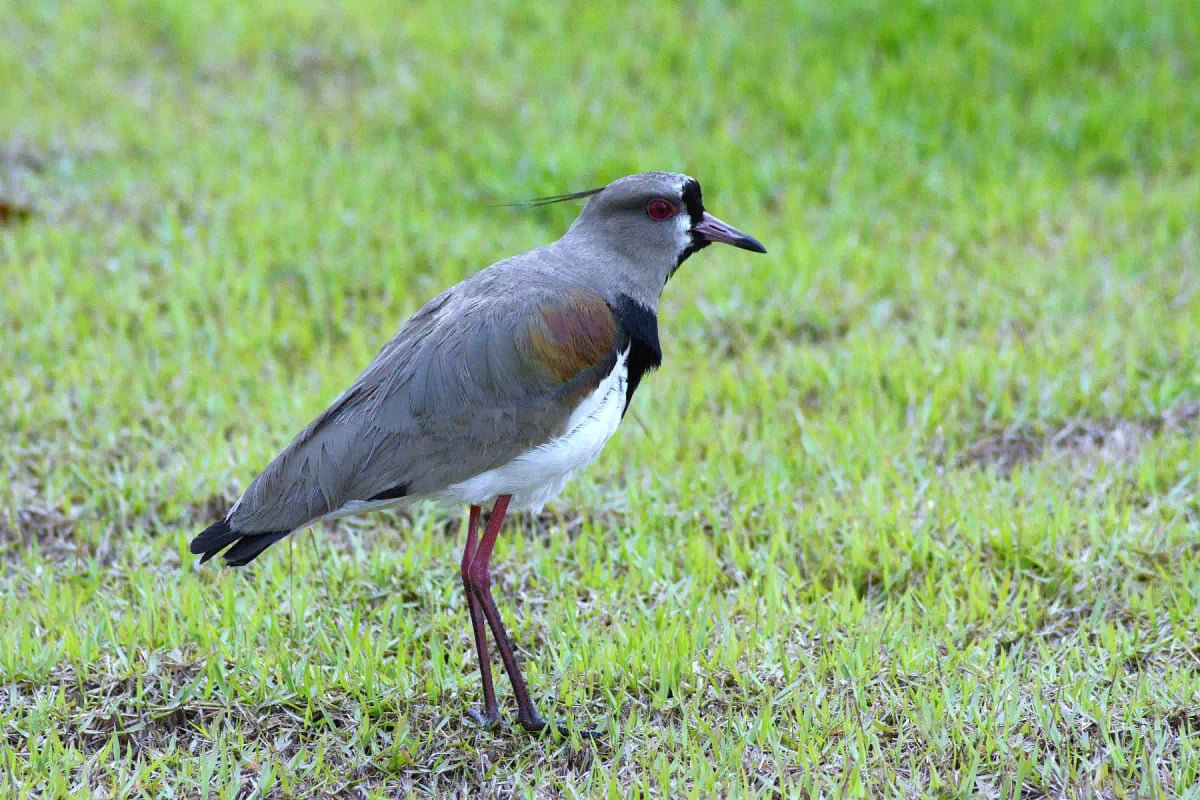
The southern lapwing is one of South America's most recognizable birds, identifiable at a glance by its glossy black crest, vivid red eyes, and red bill with a dark tip. Its back is a warm bronze brown, its chest bears a bold black patch, and its belly is white. In flight, a broad white stripe runs across each wing. Adults carry sharp red spurs on the bend of each wing, used in fights and against predators. This plover inhabits open country: grasslands, wetland edges, farmland, roadsides, and city parks. It nests on bare ground, and both parents defend the eggs with striking ferocity, diving at dogs, horses, and people alike. Its loud, repetitive call is one of the most familiar sounds across South American lowlands. Highly adaptable to landscapes shaped by humans, the species has expanded its range north into Central America, reaching Costa Rica in 1997 and Nicaragua more recently.
Habitat and distribution
Few birds in South America are as broadly distributed as the southern lapwing. It occupies a sweeping range from Tierra del Fuego in the far south to Venezuela, the Guianas and Trinidad and Tobago in the north, taking in Argentina, Uruguay, Chile, Brazil, Bolivia, Paraguay, Peru, Ecuador and Colombia along the way, and it is only missing from the densest forests. Rather than forests, it favors open terrain: short grasslands, the margins of rivers and lakes, flooded fields, roadsides, and urban parks. It is especially common at low elevations but also lives in open Andean valleys; higher up, in the puna and the altiplano, its place is taken by a relative, the Andean lapwing. The species has been pushing north for decades, an expansion closely tied to the spread of cattle pastures and cleared land. It reached Trinidad in 1961 and Tobago in 1974, has lived in Panama since at least the 1930s and grown much more common there since the early 2000s, arrived in Costa Rica in 1997 and is now reaching Nicaragua. Lost birds have even turned up as far away as Mexico, the Caribbean islands and the Falkland Islands.
Diet
Across its range, the southern lapwing eats mainly invertebrates. Beetles, ants, grasshoppers, earthworms, and insect larvae make up the bulk of its diet, along with other small creatures found in soil and vegetation. It hunts in the typical plover style: walking a few steps, pausing to scan, then picking at the ground with its bill. Moist soils and areas with short grass suit it best, as both make prey easier to spot and reach. The species also forages along the muddy edges of ponds and streams, where aquatic invertebrates are more accessible. It is a daytime feeder but will call and move about on moonlit nights, particularly during the breeding season when adults remain alert around the nest.
Wing spurs, nest and chicks
Hidden at the bend of each wing, the southern lapwing carries a sharp, red, bony spur. Most of the time it is barely visible, but when the bird raises its wings in a threat display or strikes during a dive, the spurs become weapons, used against rival lapwings, birds of prey, dogs and, occasionally, people who come too close. The nest is a simple shallow scrape on bare or short grassy ground, sometimes lined with a few bits of plant material, often in the middle of a pasture, a park or even a sports field. The female lays 2 to 3 eggs, rarely 4, olive brown with dark blotches, so well camouflaged that they are hard to see even at a few steps. Both parents incubate and guard the nest, and the species often breeds cooperatively: a pair may be helped by one or two young from the previous season, which join in defending the territory. The chicks leave the nest a few hours after hatching and feed themselves, while the adults keep watch. At the first sign of danger the parents call, and the downy chicks crouch flat on the ground and freeze, trusting their camouflage.
Behavior
The southern lapwing is strongly territorial, and its boldness during the breeding season is remarkable. When a nest is threatened, both parents respond instantly, calling at full volume and making steep aerial dives toward the intruder. Dogs, horses, cattle, and people all receive the same treatment. The wing spurs adults carry can inflict real contact during these strikes, making the birds genuinely formidable defenders. Outside of breeding, lapwings are more tolerant of one another and may gather in loose flocks to feed. They roost on open ground, often near water. The species is largely resident across its range, though some populations at higher latitudes make seasonal movements in response to cold weather and the availability of food.
Call: the tero tero alarm
Anyone who has spent time in the South American countryside knows the southern lapwing's call before they know its name. The sharp, insistent cry, often described as a rapid series of notes resembling "tero tero" or "kree kree," carries a long distance across open fields and is one of the most frequently heard bird sounds on the continent. The call functions as an alarm, warning other animals of approaching danger, and as a territorial signal directed at rival lapwings. It is delivered with particular intensity during the breeding season, often continuing through the night. Other birds and mammals have learned to pay attention to these outbursts, since a suddenly calling lapwing frequently signals that a predator is nearby.
Names and subspecies: tero, queltehue and quero-quero
Across South America, the southern lapwing is named after its call. In Argentina and Uruguay it is the tero, in Paraguay the tero-tero, in Brazil the quero-quero and in Chile the queltehue, all imitations of its loud, repeated cry. In Uruguay it is considered the national bird, and in southern Brazil the quero-quero is a symbol of the gaúcho countryside, admired for standing guard over its pasture. Its scientific name, Vanellus chilensis, means "little fan from Chile": vanellus refers to the fanning sound of a lapwing's wings, and the species was first described from Chile. Scientists recognize three or four subspecies. The nominate chilensis lives in Chile and western Argentina, fretensis in Patagonia and Tierra del Fuego, though it is sometimes merged with chilensis, lampronotus across the rest of South America south of the Amazon, and cayennensis in the north, from the Guianas and Venezuela to Colombia, Panama and Costa Rica. The northern birds have a browner head and slightly different calls, while the southern ones show more gray on the head and neck.
Conservation
The southern lapwing holds a status of Least Concern on the IUCN Red List, a reflection of its large population and its remarkable ability to thrive alongside people. Where many species struggle as natural habitats disappear, this lapwing has turned the transformation of land to its advantage. Cattle pastures, irrigated cropland, roadside verges, and city parks all provide the short grass and open ground it needs to feed and nest. Urban populations have grown noticeably in cities across South America, with pairs nesting on lawns, flat rooftops, and sports fields. No significant threats currently affect the species at a population level, and its range continues to expand northward. It stands as one of the clearest examples of a bird that has adapted well to a world shaped by human activity.
Where it is found
The Southern Lapwing can be found in places such as:
Researched and written by Juan Pablo. Sources: IUCN Red List, scientific literature and regional field guides. Last updated: .
Technical factsheet














Frequently Asked Questions
Is the southern lapwing the national bird of Uruguay?
Yes. In Uruguay the southern lapwing, known as the tero, is considered the national bird. It lives in every corner of the country, from the rolling grasslands of the interior to football fields and parks in Montevideo, and Uruguayans admire it as a watchful, brave bird that warns everyone when someone approaches. It is not the national bird of Argentina, where that title goes to the rufous hornero, although the tero is just as familiar there.
What are the spurs on a southern lapwing's wings for?
Southern lapwings have a sharp, red, bony spur at the bend of each wing. They use them as weapons: in fights with rival lapwings over territory, to fend off birds of prey and to strike dogs or other animals that threaten their nest. When the bird raises its wings in a threat display, the red spurs become more visible, which may also work as a warning. Several other lapwing species around the world have similar spurs.
Why do southern lapwings scream at night?
Southern lapwings sleep lightly in open fields, and any movement nearby, a fox, a dog, a car or a person walking, sets them off. Because their nests and chicks are on the ground, they react to danger at any hour, especially during the breeding season, and on moonlit nights they may also move about and feed. For people in the countryside, a tero calling in the dark is a well known sign that something or someone is moving out there.
What is the difference between the southern lapwing and the Andean lapwing?
They are close relatives that split the continent by altitude. The southern lapwing lives in lowland grasslands, farms and parks and has a black crest, a black throat and chest patch and bronze shoulders. The Andean lapwing lives high in the Andes, in the puna and altiplano from Peru to northern Chile and Argentina, has no crest, a pale gray head and neck, and a less contrasting chest. Both have red eyes, red legs and loud, similar calls, and both defend their nests fiercely.
Do southern lapwings live in Central America?
Yes, and their range there is still growing. Southern lapwings have lived in Panama since at least the 1930s and became much more common there in the early 2000s. The first ones reached Costa Rica in 1997, and today they are fairly common in open country in the south of the country, moving north as forests are turned into pastures. The species is now reaching Nicaragua, and wandering birds have been seen in Honduras, El Salvador, Guatemala, Belize and even Mexico.
Why is the southern lapwing so loud?
The southern lapwing uses its sharp, piercing call, often described as 'kree kree' or 'tero tero', to warn of danger and drive away intruders near its nest. It is essentially the neighborhood alarm system of South American grasslands. The calls are so reliable that other animals, including livestock and deer, often react to them as a signal that something is approaching.
Does the southern lapwing really attack people?
Yes, it does. When nesting, the southern lapwing will dive at anyone or anything it sees as a threat, including dogs, horses and people. It swoops low and calls aggressively, and some individuals will even make physical contact. This fearless behavior is what makes it one of the most recognizable and talked about birds across South America.
What does the southern lapwing eat?
The southern lapwing feeds mainly on insects, earthworms and small invertebrates found in moist soil and grassy areas. It forages by walking steadily across the ground, stopping to peck or probe with its bill. It tends to prefer areas where the soil is soft and easy to search, which is why it is so common around irrigated fields, riverbanks and parks.
Is the southern lapwing endangered?
No. The southern lapwing is listed as Least Concern on the IUCN Red List, and its population is actually doing very well. It has adapted easily to landscapes shaped by humans, such as farmland, city parks and roadsides, which has helped it expand rather than decline. It is one of the most common and visible birds across the whole of South America.
Can the southern lapwing live in cities?
Absolutely. The southern lapwing has adapted remarkably well to urban life and is a familiar sight in city parks, sports fields, highway medians and even school yards across South America. As long as there is an open grassy area with some moist soil nearby, it will settle in. Nesting on the ground in busy urban spaces does mean its eggs are sometimes at risk from pedestrians and dogs.
What does the southern lapwing look like?
The southern lapwing is a striking bird. It has a black chest patch and a black crest that curves backward from the top of its head. Its back is a warm bronze brown, its belly is white, and it has bright red eyes and a red bill with a dark tip. In flight, a bold white wing stripe becomes visible. Adults also have sharp red wing spurs, which they use during confrontations. It measures 32 to 38 cm and weighs about 250 to 425 grams, and males and females look alike.