Kouprey
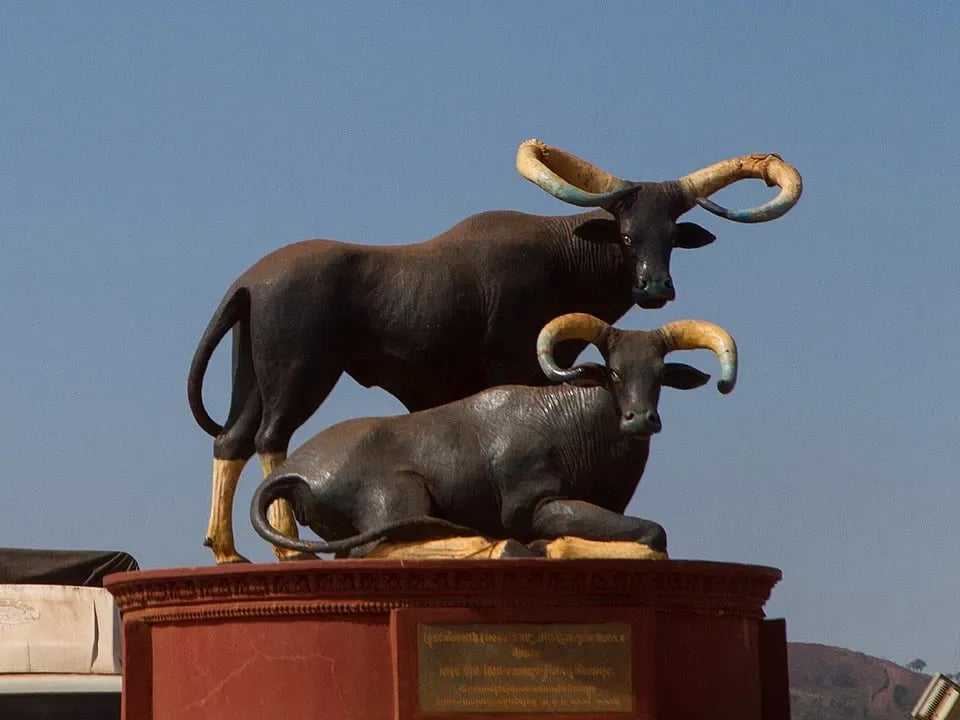
The kouprey is a large wild ox native to the forests of Indochina. Bulls stand up to 190 cm at the shoulder and carry long, forward-sweeping horns that develop frayed, splintered tips with age, a trait unique among wild cattle. A prominent dewlap hangs from the throat, longer in males than in females. The body is slender for an animal of its size, with long legs built for moving through open woodland. Historically recorded in Cambodia, southern Laos, Vietnam, and parts of eastern Thailand, the kouprey has not been reliably sighted since the late 1960s. Hunting, habitat loss, and decades of regional conflict destroyed much of its range. It is now listed as Critically Endangered and possibly extinct. Cambodia declared it the national animal in 1960, and it remains a powerful symbol of the wildlife losses suffered across Southeast Asia.
Habitat and distribution
Across what is now Cambodia, southern Laos, Vietnam, and parts of eastern Thailand, the kouprey once moved through a mosaic of open deciduous forests, grassy clearings, and low hills. It favored terrain where trees thinned out enough to allow the growth of grasses and low shrubs, providing both food and cover. The lowland forests of northern Cambodia, particularly around the Mekong and its tributaries, appear to have held the largest concentrations. Seasonal movements brought herds from denser forest in the wet season to more open ground during the dry months when water and pasture were easier to find. Decades of warfare, land clearing, and uncontrolled hunting collapsed these populations across the entire region, and no confirmed habitat currently supports a living population.
Appearance
Few wild cattle have a silhouette as distinctive as the kouprey. Bulls stood up to 190 cm at the shoulder and could weigh around 900 kg, yet the body carried a leanness unusual for an animal of that size, supported by notably long legs. The horns of adult males swept forward and upward before curving outward, and the tips broke and frayed over time into a distinctive splintered shape seen in no other wild cattle species. Females carried thinner, lyre-shaped horns without the fraying. A large dewlap of loose skin hung from the throat, especially pronounced in males. Young animals were reddish brown, while older bulls darkened to near black. A pale stockings pattern marked the lower legs on all individuals.
Behavior
Based on observations made before populations collapsed, kouprey gathered in herds of roughly 8 to 20 animals, usually made up of females, young, and one or a few adult males. During the heat of the day they rested in the shade of forested areas, moving out into open clearings at dusk to graze. Their diet centered on grasses, and they also browsed on leaves and low shrubs when pasture was scarce. Seasonal shifts in food and water availability drove regular movements across their range. Bulls were sometimes observed alone or in small bachelor groups outside of the breeding season. Because so little field study was possible before the species disappeared, many details of their social structure and reproduction remain poorly understood.
Conservation status
The IUCN lists the kouprey as Critically Endangered, with the very real possibility that it is already extinct. No sighting backed by physical evidence has been recorded since the late 1960s, and decades of camera trap surveys across Cambodia, Laos, and Vietnam have produced nothing conclusive. The species was pushed to the edge by a combination of intensive hunting for meat and trophies, the destruction of its forest habitat through agriculture and logging, and the chaos caused by prolonged armed conflict across Indochina throughout the latter half of the twentieth century. Disease transmitted by domestic cattle may have dealt a further blow to already weakened herds. Occasional unconfirmed reports from remote border areas have kept hope alive, but no verified population is known to exist today.
Cultural significance
Cambodia placed the kouprey at the heart of its national identity when King Norodom Sihanouk declared it the country's national animal in 1960. The choice reflected the deep connection between Cambodian people and the wildlife of their forests, as well as a pride in species found nowhere else in the world. That the kouprey may have vanished within just a few years of receiving this honor makes it a particularly painful symbol of what the region lost during decades of war and environmental destruction. Conservation organizations and the Cambodian government have periodically renewed calls to search for surviving animals, and the species appears in educational programs as a reminder of why protecting remaining wild habitats matters. Whether alive or lost forever, the kouprey endures as an emblem of Southeast Asian wildlife at its most irreplaceable.
Researched and written by Juan Pablo. Sources: IUCN Red List, scientific literature and regional field guides. Last updated: .
Technical factsheet




Frequently Asked Questions
What does the kouprey eat?
The kouprey was primarily a grazer, feeding on the grasses that grew in open clearings and woodland edges. When pasture was scarce, it supplemented its diet by browsing on leaves and low shrubs. Like other large wild cattle, it needed access to water daily and followed seasonal patterns across its range to find the best combination of food and water throughout the year.
Where did the kouprey live?
The kouprey lived across parts of Indochina, with records from Cambodia, southern Laos, Vietnam, and eastern Thailand. It favored open deciduous forests and grassy clearings rather than dense jungle. The largest numbers were thought to live in northern Cambodia, around the lowland forests near the Mekong River. Sadly, no confirmed population exists anywhere in the wild today.
Is the kouprey extinct?
The kouprey is listed as Critically Endangered by the IUCN, but many scientists believe it may already be extinct. No sighting supported by physical evidence has been recorded since the late 1960s. Camera trap surveys across Cambodia, Laos, and Vietnam have found no trace of the animal. Occasional unconfirmed reports from remote areas have kept some hope alive, but no living population has been verified.
Why did the kouprey disappear?
Several threats hit the kouprey at the same time. Hunters targeted it heavily for meat and trophies. Forests across Indochina were cleared for farming and logging, stripping away its habitat. Decades of armed conflict made conservation impossible across the region. Disease spread by domestic cattle may have weakened surviving herds further. Together, these pressures pushed the species to the edge of extinction within just a few decades.
What makes the kouprey unique among wild cattle?
The most striking feature of the kouprey is the horns of adult bulls. They sweep forward and upward, then curve outward, and the tips gradually splinter and fray with age into a fringe unlike anything seen in other wild cattle species. No one fully understands why this happens. Combined with a large dewlap and a lean, long-legged build, the kouprey had a silhouette unlike any other bovine on Earth.
Is the kouprey Cambodia's national animal?
Yes. King Norodom Sihanouk declared the kouprey Cambodia's national animal in 1960, recognizing it as a species found nowhere else in the world in such numbers. It became a symbol of national pride and of the unique wildlife of Southeast Asia. The fact that the animal likely vanished within years of receiving that honor makes it one of the most heartbreaking examples of wildlife loss in the region's history.
How big is a kouprey?
The kouprey was one of the largest wild cattle species in Asia. Bulls could stand up to 190 cm at the shoulder and weigh around 900 kg, which is comparable in size to a large gaur or banteng. Despite that bulk, the kouprey had a noticeably lean frame and long legs, giving it a rangier appearance than most other wild cattle of similar weight. Females were smaller and lighter than males.