Bushmaster
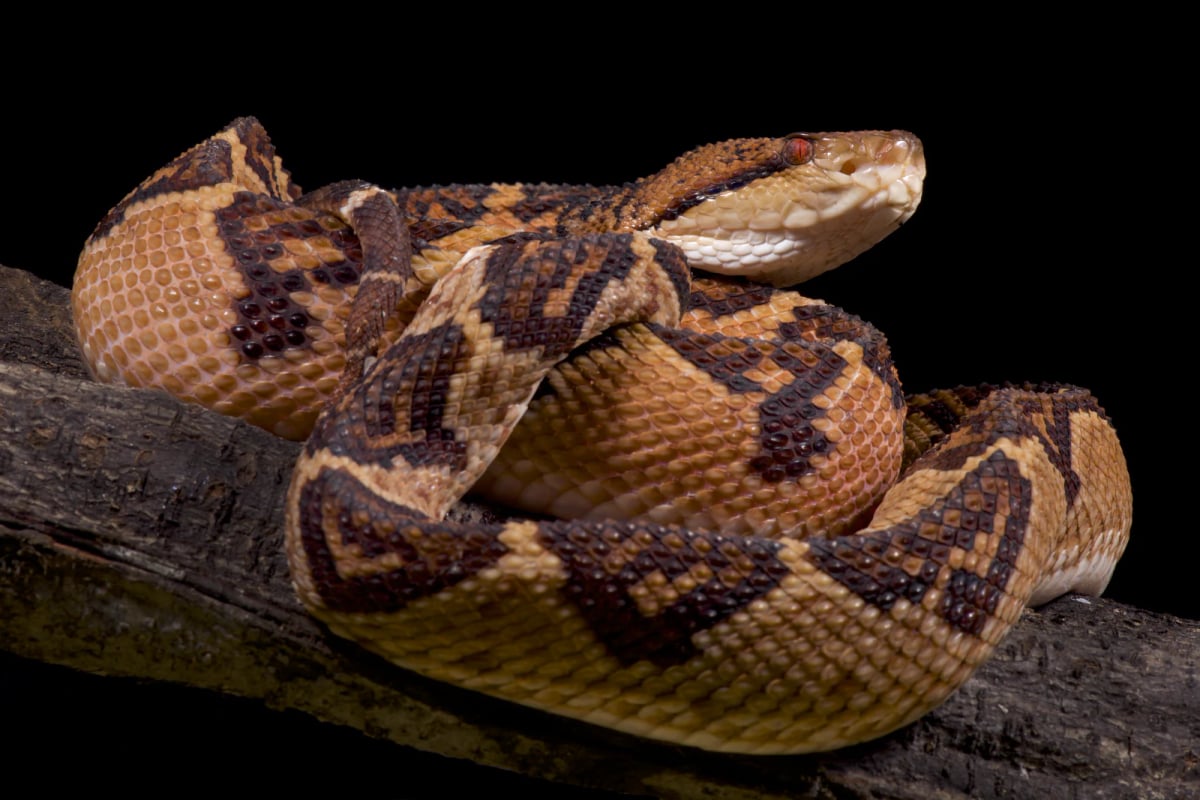
The bushmaster (Lachesis muta), or South American bushmaster, is the longest venomous snake in the Americas and one of the longest vipers in the world. Adults usually measure 2 to 2.5 meters and can pass 3.5 meters. It is a pit viper, with heat sensing pits between the eyes and nostrils, long fangs and a heavy body covered in rough, ridged scales that give it the look of pineapple or jackfruit skin, the origin of names such as surucucu pico de jaca in Brazil. Its color is tan, yellowish or reddish brown with a chain of dark diamond shaped blotches along the back. It lives on the floor of lowland rainforests across the Amazon basin and the Guianas, in Brazil's Atlantic Forest and on the island of Trinidad, where it is called the mapepire zanana. The bushmaster is active at night and is a patient ambush hunter, waiting coiled beside animal trails for days or even weeks for a spiny rat, agouti or opossum to pass. Unlike every other pit viper in the Americas, it lays eggs instead of giving birth to live young, and the female stays coiled around them. Bites are rare because it lives deep in the forest and avoids people, but they are a medical emergency. The IUCN lists the species as Least Concern.
What is a bushmaster snake?
The bushmaster is a large venomous pit viper of South American rainforests, and the longest venomous snake in the Americas. Its scientific name, Lachesis muta, has a dark poetic touch: Lachesis was one of the three Fates of Greek mythology, the one who measured the thread of each person's life, and muta means silent. The name refers to its habit of vibrating its tail like a rattlesnake when it is disturbed, but without a rattle, so it makes little sound, which is also why it has been called the silent fate and the mute rattlesnake. Like rattlesnakes and lanceheads, it belongs to the pit vipers, which have a heat sensing pit on each side of the head that lets them detect warm blooded prey in total darkness. The bushmaster has many local names. In Brazil it is the surucucu, in Peru the shushupe, in Bolivia the pucarara, in Colombia the verrugosa, in Venezuela the cuaima piña and in Trinidad the mapepire zanana. Many of these names refer to its rough, knobbly scales. For a long time all bushmasters were treated as one species, but today scientists recognize several, and the South American bushmaster covered on this page is the largest and most widespread.
How big is a bushmaster?
The bushmaster is the longest viper in the Americas and one of the longest in the world. Adults usually measure 2 to 2.5 meters, and the largest reliably measured specimens reach about 3.6 meters, although some old stories speak of even bigger snakes. Only a few venomous snakes are longer, such as the king cobra of Asia and the black mamba of Africa. Bushmasters are also heavy and muscular, usually weighing 3 to 5 kilograms. The head is broad and rounded, clearly wider than the neck, with small eyes, vertical pupils and the heat sensing pits typical of pit vipers. The fangs are long, among the longest of any snake, and can reach about 4 centimeters in big individuals. The body is covered in rough, strongly keeled scales that stick up like little knobs, which is where names such as verrugosa, meaning warty, come from. The color is tan, pinkish, yellowish or reddish brown, with a row of dark brown or black diamond shaped blotches running down the back, a pattern that blends perfectly with the dead leaves of the forest floor. The tail ends in a row of spiny, modified scales that the snake vibrates when it feels threatened.
How venomous is the bushmaster?
Bushmaster venom is not the most toxic drop for drop, but the snake makes up for it with size. Its long fangs inject deep, and a large bushmaster can deliver a big dose of venom in a single bite, which makes it one of the most dangerous snakes in the Americas. The venom acts mainly on the blood and tissues. It causes intense pain and swelling, bleeding, blisters and damage to the tissue around the bite, and it interferes with blood clotting, so victims can bleed from the gums, wounds and internal organs. Bushmaster bites also cause a set of symptoms that doctors call the Lachesis syndrome, which sets them apart from bites of lanceheads and other pit vipers. Within minutes or hours, victims may suffer vomiting, diarrhea, sweating, a slow heart rate, a sharp drop in blood pressure and fainting, effects linked to the nervous system. Without treatment, a serious bushmaster bite can kill. With prompt care in a hospital, most people survive. Specific antivenoms are produced in Brazil, Colombia, Peru and other countries, often combined with antivenom for lanceheads. Scientists also study the venom for proteins that may help in research on blood clotting and blood pressure.
Where do bushmasters live?
The South American bushmaster lives in the tropical rainforests of northern and central South America. Its range covers the Amazon basin in Brazil, Peru, Bolivia, Ecuador and Colombia, the forests of southern and eastern Venezuela, and the Guianas: Guyana, Suriname and French Guiana. It also lives on the island of Trinidad, in the forests of the Northern Range and other wooded areas, but not on Tobago. A separate population lives in the Atlantic Forest along Brazil's eastern coast, from Ceará and Pernambuco south to Rio de Janeiro, cut off from the Amazon by drier country. Bushmasters are snakes of mature, humid forest with a deep layer of leaf litter and plenty of fallen logs, burrows and buttress roots where they can hide. They live mostly in the lowlands but can be found up to about 1,800 meters on the lower slopes of the Andes. They need large areas of undisturbed forest and tend to disappear where forest is cleared for farms and cattle, which is one reason why they are rarely seen even by people who live in the region. During the day they rest coiled in hollow logs, among roots or inside the burrows of armadillos and agoutis, and they come out at night to hunt.
Bushmaster species
For many years, all bushmasters from Central and South America were treated as a single species, Lachesis muta. Genetic and anatomical studies have since split them into four species, and some scientists recognize a fifth. The South American bushmaster, Lachesis muta, is the one on this page. It lives in the Amazon basin, the Guianas and Trinidad, and it includes the Atlantic Forest bushmaster of eastern Brazil, which many researchers now treat as its own species, Lachesis rhombeata, because its population is isolated and genetically distinct. The Central American bushmaster, Lachesis stenophrys, lives in the Caribbean lowlands of Nicaragua, Costa Rica and Panama. The black headed bushmaster, Lachesis melanocephala, is found only in southern Costa Rica, on the Pacific side, and is easy to recognize by its dark head. The Chocoan bushmaster, Lachesis acrochorda, lives in the wet forests of Panama, western Colombia and northwestern Ecuador. All bushmasters share the same body plan, rough scales, nocturnal habits and egg laying, and all are dangerous to people. In Colombia and Ecuador, where two species occur, the Chocoan bushmaster lives west of the Andes and the South American bushmaster in the Amazon to the east.
What do bushmasters eat?
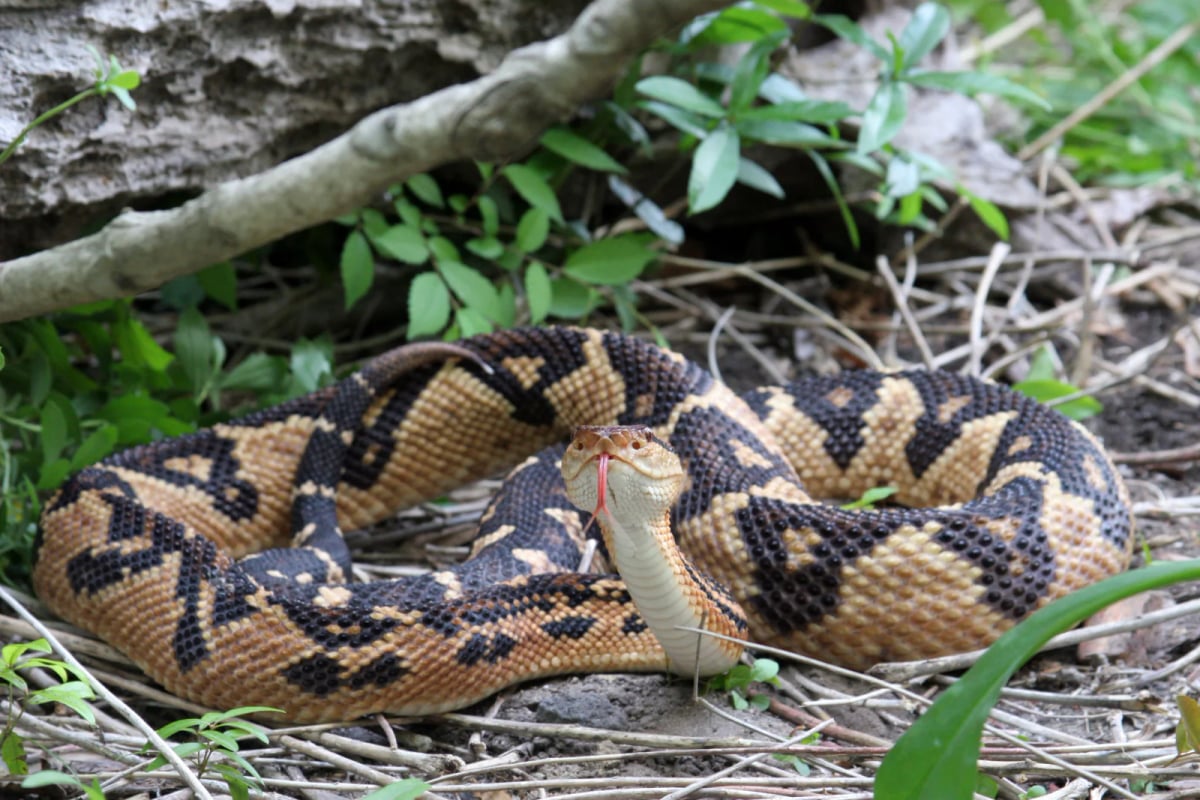
Bushmasters feed almost entirely on mammals, and they are among the most patient hunters of any snake. Their main prey are rodents such as spiny rats, agoutis, pacas and other forest rats, along with opossums and occasionally small birds. Instead of searching actively, a bushmaster chooses a spot next to a trail, a fallen log or a burrow used by its prey, coils up among the leaves and waits. It may stay in the same ambush position for days, and in some studies individuals have waited for weeks, barely moving. The heat sensing pits on its face allow it to detect the body heat of a passing rodent even on the darkest night. When prey comes within reach, the snake strikes, injects venom and usually lets go, then follows the scent trail of the dying animal and swallows it whole, head first. Because bushmasters are large and eat big meals, they need to eat only rarely. A single large rodent can sustain a bushmaster for weeks, and studies of wild snakes suggest that they may eat only a few times a year. This slow, low energy lifestyle is one reason they are so hard to find: most of the time they sit perfectly still and camouflaged on the forest floor.
Bushmaster eggs and young
The bushmaster is the only pit viper in the Americas that lays eggs. Rattlesnakes, lanceheads, cottonmouths and all its other relatives on the continent give birth to live young, so this habit makes the bushmaster unusual. Mating usually takes place during the rainy season, and a few months later the female lays a clutch of about 5 to 19 eggs, often around a dozen, in a sheltered spot such as a burrow, a hollow among roots or a cavity under a fallen log. She then coils around the eggs and stays with them for much of the incubation, which lasts about two and a half to three months. This kind of care is rare among snakes, and it probably helps protect the eggs from predators and keeps the temperature and humidity stable. The young hatch at about 40 to 50 centimeters long and are fully venomous from birth. They look like small adults, although their colors are often brighter, and they leave the nest soon after hatching to hunt on their own. Females may breed only every two or three years, because producing a large clutch and fasting while guarding it takes a lot of energy. Breeding bushmasters in captivity is famously difficult, and only a few zoos have managed it.
Bushmaster bites and how to stay safe
Despite its fearsome reputation, the bushmaster is responsible for only a small share of snakebites in South America. Most bites in the region come from lanceheads, which are more common, live closer to people and thrive in plantations and farmland. Bushmasters, by contrast, live deep in mature forest, are active at night and usually stay still or move away when people approach. When bites happen, they usually involve forest workers, hunters and rubber tappers who step on or near a hidden snake, often at night. A bushmaster disturbed at close range may vibrate its tail, raise its head in an S shaped coil and strike, and because it is large and has long fangs, the bite can be very serious. The basic safety advice in bushmaster country is simple: wear boots and long trousers in the forest, use a flashlight at night, watch where you put your hands and feet, and never try to catch or kill a snake. If someone is bitten, they should keep calm, keep the limb still, remove rings and tight clothing and get to a hospital as fast as possible, where antivenom can be given. Tourniquets, cutting the wound, sucking out venom and traditional remedies do not help and can make things worse.
Is the bushmaster endangered?
The IUCN lists the South American bushmaster as Least Concern, because it still lives across a huge area of rainforest in the Amazon and the Guianas, much of it remote and protected. That does not mean it is common. Bushmasters are naturally scarce, slow to breed and dependent on large areas of intact forest, so they disappear quickly where the forest is cut for cattle ranching, soy and other crops, mining or roads. Many are also killed on sight by people who fear them, and road traffic kills others. The situation is much more serious in Brazil's Atlantic Forest. Less than an eighth of that forest remains, broken into fragments, and the bushmasters that live there, often treated as a separate species, Lachesis rhombeata, are rare and considered threatened in Brazil. Scientists have called for them to be assessed separately on national and international red lists. In Trinidad, the bushmaster depends on the forests of the Northern Range and other wooded areas, which are under pressure from development and quarrying. Protecting large blocks of rainforest, teaching people about snakes and making antivenom available where bites happen are the best ways to protect both people and bushmasters.
Where it is found
The Bushmaster can be found in places such as: