Inland Taipan
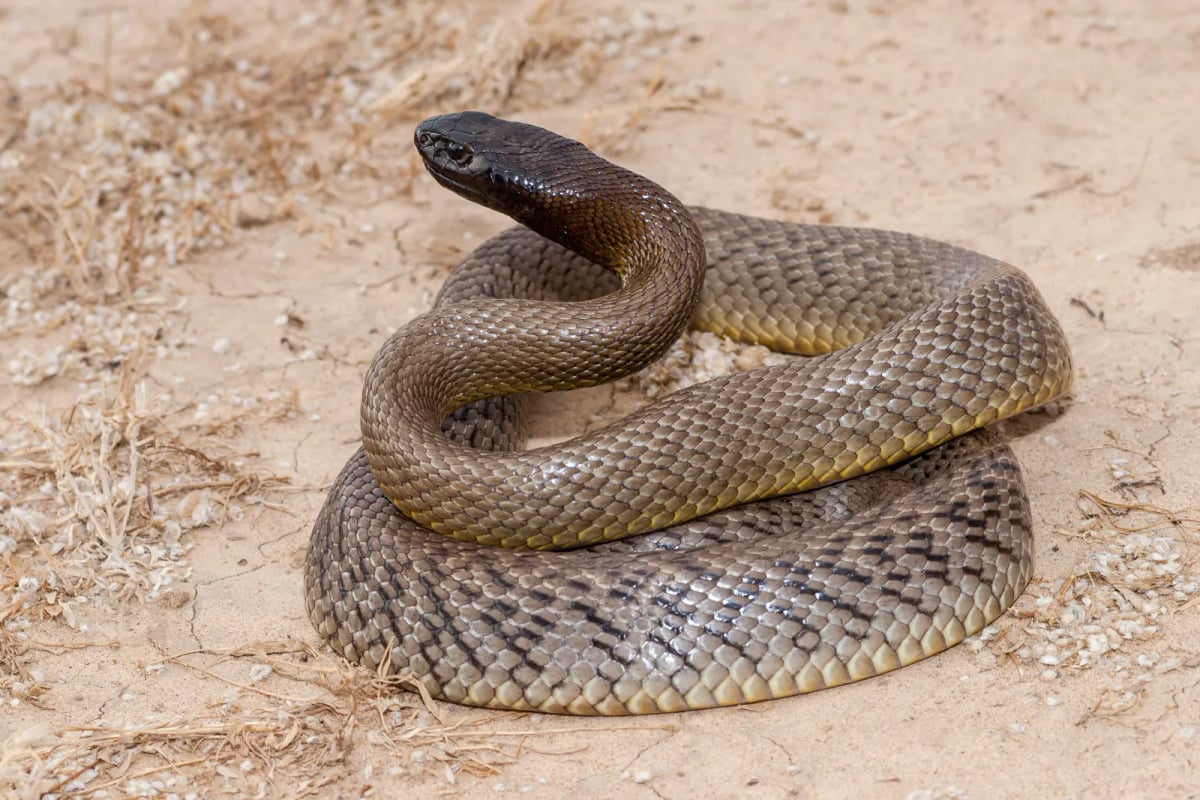
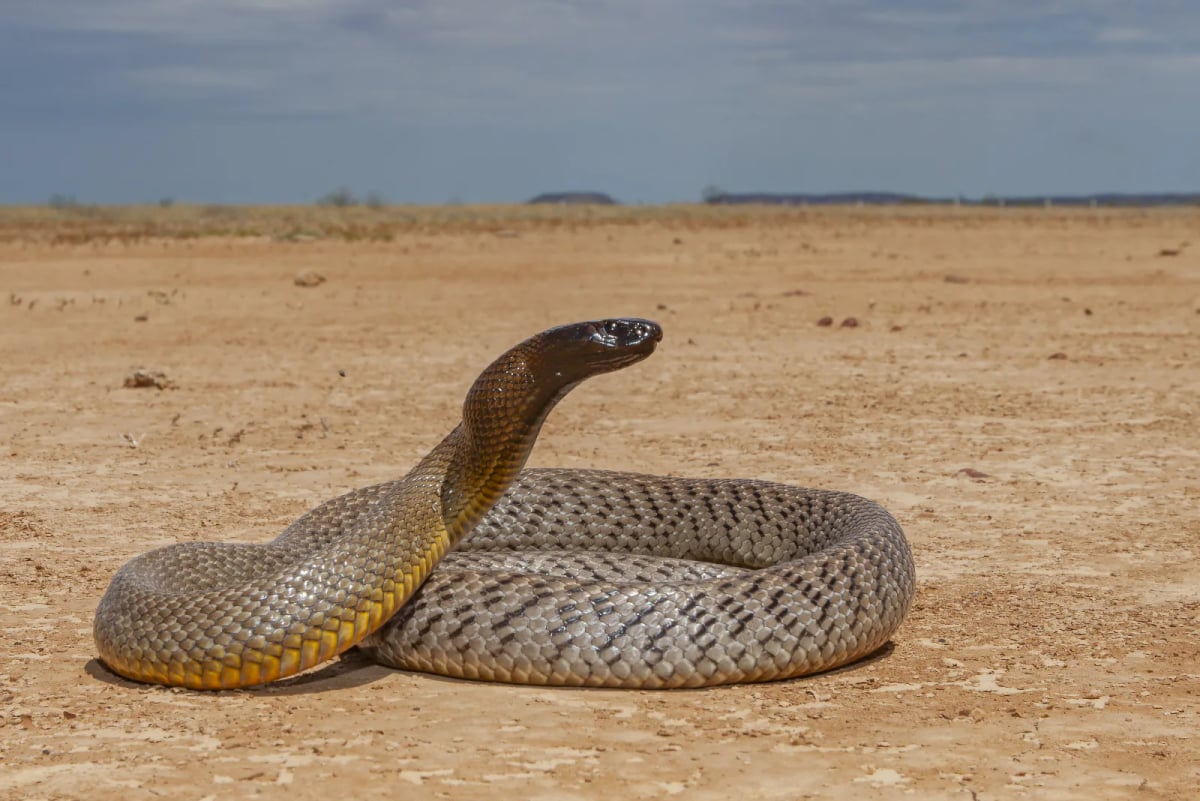
The inland taipan (Oxyuranus microlepidotus), also called the fierce snake, small scaled snake or western taipan, is an Australian snake with the most toxic venom of any land snake in the world. Measured in laboratory tests on mice, a single bite carries enough venom to kill many adult people in theory. In practice, it is a shy and reclusive snake that lives in one of the most remote parts of the continent, the dry floodplains and gibber country where Queensland meets South Australia, and there are no recorded human deaths from its bite. It is a slender, fast elapid, related to cobras and brown snakes, usually about 1.8 meters long. Its color changes with the seasons, from light brown or straw in summer to dark brown with a nearly black head in winter, which helps it absorb more heat from the sun when it is cold. It spends much of its life in deep cracks in the clay soil and in burrows dug by rodents, and it hunts almost only small mammals, especially the long haired rat, whose numbers boom after floods. Females lay about a dozen eggs in abandoned burrows. The IUCN lists the inland taipan as Least Concern.
What is the inland taipan?
The inland taipan is a venomous snake found only in the dry interior of eastern central Australia, and it is famous as the land snake with the most toxic venom in the world. Its scientific name is Oxyuranus microlepidotus, which means small scaled sharp tail, and it has several common names: fierce snake, a name given by early settlers that does not fit its shy character, small scaled snake and western taipan. Taipan comes from the word used by the Wik Mungkan people of Cape York for the coastal taipan, a close relative. The inland taipan belongs to the family Elapidae, together with cobras, mambas, coral snakes and the many venomous snakes of Australia, such as brown snakes and the tiger snake. Like them, it has short, fixed fangs at the front of the mouth. It was first described in 1879 from specimens collected near the junction of the Murray and Darling rivers, but after that it went almost unrecorded for about 90 years, until it was found again in the 1970s in southwestern Queensland. Since then it has been studied in the wild and kept in zoos, and its venom has become one of the most researched in the world, both for antivenom and for the search for new medicines.
Is the inland taipan the most venomous snake in the world?
By the usual scientific measure, yes, at least among land snakes. Venom toxicity is compared with a laboratory test called the LD50, which measures the dose needed to kill half of a group of mice. On that scale, the inland taipan's venom is the most toxic of any land snake, clearly ahead of the eastern brown snake and the coastal taipan, and far ahead of famous snakes such as the king cobra and the black mamba. Some sea snakes have venom of similar strength. A typical bite from an inland taipan delivers about 44 milligrams of venom, and the largest yield recorded from milking was about 110 milligrams, which in theory would be enough to kill well over a hundred people. The venom is a mix of powerful neurotoxins, which block the signals between nerves and muscles and cause paralysis, procoagulants, which use up the blood's clotting factors and can cause dangerous bleeding, and toxins that damage muscle and the kidneys. It also contains an enzyme that helps the venom spread quickly through the body. All of this works especially well on mammals, the snake's only prey. Most venomous does not mean most dangerous, though: the inland taipan is so shy and lives so far from people that it almost never bites anyone.
What happens if an inland taipan bites you?
An inland taipan bite is a life threatening medical emergency. The bite itself may hurt little, but within minutes to hours the venom can cause headache, nausea, vomiting and abdominal pain, followed by drooping eyelids, blurred vision, difficulty swallowing and speaking, and a spreading paralysis that can stop breathing. At the same time, the venom disrupts blood clotting, so the victim can bleed from the bite, the gums and internal organs, and the toxins can damage muscles and the kidneys. Without treatment, a serious bite could kill an adult. Yet there are no recorded human deaths from an inland taipan bite. The few known bites have mostly involved reptile keepers and researchers handling the snakes, and all of them survived thanks to fast first aid, hospital care and antivenom. The standard first aid in Australia is the pressure immobilization technique: keep the person calm and still, wrap a firm elastic bandage over the bite and up the whole limb, splint it and call an ambulance immediately. Do not wash the bite, because traces of venom help doctors identify the snake. Australia's taipan antivenom, first made in the 1950s for the coastal taipan, also works against the inland taipan, and modern hospitals can give it quickly.
How big is the inland taipan?
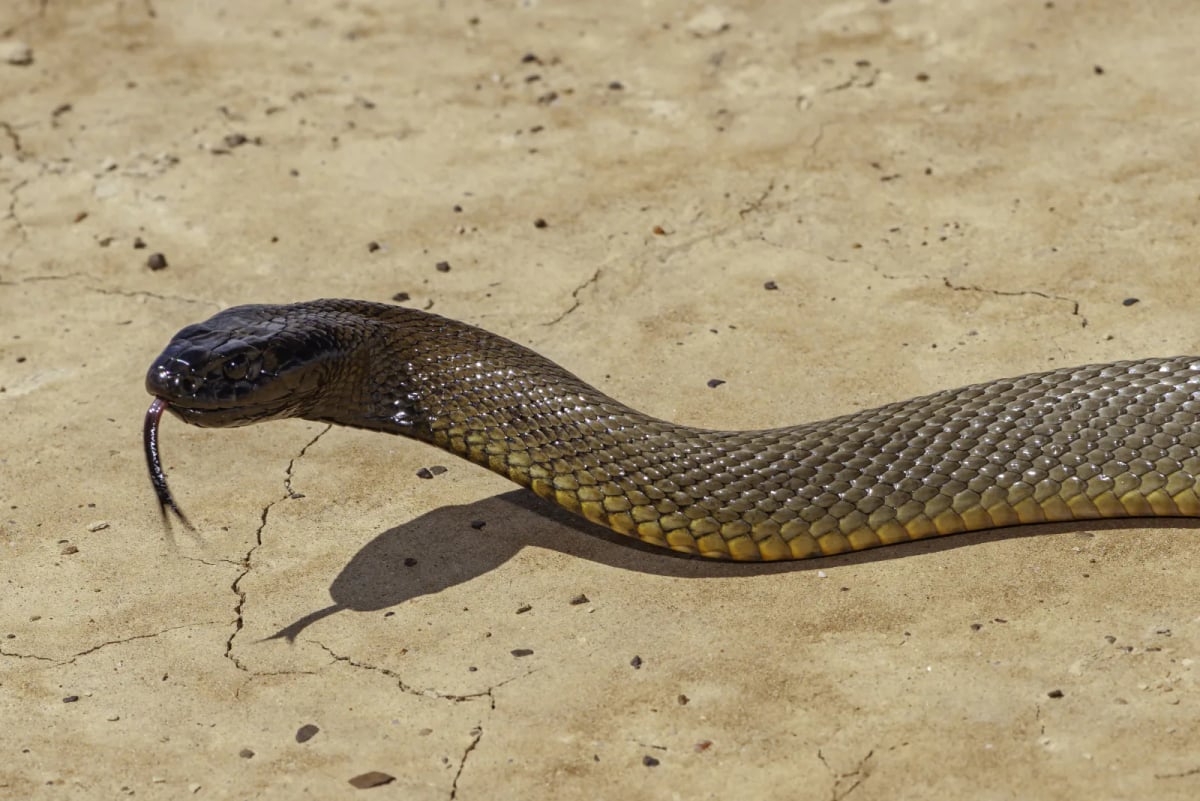
The inland taipan is a medium sized, slender snake. Adults are usually about 1.8 meters long, and the largest reach about 2.5 meters, a little smaller than the coastal taipan. The head is long and rectangular, slightly wider than the neck, with large, dark eyes and a rounded snout. Its scales are smooth and small, which gives it the name small scaled snake. Its most remarkable feature is its color, which changes with the seasons. In summer, inland taipans are pale, with a light brown, straw or olive body and a lighter head. As the weather cools, they become darker, and in winter many are dark brown with an almost glossy black head and neck. Scientists believe this helps them control their temperature: a darker snake absorbs heat from the sun faster on cold mornings, so it can warm up and become active with only part of its body exposed at the entrance of a crack or burrow. Many individuals also show a pattern of dark edged scales that forms faint chevrons along the body. Despite its reputation, the inland taipan is a graceful, alert snake that moves quickly over the open ground of its desert home and often raises its head to look around.
Where does the inland taipan live?
The inland taipan lives only in Australia, in a remote region of the arid interior around the corner where Queensland, South Australia, the Northern Territory and New South Wales meet. The heart of its range is the Channel Country of southwestern Queensland and northeastern South Australia, a vast system of braided rivers such as Cooper Creek and the Diamantina that flood only after big rains and then dry out for years. There it lives on black soil floodplains and gibber plains, flat, stony landscapes with very little vegetation. The cracking clay soils are the key to its survival. When the floodplains dry, the clay shrinks and opens deep cracks and holes, which the snake uses to escape the heat of summer and the cold of winter nights and to find its prey. It also shelters in burrows dug by rodents and other animals. The inland taipan is mostly active during the day, especially in the morning, and retreats underground when it gets too hot. Because its habitat is so remote and so sparsely populated, there are few places where people and inland taipans meet. Older records from the Murray and Darling rivers in New South Wales and Victoria have not been repeated in modern times.
What does the inland taipan eat?
The inland taipan feeds almost only on small mammals, and its main prey is the long haired rat, a native rodent of the arid interior. Long haired rats are famous for their boom and bust cycles: after big floods turn the Channel Country green, their numbers can explode into plagues of millions, and then crash during the following droughts. The inland taipan follows these cycles. When rats are abundant, the snakes eat well, grow fat and breed, and when the rats disappear, they survive on fat reserves and on other prey such as plains rats, hopping mice, dunnarts and introduced house mice. The snake hunts by searching cracks and burrows, where rodents shelter during the day. Because a cornered rat can bite back hard in a narrow space, the inland taipan has a very efficient technique: it strikes several times in rapid succession and often holds the prey in its jaws while the venom works, instead of letting it run off. Its extremely powerful venom, tuned for warm blooded animals, kills the rodent within moments, which keeps the snake from being injured. It then swallows the prey whole, usually head first. Some scientists believe the venom's strength is linked to this diet of mammals, which can fight back in tight places.
Inland taipan vs eastern taipan
There are three species of taipan, all found in Australia, and the inland taipan is often confused with its better known relative, the coastal or eastern taipan, Oxyuranus scutellatus. The coastal taipan lives in the tropical and subtropical woodlands, grasslands and sugarcane fields of northern and eastern Australia, from northern New South Wales through Queensland to the Northern Territory and the Kimberley, and also in southern New Guinea. It is bigger, often 2 to 2.5 meters long and sometimes more, and its color stays the same all year. Its venom is the third most toxic of any land snake, after the inland taipan and the eastern brown snake, but because it lives closer to people and is more nervous, it has caused far more serious bites. Before antivenom was developed in the 1950s, almost every bite was fatal. The third species, the Central Ranges taipan, Oxyuranus temporalis, was only described in 2007 from the deserts of Western Australia and the Northern Territory and is still very poorly known. Searches for a taipan snake often mix the species, but only the inland taipan lives in the Channel Country, changes color with the seasons and specializes in rats.
Inland taipan eggs and young
Inland taipans breed in the cooler months. Males become active in late winter and early spring and search for females, and rival males may wrestle, intertwining their bodies and trying to push each other down, without biting. After mating, the female lays her eggs in midsummer, usually in a deep crack in the soil or in an abandoned animal burrow, where temperature and humidity stay more stable. A typical clutch has about 11 to 20 eggs, and larger, well fed females lay more, so clutches are biggest after good rat years. The eggs take about two months or a little longer to hatch, and the female does not stay to guard them. Newly hatched taipans are about 45 centimeters long, fully venomous and independent from the start. They feed on small rodents such as young mice and grow quickly when food is plentiful. Males can mature in less than two years and females a little later, depending on how much food they find. In the wild, young taipans face many dangers. They are eaten by birds of prey and by the large monitor lizards of the desert, and by mulga snakes, which are resistant to the venom of other Australian snakes.
Is the inland taipan endangered?
No. The IUCN lists the inland taipan as Least Concern, because its remote range is large, little changed by people and largely free of the threats that affect snakes elsewhere. Very few people live in the Channel Country, there is little farming apart from extensive cattle grazing, and the snake's underground habits protect it from heat, fire and predators. Its numbers depend mostly on rain and on the boom and bust cycles of long haired rats, so local populations can rise and fall a lot from year to year, but there is no sign of a long term decline. That does not mean the species faces no risks. Overgrazing by cattle can compact the soil and reduce the cracks the snake depends on, and introduced animals such as feral cats and foxes compete for the same rodents. Climate change could alter the rhythm of floods and droughts that drives the whole ecosystem. In Queensland and South Australia, all native snakes are protected by law, and it is illegal to kill them. Inland taipans are kept in a few zoos and reptile parks, such as the Australian Reptile Park, which milks them to supply venom for antivenom production, helping to save lives from many dangerous Australian snakes.