Mountain Hare
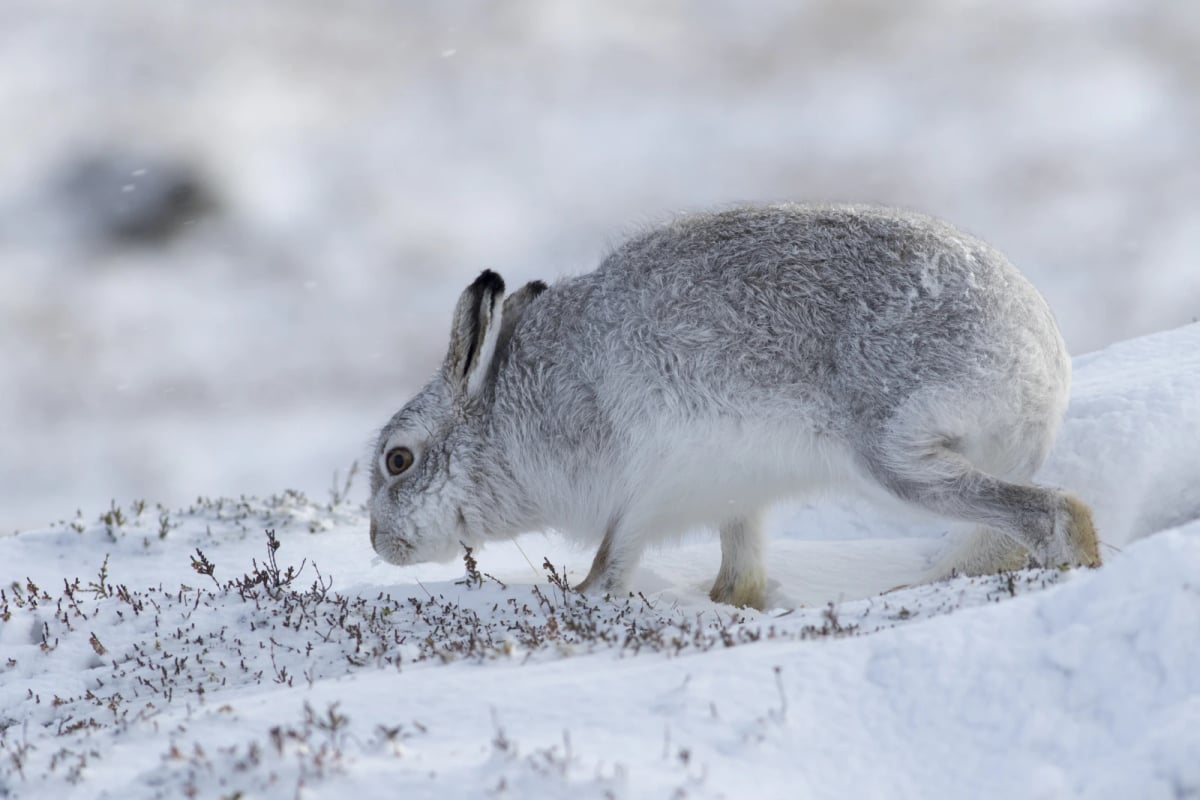
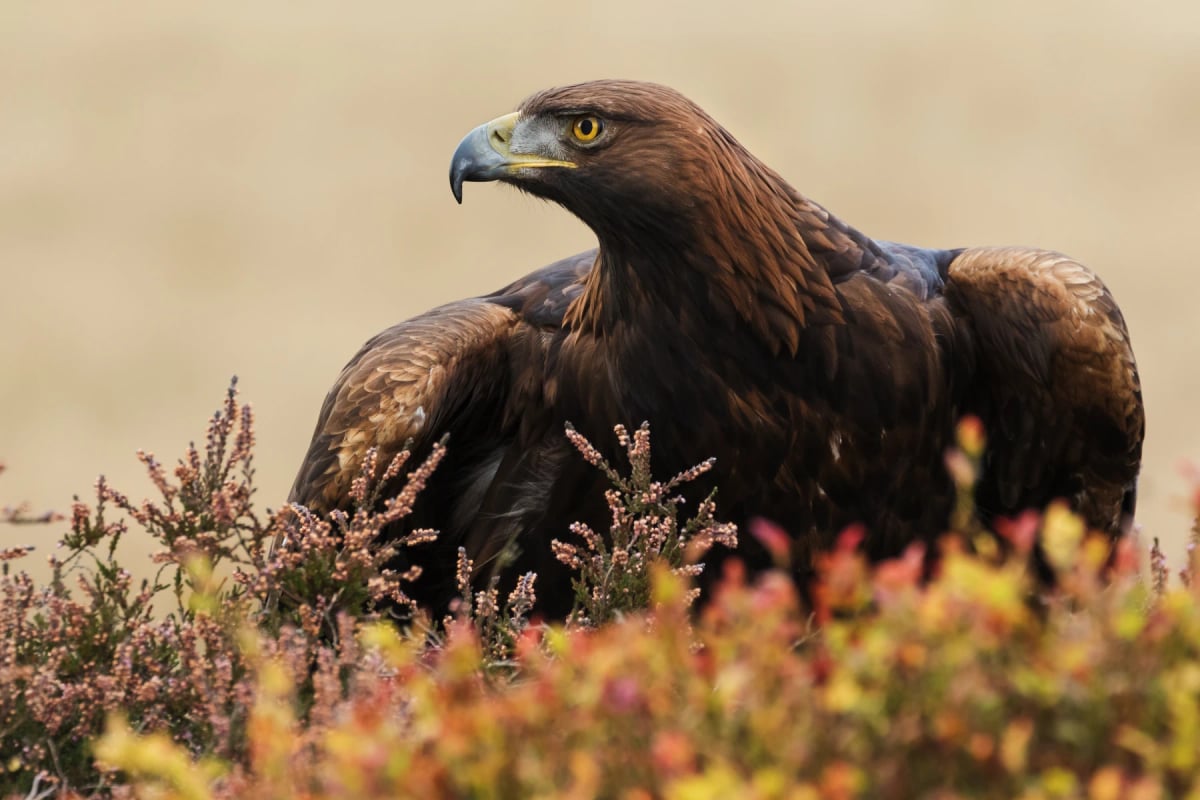
The mountain hare (Lepus timidus), also called the blue hare, white hare or variable hare, is a hare of cold northern lands and high mountains. It is best known for changing color with the seasons: in most of its range it grows a white winter coat that hides it in the snow, keeping only black tips on its ears, and turns gray brown again in spring. It lives across the boreal forests, tundra and moorlands of northern Europe and Asia, from Scandinavia and the Baltic through Russia to Mongolia, northeastern China and Hokkaido in Japan, with separate populations in the Alps, Scotland and Ireland that have survived there since the end of the last ice age. The Irish hare, a subspecies found only in Ireland, rarely turns white and lives in lowland fields, bogs and coastal dunes, and it is often named as Ireland's national animal. Mountain hares are a little smaller than brown hares, with shorter ears and a shorter, all white tail. They eat grasses and heather in summer and twigs and bark of willow, birch and other shrubs in winter. They are hunted in many countries and preyed on by foxes, lynx and golden eagles. The IUCN lists the species as Least Concern, but warmer winters with less snow are a growing problem for a hare that turns white on time.
What is a mountain hare?
The mountain hare is a hare of cold climates that lives across the far north of Europe and Asia and in a few isolated mountain ranges farther south. Its scientific name is Lepus timidus, which means timid hare, and it goes by many common names: blue hare, from the bluish gray tinge of its summer coat in Scotland, white hare or snow hare, from its winter coat, and variable hare, because it changes color with the seasons. It belongs to the same genus as the brown hare of European farmland and the arctic hare of North America, its closest relative. Scientists recognize around 15 subspecies, from the Irish hare in the west to the Hokkaido hare in Japan. The mountain hare is a survivor of the last ice age. When glaciers covered much of Europe, it lived on the cold steppe and tundra south of the ice. As the climate warmed and forests spread, it retreated north to Scandinavia and Russia and up into the Alps, leaving isolated populations behind in Scotland and Ireland. That is why mountain hares live today both in the Arctic and on high Alpine slopes, and why the Irish hare is the only hare native to Ireland.
The Irish hare
The Irish hare, Lepus timidus hibernicus, is a subspecies of the mountain hare found only in Ireland, and it has lived on the island since before the end of the last ice age, which makes it one of Ireland's oldest native mammals. It looks different from mountain hares elsewhere. It is larger and stockier, with a warm reddish brown coat, and it rarely turns white in winter: most stay brown all year, and only some get white patches. It also lives in different places. Instead of mountains, Irish hares prefer lowland grassland, farmland, bogs, salt marshes and coastal dunes, and some well known groups live on the grass of Dublin Airport and on North Bull Island in Dublin Bay. Because of these differences, some scientists have argued that it should count as its own species. The Irish hare has deep roots in folklore and is the animal most often named as Ireland's national animal, and it appeared on the threepence coin of the Irish Free State from 1928. It is protected under Irish wildlife law, but hare coursing with dogs is still legal under licence. The brown hare, introduced in the 1800s, lives in parts of Northern Ireland and can compete and hybridize with it.
How big is a mountain hare?
Mountain hares are medium sized hares, a little smaller than the brown hare. The body measures about 45 to 65 centimeters, and adults usually weigh 2 to 5.8 kilograms, with large differences between regions. Hares in Scotland are among the smallest, at around 2.5 to 3.5 kilograms, while those in Russia and Fennoscandia, and the Irish hare, are larger. Compared with a brown hare, the mountain hare has shorter ears, a rounder head and a more compact body, all of which help it lose less heat in the cold. The ears always have black tips, even when the rest of the animal is white. The tail is short and white on top and underneath, while the brown hare's tail is black on top. The hind feet are large and covered with dense fur in winter, which spreads the hare's weight like snowshoes and lets it run across soft snow without sinking. In summer the coat is gray brown, often with a bluish tinge in Scotland, and the eyes are large and set high on the sides of the head, giving the hare an almost complete view around itself. Mountain hares are fast and agile runners, able to zigzag sharply to escape eagles and foxes.
Why does the mountain hare turn white?
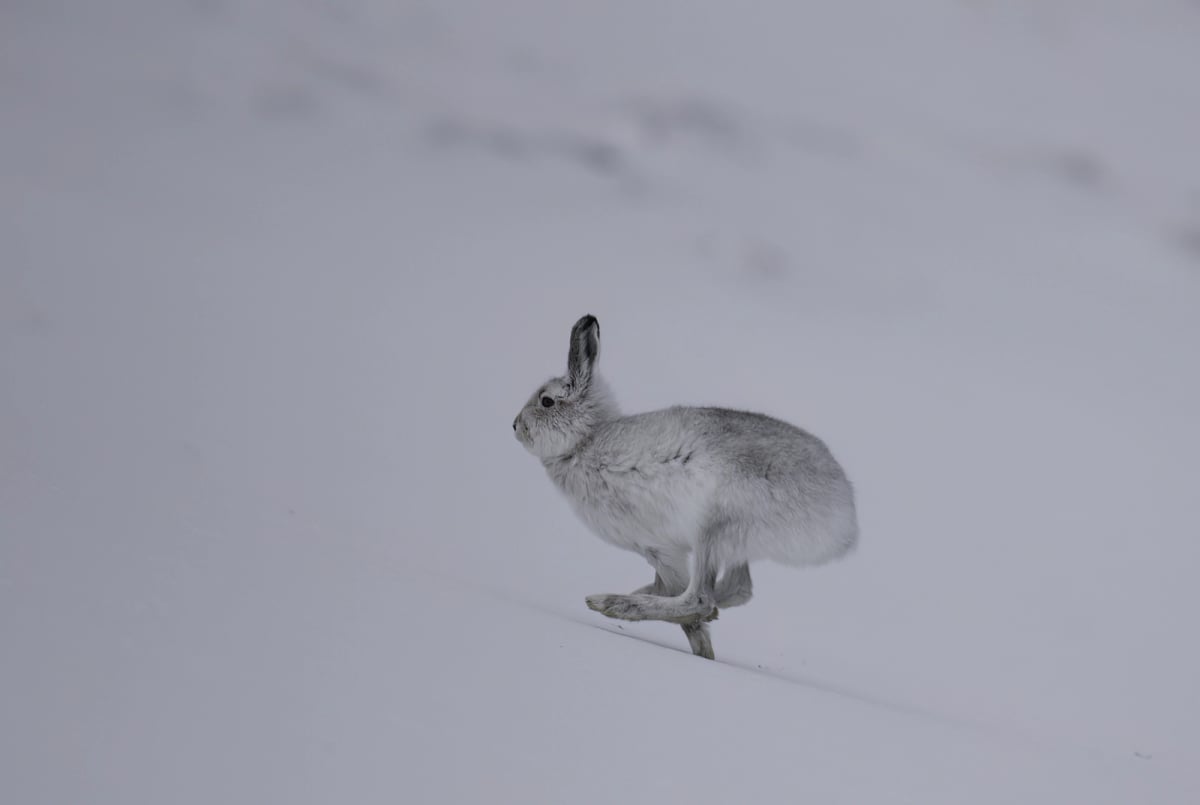
The mountain hare molts three times a year, and in autumn it replaces its gray brown fur with a thick white winter coat. The change is triggered mainly by day length, not by snow or temperature. As the days shorten in October and November, the hare starts growing white hairs, beginning with the feet and belly and ending with the back and head, and by midwinter most hares are white except for the black ear tips. In spring the process reverses, and patchy, half white hares are a common sight in March and April. The white coat is camouflage. On snow, a white hare is very hard for golden eagles, foxes and lynx to spot, especially when it crouches still in a shallow scrape. The winter coat is also denser and warmer than the summer one. Not all mountain hares turn completely white. In areas with little snow, such as Ireland and parts of southern Sweden, many stay brown or become only partly white, a pattern that seems to be inherited. Because the timing depends on daylight, warmer winters are now a problem: in years with late or little snow, white hares sit on brown ground and become easy to see, which researchers in Scotland and Scandinavia are studying closely.
Mountain hare vs brown hare
The mountain hare and the brown hare, also called the European hare, are close relatives, and in parts of Europe they live side by side, so it helps to know how to tell them apart. The brown hare is bigger and leaner, with longer legs and much longer ears, which reach well past the nose when laid forward. The mountain hare's ears are shorter and do not reach the tip of the nose. The tail is a good clue: the brown hare's tail is black on top and white below, while the mountain hare's is all white. Color helps most of the year, since the brown hare stays tawny brown in all seasons and never turns white, and its eyes are a striking amber color. Habitat is another clue. Brown hares prefer lowland farmland, meadows and open woodland, while mountain hares live in boreal forest, moorland, tundra and high mountains, except in Ireland, where the Irish hare also uses lowland fields. Where both species meet, as in Sweden, Finland, the Alps and Northern Ireland, the brown hare is often expanding into mountain hare areas as the climate warms, and the two sometimes interbreed. The arctic hare of Canada and Greenland, another relative, is larger and stays white almost all year in the high Arctic.
Where do mountain hares live?
Mountain hares have one of the largest ranges of any hare. They live across the boreal forest and tundra of northern Eurasia, from Norway, Sweden and Finland through the Baltic states, Belarus and almost all of Russia to Kazakhstan, Mongolia, northeastern China and the island of Hokkaido in Japan. In the far north they live in open tundra and birch woodland, and farther south in coniferous forest with clearings, bogs and young growth. Away from this main range there are isolated populations left behind by the ice age. In the Alps, the mountain hare lives above the tree line and in high forests of France, Switzerland, Italy, Austria, southern Germany and Slovenia, usually between about 1,300 and 3,000 meters and occasionally as high as 3,700 meters. In Scotland, it lives on heather moorland and mountain slopes, especially in the Highlands and the Cairngorms, and it was introduced to the Peak District in England in the 1800s, its only population there. In Ireland, the Irish hare lives almost everywhere, from sea level to mountaintops. Across this huge area, mountain hares need open ground to feed, cover such as heather, shrubs or rocks to hide in and, in most places, snow in winter.
What do mountain hares eat?
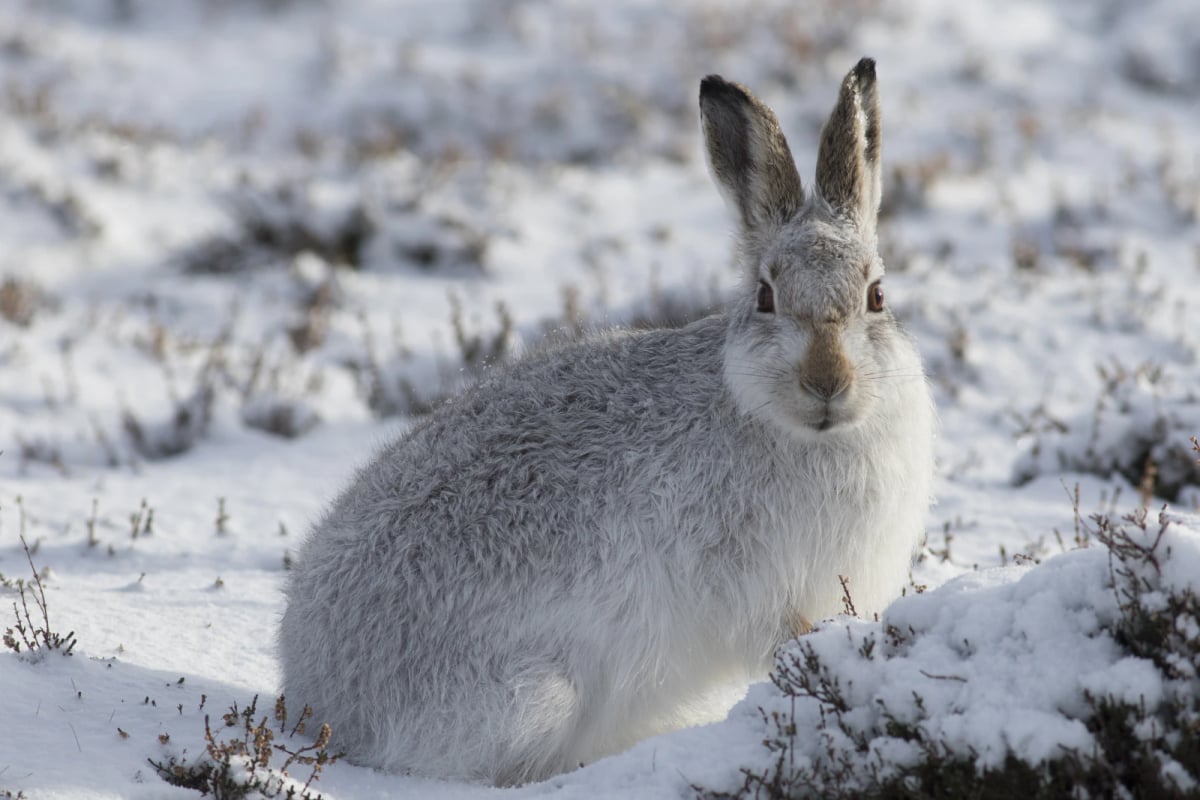
Mountain hares are herbivores, and their diet changes with the seasons. In spring and summer they eat grasses, sedges, herbs and young shoots, choosing the most nutritious plants available. In Scotland, heather is the most important food all year, and in winter it can make up most of what they eat, which is why mountain hares are common on heather moorland managed for grouse. Where there is deep snow, hares switch to woody food: they gnaw twigs, buds and bark from willows, birches, aspen, rowan, juniper and young pines, and they can reach higher branches by standing on packed snow. In Scandinavia and Russia, this winter browsing can leave clear marks on young trees. Like other hares and rabbits, mountain hares get the most out of tough plant food by eating twice: they produce soft droppings that they eat again to absorb more nutrients, and only the second, dry pellets are left behind. They usually feed at dusk and during the night and spend the day resting in a shallow scrape called a form, often under a rock or a bush or in the shelter of heather. In winter they may dig short tunnels into the snow for shelter, and in some areas they gather in loose groups at good feeding spots.
Mountain hare leverets and breeding
The mountain hare's breeding season runs from late winter to late summer, starting earlier in the south and later in the far north. In early spring, males chase females across open ground, and the famous boxing matches of hares are usually a female standing on her hind legs and striking at a male who is pushing too hard. After a pregnancy of about 50 days, the female gives birth to one to five young, called leverets, usually two or three. A female can have two or three litters a year, fewer in the north, where summers are short. Unlike rabbits, hares do not dig burrows for their young. Leverets are born above ground in a simple form among heather, grass or rocks, already covered in fur, with their eyes open and able to move within hours. To avoid drawing predators, the mother leaves them alone during the day and comes back only once a day, around dusk, to nurse them for a few minutes with very rich milk. The leverets grow quickly and are weaned at three to four weeks old. Many do not survive: foxes, stoats, wildcats, crows, buzzards and eagles take young hares, and cold, wet weather kills others. Mountain hares can breed in the year after their birth.
Are mountain hares protected?
The IUCN lists the mountain hare as Least Concern because it is still widespread across northern Europe and Asia, and in Russia and Scandinavia it remains a common game animal. The picture is different in some places. In Scotland, counts on grouse moors showed steep declines in some areas, partly because of large culls to protect trees and to reduce ticks that affect red grouse. After public pressure, the mountain hare became a protected species in Scotland in March 2021, and it can now be killed only under licence. In Ireland, the Irish hare is protected by wildlife law, but licensed coursing continues, and outbreaks of a rabbit disease that also affects hares led to coursing being suspended in 2019. In the Alps, populations are scattered and shrinking upslope as the climate warms, and in parts of Sweden and Finland the brown hare is pushing north and competing with mountain hares. Climate change is the biggest long term worry. Shorter, warmer winters with less snow leave white hares exposed on brown ground, and the cold habitats they depend on are moving north and uphill. Hunting, collisions with cars and changes in forestry and farming also affect local numbers.