Sand Cat
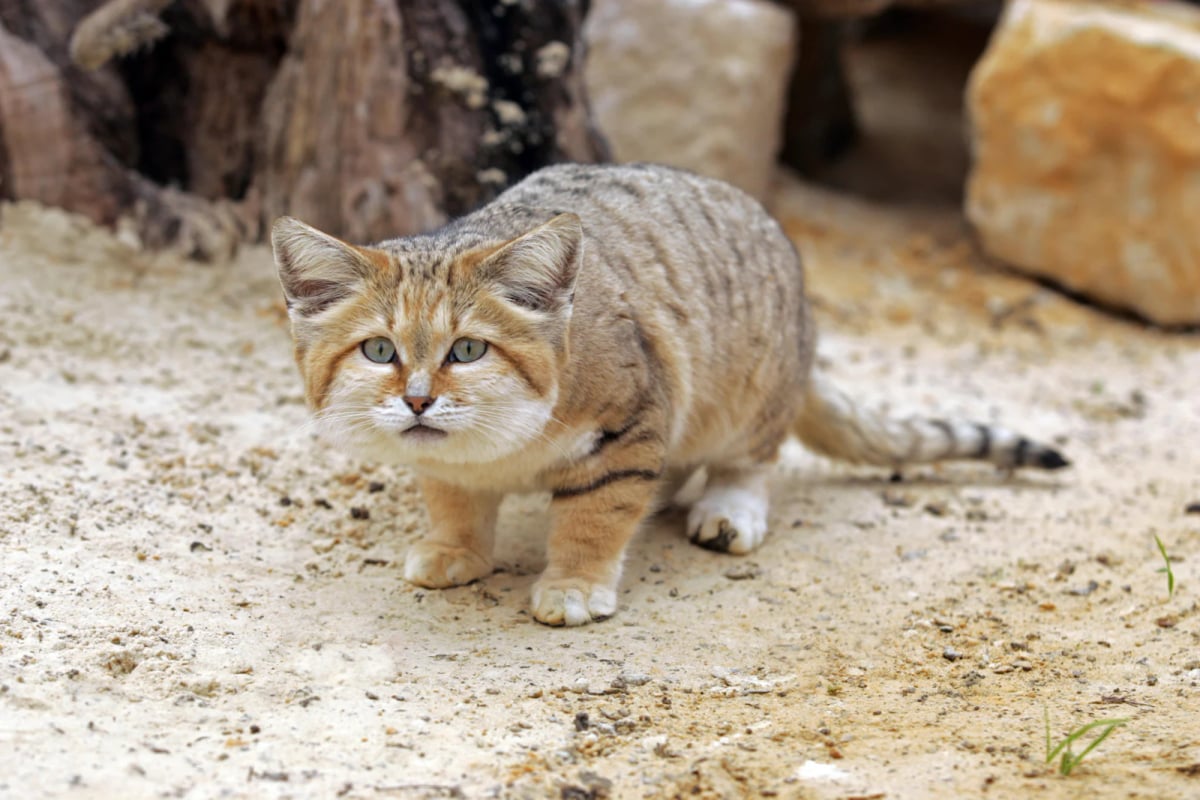
The sand cat (Felis margarita) is the only cat that lives entirely in true sandy and stony deserts, far from water. It is a little smaller than a house cat, with a broad, flat head, large ears set low and wide apart, sandy yellow fur and a black tipped tail with a few dark rings. Its paws are covered with thick, long hair underneath, which protects them from the burning sand by day and the cold at night and helps it walk on loose dunes without sinking or leaving clear tracks. Its hearing is exceptional: enlarged ear canals and middle ear chambers let it pick up the faint sounds of rodents moving under the sand. The sand cat lives in the Sahara, the deserts of Arabia and the Karakum and Kyzylkum deserts of Central Asia. It is active mainly at night, resting by day in burrows it digs itself or takes over from foxes and rodents, and it can survive without drinking, getting almost all the water it needs from its prey: gerbils, jerboas, small birds, lizards and even horned vipers. It is shy, rarely seen and hard to study, and much of what is known comes from camera traps and radio tracking. The IUCN lists the sand cat as Least Concern, but its numbers are unknown and some local populations are threatened.
What is a sand cat?
The sand cat is a small wild cat and the only member of the cat family that lives entirely in true deserts. It is found across the Sahara, the Arabian Peninsula and the deserts of Central Asia, in some of the hottest and driest places on Earth. Its scientific name, Felis margarita, honors Jean Auguste Margueritte, a French general who led an expedition into the Algerian Sahara, where the species was first described for science in 1858. It is also called the sand dune cat. The sand cat belongs to the genus Felis, together with the wildcat, the jungle cat, the black footed cat of southern Africa and the domestic cat, and genetic studies show that it is closely related to the wildcat lineage that gave rise to house cats. That is one reason why it looks so much like a small, sandy colored tabby with oversized ears, and why it often goes viral online as a cat that looks like a kitten its whole life. Despite that appearance, it is a tough, fully wild predator, adapted to survive extreme heat and cold, long periods without water and some of the most dangerous prey in the desert, including venomous vipers.
How big is a sand cat?
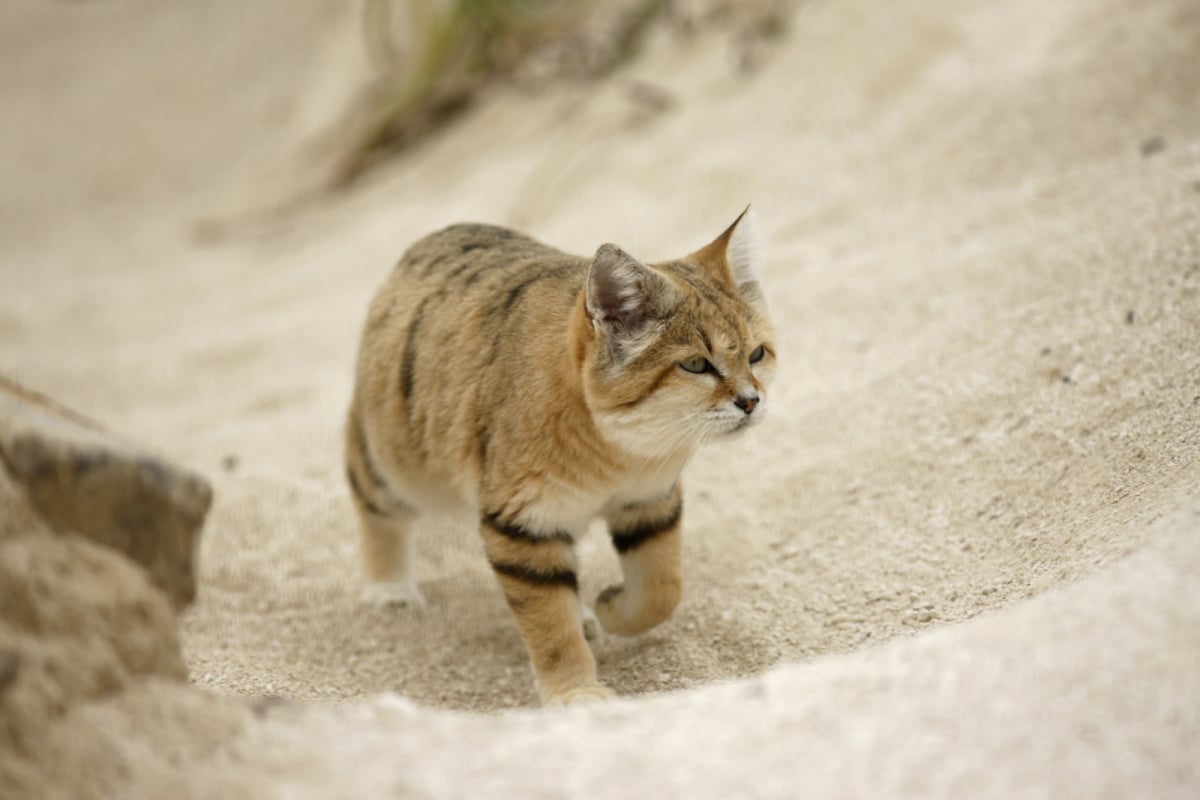
The sand cat is smaller than most house cats. Its body measures about 39 to 52 centimeters, its tail adds 23 to 31 centimeters, and adults weigh only about 1.4 to 3.4 kilograms, with males a little heavier than females. It stands only about 25 centimeters at the shoulder. The legs are short, and the body is stocky and low to the ground. The head is broad and flat, with large, pointed ears set low and wide apart, wide yellow eyes and a reddish line running from the outer corner of each eye across the cheek. The fur is thick and soft, pale sandy yellow to grayish, with faint stripes on the legs and sometimes on the body, and a white chin and belly. The tail ends in a black tip with two or three dark rings. Their round face, big ears and soft coat keep a kittenish look even in adults, which is why sand cats are often described online as eternal kittens. Their most unusual feature is under the feet: the pads are covered with a dense mat of long, stiff hair. Sand cats from Central Asia grow a longer, thicker coat in winter, when temperatures in the Karakum desert can drop well below freezing.
How sand cats survive in the desert
The sand cat is built for a place where daytime ground temperatures can pass 50 degrees, nights can be freezing and water may not be available for months. Its first trick is behavioral: it avoids the worst heat by resting in a burrow during the day, where the temperature stays much more stable, and comes out at dusk to hunt. Its feet are covered with long hair that insulates them from hot or cold sand, spreads its weight on loose dunes and leaves only faint, blurry footprints, which makes it very hard to track. Its ears are its most important tool. The ear openings and the bony chambers of the middle ear are larger than in any other cat of its size, which makes its hearing very sensitive to low frequency sounds, such as rodents moving or digging under the sand. Because the ears are set low on the head, the cat can listen while keeping a flat profile against the ground. The sand cat also has a remarkable ability to live without drinking. It gets almost all the water it needs from the bodies of its prey and from the moisture in the burrows of the animals it eats, and its kidneys produce very concentrated urine to save water.
Where do sand cats live?
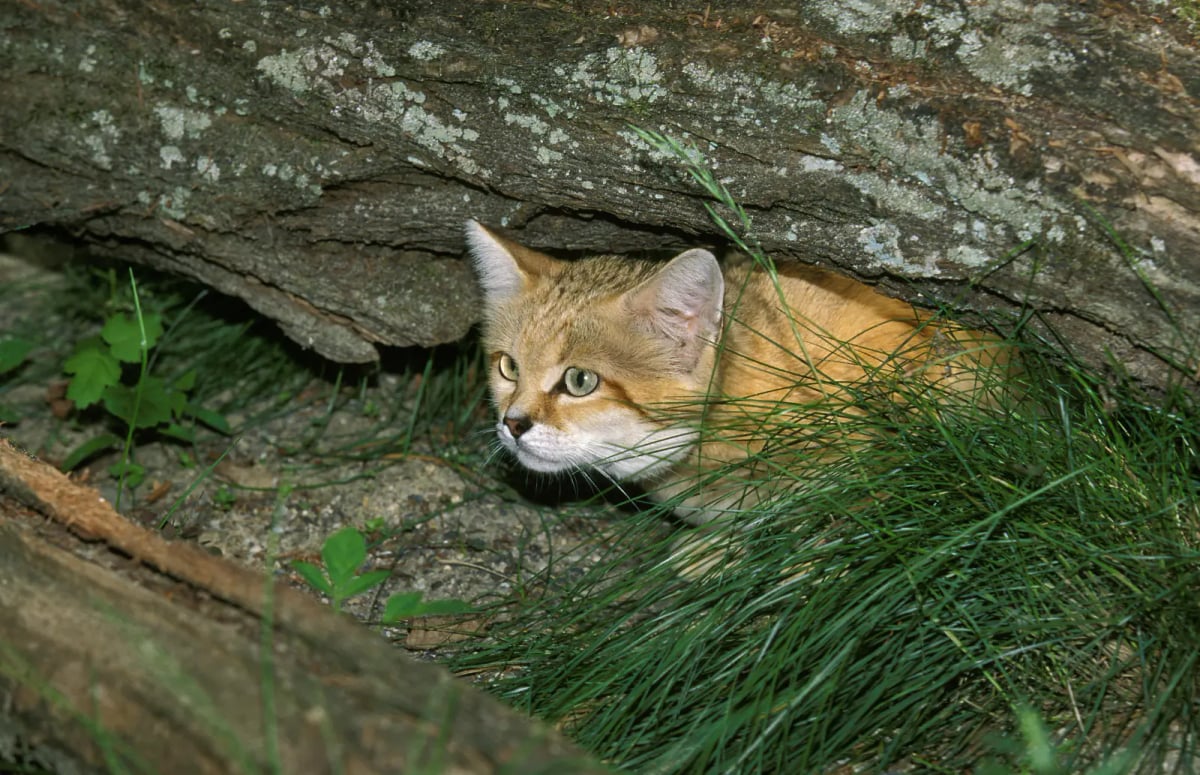
Sand cats live in three separate desert regions. In North Africa they are found across the Sahara, from Western Sahara and Mauritania through Mali, Algeria and Niger to Chad, Sudan and Egypt. In the Middle East they live in the deserts of the Arabian Peninsula, including Saudi Arabia, the United Arab Emirates, Qatar, Oman and Kuwait, and in the eastern deserts of Jordan, Syria and Iraq. In Central Asia they live in the deserts of Iran, Turkmenistan, Uzbekistan and southern Kazakhstan, especially the Karakum and Kyzylkum. Within these regions, sand cats prefer flat or gently rolling sandy plains and stony desert with scattered shrubs and grass clumps, which shelter the rodents they hunt. They avoid bare, shifting dunes without vegetation, and they also avoid places with many people, dogs and feral cats. Their distribution is patchy, and because they are so hard to see, many gaps on the map may simply reflect a lack of surveys. New camera trap studies keep finding them in new places: in 2017 and 2018 they were recorded at a dozen new sites in Abu Dhabi, and in 2026 a study in Qatar suggested a sizable population there. They are probably extinct in Israel, Pakistan and Yemen.
What do sand cats eat?
Sand cats are carnivores that eat whatever small animals they can find in the desert. Their main prey are small rodents such as gerbils, jirds, jerboas and spiny mice, which make up most of their diet in many areas. They also catch small hares, birds such as larks and wheatears, lizards, insects and spiders. Sand cats are famous for hunting snakes, including venomous horned vipers and sand vipers. They strike the snake on the head with fast blows of their paws, stunning it before biting it, and they may cache leftover prey in the sand to eat later. Their hunting technique relies on hearing. A sand cat walks slowly across the desert at night, often covering several kilometers, and stops frequently to listen with its head low. When it hears a rodent moving underground or in a burrow, it can dig quickly with its front paws to reach it, or it waits and pounces when the animal comes to the surface. Radio tracking studies have shown that sand cats can travel more than 5 kilometers in a single night while hunting, and that individual cats may range over large areas when prey is scarce. Because they get their water from prey, a steady supply of rodents is essential for their survival.
Sand cat behavior: burrows, night hunts and a barking call
Sand cats are solitary and mostly nocturnal. They spend the hottest part of the day underground, in burrows they dig themselves in firm sand or at the base of a bush, or in old burrows of foxes, porcupines, gerbils and other animals, which they sometimes enlarge. In cooler weather they may sunbathe at the entrance in the morning. A single cat can use several burrows within its home range and switch between them. At dusk they come out and travel long distances while hunting, moving in a low crouch that keeps them close to the ground and hard to see. When they feel threatened, sand cats crouch and freeze, relying on their camouflage, and they close their eyes when a light shines on them, which hides the reflection and makes them even harder to spot at night. Researchers in Morocco and Arabia have used this habit, and the cats' tolerance of slow vehicles, to study them with spotlights. Sand cats are usually quiet, but they have an unusual call. During the breeding season, they communicate with loud, repeated barking calls that sound a lot like a small dog, useful for finding mates across the open desert. They also hiss, growl, purr and mew like other small cats.
Sand cat kittens
Sand cats can breed at different times of year depending on the region. In the Sahara, kittens are often born in spring, while in Central Asia, where winters are harsh, breeding is concentrated in spring and early summer, and in some areas females can have two litters a year. After a pregnancy of about 59 to 67 days, the female gives birth in a burrow to a litter of usually two to five kittens, sometimes more. Newborn kittens are tiny, weighing only about 40 to 80 grams, with soft, pale fur marked with faint spots and stripes. Their eyes open after about two weeks. They grow quickly, start eating solid food at around five weeks and begin moving around outside the burrow and exploring with their mother. By three to four months they are hunting on their own, and they become independent soon after, at an age when many other small cats are still with their mothers. Sand cats can breed at around one year of age. In the wild, young sand cats face many dangers, from predators such as jackals, foxes, eagle owls and large snakes to feral dogs. In zoos, sand cats are bred under coordinated programs, but kitten mortality is often high, as with other desert cats.
Is the sand cat a pet?
No. Because it looks like a kitten that never grows up, many people search for a sand cat as a pet, but it is a wild species that has never been domesticated, and it is not suited to life in a home. Sand cats are shy, mainly nocturnal and adapted to extremely dry conditions. In captivity they are very sensitive to humidity and to respiratory infections, and even specialized zoos find them difficult to keep healthy and to breed. Keeping or trading sand cats is restricted or illegal in most countries where they live, and the species is listed under CITES, which regulates international trade. The illegal pet trade is a real problem. In parts of the Arabian Peninsula, sand cats have been captured from the wild and sold in animal markets or kept as status pets, and many die in transport or soon after. This trade removes cats from populations that are already small and scattered, especially in places like Kuwait and the eastern deserts of the Middle East. Conservation groups encourage people to enjoy sand cats through photos, documentaries and responsible wildlife tours, and to report the sale of wild cats to the authorities.
Is the sand cat endangered?
The IUCN lists the sand cat as Least Concern in its global assessment, after years as Near Threatened, mainly because it lives across a huge area of desert that is little used by people. Its total population, however, is unknown, and many local populations are small, isolated and poorly studied. The species is probably extinct in Israel, where a reintroduction attempt failed, and in Pakistan and Yemen. The main threats differ between regions. In some areas, desert habitats are being turned into farms, roads, settlements and oil and gas fields, and overgrazing by livestock removes the shrubs and grasses that shelter rodents. Feral and domestic dogs and cats are a growing problem near camps and villages, because they kill sand cats, compete for prey and may spread diseases. Sand cats are also caught in traps set for foxes and jackals, poisoned by rodent baits and captured for the illegal pet trade. Climate change, with longer and more severe droughts, may reduce rodent numbers. Hunting the species is banned in many range countries. Researchers using camera traps and radio collars in Morocco, the United Arab Emirates, Qatar and Central Asia are learning more about where sand cats live, which is the first step to protecting them.
Where it is found
The Sand Cat can be found in places such as: