White Rhinoceros
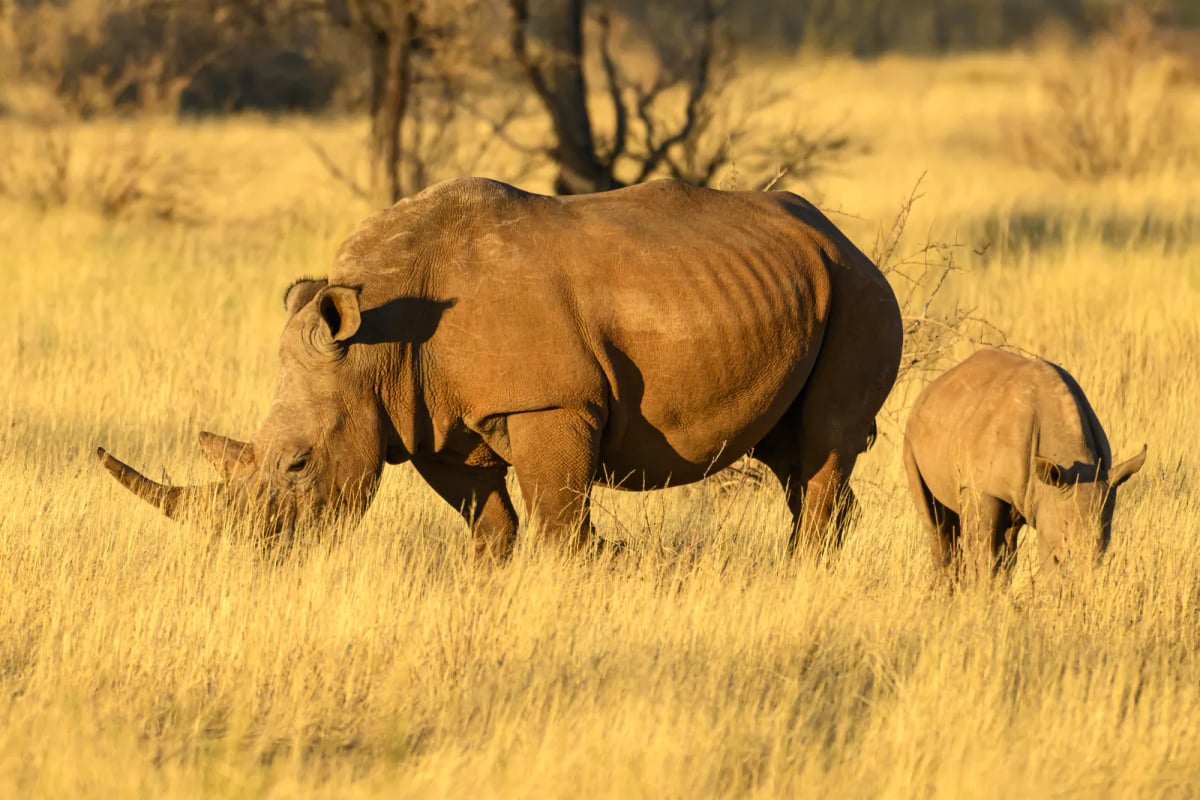
The white rhinoceros (Ceratotherium simum), also called the square lipped rhino, is the largest of the five living rhino species and, after the elephants, the heaviest land animal on Earth. Big bulls stand up to 1.8 meters at the shoulder and weigh around 2,300 kilograms. Despite its name it is gray, and the easiest way to recognize it is its wide, flat upper lip, built for cropping short grass like a lawnmower. It also has a long head carried close to the ground, a hump on the back of the neck and two horns made of keratin, the front one much longer. White rhinos graze in open savanna and grassland in southern and eastern Africa, and they are more sociable and calmer than black rhinos: females and their calves often rest and feed in small groups. The species has two subspecies. The southern white rhino was saved from about 20 to 50 animals in the late 1800s and now makes up almost the whole population, while the northern white rhino is down to two females, Najin and Fatu, who live under guard in Kenya. Poaching for horn remains the main threat. About 15,750 white rhinos were counted at the end of 2024, most of them in South Africa, and the IUCN lists the species as Near Threatened.
What is a white rhino?
The white rhino is one of the five living rhinoceros species and one of the two found in Africa, alongside the black rhino. Its scientific name is Ceratotherium simum, and it belongs to the order of odd toed hoofed mammals, together with horses, zebras and tapirs. It is the largest rhino of all, and among land animals only the African and Asian elephants are heavier. The name white rhino is misleading, because the animal is gray, often tinted brown or reddish by the mud and dust it rolls in. A popular story says the name came from a Dutch or Afrikaans word for wide, describing its broad mouth, but historians have found little evidence for that, and the real origin is uncertain. That is why many guides prefer the name square lipped rhino, which points to the feature that really sets it apart. Searches for an albino rhino often land here, but white rhinos are not albino, and true albino rhinos are extremely rare. The species is split into two subspecies: the southern white rhino, which makes up almost every white rhino alive today, and the northern white rhino, which is down to its last two animals.
White rhino vs black rhino: how to tell them apart
Color does not help, since both African rhinos are gray. The surest clue is the mouth. The white rhino has a wide, square upper lip for grazing short grass, while the black rhino has a pointed, hooked lip that works like a finger to grab leaves and twigs from bushes. The head tells the same story. A white rhino walks with its long head held low, almost touching the grass, while a black rhino carries its shorter head higher, at the level of the shrubs it browses. Size is another sign. White rhinos are much bigger, with bulls of around 2,300 kilograms against 800 to 1,400 kilograms for a black rhino, and they have a clear hump on the back of the neck. The ears differ too: a white rhino's are long and tube shaped, a black rhino's shorter and rounder. Behavior helps in the field. White rhinos are calmer and often feed in small groups in open grassland, while black rhinos are mostly solitary, nervous and fond of thick bush. A classic guide's trick is to look at a mother and calf: a white rhino calf usually walks in front of its mother, and a black rhino calf behind.
How big is a white rhino?
The white rhino is enormous. Adults stand 1.5 to 1.8 meters at the shoulder and measure 3.4 to 4 meters from the nose to the base of the tail, plus a tail of about 70 centimeters. Bulls usually weigh between 2,000 and 2,500 kilograms, and the biggest have been estimated at around 3,600 kilograms. Cows are clearly smaller, at around 1,600 to 1,700 kilograms. That makes the white rhino the largest of all rhinos and the third heaviest land animal, after the African and Asian elephants. Its body looks built for grazing: the head is long and heavy, the neck has a big muscular hump that helps hold it close to the ground, and the wide, flat lips crop grass right down to the soil. The skin is thick, gray and almost hairless, except for the ear fringes and the tail tip, and it often takes on the color of the local mud. White rhinos have poor eyesight but an excellent sense of smell and sharp hearing, and their tube shaped ears turn on their own to follow sounds. Despite their weight they can run surprisingly fast, reaching about 40 to 50 km/h over short distances.
White rhino horns
White rhinos have two horns, one behind the other on the snout. The front horn is the long one and often grows to between 60 centimeters and a meter, while the rear horn is much shorter. The longest front horn on record measured more than 1.5 meters. Females tend to have longer, thinner horns, and males shorter, thicker ones. A rhino horn is not bone and has no core. It is made of keratin, the same protein as human hair and nails, packed into a dense mass that keeps growing throughout the animal's life, at a few centimeters a year. Rhinos use their horns to defend calves, to spar with rivals, to dig for water and to break branches, and bulls rub them on the ground and on trees. Because the horn is keratin, it can be cut off without pain, and many reserves now dehorn their rhinos so poachers have less reason to kill them. The cut horn grows back, so dehorning has to be repeated every year or two. Rhino horn is sold illegally as a traditional medicine and as a luxury item, mainly in Asia, even though it has no proven medical effect.
Where do white rhinos live?
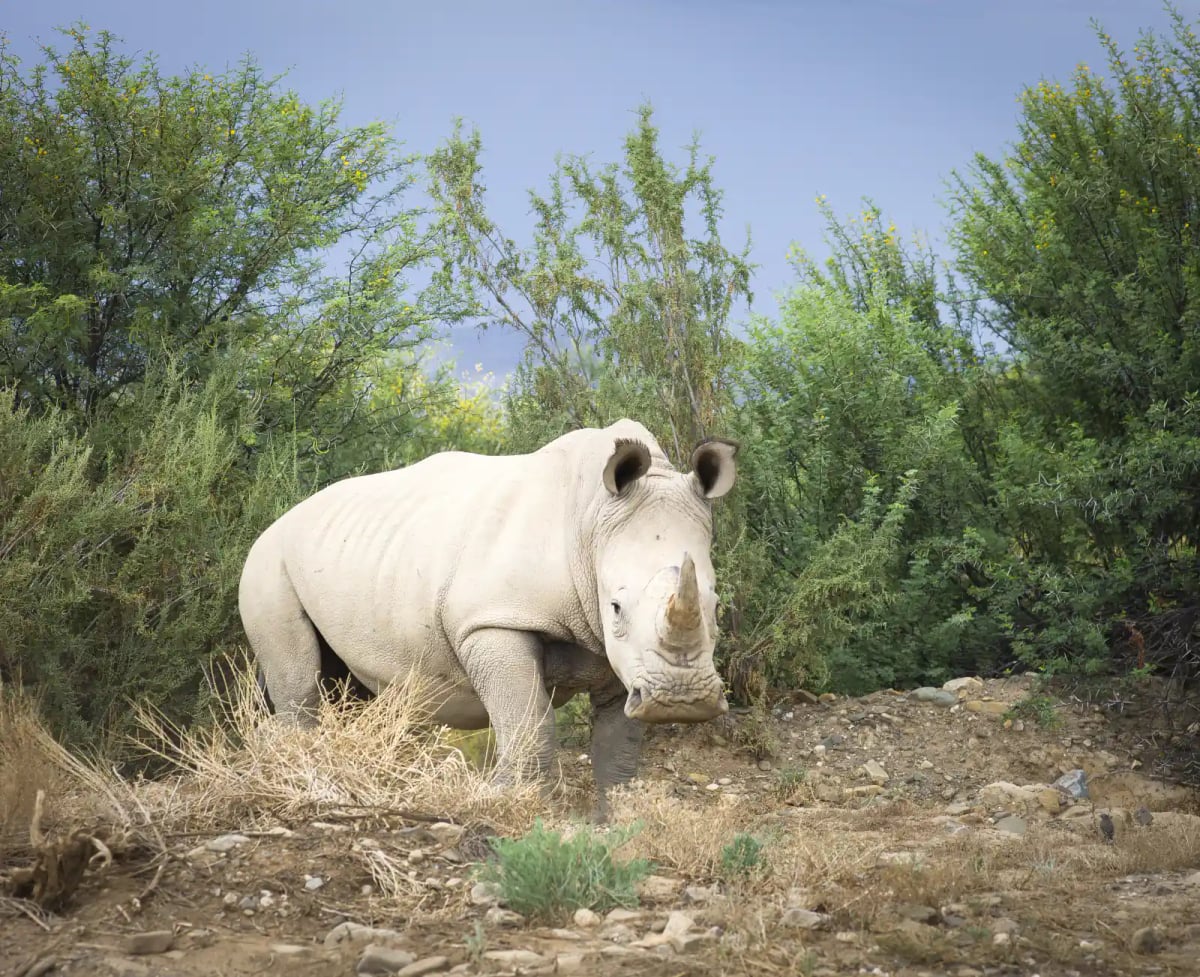
White rhinos live in the savannas and grasslands of southern and eastern Africa, wherever there is short grass to graze, water to drink and wallow in, and some trees or bushes for shade. South Africa is by far the stronghold, with the large majority of the world's white rhinos, in national parks such as Kruger and Hluhluwe iMfolozi and on many private reserves and game ranches. Smaller populations live in Namibia, Kenya, Zimbabwe, Botswana, Eswatini, Uganda, Zambia and Mozambique. Most of these were reintroduced with rhinos moved from South Africa, after the species had been wiped out or had never lived there. Kenya and Zambia, for example, are outside the southern white rhino's original range, and the rhinos there today descend from animals brought in. New populations keep being created. Rwanda received southern white rhinos at Akagera National Park in 2021, and calves have since been born there. In the Democratic Republic of the Congo, Garamba National Park, the last wild home of the northern white rhino, got southern white rhinos in 2023 and 2025. The northern subspecies once lived in Uganda, South Sudan, Sudan, Chad, the Central African Republic and the Congo, and is now extinct in the wild.
What do white rhinos eat?
White rhinos are grazers and eat almost nothing but grass. They prefer short, green grasses and use their wide, flat lips like a lawnmower, cropping the grass close to the ground while they walk slowly forward with their heads down. They have no front teeth, so the lips do all the cutting, and the big cheek teeth grind the grass. A white rhino spends about half of the day feeding, spread over the morning, the evening and much of the night, and rests in the shade during the hottest hours. Because they graze so heavily in the same places, white rhinos create grazing lawns, patches of short, nutritious grass that also attract impalas, zebras, wildebeest and buffaloes. When they disappear from an area, the grass grows taller and those smaller grazers lose part of their food, which is one reason white rhinos are seen as engineers of the savanna. They need water too. White rhinos drink almost every day when water is close and can manage two to four days without it in the dry season. They also love wallowing in mud, which cools them down and protects their skin from the sun and from biting insects.
Are white rhinos aggressive?
White rhinos are the calmest of the rhinos. They are less nervous than black rhinos, often let safari vehicles get fairly close and usually move away rather than attack. That does not make them harmless. An adult weighs more than two tonnes and can charge at around 40 km/h, and a mother with a young calf or a bull that feels cornered can be dangerous, so people on foot should always keep a good distance. Unlike black rhinos, white rhinos are sociable. Females and their calves often rest and feed together in small groups, sometimes joined by young animals of both sexes, and in good grazing areas more than ten rhinos can gather. A group of rhinos is called a crash. Adult bulls are territorial. Each dominant bull holds a territory, marks it with piles of dung called middens and with sprays of urine, and scrapes the ground with his feet to spread his scent. Other bulls may live inside a territory if they behave as subordinates. Fights between rival bulls are serious, with horn blows that can kill. Rhinos also communicate with snorts, grunts and squeals, and oxpeckers often ride on their backs to eat ticks.
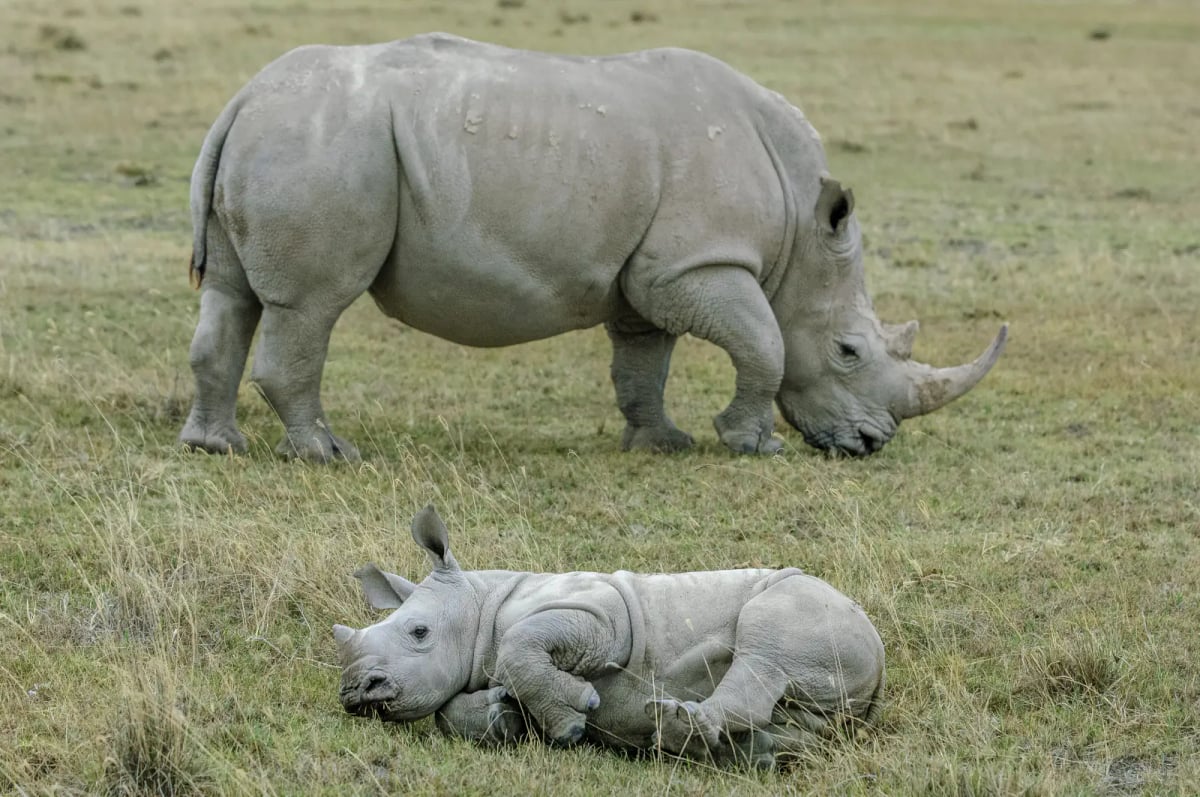
White rhino calves
A female white rhino carries her calf for about 16 months, one of the longest pregnancies of any land mammal. Before giving birth she leaves her group and hides in thick cover, and the single calf is born weighing about 40 to 65 kilograms. Within an hour it can stand, and within a few days it follows its mother everywhere. A white rhino calf usually trots in front of its mother, who guides it with her horn, while black rhino calves tend to follow behind. The calf starts nibbling grass at about two months but keeps nursing for more than a year. It stays with its mother until the next calf is born, about two and a half to three years later, and then often joins other young rhinos or another female for a while. Females have their first calf at around six to seven years of age, and males usually need to be ten to twelve years old before they can win a territory and breed. Adult rhinos have almost no natural enemies, but lions and spotted hyenas sometimes kill calves, which is why mothers stay close and defend them fiercely. In the wild, white rhinos can live 40 to 50 years.
Northern white rhino: Najin and Fatu, the last two
The northern white rhino (Ceratotherium simum cottoni) once lived in the grasslands and open woodlands of Uganda, South Sudan, Sudan, Chad, the Central African Republic and the Democratic Republic of the Congo. Poaching for horn and years of war destroyed it. There were about 2,000 in the 1960s and only around 15 by the mid 1980s, all in Garamba National Park in the Congo. The last wild ones were seen in 2006, and the subspecies is now considered extinct in the wild. In 2009 four of the few northern white rhinos left in zoos were moved from Dvůr Králové Zoo in the Czech Republic to Ol Pejeta Conservancy in Kenya, in the hope that they would breed. Sudan, the last male, died there in March 2018 at about 45 years old. Today only two animals remain, both female: Najin, born in 1989, and her daughter Fatu, born in 2000. They live at Ol Pejeta under armed guard, and neither can carry a pregnancy. Scientists of the BioRescue project collect eggs from Fatu and fertilize them with frozen sperm from dead males. By April 2026 they had produced 39 northern white rhino embryos, which they hope will be carried to birth by southern white rhino surrogate mothers.
Southern white rhino: saved from extinction
The southern white rhino (Ceratotherium simum simum) is one of the great comeback stories in conservation. It once lived across much of southern Africa, but hunting by European settlers was so intense that by the end of the 1800s only a small group, often estimated at 20 to 50 animals, survived in what is now Hluhluwe iMfolozi Park in South Africa. Protection of that last pocket allowed the population to grow slowly. In the 1960s, under a program known as Operation Rhino, the Natal Parks Board began capturing rhinos and moving them to other parks, private reserves and zoos around the world, and to countries where the species had been wiped out. Every southern white rhino alive today descends from that small group. Numbers climbed to more than 20,000 by around 2012. Then a wave of poaching for horn hit, and South Africa lost more than a thousand rhinos a year between 2013 and 2017. Strict protection, dehorning and the growing role of private reserves have reduced poaching since then, but drought and new counts have shown declines, and the African Rhino Specialist Group of the IUCN estimated about 15,750 white rhinos at the end of 2024.
How many white rhinos are left?
About 15,750 white rhinos were living in Africa at the end of 2024, according to the African Rhino Specialist Group of the IUCN. That is far more than any other rhino species, but the number fell by around 11 percent compared with the previous estimate, mainly because of a drop in South Africa linked to poaching, drought and corrections to earlier counts. All of them are southern white rhinos except for the two northern white females at Ol Pejeta. The IUCN lists the white rhino as Near Threatened in its last assessment from 2020, while the northern subspecies on its own is Critically Endangered and possibly extinct in the wild. Poaching for horn is still the biggest threat, driven by illegal demand in parts of Asia and run by organized crime networks. South Africa's poaching losses have come down from their peak, but hundreds of rhinos are still killed every year. Rangers, dogs, tracking collars, dehorning and community programs all help, and private landowners now look after a large share of the population. Moving rhinos to new parks, such as Akagera in Rwanda, Zinave in Mozambique and Garamba in the Congo, spreads the risk and brings the species back to places where it had been lost.
Where it is found
The White Rhinoceros can be found in places such as: